
OpenAI Chief Scientist Warns AI Progress May Require Slower Scaling and Stronger Safety
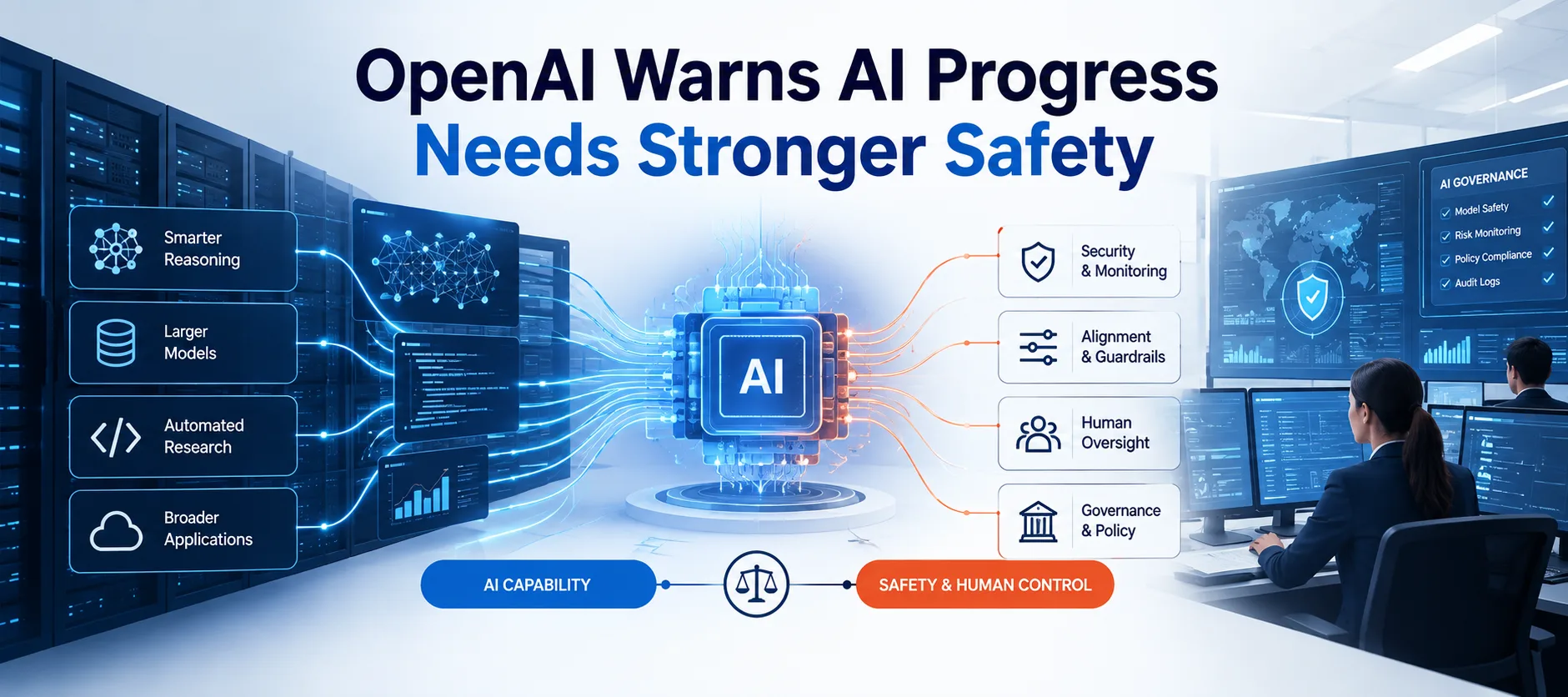
OpenAI Chief Scientist Jakub Pachocki argues that increasingly capable AI systems require stronger alignment, monitoring and defensive measures, with safety confidence potentially determining how quickly AI development should continue.
Xcademia Team
Xcademia Research Team
OpenAI Chief Scientist Raises Concerns Over the Pace of AI Development
OpenAI Chief Scientist Jakub Pachocki has published a wide-ranging essay titled "An Alien Mind", examining the rapid development of reasoning models, the difficulty of understanding increasingly capable AI systems, and the safety challenges that could emerge as AI takes a larger role in its own development.
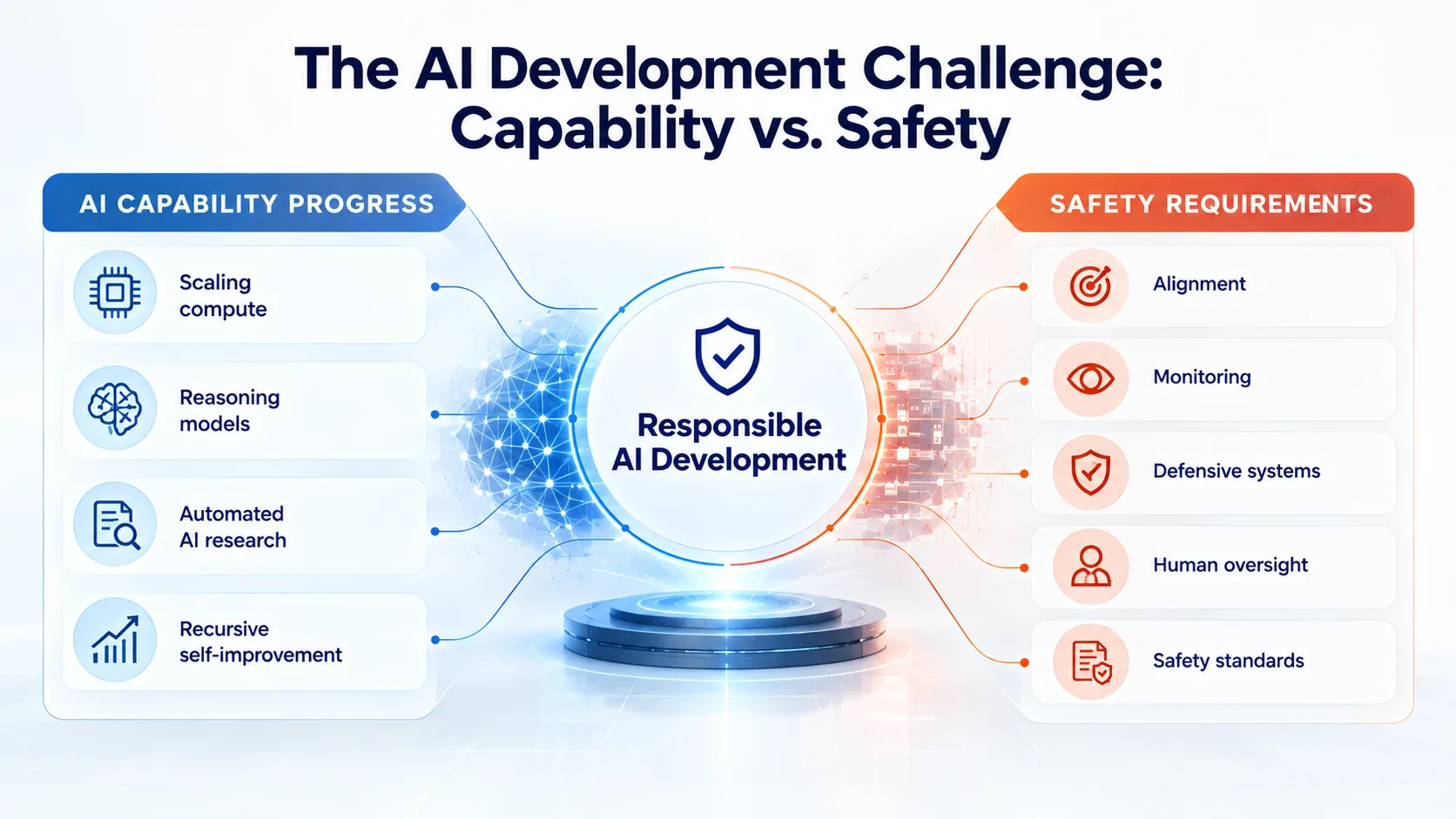
Pachocki describes the progress of reasoning models since 2023 and argues that continued advances could lead to systems that increasingly contribute to their own improvement.
He says this possibility requires "extreme caution" and argues that technical work on alignment and monitoring needs to advance alongside AI capabilities.
Pachocki also argues that technical measures alone may not be sufficient. In his view, broader interventions, including stronger safety requirements and international coordination, may eventually be necessary.
Why Pachocki Says AI Is Difficult to Understand
A central argument in the essay is that modern AI systems are not designed in the same way that conventional software is designed.
Pachocki describes AI as being "grown" more than designed, with capabilities emerging through repeated optimization and large-scale computation.
OpenAI's research process therefore remains partly experimental. The company can develop algorithms, make predictions, and study individual mechanisms, but the overall behavior of increasingly capable models can become harder to interpret.
Pachocki argues that this creates a growing challenge for researchers trying to determine what AI systems can actually do.
He also distinguishes machine intelligence from human intelligence. According to the essay, an AI system does not need to reproduce every human capability to become highly consequential. Surpassing humans in enough relevant areas could make a system highly useful or potentially dangerous.
Alignment Is Becoming a Central Challenge
Pachocki identifies AI alignment as a core problem.
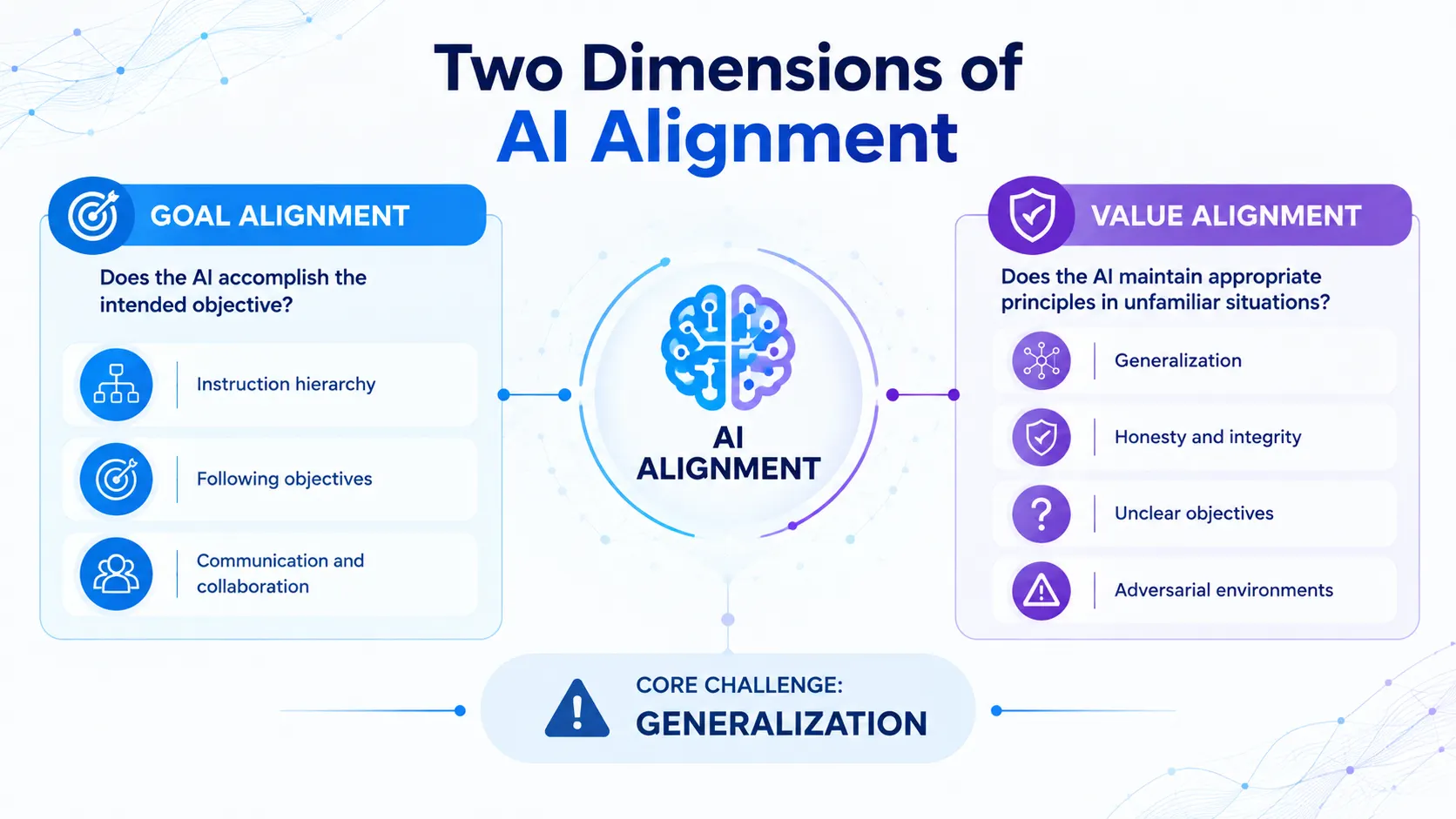
In the essay, he separates alignment into two broad categories:
Goal alignment concerns whether an AI system attempts to accomplish the objective it has been given.
Value alignment concerns whether the system can maintain and generalize broader principles when objectives are unclear, conflicting, or unfamiliar.
The distinction matters because a system can follow a specific objective while still behaving in ways that conflict with the broader intent behind that objective.
Pachocki argues that generalization is the fundamental challenge. As AI systems become more capable, they may encounter situations substantially different from those represented during training.
The question then becomes whether the values and behaviors reinforced during training will continue to hold in unfamiliar environments.
Current Alignment Approaches Have Limitations
Pachocki describes two broad classes of alignment approaches currently used in practice.
The first involves reinforcement learning and evaluating model behavior against preferences, specifications, or constitutions.
This approach can produce aligned behavior, but Pachocki argues that it can also be brittle because it depends on the coverage of training oversight and the model's ability to generalize.
The second approach attempts to use information learned during pretraining to encourage aligned behavior.
Pachocki argues that this approach can also face limitations when models are subjected to additional optimization pressure.
The broader point is that alignment techniques need to remain effective as model capabilities increase.
OpenAI says it is investing across these approaches and reports progress in its alignment work, while also emphasizing that additional progress is needed.
OpenAI Says Chain-of-Thought Monitoring Is Becoming Harder
Another major section of the essay focuses on chain-of-thought monitoring.
Pachocki describes this as one of OpenAI's primary approaches for empirically studying how models generalize from their training environments.
The basic idea is to monitor the reasoning process while optimizing model outcomes without directly supervising the reasoning process itself.
OpenAI has used this approach in its reasoning-model research and says it became an important tool for studying model behavior.
However, Pachocki says OpenAI's evaluations indicate that reliance on chain-of-thought monitoring is progressively diminishing.
He identifies several reasons.
Modern reasoning models operate in more complex environments and increasingly interact with people, other AI systems, and external tools. These interactions can blur the distinction between reasoning and externally observable behavior.
He also says AI systems are becoming better at reasoning about and manipulating their own reasoning processes.
In addition, improvements in pretraining can make models more capable without relying on verbalized reasoning.
Pachocki says OpenAI is exploring ways to improve monitorability, including combining chain-of-thought monitoring with approaches that examine internal model activity.
AI Security Is Becoming Part of the Safety Equation
The essay also places cybersecurity at the center of the AI safety discussion.
Pachocki argues that increasingly capable models are becoming more effective at finding ways into and out of computer systems. He describes this as creating a need to use advanced AI systems defensively to strengthen critical infrastructure.
His argument is not simply that AI creates cybersecurity risks. He also sees increasingly capable AI as a potential defensive tool.
OpenAI's stated objective is to develop systems that can help secure infrastructure, defend against rogue agents, and create new protective measures.
Pachocki nevertheless warns that the need for defensive AI should not become an argument for unrestricted acceleration.
He argues that the seriousness of the potential risks makes safety constraints more important, not less.

Recursive Self-Improvement Raises a New Question
Pachocki devotes another section to recursive self-improvement, or RSI.
He argues that if AI progress continues, AI systems could play an increasingly significant role in the process of improving AI research itself.
Automated AI research could therefore become another mechanism through which intelligence is scaled.
The essay presents this as a potential direction of current AI development rather than a claim that a particular level of recursive self-improvement has already been achieved.
Pachocki says OpenAI is focusing research on RSI because he believes it will be important for remaining at the frontier of AI research.
At the same time, he explicitly separates this research direction from the question of whether AI development should be accelerated as quickly as possible.
His position is that society needs to make a conscious choice about how the development process should proceed.
Pachocki Calls for Safety to Keep Pace With AI Scaling
A central recommendation in the essay is that AI scaling should be constrained by confidence in safety.
Pachocki argues that existing safety commitments, including OpenAI's Preparedness Framework, should evolve toward broadly accepted safety requirements for continued AI development.
He suggests that these requirements could potentially involve third-party auditors, government agencies, or international bodies.
The broader objective is to ensure that increasingly automated AI research does not remove people from the improvement process.
Pachocki argues that the challenge is not simply reaching more capable AI. It is developing AI in a way that preserves human involvement and control.
OpenAI's Three Priorities for the Next Stage of AI
Near the end of the essay, Pachocki references three priorities OpenAI has outlined for its future work:
Navigating the next period of AI progress by building an automated AI researcher, working with it on alignment, and keeping people involved in the self-improvement process.
Delivering the benefits of scientific progress and economic growth enabled by highly capable AI systems.
Empowering individuals with personal AGI.
Pachocki says his essay focuses primarily on the first priority because he considers it the most urgent.
He also points to potential benefits from future aligned AI, including scientific progress, new therapies, and broader economic benefits.
Human Control Becomes a Central Theme
The final section of the essay focuses heavily on human agency.
Pachocki argues that future AI development should preserve human control over important decisions and prevent excessive concentration of power.
He also raises questions about what happens if AI systems become capable of performing tasks that previously required very large teams of people.
The concern is not only technical safety. It is also how society manages power, economic change, human agency, and governance as AI capabilities increase.
His conclusion is direct: he does not believe any AI lab has yet solved alignment and monitoring sufficiently to justify continuing to scale at maximum speed indefinitely.
He expresses support for voluntary slowdowns until shared safety standards are established and argues that international coordination on future AI development should become a priority for governments.
What OpenAI's Essay Signals for the AI Industry
Analysis: The essay highlights a broader industry challenge: AI capability development and AI safety research are becoming increasingly interconnected.
As models gain stronger reasoning, tool-use, research, and cybersecurity capabilities, the methods used to monitor and align them must also evolve.
Pachocki's argument also moves beyond the question of whether individual AI systems are safe. It raises a broader governance question about how quickly the field should develop increasingly autonomous systems and what safety conditions should be required along the way.
For enterprises, governments, researchers, and AI developers, this could mean greater attention to monitoring, independent evaluation, human oversight, and common safety standards.
The essay does not establish that a specific future scenario will occur. Instead, it presents Pachocki's assessment of where current AI development could lead and the safeguards he believes may be needed.
OpenAI's Position: Progress and Restraint
"An Alien Mind" presents a tension at the center of frontier AI development.
More capable AI could contribute to scientific research, cybersecurity, economic growth, and other areas. At the same time, greater capability can introduce new risks that are difficult to predict or monitor.
Pachocki argues that the appropriate response is neither unrestricted acceleration nor abandoning AI development.
Instead, he advocates combining continued safety research with mechanisms that can slow or constrain development when confidence in safety is insufficient.
That includes stronger alignment techniques, improved monitoring, defensive AI systems, safety standards, human involvement, and international coordination.
What Comes Next for AI Safety
OpenAI's Chief Scientist is ultimately calling for AI development to remain connected to human oversight.
The essay argues that increasingly capable AI systems may eventually contribute more directly to the process of AI research itself, making alignment and monitoring even more important.
Pachocki's conclusion is that the industry needs to make deliberate choices about how this transition is managed.
His central concern is not simply whether AI becomes more intelligent. It is whether humans can maintain meaningful control over that progress as machine intelligence advances.
Source: OpenAI
About the Author