
Kairos Data Extortion Case Reveals $1 Million Ransom Payment by U.S. Government Entity
A new threat intelligence report analyzes a leaked negotiation transcript revealing how a U.S. government entity paid $1 million to the Kairos data-extortion group. The case offers rare insight into modern data-only extortion, negotiation tactics, and cryptocurrency payment flows
Xcademia Team
Xcademia Research Team
Leaked Negotiation Reveals How a U.S. Government Entity Paid $1 Million in a Data-Extortion Attack
A newly published threat intelligence report has provided a rare behind-the-scenes look at a successful data-extortion campaign involving the threat actor known as Kairos. Based on a leaked negotiation transcript and blockchain analysis, researchers reconstructed the month-long negotiation that ended with a $1 million Bitcoin payment by a U.S. government entity.
Unlike traditional ransomware operations, the report notes that Kairos has not been confirmed as a ransomware group because no encryptor, locker binary, or ransomware payload has been independently identified. Instead, the group's leverage appears to rely entirely on data theft, public exposure threats, and psychological pressure.
The research highlights how data-only extortion is becoming an increasingly effective tactic against organizations, particularly public-sector entities that manage sensitive information.
Executive Summary
According to the report:
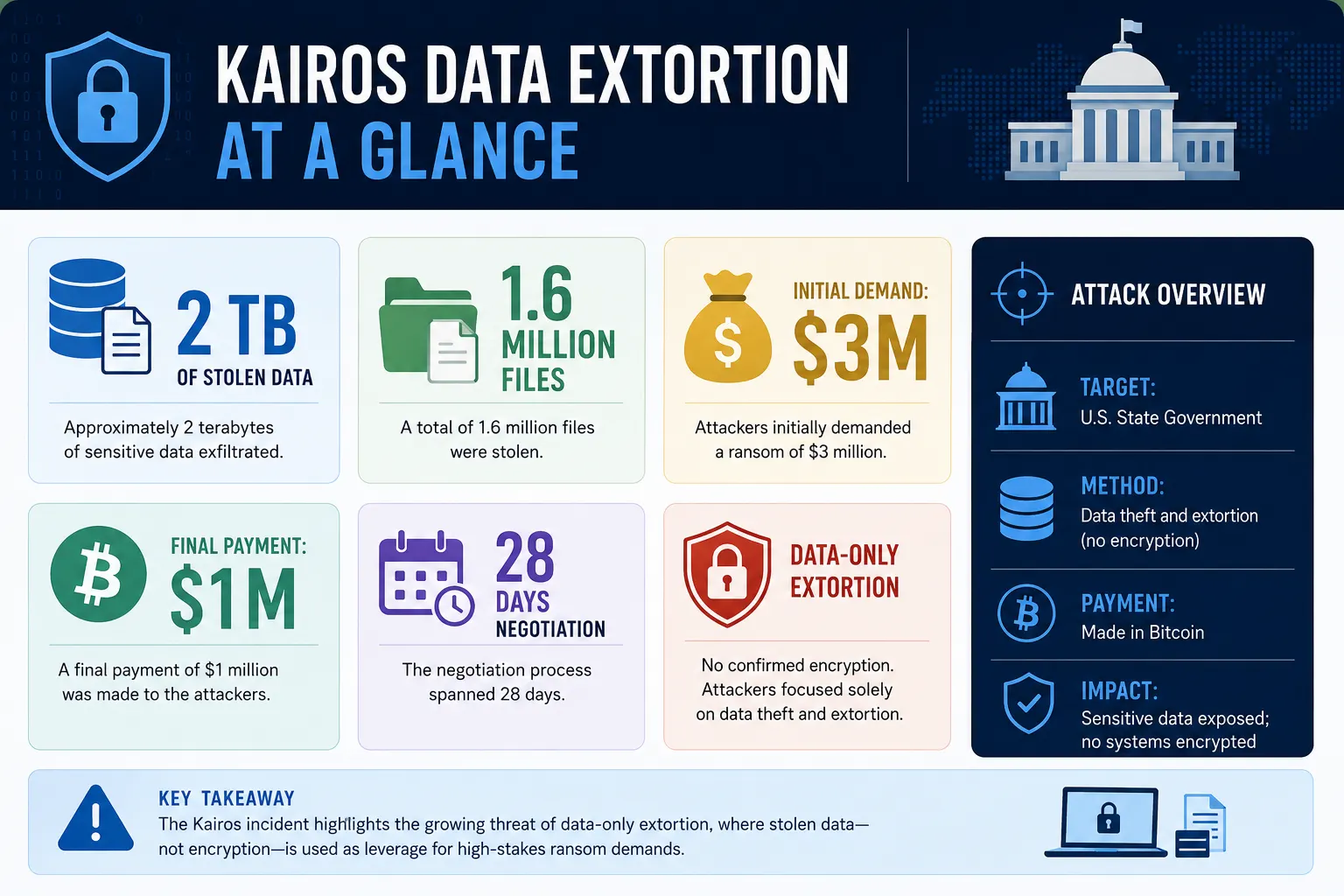
Kairos claimed to steal more than 2 TB of data comprising approximately 1.6 million files.
The attackers initially demanded $3 million.
The victim gradually increased offers from $100,000 to $430,000.
Negotiations concluded with a $1 million ransom payment.
Kairos later claimed the intrusion resulted from a brute-force credential attack.
Researchers found no technical evidence proving the stolen data was actually deleted after payment.
The report emphasizes that while blockchain analysis identifies cryptocurrency movement, it does not attribute the attack to specific individuals.
A Different Kind of Extortion
Traditional ransomware attacks typically involve encrypting an organization's systems before demanding payment.
In contrast, Kairos allegedly focused exclusively on data exfiltration.
Researchers found no evidence that malware encrypted systems or disrupted operations.
Instead, the attackers relied on:
Stolen documents
Publication threats
Leak-site timers
Reputation damage
Public pressure
The report argues this reflects the broader industry shift toward data-only extortion, where attackers weaponize stolen information rather than encrypted infrastructure.
Inside the Negotiation
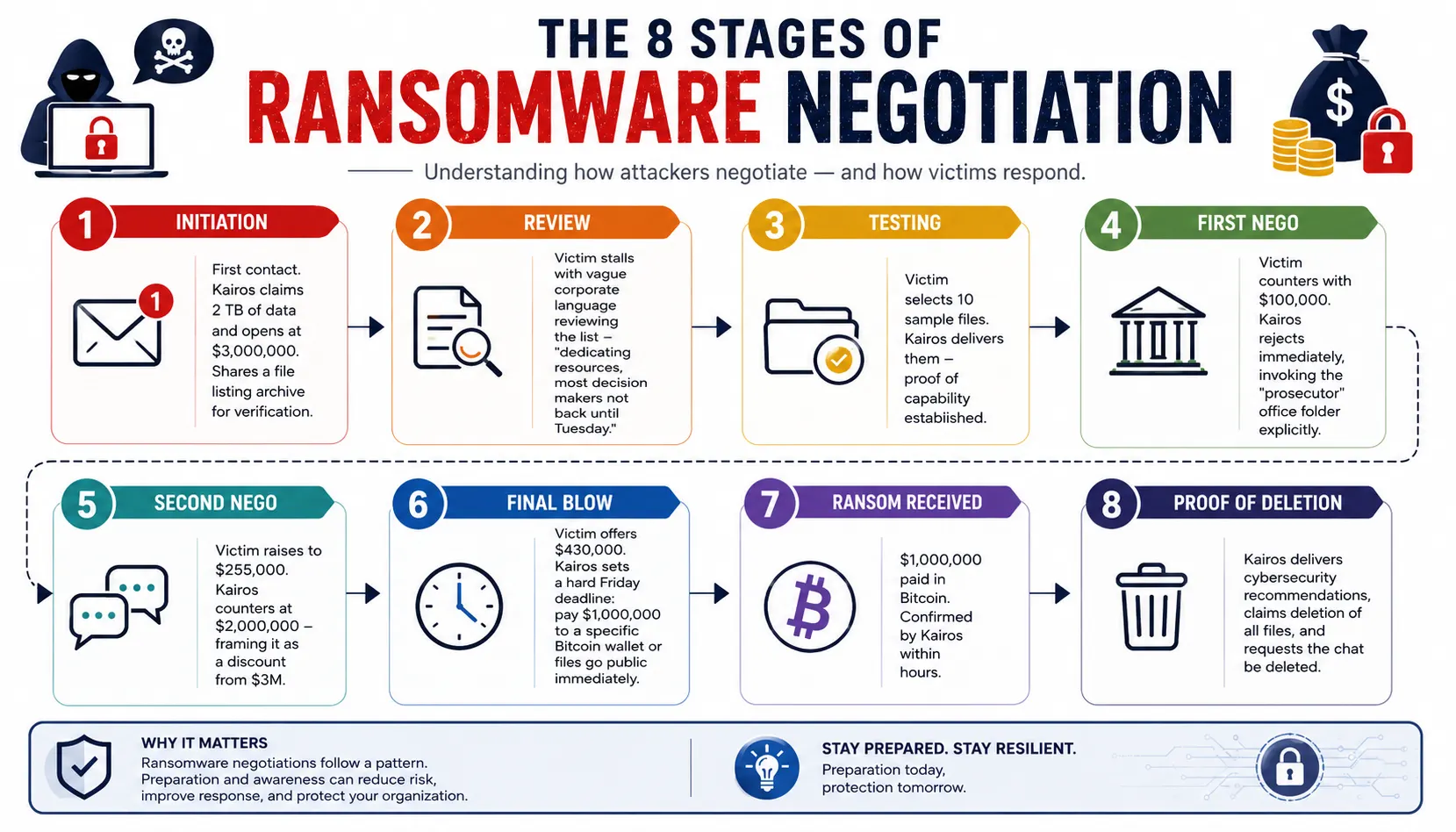
The leaked transcript documents nearly one month of communication between Kairos and the affected government entity.
Timeline Highlights
Date | Event |
|---|---|
19 May 2025 | Kairos demands $3 million |
27 May | Sample files provided as proof of access |
4 June | Victim offers $100,000 |
6 June | Offer increases to $255,000 |
9 June | Final victim offer reaches $430,000 |
9 June | Kairos lowers demand to $1 million |
13 June | Payment completed |
Researchers describe Kairos as maintaining pressure throughout the negotiation using deadlines, public exposure threats, and staged concessions.
Pressure Tactics
The report identifies several recurring negotiation strategies:
Artificial deadlines
Leak-site countdown timers
References to sensitive government files
Reputation-based pressure
Incremental "discounts"
Proof-of-access through sample documents
These techniques gradually increased psychological pressure while preserving the attacker's negotiating leverage.
The Data Deletion Problem
Following payment, Kairos claimed it had:
Deleted stolen files
Removed copies
Agreed not to attack again
However, researchers caution that none of these claims can be independently verified.
The attackers supplied:
Text logs
File listings
Claimed deletion records
But these materials lacked:
Cryptographic proof
Hash verification
Independent validation
Technical evidence confirming deletion
The report concludes that organizations should never assume stolen data has actually been destroyed simply because attackers claim it has.
Following the Money
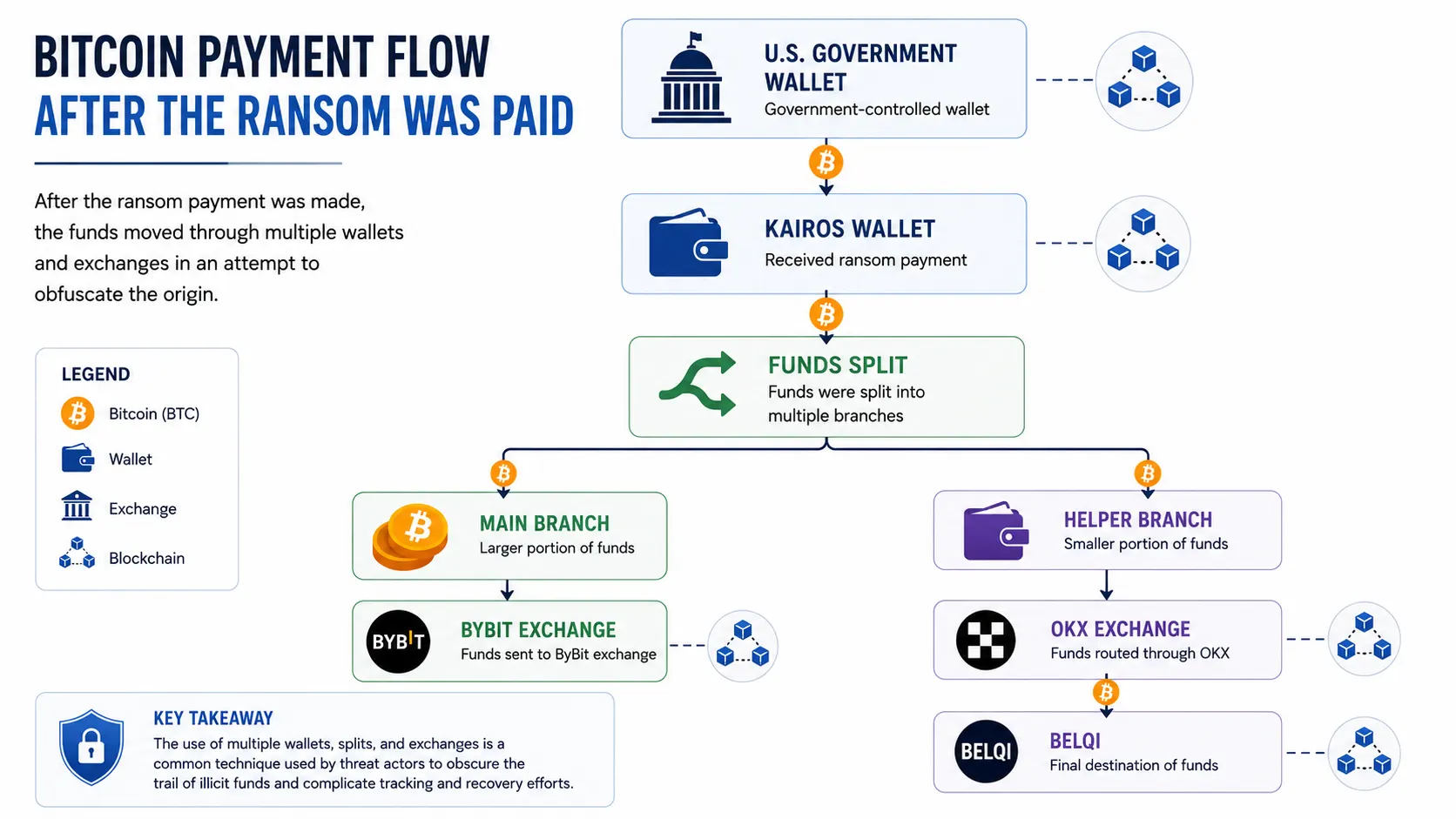
Researchers traced the Bitcoin payment after it reached the attackers.
According to blockchain analysis, the ransom quickly split into multiple branches before eventually reaching wallets associated with several cryptocurrency exchanges.
Observed exchange touchpoints included:
ByBit
OKX
BELQI
The report stresses that these transfers provide investigative leads, not proof that the exchanges or any individuals were involved in criminal activity.
Instead, the movement illustrates how ransomware operators rapidly fragment cryptocurrency transactions after receiving payment.
Evidence Does Not Confirm Kairos Is a Ransomware Group
One of the report's most significant conclusions is that Kairos should not automatically be classified as a ransomware group.
Researchers found:
No ransomware executable
No locker binary
No encryption sample
No independently verified ransomware payload
Instead, Kairos appears to function primarily as a data-extortion operation that relies on publication threats rather than file encryption.
This distinction matters because modern threat actors increasingly separate data theft from encryption while still demanding multimillion-dollar payments.
Lessons for Public-Sector Organizations
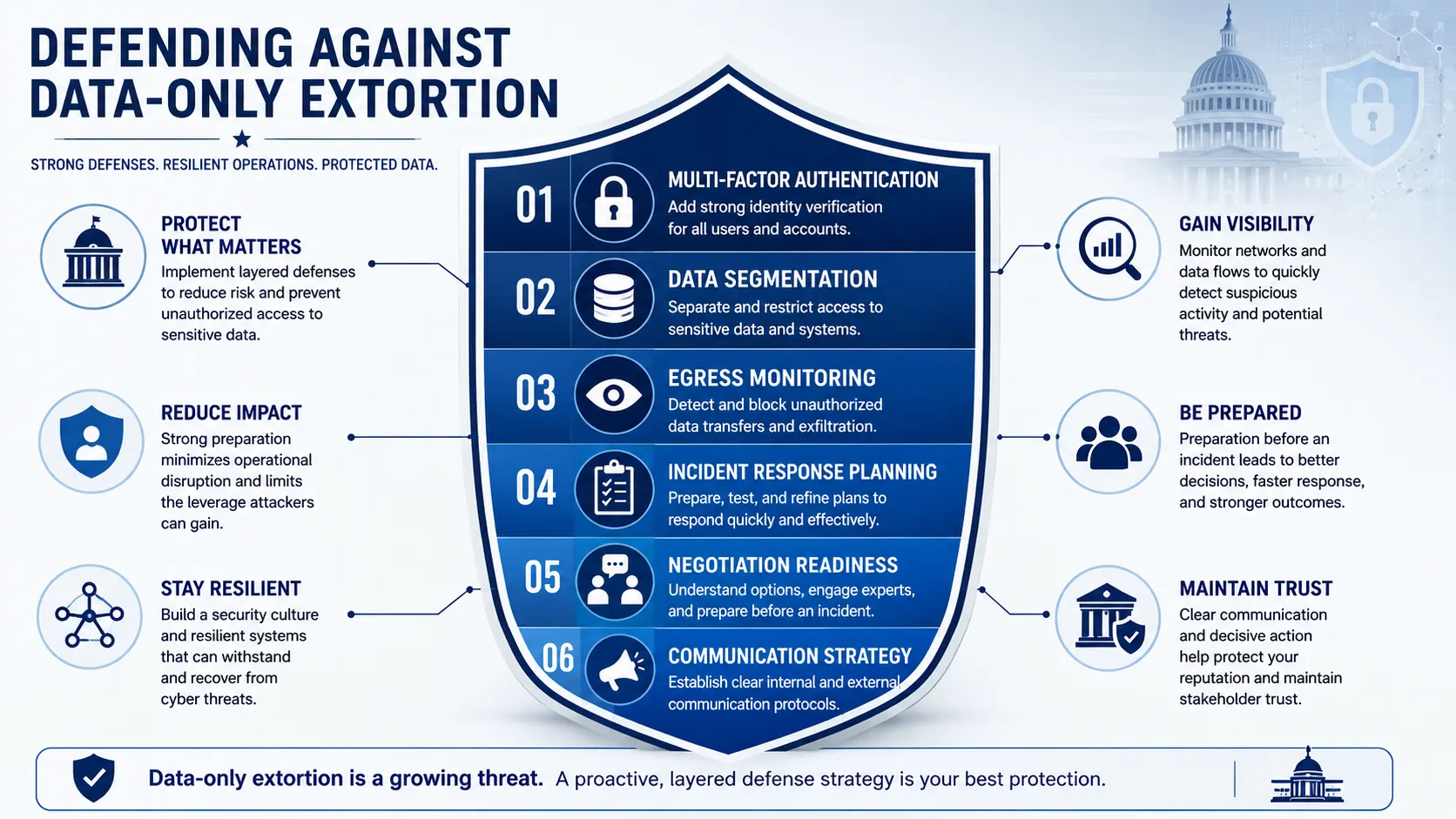
The report outlines several recommendations for organizations preparing for similar attacks:
Pre-authorize executive decision-making during cyber incidents.
Enable multi-factor authentication and monitor brute-force attempts.
Detect unusual outbound data transfers.
Segment highly sensitive information.
Develop public communication plans before an incident occurs.
Use experienced ransomware negotiators when appropriate.
Treat attacker deletion claims as unverified unless independently confirmed.
These measures can improve incident response while reducing pressure during extortion negotiations.
Looking Ahead
The report suggests that while Kairos appears less active than in previous months, there is insufficient evidence to conclude the operation has ended.
Researchers also note that Ukrainian authorities reportedly disrupted infrastructure associated with the group's leak site, although this does not confirm arrests or the complete dismantling of the operation.
More broadly, the case demonstrates how attackers can successfully extort organizations without deploying ransomware encryption. As data-only extortion campaigns continue to evolve, public-sector organizations may need to place greater emphasis on credential protection, data governance, and incident preparedness rather than focusing solely on system recovery.
Source: The Raven File for RANSOM-ISAC
About the Author