
Introducing Claude Opus 5 on AWS: Anthropic's Most Capable AI Model Arrives on Amazon Bedrock
Anthropic's Claude Opus 5 is now available on Amazon Bedrock and Claude Platform on AWS, bringing advanced coding, reasoning, visual understanding, and long-running AI agent capabilities with enterprise-grade security, zero data retention, and seamless AWS integration.
Xcademia Team
Xcademia Research Team
Introduction
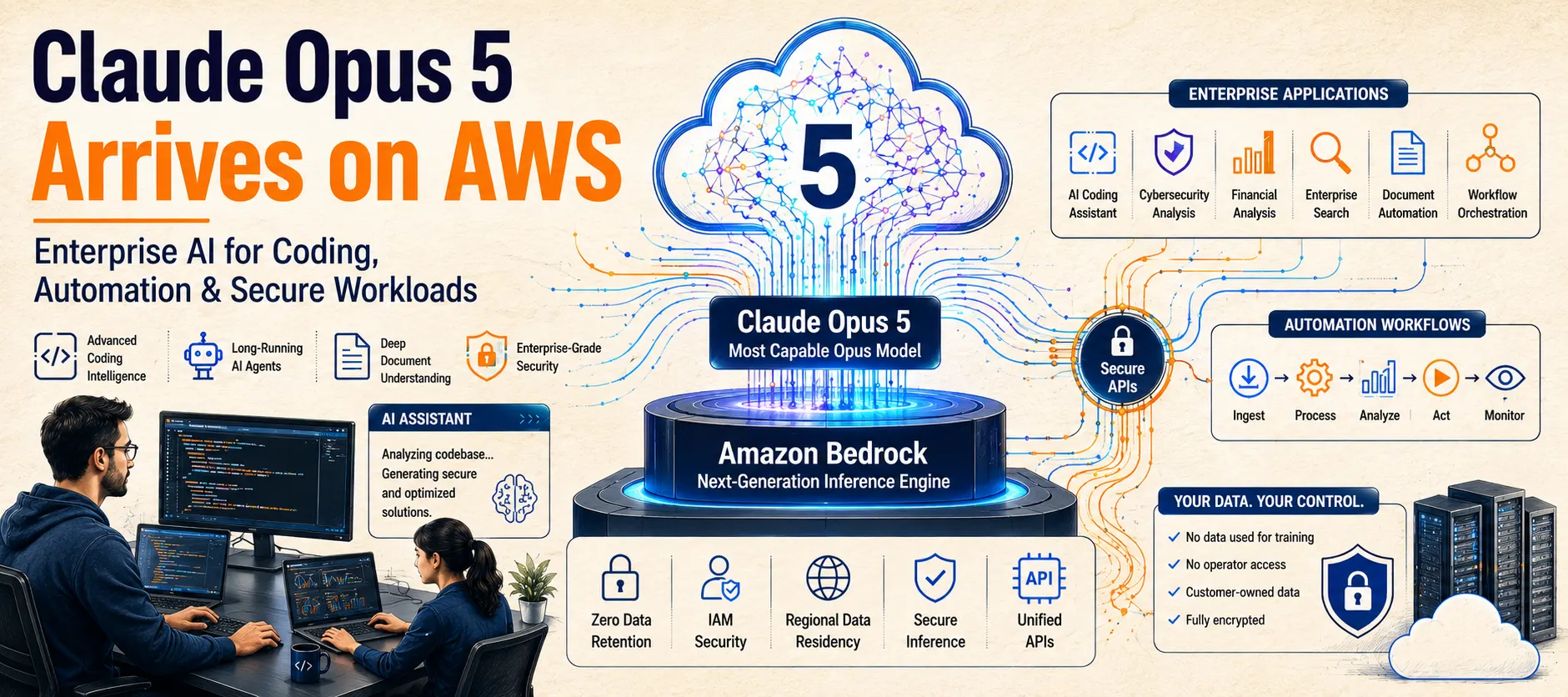
Enterprise artificial intelligence is rapidly evolving beyond chatbots into autonomous systems capable of solving complex business problems, writing production-grade software, analysing extensive documentation, and completing multi-step workflows with minimal human intervention. As organisations increasingly deploy AI into mission-critical environments, the demand for models that combine frontier intelligence with enterprise-grade security and governance continues to grow.
Addressing this need, Amazon Web Services (AWS) and Anthropic have announced the availability of Claude Opus 5 on Amazon Bedrock and Claude Platform on AWS. The release marks the debut of Anthropic's fifth-generation Opus family and introduces what the company describes as its most capable Opus model to date.
Claude Opus 5 is designed for organisations building sophisticated AI applications, particularly those involving agentic coding, knowledge-intensive tasks, document analysis, visual understanding, and long-running autonomous workflows. Unlike traditional AI assistants that respond to individual prompts, Opus 5 is engineered to maintain context over extended sessions, recover from errors, and independently navigate complex tasks that may take hours or even days to complete.
For AWS customers, the announcement is particularly significant because Claude Opus 5 integrates directly with Amazon Bedrock's managed AI infrastructure. This enables enterprises to deploy advanced generative AI while maintaining existing AWS security controls, regional data residency requirements, and enterprise governance policies.
Another notable advantage is that Amazon Bedrock provides Zero Data Retention (ZDR) by default, ensuring customer prompts and responses are not retained by the service. This makes Claude Opus 5 attractive for organisations operating in highly regulated industries such as finance, healthcare, government, and cybersecurity.
Rather than introducing an entirely new development ecosystem, AWS enables organisations to access Claude Opus 5 using familiar Bedrock APIs, SDKs, IAM permissions, and existing AWS authentication mechanisms. This lowers adoption barriers while allowing enterprises to scale AI workloads inside their current cloud environments.
Key Developments
The introduction of Claude Opus 5 represents more than a routine model upgrade. According to Anthropic, it delivers meaningful improvements across several production workloads that enterprises increasingly rely on.
Among the most notable enhancements are:
Advanced software engineering assistance
Improved long-context reasoning
Better visual understanding
Higher-quality document analysis
More capable autonomous AI agents
Enhanced enterprise workflow automation
Stronger cybersecurity-related reasoning
Unlike many AI models that excel primarily in conversational tasks, Claude Opus 5 focuses on professional work where reliability, consistency, and contextual understanding are essential.
1. Significant Improvements in Coding
One of the biggest improvements is software development.
Anthropic states that Claude Opus 5 can understand large codebases similarly to an experienced software engineer. Instead of simply generating isolated code snippets, the model analyses existing architecture, navigates repositories, adapts its strategy during execution, and produces production-quality implementations.
These capabilities are particularly valuable for:
Code migration
Large-scale refactoring
Architecture design
Automated testing
Documentation generation
Debugging complex applications
For development teams adopting AI-assisted software engineering, this represents a substantial step beyond traditional code completion tools.
2. Long-Running AI Agents
Another major advancement is support for dependable long-running AI agents.
Traditional LLMs often lose direction during lengthy workflows. Claude Opus 5 is designed to continue working over extended periods, even recovering from mistakes or adapting when unexpected obstacles arise.
This makes it suitable for workflows such as:
Multi-day research
Software migration
Enterprise reporting
Security investigations
Business analysis
Compliance reviews
Instead of requiring continuous human supervision, AI agents powered by Claude Opus 5 can independently break large objectives into smaller tasks and continue progressing toward completion.
Technical Breakdown
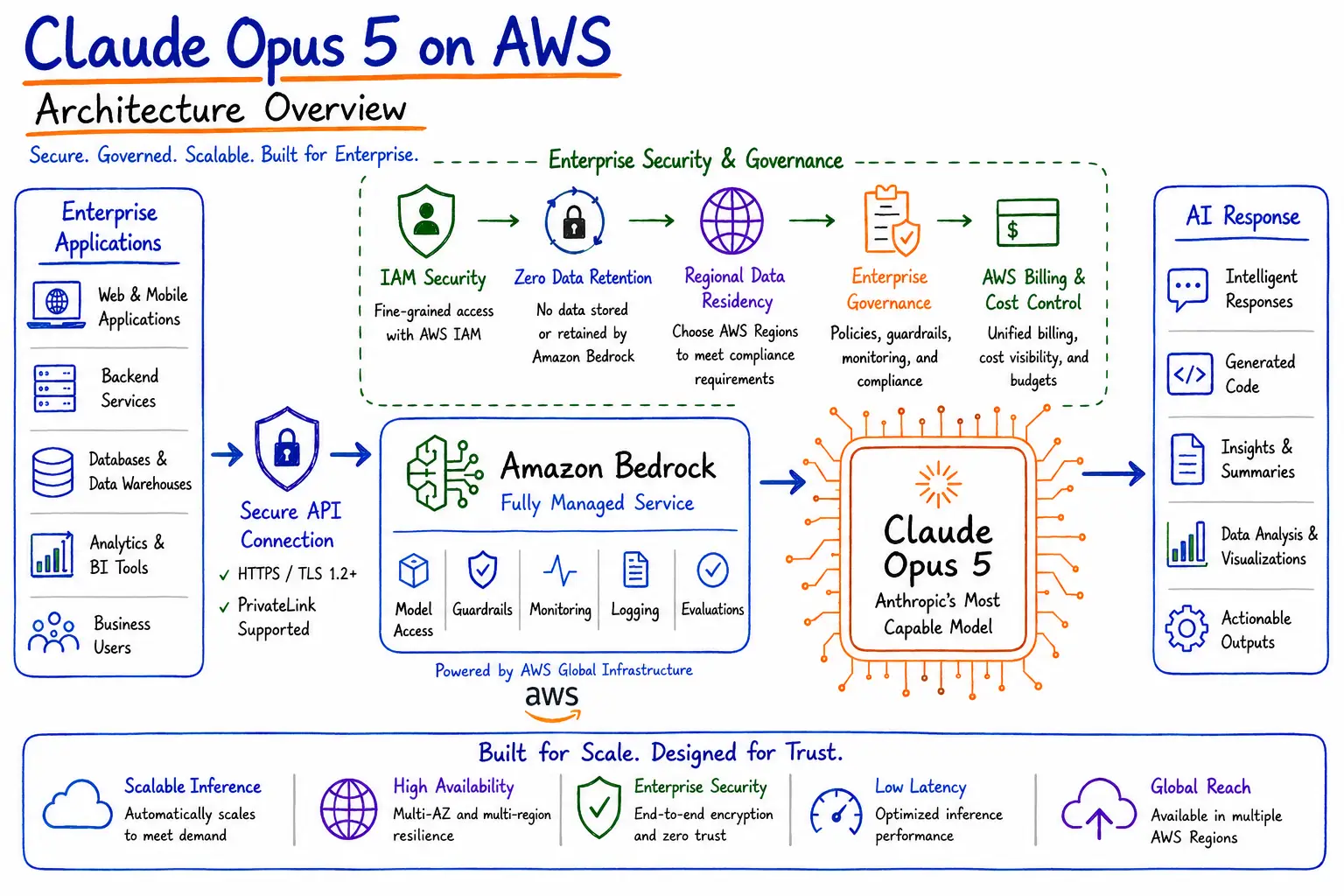
One of the biggest advantages of Claude Opus 5 is that organisations do not need to adopt a completely new infrastructure. Instead, they can deploy the model directly through Amazon Bedrock using familiar AWS APIs and SDKs.
Developers can access the model through:
Amazon Bedrock Runtime API
Amazon Bedrock Converse API
Anthropic Messages API
Anthropic Bedrock SDK
This flexibility allows organisations to integrate Claude Opus 5 into existing applications while maintaining consistent authentication, monitoring, and governance across AWS services.
1. Enterprise Security
Amazon Bedrock provides several enterprise features that distinguish it from standalone AI platforms.
These include:
Zero Data Retention by default
Enterprise IAM authentication
Regional deployment options
AWS-native billing
Secure inference infrastructure
Zero operator access
Together, these capabilities help organisations satisfy compliance requirements while deploying advanced AI into production environments.
2. Supported Enterprise Workloads
Claude Opus 5 is particularly suited for workloads requiring high reasoning accuracy.
Examples include:
Financial analysis
Compliance documentation
Technical research
Security investigations
Software engineering
Legal document review
Report generation
Workflow automation
Unlike smaller models optimised primarily for speed, Claude Opus 5 prioritises reasoning quality for complex enterprise scenarios.
3. Calling Claude Opus 5 Using Amazon Bedrock
AWS enables developers to invoke Claude Opus 5 using familiar SDKs. The following example demonstrates how to send a prompt to the model using the AWS SDK for Python (Boto3).
import boto3
import json

# Create a Bedrock Runtime client
bedrock_runtime = boto3.client(
    service_name="bedrock-runtime",
    region_name="us-east-1"
)

# Invoke Claude Opus 5
response = bedrock_runtime.invoke_model(
    modelId="global.anthropic.claude-opus-5",
    contentType="application/json",
    accept="application/json",
    body=json.dumps({
        "anthropic_version": "bedrock-2023-05-31",
        "max_tokens": 4096,
        "messages": [
            {
                "role": "user",
                "content": "Design a distributed architecture on AWS in Python that should support 100k requests per second across multiple geographic regions."
            }
        ]
    })
)

result = json.loads(response["body"].read())
print(result["content"][1]["text"])
Developers can also use the Amazon Bedrock Converse API for unified multi-model interactions or the Anthropic Bedrock SDK, which provides access to Anthropic's native Messages API while leveraging AWS authentication and billing. Additionally, Claude Opus 5 supports dynamic tool management through tool_addition and tool_removal, allowing AI agents to add or remove tools during extended conversations without resending the complete tool configuration.
4. Deployment Requirements
Before deploying Claude Opus 5, AWS recommends ensuring the following prerequisites are in place:
Active AWS account with Amazon Bedrock access
AWS CLI installed and configured
Python 3.8 or later
Boto3 SDK
Anthropic Bedrock SDK
IAM permissions for Bedrock model invocation
These requirements enable organisations to integrate Claude Opus 5 into production workloads using standard AWS development practices.
Industry Impact
The arrival of Claude Opus 5 on Amazon Bedrock reflects a broader shift in enterprise AI adoption. Organisations are increasingly moving beyond experimenting with generative AI to deploying production-ready systems that can automate complex workflows, support software engineering teams, and assist with business-critical decision making. By making Anthropic's most capable model available through Amazon Bedrock, AWS strengthens its position as a leading platform for enterprise AI while giving customers access to advanced foundation models without leaving their existing cloud environment.
1. Accelerating Enterprise AI Adoption
Many organisations have already standardised on AWS for infrastructure, security, identity management, and compliance. Running Claude Opus 5 through Amazon Bedrock allows these organisations to integrate advanced AI capabilities without introducing additional operational complexity.
This integration provides several enterprise advantages:
Unified AWS authentication through IAM.
Consistent monitoring and logging across AI workloads.
Simplified billing under existing AWS accounts.
Regional deployment options to satisfy data residency requirements.
Enterprise governance through familiar AWS security controls.
For technology leaders, this means AI projects can move from proof-of-concept to production more quickly while remaining aligned with existing cloud governance policies.
2. A Stronger Platform for AI-Assisted Software Development
Software engineering is one of the areas where Claude Opus 5 introduces the most significant improvements.
Rather than acting solely as a code completion assistant, the model is designed to understand the broader context of software projects. According to Anthropic, it can analyse large repositories, navigate existing architectures, produce production-quality implementations, and adapt its reasoning as development progresses.
This capability has practical implications across the software development lifecycle, including:
Modernising legacy applications.
Refactoring large codebases.
Generating technical documentation.
Reviewing pull requests.
Assisting with debugging.
Designing scalable cloud architectures.
Creating automated test suites.
For development teams facing growing software complexity, AI models capable of understanding entire projects instead of isolated files can significantly improve productivity and reduce repetitive engineering work.
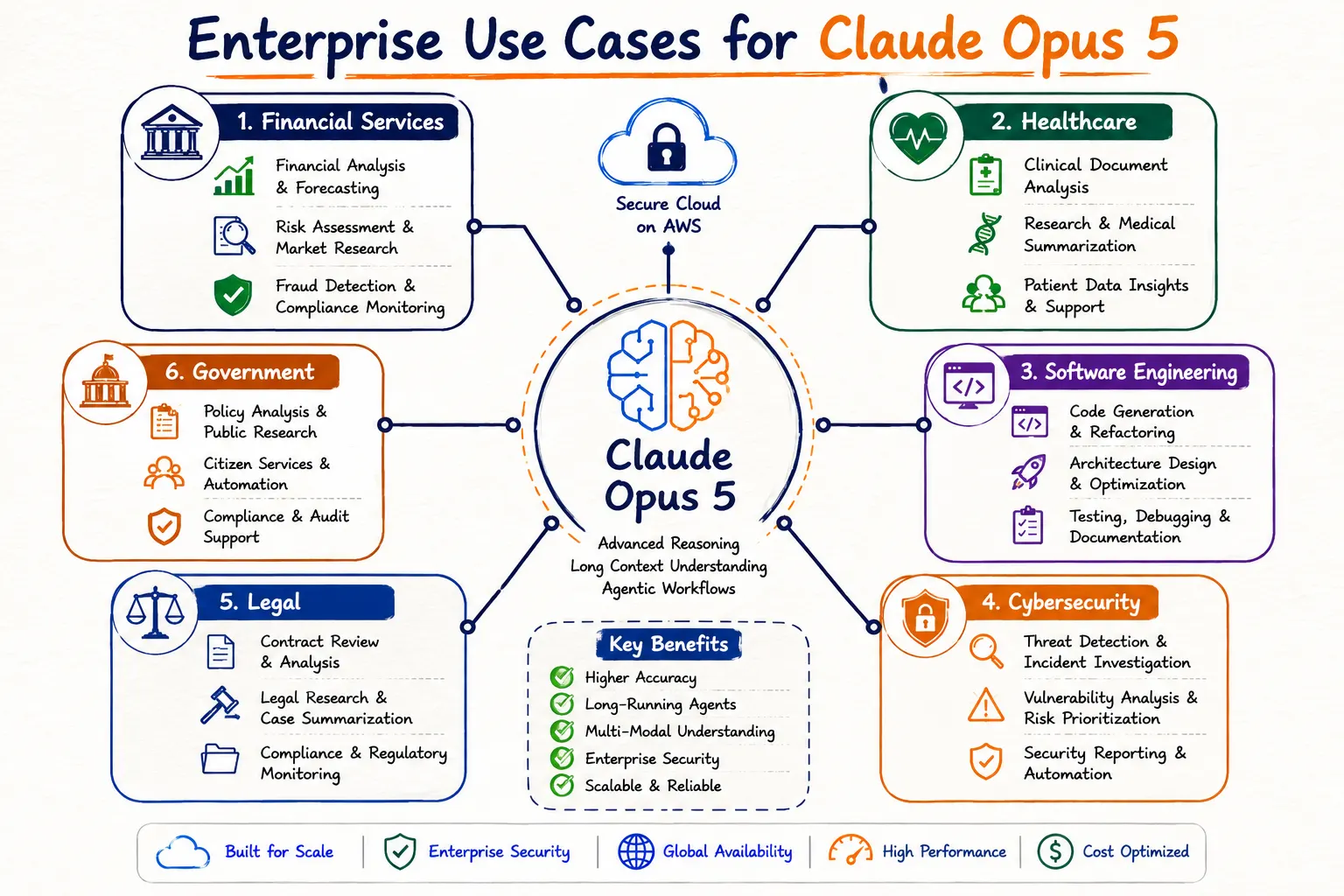
3. Supporting Knowledge-Intensive Industries
Claude Opus 5 is also positioned for organisations that process large volumes of documents and require high reasoning accuracy.
Industries likely to benefit include:
Financial Services
Banks, insurance providers, and investment firms often analyse lengthy reports, regulatory filings, contracts, and market research. Claude Opus 5's improved reasoning can assist analysts in summarising information, identifying risks, and generating structured reports while preserving contextual understanding across extensive documents.
Healthcare
Healthcare organisations increasingly rely on AI to support documentation, clinical research, and administrative workflows. Although human oversight remains essential, advanced language models can help professionals organise complex information more efficiently.
Legal Services
Law firms and corporate legal departments frequently review contracts, compliance documentation, and regulatory updates. Claude Opus 5's long-context capabilities make it well suited for analysing lengthy legal documents while maintaining consistency across large volumes of text.
Public Sector
Government agencies often process policy documents, citizen services, procurement records, and regulatory material. AI systems capable of managing complex documentation can improve operational efficiency without replacing human decision makers.
Why This Matters
Claude Opus 5 represents more than another incremental language model release. It highlights the industry's transition towards AI systems that function as collaborative digital workers rather than conversational assistants.
Several trends make this launch particularly important.
1. AI Agents Are Becoming Practical
Enterprises increasingly want AI systems that can perform complete workflows instead of answering isolated questions.
Agentic AI enables models to:
Break large tasks into smaller objectives.
Maintain context across extended interactions.
Recover from errors.
Use external tools.
Continue working with limited supervision.
Claude Opus 5 has been designed with these scenarios in mind, making it suitable for organisations building autonomous software engineering assistants, research agents, and workflow automation systems.
2. Enterprise Security Remains a Priority
While AI capabilities continue to improve, enterprise adoption depends equally on governance, compliance, and trust.
Amazon Bedrock's Zero Data Retention by default provides organisations with greater confidence when processing sensitive information. Combined with AWS identity management and regional deployment options, the platform addresses several concerns that often delay enterprise AI deployments.
For regulated sectors, security features can be just as important as model performance.
3. Cloud Platforms Are Becoming AI Platforms
The launch also reinforces an important industry trend.
Cloud providers are no longer simply offering computing infrastructure. They are becoming integrated AI platforms where customers can build, deploy, monitor, and govern foundation models using familiar cloud-native services.
Rather than requiring organisations to integrate separate AI vendors, Amazon Bedrock provides a unified environment supporting multiple foundation models through consistent APIs and security controls.
This reduces operational complexity while giving developers flexibility when selecting models for different workloads.
Challenges and Considerations
Although Claude Opus 5 introduces substantial improvements, organisations should evaluate several practical considerations before deploying it into production.
1. Cost Versus Performance
High-capability models generally require more computational resources than smaller models.
For straightforward automation tasks, lightweight models may deliver sufficient performance at lower operational cost. Organisations should evaluate whether the additional reasoning capabilities of Claude Opus 5 justify the increased inference cost for each workload.
2. Human Oversight Remains Essential
Even advanced AI models can generate incorrect, incomplete, or misleading information.
Outputs involving legal advice, healthcare recommendations, financial decisions, or cybersecurity investigations should continue to undergo human review before being acted upon.
Enterprise AI should augment professional expertise rather than replace it.
3. Governance and Compliance
Although Amazon Bedrock offers strong governance capabilities, organisations remain responsible for implementing appropriate internal controls.
Best practices include:
Role-based access controls.
Prompt auditing.
Output monitoring.
Security reviews.
Compliance validation.
Responsible AI governance.
Effective governance becomes increasingly important as AI systems begin making autonomous decisions within enterprise workflows.
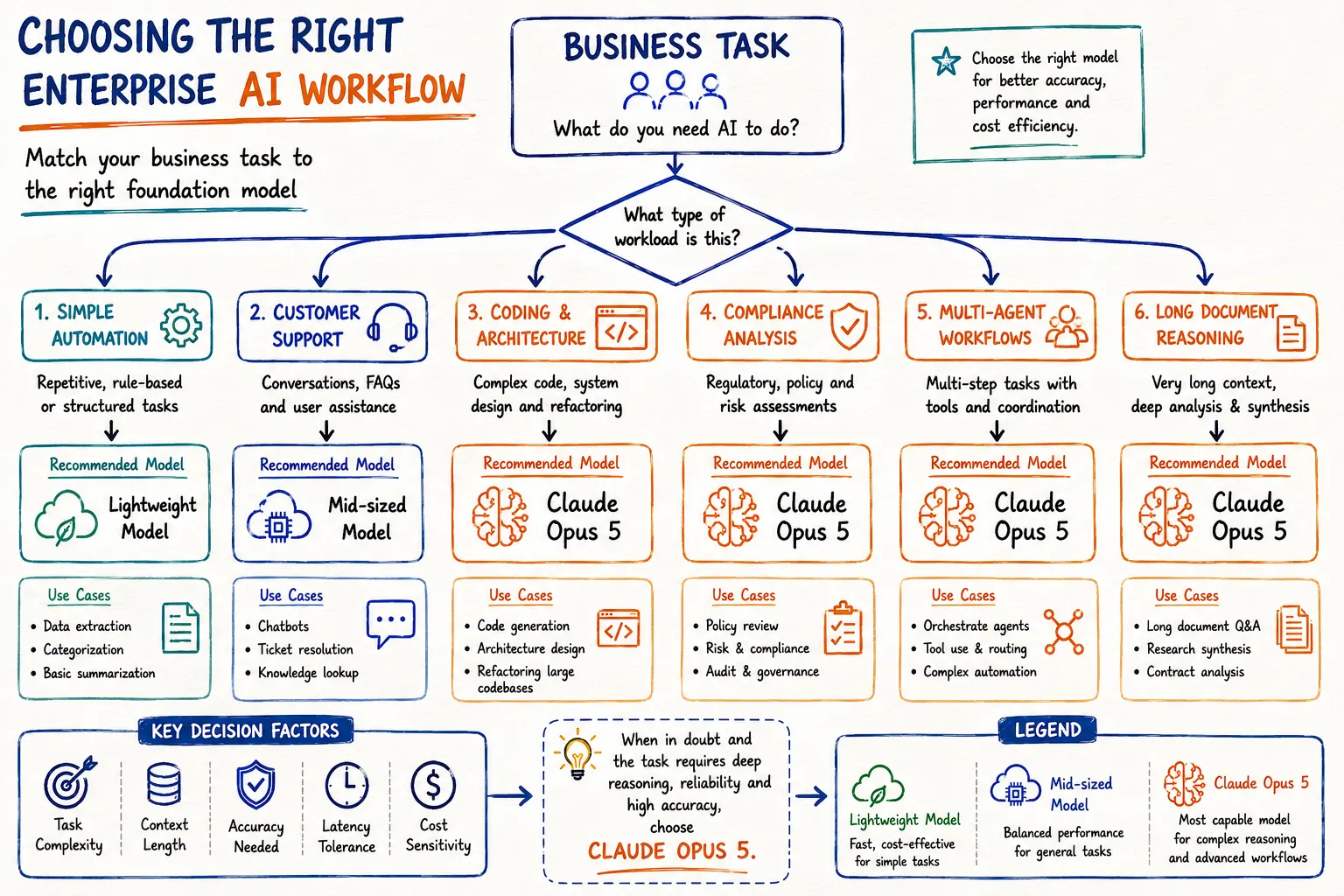
4. Model Selection
Not every workload requires the most capable model.
Many organisations will adopt a multi-model strategy in which lightweight models handle routine tasks while Claude Opus 5 is reserved for high-value reasoning, software engineering, or document analysis.
Selecting the right model for each use case can improve both performance and operational efficiency.
Future Outlook
Claude Opus 5 is likely to influence the next phase of enterprise AI adoption, where intelligent agents become integral to software development, business operations, and knowledge work. As organisations gain confidence in deploying autonomous systems, demand will continue to grow for models that combine advanced reasoning with enterprise-grade governance and security.
Future developments are expected to focus on deeper integration between foundation models and enterprise applications, enabling AI agents to collaborate across cloud services, databases, developer tools, and business platforms. Improvements in multimodal understanding, tool orchestration, and long-term memory will further expand the range of tasks AI systems can perform with minimal supervision.
AWS is also expected to continue enhancing Amazon Bedrock with additional optimisation, governance, and evaluation capabilities, giving customers greater flexibility when selecting and managing foundation models for production workloads.
Conclusion
The availability of Claude Opus 5 on Amazon Bedrock marks a significant milestone in the evolution of enterprise AI. By combining Anthropic's most advanced Opus model with AWS's managed AI infrastructure, the offering delivers powerful reasoning, coding, and workflow automation capabilities while maintaining the security, governance, and operational controls expected by enterprise customers.
Features such as Zero Data Retention by default, native AWS integration, support for multiple APIs, and strong long-context reasoning make Claude Opus 5 a compelling option for organisations building sophisticated AI-powered applications. From software engineering and cybersecurity to financial analysis and document-intensive workflows, the model is designed to tackle complex tasks that demand both intelligence and reliability.
As enterprises continue moving from AI experimentation to large-scale production deployments, platforms that balance cutting-edge model performance with enterprise trust and governance will play a central role in shaping the future of intelligent business systems.
Source: AWS Machine Learning Blog
About the Author