
GPT-6 Astra Brings Advanced Computer Use, Coding and Enterprise Controls to OpenAI's Work Platform
OpenAI says GPT-6 Astra is its most capable model for professional work, with advances in computer use, coding, cybersecurity and enterprise controls across ChatGPT Work, Codex and the API.
Xcademia Team
Xcademia Research Team
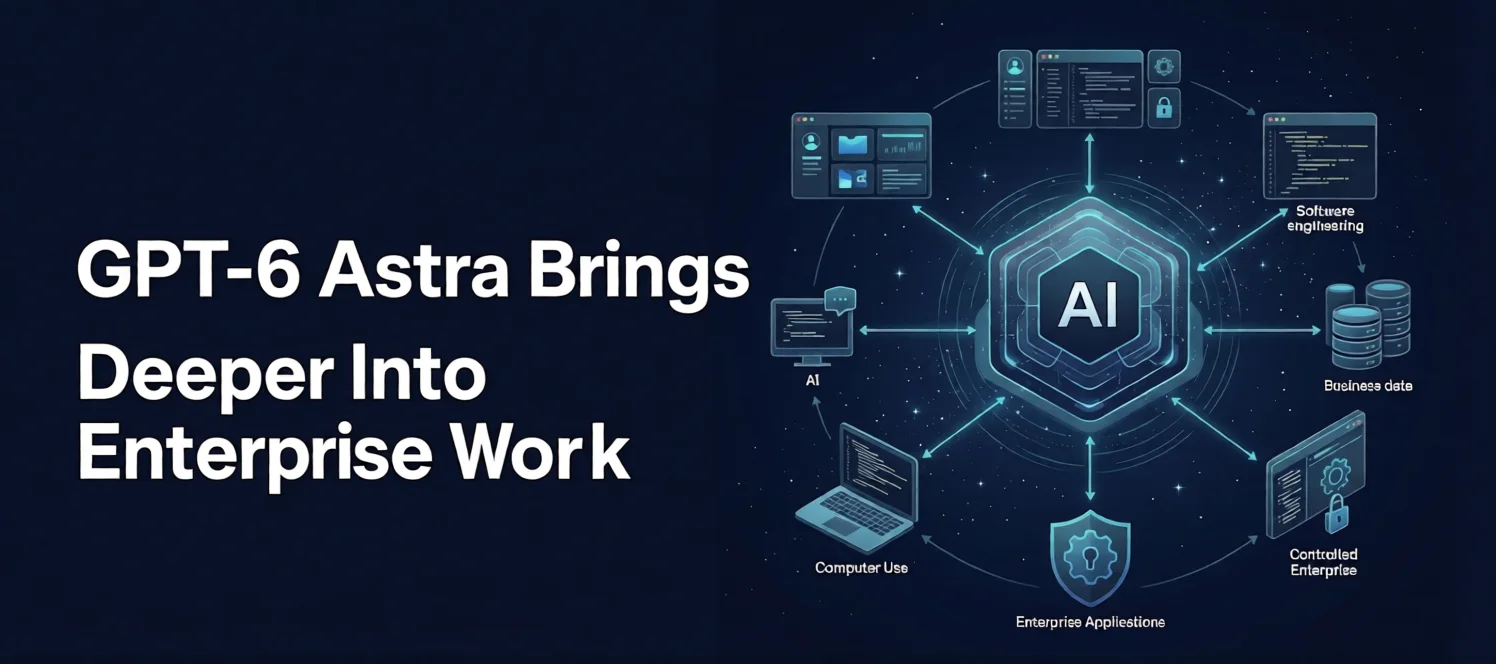
OpenAI introduces GPT-6 Astra for complex professional work
OpenAI says GPT-6 Astra is its most capable model and is designed for demanding professional work across areas including computer use, browsing, software engineering, cybersecurity and science.
The model is now available through ChatGPT Work, Codex and the API, according to OpenAI.
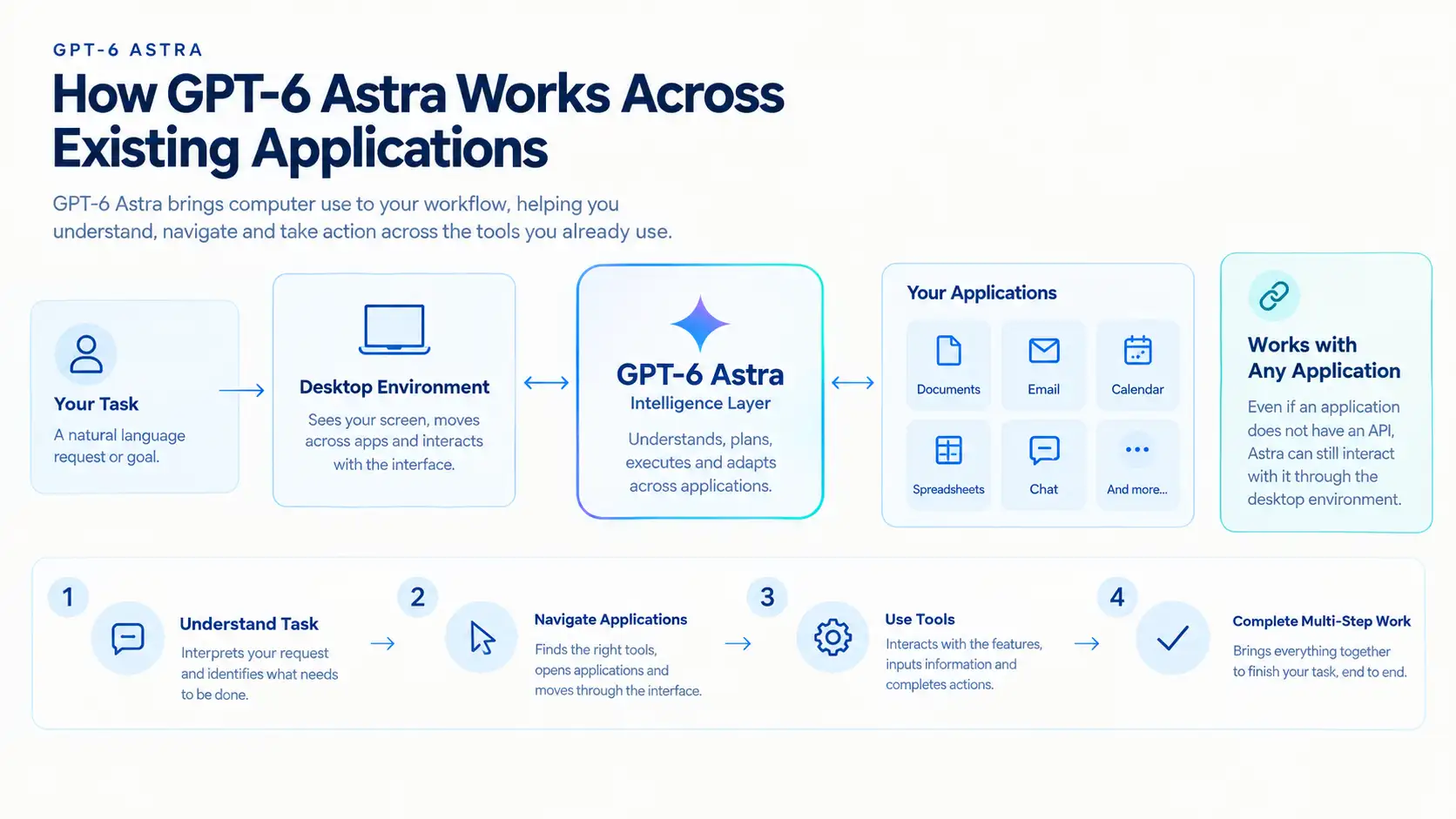
A key focus of Astra is the ability to work with the applications people already use. OpenAI says the model can operate through computer interfaces in ChatGPT Work and Codex, including applications that do not provide an API.
This allows businesses to incorporate AI into existing workflows without necessarily building custom integrations before getting started, according to the company.
OpenAI also says Astra is designed to handle multi-step professional tasks while improving speed, accuracy and judgment.
OpenAI highlights computer use as a core capability
Computer use is one of the central capabilities highlighted in the GPT-6 Astra announcement.
Rather than limiting the model to text-based interaction or applications with dedicated APIs, OpenAI says Astra can work through the same computer applications used by people.
This capability is particularly relevant to professional workflows where information may be spread across multiple applications or where software does not expose an API.
OpenAI says Astra was evaluated on computer-use scenarios involving professional tasks, including financial modeling.
The company cites an example involving the Financial Modeling World Cup, saying GPT-6 Astra completed challenges using computer use at approximately four times the speed of the winning human competitor.
This is an OpenAI-reported result based on the specific competition example described in the announcement.
OpenAI reports early enterprise use cases
OpenAI says organizations began using Astra shortly after its rollout for a range of professional tasks.
The company cites examples including GPU optimization, identifying discrepancies in financial statements and producing presentations that better follow established company styles.
OpenAI also highlights Astra's ability to follow company voice, templates and design standards.
According to the announcement, this is intended to make initial outputs closer to materials teams can use directly.
The company provides an example involving presentation generation, where Astra created a fictional presentation using elements from an OpenAI presentation template.
OpenAI says the model was also deployed internally before launch.
Its developer and marketing teams used Astra and Codex to produce a developer first-impressions video from multicamera footage.
OpenAI says its engineering team also used Astra to identify and resolve a memory-allocation bottleneck affecting Codex sessions in a test environment.
The company reports that switching memory allocators resulted in 25% lower turn latency with approximately 30% higher peak memory use in that environment.
These figures are specific to OpenAI's reported internal test environment and should not be treated as a general performance guarantee.
GPT-6 Astra targets coding and complex technical work
Software engineering is another major area highlighted by OpenAI.
The company says Astra delivers state-of-the-art performance across software engineering evaluations and points to results from Terminal-Bench 4.0 and DeepSWE v1.1.
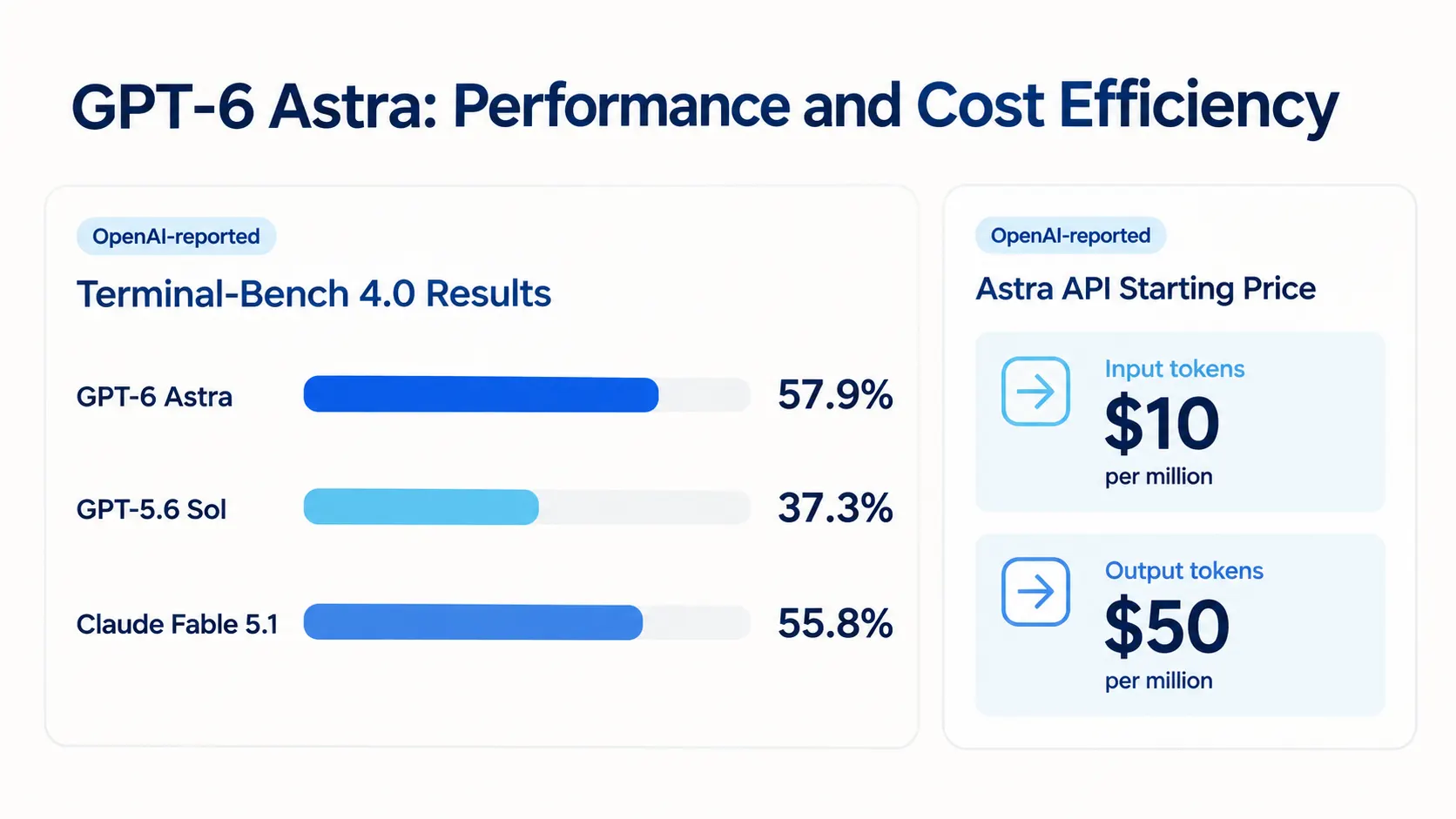
OpenAI reports that Astra reached 57.9% on Terminal-Bench 4.0, compared with 37.3% for GPT-5.6 Sol and 55.8% for Claude Fable 5.1 in the comparison presented in its announcement.
OpenAI also says Astra reached 74% on DeepSWE v1.1, describing the result as a new record.
The company says these results were achieved with fewer steps and greater token efficiency on complex, long-horizon software engineering tasks.
These are vendor-reported benchmark results. Benchmark performance can vary depending on evaluation methodology, configuration and task selection.
OpenAI emphasizes efficiency alongside performance
OpenAI says Astra has been trained to complete tasks using fewer tokens and fewer retries.
The company argues that this can reduce rework and lower the cost associated with individual tasks.
OpenAI says GPT-6 Astra occupies a strong position on what it describes as the cost-efficiency frontier across professional work and coding evaluations.
The model's API pricing starts at:
$10 per million input tokens
$50 per million output tokens
OpenAI also compares Astra's API cost with other models in the Terminal-Bench 4.0 results presented in the announcement.
The reported comparisons should be understood as OpenAI's analysis of the evaluation and estimated API costs rather than an independent industry-wide cost study.
Enterprise controls become a major part of Astra
OpenAI says GPT-6 Astra is also designed with stronger controls for consequential workplace actions.
The company says Astra is its most aligned model yet, with stronger adherence to human intent and authorization.
OpenAI tested the model using an internal computer-use safety benchmark focused on business scenarios involving potentially harmful or unauthorized outcomes.
Examples included exposing confidential information, sharing a dashboard too broadly and deleting data.
According to OpenAI, Astra produced unintended outcomes 89% less often than GPT-5.6 Sol and 74.7% less often than Claude Fable 5.1 in that evaluation.
OpenAI says additional confirmation and automated review further improved performance for GPT-6 Astra and GPT-5.6 Sol.
These findings come from OpenAI's internal benchmark and are not an independently audited safety comparison.
New controls give enterprise administrators more control
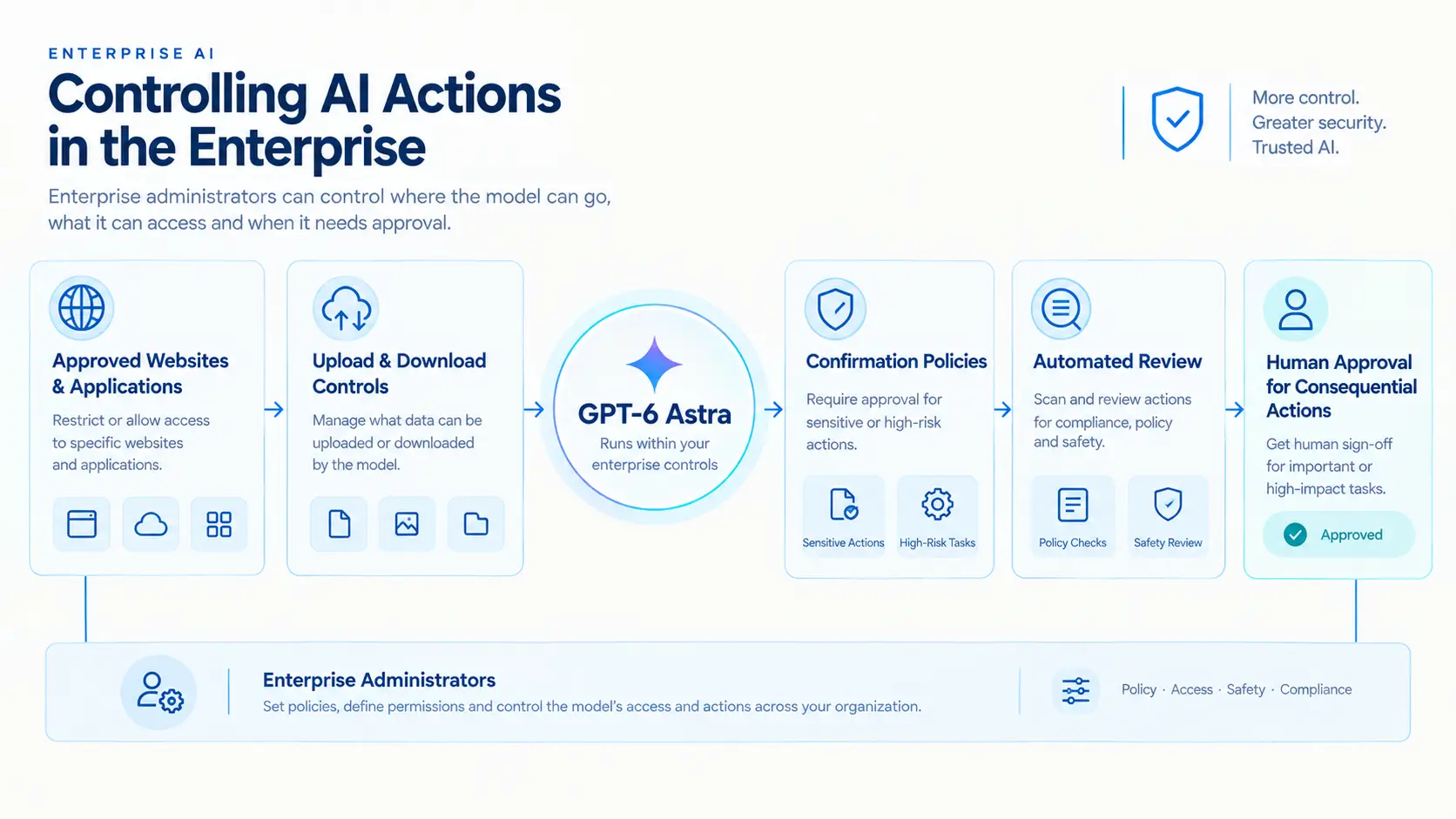
OpenAI says organizations can determine how broadly GPT-6 Astra is deployed.
New enterprise administrator controls can restrict access to approved websites and desktop applications.
Administrators can also manage uploads and downloads and control browsing history.
ChatGPT Work and Codex include additional safeguards, according to OpenAI.
These include confirmation policies that can require approval before consequential actions and automated review of potentially unsafe or unauthorized tool calls.
The approach allows organizations to begin with more restricted configurations and expand access over time, according to the company.
GPT-6 Astra reaches OpenAI's critical cybersecurity capability threshold
Cybersecurity is another area where OpenAI highlights a significant development.
The company says Astra is the first model to reach its Critical cybersecurity capability threshold under OpenAI's Preparedness Framework.
OpenAI says it has strengthened protections against misuse and against the model taking unauthorized actions.
The company says these measures include training Astra to respect safety and security boundaries, improving resistance to attempts to bypass safeguards and deploying automated checks intended to block harmful responses.
The announcement does not provide a broader industry comparison for this threshold.
The cybersecurity claim therefore should be understood specifically within OpenAI's Preparedness Framework and terminology.
Enterprise applications can be accessed through new plugins
OpenAI is also introducing enterprise plugins in ChatGPT Desktop alongside Astra.
The company says these plugins use its latest browser-use capabilities to provide access to familiar enterprise applications.
The announcement names plugins from:
Oracle Analytics
Power BI, a Microsoft Fabric service
Navan
Avalara
OpenAI presents these integrations as a way to make enterprise applications more accessible through the desktop experience.
The source does not provide additional technical specifications for the plugins.
Zero Data Retention remains available for eligible API customers
OpenAI also notes that Zero Data Retention is available for eligible API customers on supported endpoints, subject to approval.
The announcement does not provide additional details about eligibility or the specific endpoints in the supplied article.
Additional details were not disclosed in the announcement.
Enterprise and customer examples
OpenAI says it is already seeing customers use GPT-6 Astra for professional work.
The announcement references organizations including Cognition, Datacurve, Basis, CodeRabbit, XTX Markets, Databricks, Hebbia, Box, Figma and Thomson Reuters Labs.
Cognition is highlighted in connection with integrating Astra into Devin's harness.
Cognition's SVP Research, Silas Alberti, says the model showed strong computer-use, writing and codebase-understanding performance in the company's internal testing.
Datacurve's CEO, Serena Ge, discusses Astra's reported DeepSWE performance and token efficiency.
OpenAI also lists several organizations among early users or customers seeing value from the model.
These customer statements are testimonials included in OpenAI's announcement and should not be treated as independent benchmark results.
Astra is positioned for a broad range of professional work
The GPT-6 Astra announcement covers a wide range of use cases rather than focusing on a single AI capability.
OpenAI highlights:
Computer use
Browsing
Professional workflows
Software engineering
Cybersecurity
Science
Financial modeling
Document and presentation work
Enterprise application access
This breadth reflects OpenAI's positioning of Astra as a general-purpose model for complex professional tasks.
The company is also emphasizing the model's ability to operate within existing workplace environments instead of requiring every workflow to be rebuilt around AI.
What GPT-6 Astra means for enterprise AI
The announcement highlights a broader shift toward AI systems that can interact with software and complete tasks rather than simply generate responses.
For enterprises, this could mean that the practical evaluation of AI models increasingly involves several factors at once.
Organizations may need to examine how effectively a model can navigate existing applications, how it performs on technical tasks, how much human oversight is required and what administrative controls are available.
Security also becomes more important when models can interact directly with business systems.
OpenAI's focus on confirmation policies, automated review, application restrictions and authorization is part of this broader enterprise deployment challenge.
These observations are editorial analysis based on the capabilities described in OpenAI's announcement, rather than independent findings about the enterprise AI market.
Availability and enterprise deployment
GPT-6 Astra is available through ChatGPT Work, Codex and the API, according to OpenAI.
Enterprise administrators can enable Astra under their applicable rate card and agreement.
OpenAI says enterprise access is off by default at launch.
The model can therefore be incorporated into both existing OpenAI environments and custom products or workflows through the API.
The company is positioning the model for organizations that need AI to work across existing applications, technical systems and professional processes.
The bigger picture
GPT-6 Astra represents OpenAI's latest push to position AI as an active participant in professional workflows rather than simply a conversational assistant.
The announcement combines improvements in computer use, software engineering, professional work and cybersecurity with new enterprise controls for managing how AI interacts with business systems.
OpenAI is also emphasizing efficiency, reporting benchmark results and API pricing alongside its safety and governance measures.
At the same time, many of the performance and safety figures in the announcement come from OpenAI's own evaluations or testing environments. They provide useful context for understanding the company's claims, but they should not automatically be interpreted as independent industry benchmarks.
The more consequential development may be the combination of model capability with mechanisms for controlling what the model can access and which actions require human approval.
As AI systems become more capable of operating software directly, the question for enterprises is increasingly not only what a model can produce, but also how safely and predictably it can operate within real business workflows.
Source: OpenAI
About the Author