
How Voicify Uses Gemini Enterprise to Deliver Faster, Smarter AI Phone Ordering at Scale
Voicify transformed AI-powered phone ordering for restaurants and healthcare by combining Gemini Enterprise, Vertex AI, and a custom voice orchestration platform. The result is lower latency, enterprise-grade reliability, 25–30% lower LLM costs, and faster customer onboarding.
Xcademia Team
Xcademia Research Team
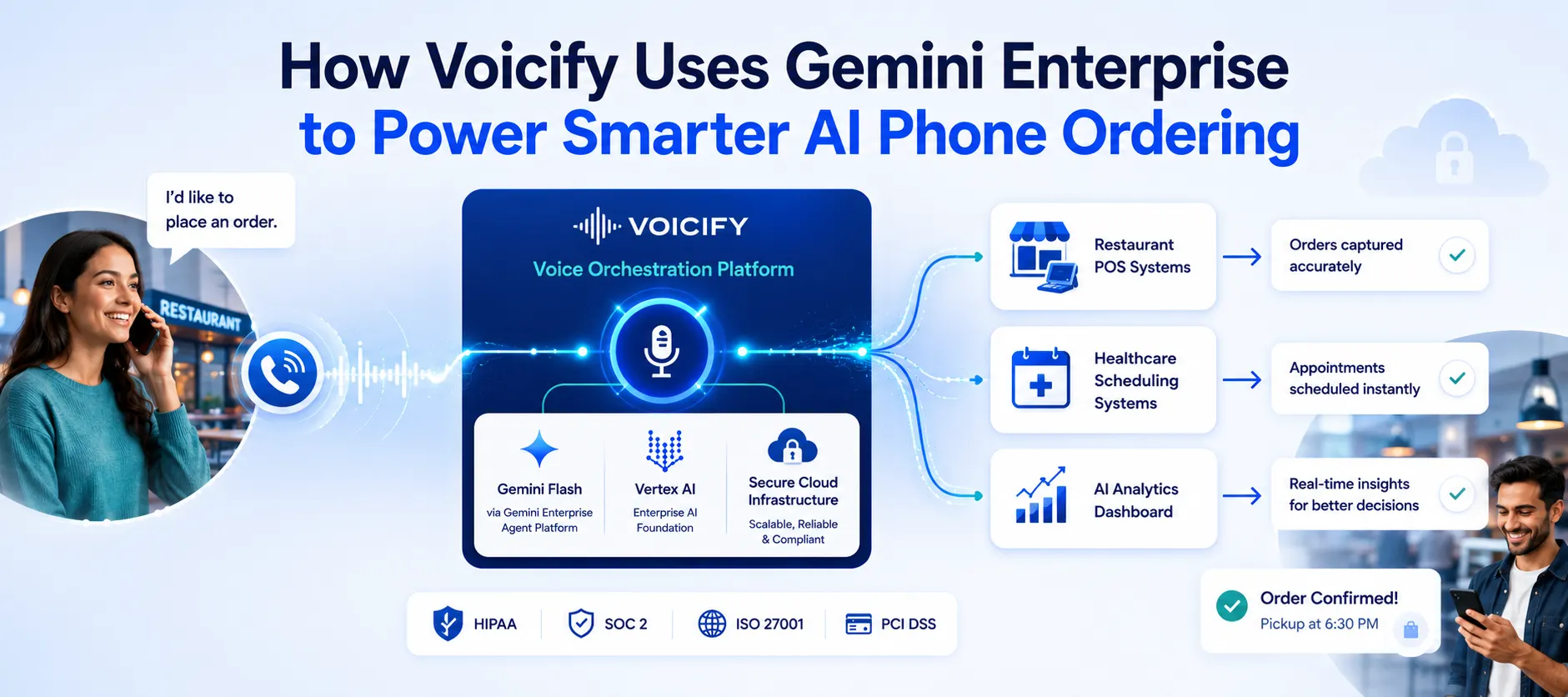
How Voicify Built an Enterprise AI Voice Platform
Artificial intelligence is rapidly changing how businesses interact with customers, but one communication channel remains surprisingly important: the phone call. While websites, mobile apps, and chatbots continue to evolve, millions of customers still prefer calling restaurants to place orders or contacting healthcare providers to schedule appointments.
For businesses, however, handling these calls efficiently has become increasingly difficult. Staff shortages, growing call volumes, and customer expectations for instant service often lead to missed opportunities and frustrating experiences.
To solve these challenges, Voicify developed an enterprise AI voice platform that automates customer conversations while maintaining the speed, accuracy, and reliability required for real-world business operations. Working with Google Cloud, the company built an AI-powered voice orchestration platform using Gemini Enterprise Agent Platform, Vertex AI, and Gemini Flash to support large-scale conversational experiences across restaurants and healthcare organizations.
According to Voicify, the new platform has reduced latency, lowered large language model (LLM) costs by approximately 25% to 30%, enabled 100% uptime during peak demand, and shortened restaurant onboarding from one to two weeks down to just one or two days.
The case demonstrates that successful enterprise conversational AI depends not only on advanced language models but also on scalable infrastructure, intelligent orchestration, and enterprise-grade reliability.
Why Phone Calls Still Matter in the AI Era
Although digital ordering channels continue to expand, phone calls remain a critical customer interaction point for many industries.
Restaurants still receive thousands of daily calls for food orders, reservations, and customer inquiries. Healthcare organizations rely heavily on phone conversations for appointment scheduling, patient communication, and administrative support.
Unlike web forms or mobile applications, phone conversations are dynamic and unpredictable. Customers often change their minds, ask follow-up questions, modify requests, or provide incomplete information that requires clarification.
Building AI systems capable of handling these natural conversations accurately is significantly more complex than creating a traditional chatbot.
When Voicify launched in 2018, its goal was to help organizations build practical, voice-driven AI assistants for multiple communication channels. However, the COVID-19 pandemic dramatically changed customer behavior and accelerated demand for automated telephone solutions.
Restaurants faced overwhelming call volumes while operating with reduced staff, and healthcare providers struggled to manage growing appointment requests efficiently.
These challenges highlighted the need for specialized AI assistants capable of managing complex voice interactions while maintaining enterprise-level accuracy.
The Four Challenges of Enterprise Voice AI
Developing an AI assistant that can reliably answer customer questions is only the beginning.
For enterprise organizations, every conversation may involve sensitive customer information, business transactions, or operational systems that require high levels of accuracy and reliability.
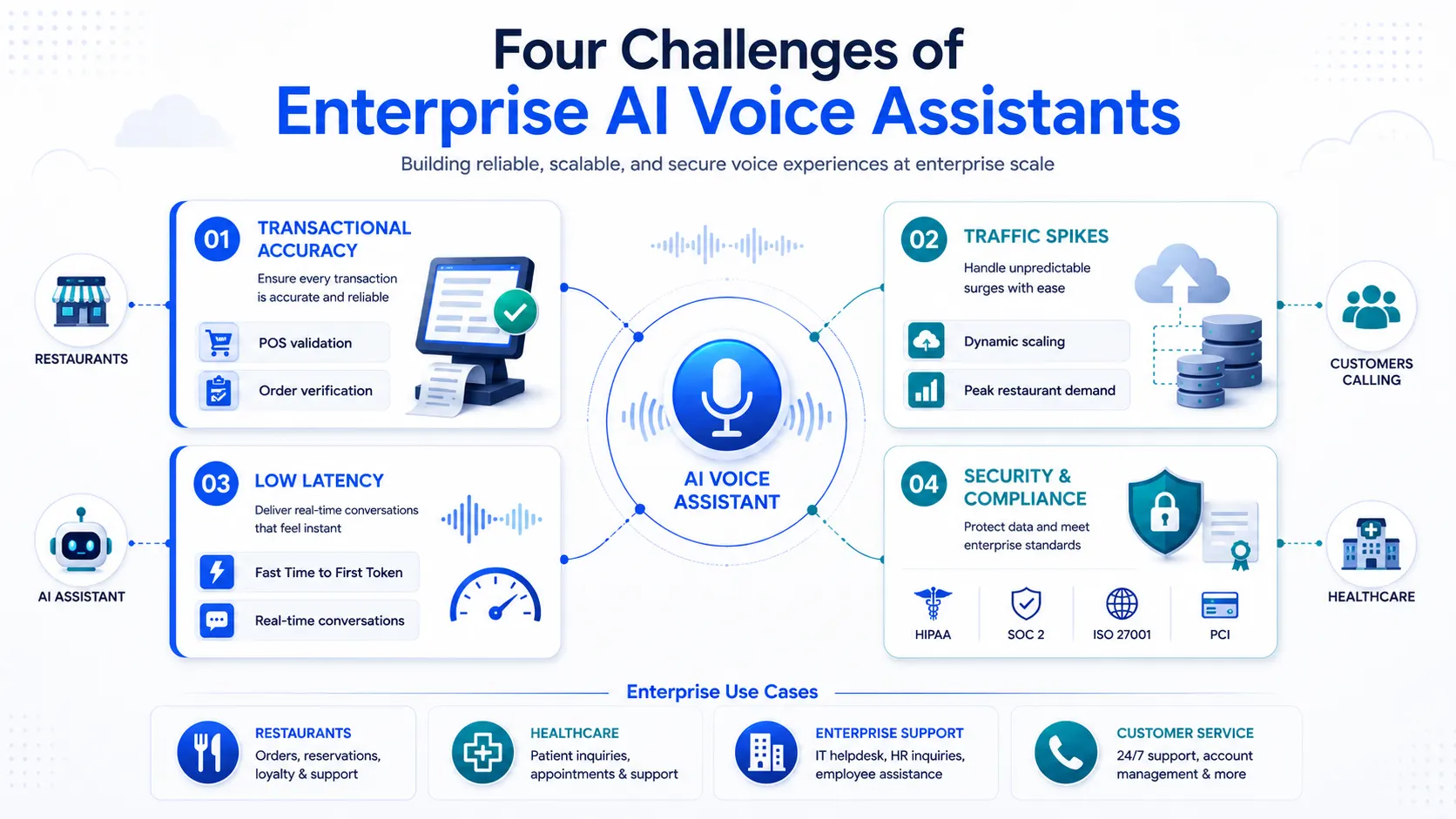
Voicify identified four major challenges that had to be addressed before AI-powered voice assistants could operate successfully at enterprise scale.
1. Transactional Accuracy
Restaurant orders and healthcare appointments cannot tolerate mistakes.
An AI assistant must correctly understand customer requests while validating them against external systems such as point-of-sale (POS) platforms or healthcare practice management software.
Even a small misunderstanding could result in incorrect food orders, scheduling errors, or customer dissatisfaction.
To meet enterprise requirements, Voicify designed its conversational platform to validate every transaction before submission, ensuring AI-generated requests align with business rules and available inventory.
2. Handling Extreme Traffic Spikes
Unlike many enterprise applications, restaurant traffic is highly unpredictable.
Demand often increases dramatically during lunch, dinner, weekends, holidays, and major sporting events.
Healthcare organizations experience similar spikes during seasonal illnesses or emergency situations.
An AI platform must scale instantly without sacrificing response quality or availability.
Overprovisioning infrastructure increases costs, while insufficient capacity risks dropped requests and poor customer experiences.
Balancing scalability with operational efficiency therefore became a key architectural priority.
3. Delivering Low-Latency Conversations
Speed plays a critical role in conversational AI.
Customers naturally expect immediate responses during phone conversations. Even short pauses between questions and answers can make interactions feel unnatural, causing callers to abandon conversations altogether.
One of Voicify's primary objectives was reducing Time to First Token (TTFT)—the time required for an AI model to begin generating its response after receiving user input.
Lower latency creates more fluid conversations and significantly improves customer satisfaction.
4. Meeting Enterprise Security Requirements
Operating in healthcare and enterprise environments introduces strict regulatory obligations.
Voicify needed an architecture capable of supporting compliance standards including:
HIPAA
SOC 2
ISO 27001
PCI
Beyond regulatory compliance, the company also required enterprise-grade infrastructure capable of protecting customer data while maintaining high availability and operational resilience.
These requirements influenced every architectural decision across the platform.
Voicify's Enterprise AI Architecture on Google Cloud
To address these challenges, Voicify built an enterprise voice orchestration platform powered by Google's AI technologies.
At its core, the platform combines conversational intelligence with deterministic business logic.
Rather than relying entirely on generative AI, the system validates every transaction against external business systems before completing customer requests.
For restaurant orders, the platform checks menu items, pricing, and available options directly with point-of-sale systems.
For healthcare organizations, it integrates with practice management software to ensure appointments and patient information remain accurate.
This hybrid architecture combines the flexibility of large language models with the reliability of traditional enterprise software.
Why Gemini Flash Improved Customer Conversations
Voicify selected Gemini Flash, delivered through Gemini Enterprise Agent Platform, to power conversational interactions.
According to the company, Gemini Flash provided several important improvements over previous models:
Faster response generation
Lower conversational latency
Improved reliability
Reduced customer wait times
Approximately 25% to 30% lower LLM costs
These improvements helped reduce interruptions during live phone calls while improving the overall customer experience.
Lower latency also allowed conversations to feel more natural by minimizing delays between customer questions and AI responses.
Moving from Google AI Studio to Vertex AI
As Voicify's customer base expanded, the company recognized that development-focused AI tools alone would not provide the scalability and operational guarantees required for enterprise deployments.
To support larger production workloads, the company transitioned from Google AI Studio to Vertex AI, which now forms part of Gemini Enterprise.
The migration was driven by several enterprise requirements:
Guaranteed production capacity
Higher availability
Improved scalability
Stronger security controls
Healthcare compliance
Enterprise support
Although enterprise services involved higher operational costs than development environments, Voicify determined that predictable performance and enterprise reliability justified the investment.
Managing Massive Traffic Spikes
Restaurant demand fluctuates dramatically throughout the day.
Holiday periods such as Thanksgiving can generate exceptionally high call volumes within short time windows.
To accommodate these workloads, Voicify combines two Vertex AI capabilities:
Provisioned Throughput
Premium Pay-As-You-Go
This hybrid scaling approach provides reserved AI processing capacity during expected demand while allowing additional resources to be allocated automatically during unexpected traffic spikes.
According to Voicify, this architecture successfully handled record-breaking call volumes before Thanksgiving without experiencing rate limiting or service interruptions.
The result was continuous AI availability even during one of the busiest ordering periods of the year.
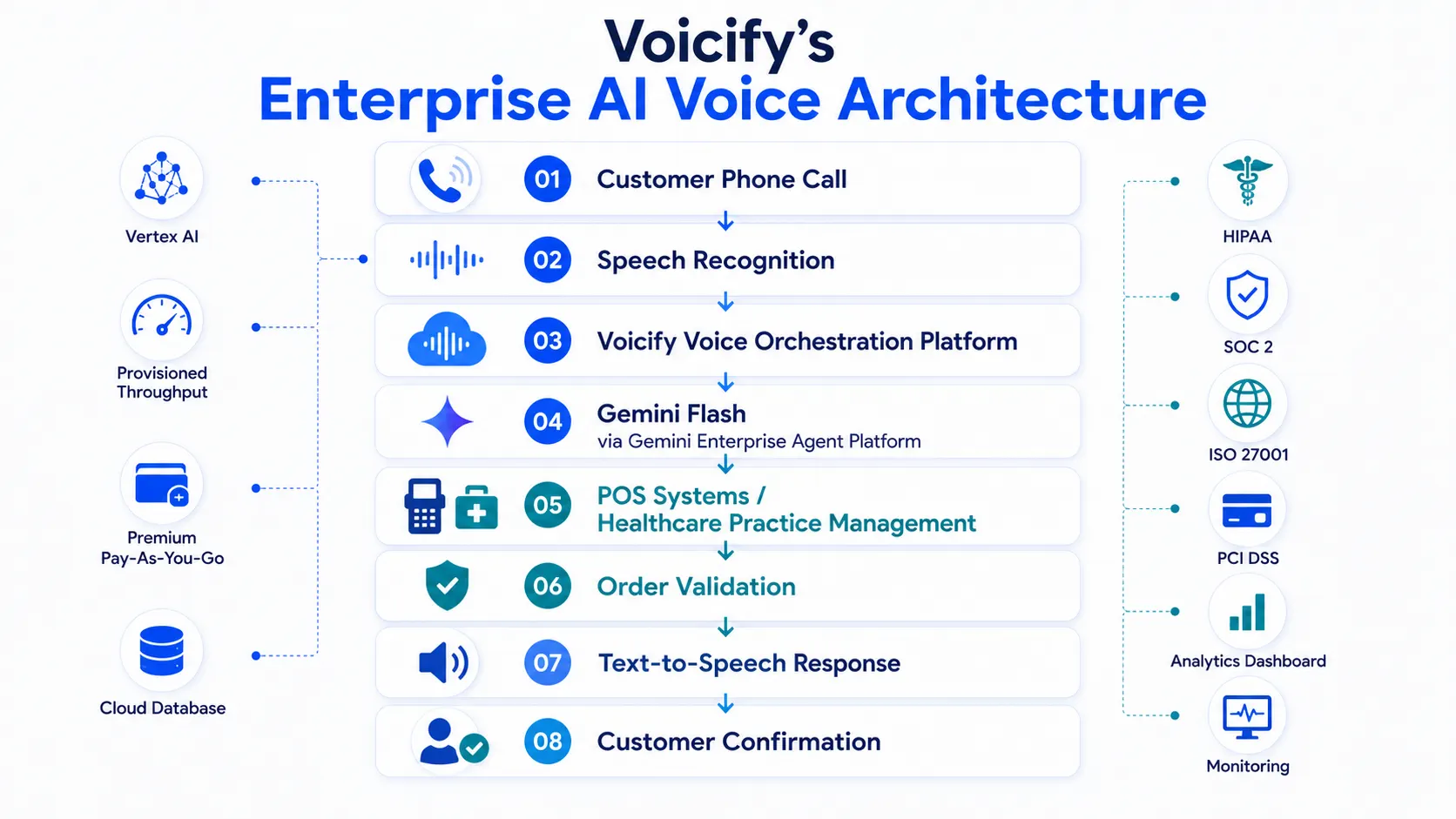
The Architecture Behind Voicify's Enterprise AI Platform
Behind every successful AI-powered phone conversation is a carefully designed orchestration layer that coordinates speech recognition, language understanding, business logic, and backend systems in real time.
Rather than allowing a large language model (LLM) to handle every aspect of a conversation independently, Voicify built a voice orchestration platform that acts as the central control layer for the entire AI phone stack.
The platform manages each stage of the interaction, including:
Automatic Speech Recognition (ASR)
Natural language understanding with Gemini Flash
Business logic and workflow orchestration
Point-of-sale (POS) and healthcare system integration
Order validation
Text-to-Speech (TTS) generation
Enterprise monitoring and security
This orchestration layer enables the platform to combine the flexibility of generative AI with the predictability required for enterprise business operations.
Instead of relying solely on AI-generated responses, the platform continuously validates actions against backend systems before executing them, helping ensure every order or appointment is processed accurately.
Smarter Menu Management Improves Speed and Accuracy
Restaurant menus can be surprisingly complex.
A single restaurant may offer hundreds of menu items, optional ingredients, meal combinations, seasonal promotions, and location-specific pricing. Including every detail in an AI prompt would dramatically increase token usage, response times, and operational costs.
To overcome this challenge, Voicify adopted a dynamic retrieval strategy.
Rather than loading the entire menu into the model's context, the platform initially provides only the information required to begin the conversation. As the customer refines their order, the orchestration platform retrieves additional menu details from the POS system only when needed.
For example, if a customer orders a pizza, the assistant retrieves topping options and sizes only after the base item has been selected. If the customer later requests a dessert or beverage, the platform fetches only those relevant menu sections.
This incremental approach offers several advantages:
Lower prompt sizes and token usage
Faster AI responses
Reduced inference costs
Improved conversational accuracy
Better scalability for large restaurant menus
By limiting context to what is immediately relevant, the assistant maintains natural conversations while avoiding unnecessary processing overhead.
Enterprise Security by Design
Serving industries such as healthcare and hospitality requires more than conversational intelligence. It demands strong security, compliance, and operational resilience.
From its inception, Voicify designed its platform to meet enterprise security expectations, supporting compliance frameworks including:
HIPAA
SOC 2
ISO 27001
PCI
The platform also incorporates enterprise-grade safeguards to help protect customer data and maintain service reliability.
In addition, Voicify's architecture supports a multicloud strategy, enabling organizations to improve availability and business continuity across different cloud environments. This flexibility helps reduce the impact of infrastructure failures while supporting customers with diverse deployment requirements.
The Business Impact
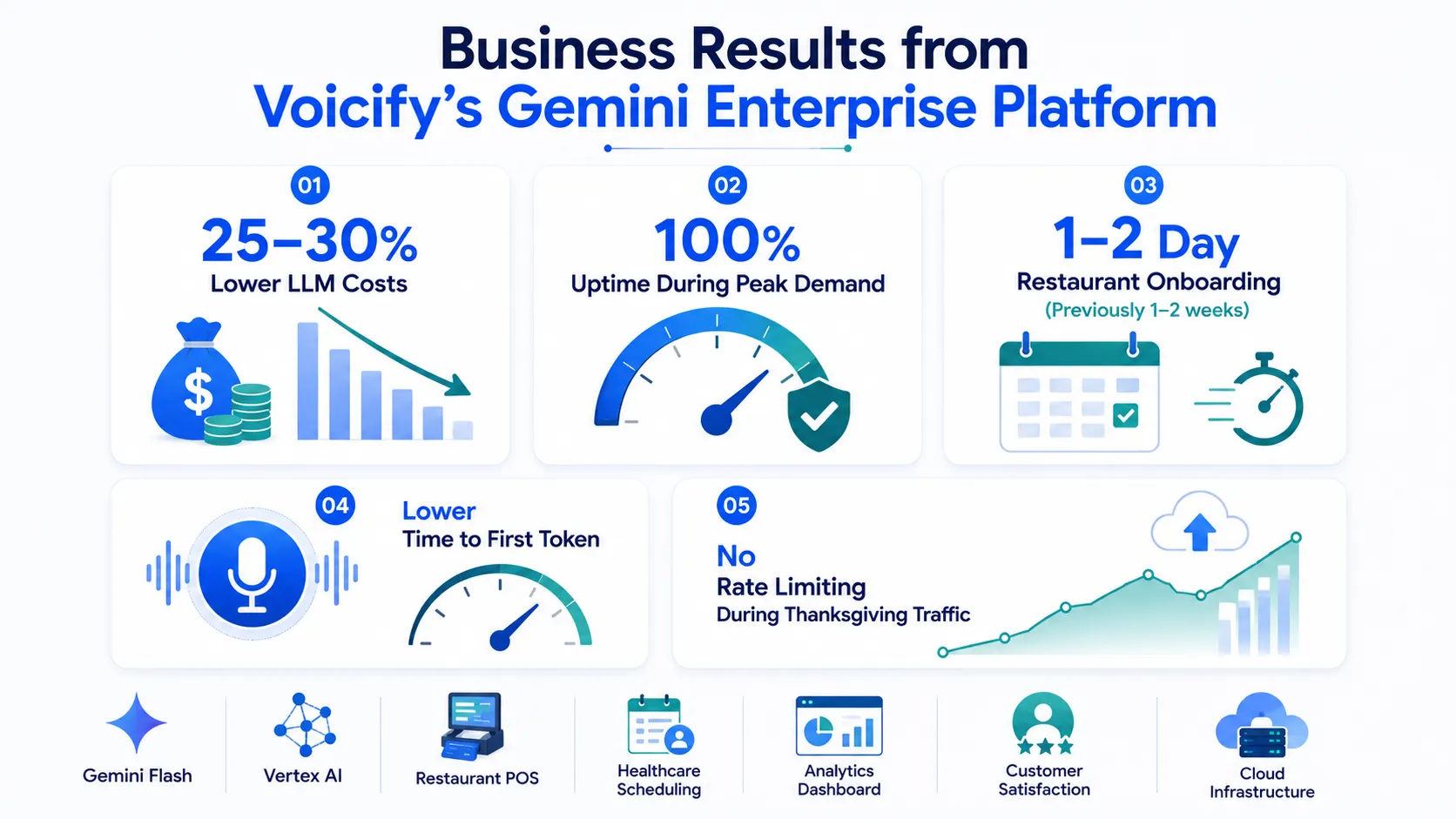
Voicify's collaboration with Google Cloud produced measurable improvements across cost, performance, scalability, and operational efficiency.
Some of the most significant outcomes include:
(a) 25–30% Lower LLM Costs
After adopting Gemini Flash, Voicify reported approximately 25% to 30% savings compared with its previous large language model deployments. Lower inference costs make it easier to scale conversational AI without proportionally increasing operating expenses.
(b Lower Latency and Faster Conversations
Reducing Time to First Token (TTFT) allows customers to receive responses more quickly, creating smoother and more natural phone interactions while reducing the likelihood of callers abandoning conversations.
(c) 100% Uptime During Peak Demand
By combining Provisioned Throughput with Premium Pay-As-You-Go on Vertex AI, Voicify successfully handled record traffic during the Thanksgiving holiday without experiencing rate limiting or dropped requests.
(d) Restaurant Onboarding Reduced from Weeks to Days
One of the most significant operational improvements came from client onboarding.
Previously, integrating a restaurant after gaining access to its POS system typically required one to two weeks. With the new Gemini-powered platform, restaurants can now begin testing within one to two days, significantly accelerating customer deployment.
(e) Improved Platform Stability
Greater reliability has reduced operational overhead while simplifying customer onboarding and day-to-day platform management, enabling engineering teams to focus on innovation rather than troubleshooting infrastructure issues.
The Future of AI Voice Assistants
Voicify sees conversational AI evolving far beyond answering customer phone calls.
Today, AI assistants primarily respond to requests initiated by users. In the future, they could become proactive digital assistants that anticipate customer needs based on previous interactions and business context.
For example, instead of waiting for a customer to call every Friday evening, an AI assistant could recognize recurring ordering patterns, confirm preferences, and proactively offer to place the order.
Similarly, healthcare assistants could remind patients about appointments, suggest follow-up visits, or help complete administrative tasks before patients even contact the clinic.
These capabilities depend on more than increasingly capable AI models. They require platforms that combine conversational intelligence, trusted business data, secure integrations, and enterprise-grade infrastructure capable of supporting real-time decision-making.
Conclusion
Voicify's journey demonstrates that delivering high-quality AI-powered customer experiences requires far more than deploying a large language model. Enterprise voice assistants must operate with low latency, transactional accuracy, scalable infrastructure, and strong security while integrating seamlessly with existing business systems.
By combining Gemini Flash, Gemini Enterprise Agent Platform, Vertex AI, and its own voice orchestration platform, Voicify has built an architecture capable of meeting these demanding requirements. The company achieved measurable improvements, including 25–30% lower LLM costs, 100% uptime during peak traffic, significantly faster onboarding, and improved response times that create more natural customer conversations.
The case also highlights an important lesson for organizations adopting conversational AI. Success depends not only on selecting the right AI model but also on designing the orchestration, infrastructure, and validation layers that surround it. These components ensure AI systems can reason effectively, integrate with enterprise applications, and execute business transactions safely at scale.
As conversational AI continues to mature, voice assistants are likely to evolve from reactive tools into proactive digital agents capable of understanding customer preferences, anticipating needs, and automating increasingly complex workflows. Organizations that invest in scalable, enterprise-grade AI architectures today will be better positioned to deliver those next-generation customer experiences tomorrow.
Source: Google Cloud Blog
About the Author