
How Target Cut Database Maintenance by 50% Using Google Cloud Spanner Graph
Target has rebuilt its retail discovery platform with Google Cloud Spanner Graph, reducing database maintenance by 50% while improving AI-powered product discovery, semantic search, and conversational shopping experiences.
Xcademia Team
Xcademia Research Team
Why Target Rebuilt Its Retail Discovery Platform
Modern retail is no longer driven by keyword searches alone. Today's shoppers expect personalized recommendations, conversational shopping assistants, and product discovery experiences that understand intent rather than just matching words.
To support these growing expectations, Target has modernized its retail discovery platform using Google Cloud Spanner Graph, replacing a fragmented database architecture with a unified platform capable of handling transactions, graph relationships, vector search, and full-text search together.
Google Cloud says the migration has reduced Target's database maintenance effort by 50%, while giving the retailer a unified platform for AI-powered product discovery, semantic search, and conversational shopping experiences.
Retail search has evolved far beyond simple keyword matching. Modern shoppers expect search engines and AI assistants to understand product relationships, shopping intent, and conversational queries in real time. Delivering these experiences requires databases that can process transactional data while also supporting semantic search, graph relationships, and AI reasoning without introducing operational complexity. For large retailers serving millions of customers, building this foundation has become just as important as the AI applications running on top of it.
Why Target Needed a New Data Platform
Target's Guest Product Confidence platform powers several customer-facing experiences, including:
Ratings and reviews
AI-powered shopping assistants
Personalized product discovery
Gift Finder conversational chat agent
The retailer launched its Gift Finder chat experience during the 2025 holiday season to help shoppers discover products through natural conversations.
Delivering these experiences at enterprise scale required more than traditional search technology.
Target needed a platform capable of supporting:
High-volume transactional workloads
Connected graph relationships
Semantic vector search
Full-text keyword search
Instead of operating multiple specialized databases independently, the company wanted a unified architecture that could handle all four capabilities together.
The Challenges of a Fragmented Database Architecture
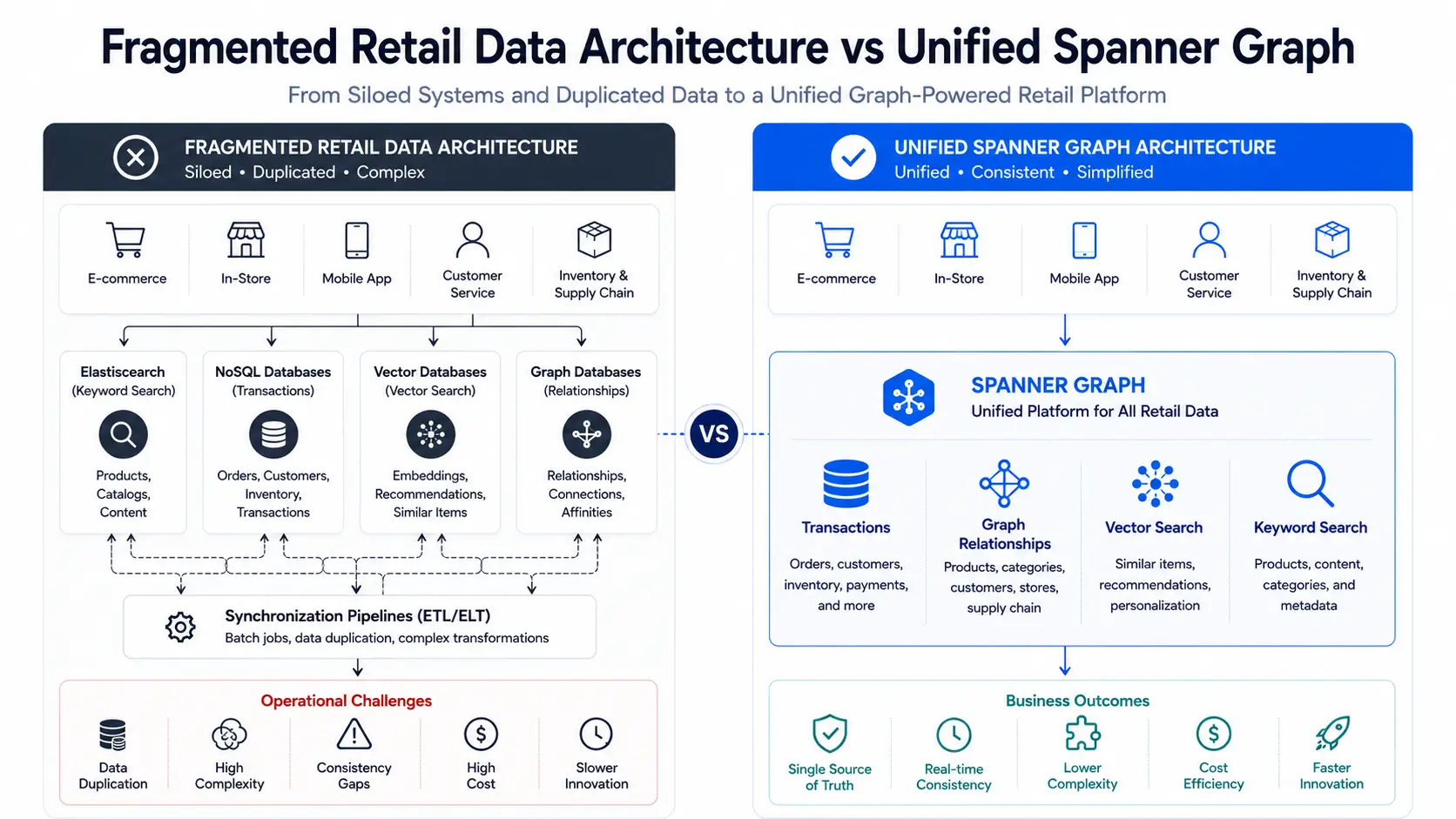
Before migrating to Spanner Graph, Target relied on Elasticsearch for search alongside separate NoSQL databases for transactional workloads.
Although functional, this architecture introduced several operational challenges.
(1) Disconnected Data Context
Keeping transactional data, search indexes, and vector information synchronized across multiple systems required continuous maintenance and often resulted in inconsistent query results.
(2) Higher Operational Overhead
Engineering teams spent significant time managing independent database clusters, tuning search indexes, and maintaining custom synchronization pipelines.
(3) Scaling Challenges
Adding new retail domains meant creating additional collections, managing increasingly complex joins, and dealing with weaker transactional guarantees across systems.
(4) Limited AI Capabilities
Graph relationships, vector similarity searches, and keyword searches could not be queried together within a single transaction, making advanced AI experiences more difficult to build.
Building a Unified AI Data Foundation with Spanner Graph
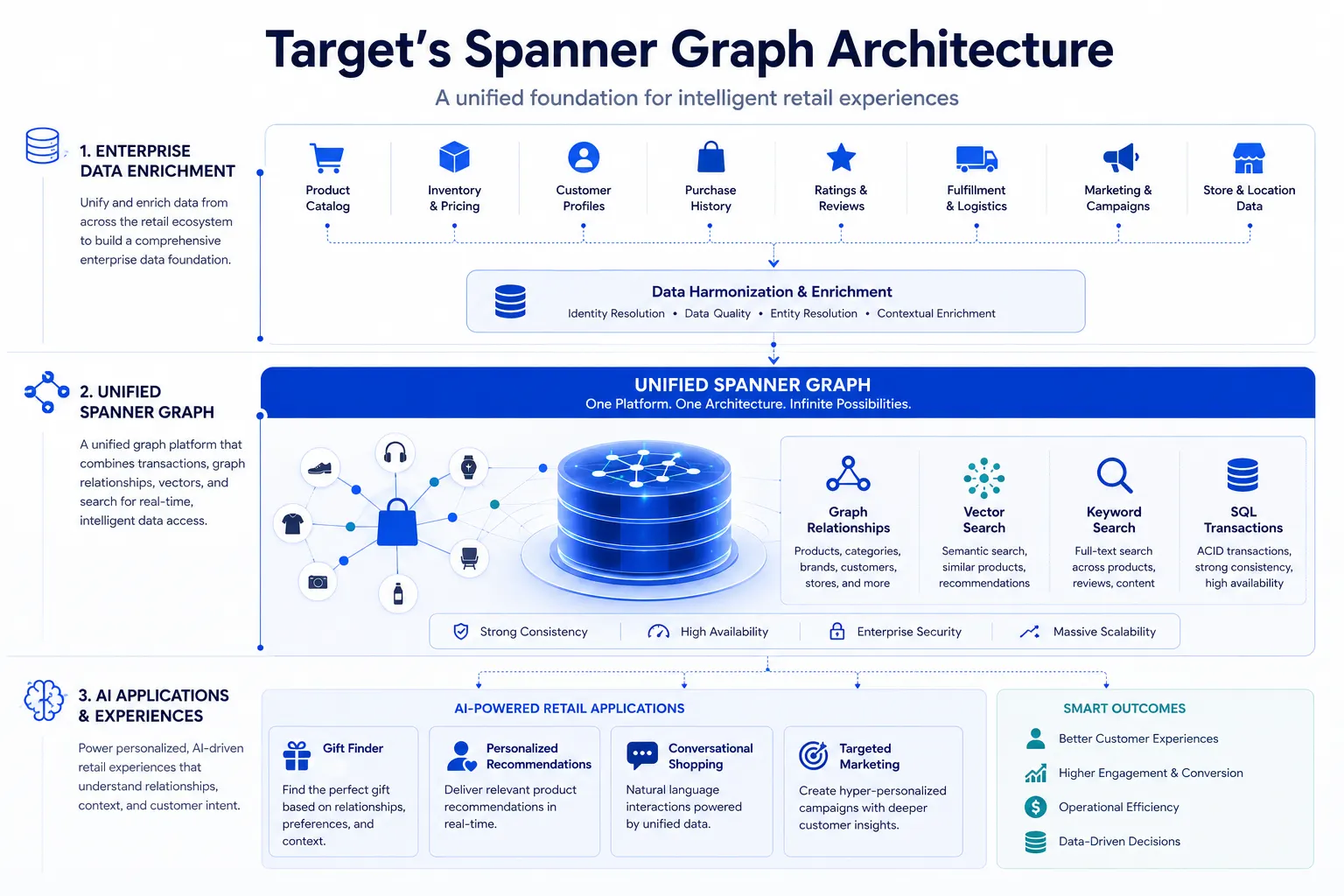
Rather than introducing additional specialized databases, Target selected Google Cloud Spanner Graph to build what it describes as an enterprise ontology: a large connected shopping graph that brings together transactional data and semantic intelligence.
This unified architecture combines:
Product relationships
Graph connections
Vector embeddings
Transactional data
Full-text search
Because these capabilities operate within the same database engine, Target can perform graph traversals, semantic searches, and SQL queries while maintaining ACID transactional consistency.
Three Core Components of the New Platform
1. Enterprise Data Enrichment
The platform aggregates retail catalog information from multiple backend systems while using generative AI to enrich product metadata and improve data quality.
2. Unified Graph, Vector, and Search Layer
Instead of moving data between specialized systems, Spanner Graph stores entities, relationships, vector embeddings, and relational data together.
This eliminates synchronization pipelines while enabling graph queries, semantic search, and keyword search from one platform.
3. AI Orchestration Layer
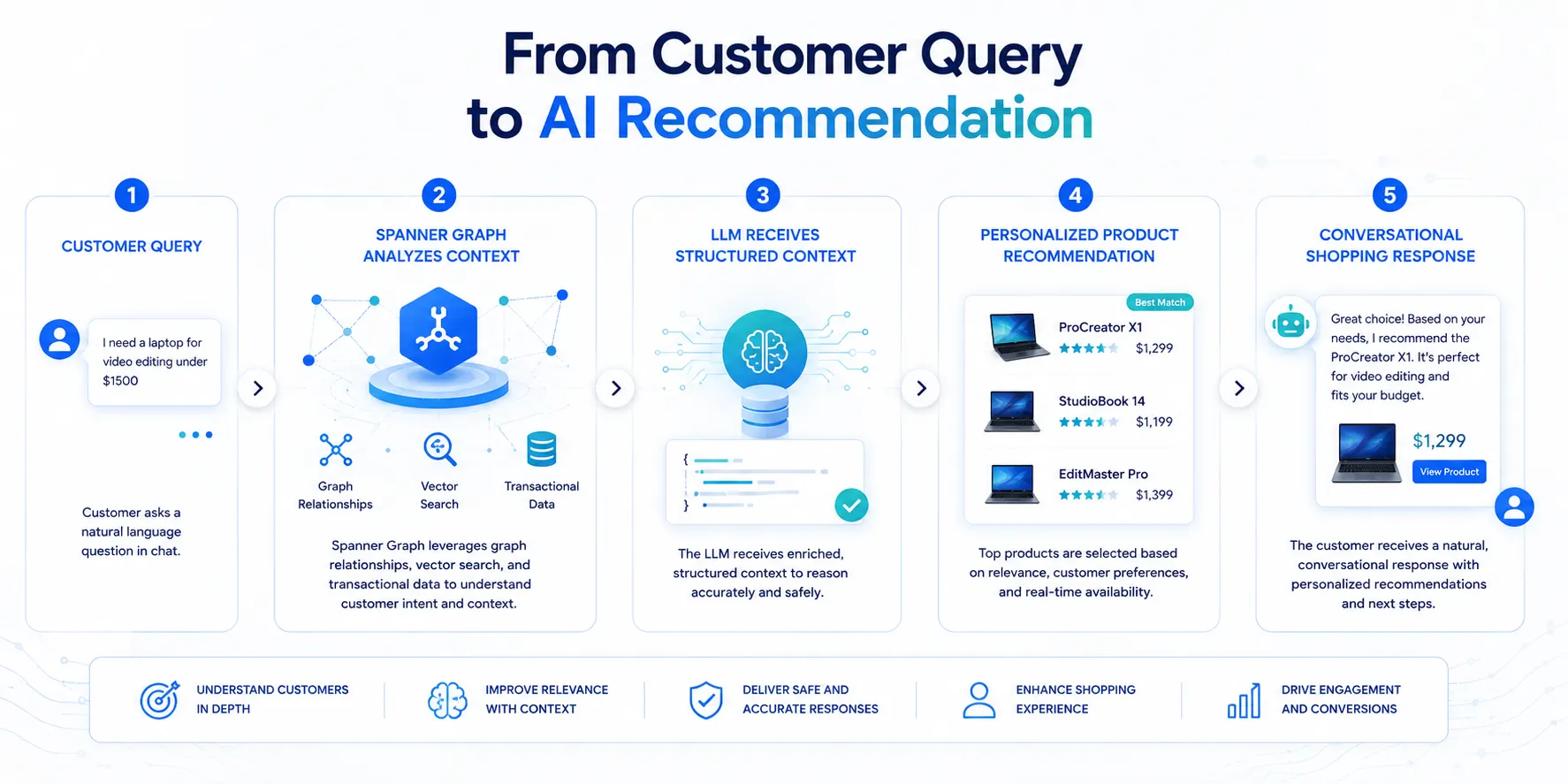
The final layer provides structured context for large language models powering conversational shopping experiences such as Target's Gift Finder.
By grounding AI responses with connected product relationships, the platform delivers more relevant recommendations while supporting responsible AI governance.
A Zero-Downtime Migration Strategy
Migrating retail infrastructure serving millions of shoppers required a gradual rollout.
Target completed the migration in four phases:
Schema and ontology mapping
Parallel data integration and replay
Canary deployment
Full production cutover and legacy system retirement
This staged approach allowed the company to validate performance and semantic accuracy before moving all production traffic to Spanner Graph.
Business Impact of the Migration
The migration delivered measurable operational improvements across both infrastructure and customer experience.
Better GraphRAG for AI Shopping
Unlike traditional Retrieval-Augmented Generation (RAG), which primarily relies on vector similarity, Target's GraphRAG approach combines semantic search with graph relationships.
This enables AI systems to understand how products relate to one another, for example, matching toys with compatible accessories or recommending products based on age suitability.
Unified SQL and Graph Queries
Developers can query relational and graph data together using SQL and Graph Query Language (GQL), reducing the need for complex ETL pipelines and duplicated datasets.
Automatic Scaling During Peak Shopping Events
Spanner automatically scales during high-demand periods such as Black Friday and Cyber Monday, allowing the platform to handle large traffic spikes without manual infrastructure management.
50% Less Database Maintenance
By replacing multiple database systems with a single managed service, Target reduced database administration and infrastructure maintenance by approximately 50%.
The reduction in operational overhead allows engineering teams to spend more time building new AI-powered customer experiences.
Why Spanner Graph Supports AI-Powered Retail
Modern retail AI depends on more than keyword matching. Recommendation engines, conversational shopping assistants, and personalized discovery experiences increasingly require databases that understand relationships between products, brands, categories, customer preferences, and shopping intent. At the same time, these systems must continue processing high-volume transactions reliably while delivering search results with low latency.
By bringing relational data, graph relationships, vector search, and full-text search together in a single managed database, Spanner Graph reduces the need for multiple specialized data systems. This unified approach provides AI applications with richer context while simplifying operations, enabling retailers to deliver more accurate recommendations and conversational shopping experiences at scale.
Conclusion
Target's adoption of Google Cloud Spanner Graph highlights how modern retailers are rethinking the data foundations behind AI-powered shopping experiences. By consolidating transactional processing, graph relationships, vector search, and full-text search into a single managed platform, the company has simplified operations while improving the infrastructure that powers personalized product discovery and conversational AI.
According to Google Cloud, the migration reduced database maintenance by 50%, allowing engineering teams to spend less time managing infrastructure and more time developing customer-facing AI capabilities. As retailers continue investing in generative AI, semantic search, and personalized shopping experiences, unified data platforms are expected to play an increasingly important role in supporting intelligent, scalable retail applications.
Source: Google Cloud Blog
About the Author