
How AI-Native Companies Are Turning Workflows Into Operating Capability
AI-native companies are moving beyond AI assistance by embedding agents into onboarding, account management, and developer workflows. Basis, Clay, and Exa show how enterprises can turn successful experiments into repeatable operating practices.
Xcademia Team
Xcademia Research Team
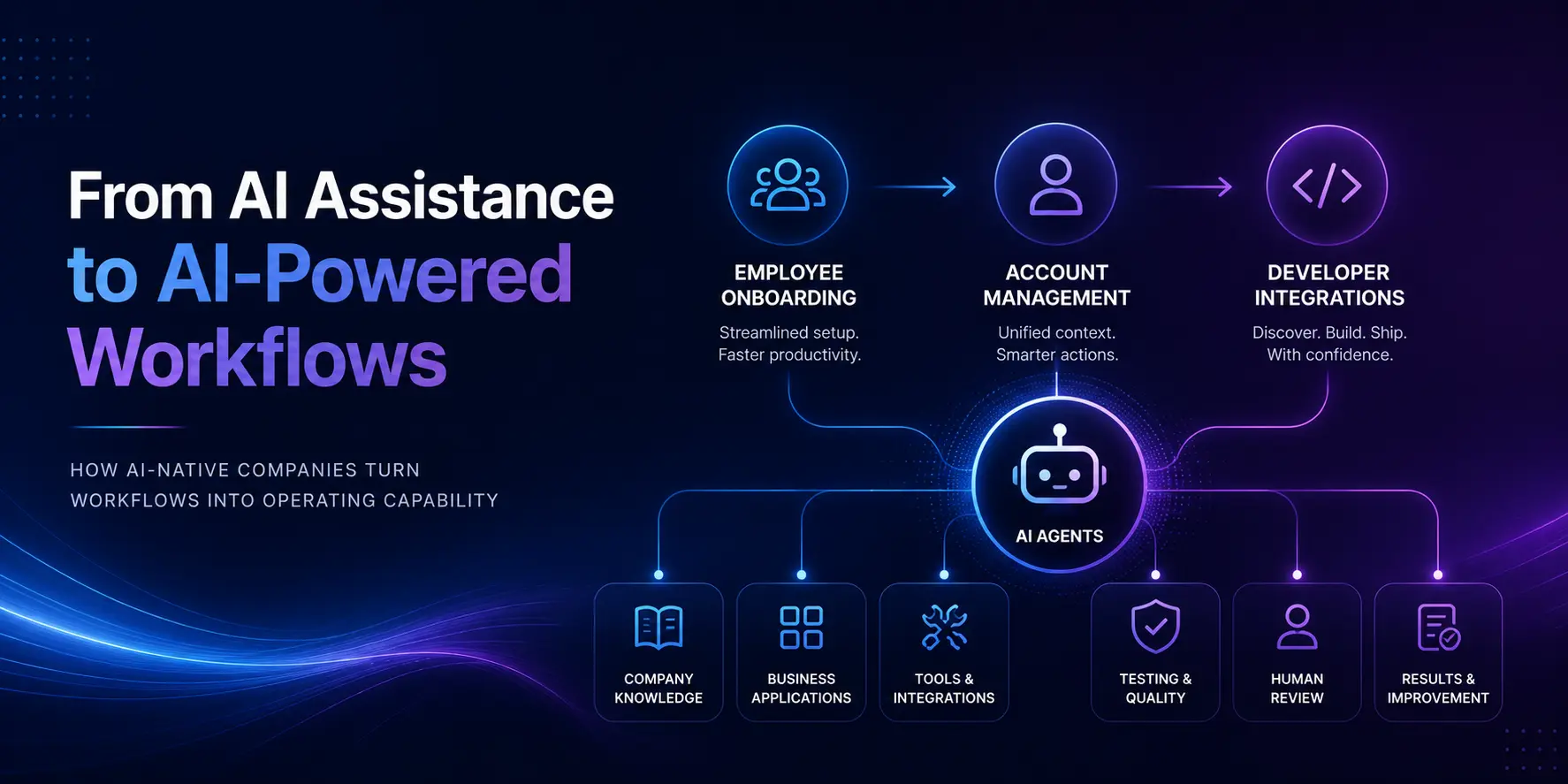
Artificial intelligence is increasingly moving from a tool employees consult to a system that can participate directly in business workflows.
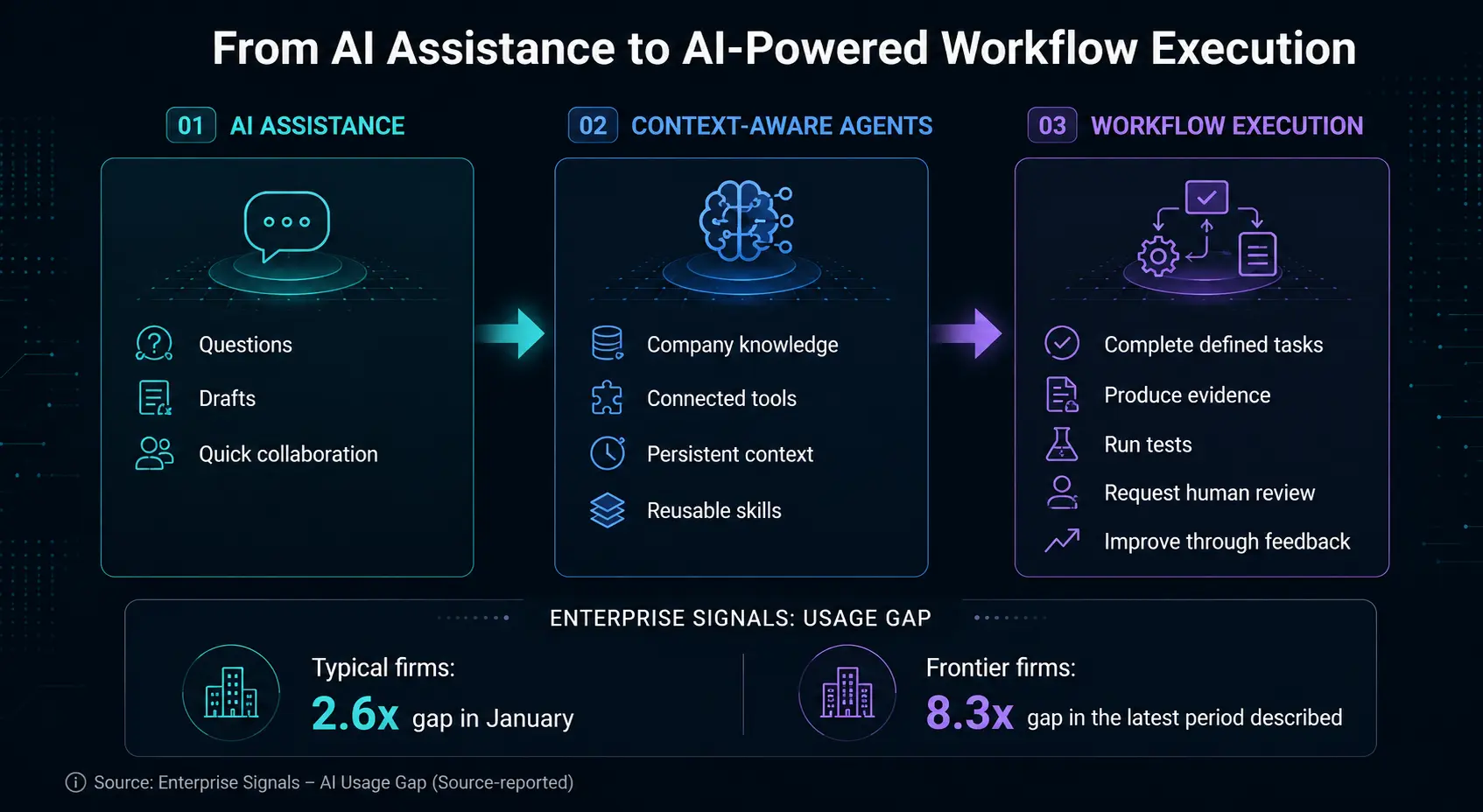
OpenAI's latest Enterprise Signals data points to a widening difference between companies that are using AI deeply and those that remain closer to basic assistance. Frontier firms, defined in the source as the top 10% of AI-using enterprises, generate 8.3 times as many output tokens per active user as typical firms, compared with 2.6 times in January. The source presents this widening gap as evidence of a broader operating shift toward connecting AI agents with company context, tools, and more substantive work.
The more important question for enterprises, however, is not simply how much AI employees use. It is whether AI-enabled workflows can become reliable, measurable, repeatable, and easier to improve.
Examples from Basis, Clay, and Exa Labs illustrate three different approaches. Basis uses agents to make employee onboarding repeatable. Clay gives account work a persistent source of context. Exa uses agents to move opportunities from discovery toward tested implementation.
Together, the examples show a progression: teach an agent a stable process, give it persistent context as the work evolves, then allow it to execute bounded tasks with tools, testing, and human review.
Basis: Turning onboarding into a reusable skill
Employee onboarding is a useful example because it combines repeatable steps with occasional exceptions.
At Basis, a company that builds AI agents for accounting firms, the source says first-day onboarding takes 30 minutes instead of two hours. New employees receive access to Codex and a company-specific onboarding skill, described as a reusable collection of instructions and resources for a particular workflow. Codex welcomes the employee, explains company concepts, and uses the computer to complete integration setup in the background.
The important part of the example is not simply that an AI system performs onboarding tasks. Basis demonstrated the process once and converted it into a reusable skill.
That skill has a defined trigger, known steps, access to appropriate tools, and a clear definition of completion. When recurring questions or exceptions emerge, HR can update the skill before the next group of employees begins onboarding.
This changes the operating model.
The workflow no longer depends entirely on one employee being available to explain the same process repeatedly. At the same time, humans remain involved when an exception or complex question requires judgment.
For enterprises, the broader lesson is that a frequently repeated process can become an opportunity for structured AI experimentation. Instead of asking an agent to perform an undefined collection of tasks, organizations can give it a clear workflow with defined inputs, actions, tools, and completion criteria.
That also creates a mechanism for improvement. Every exception can reveal where the workflow or instructions need refinement.
Clay: Giving scattered work a persistent home
Sales and account management create a different problem.
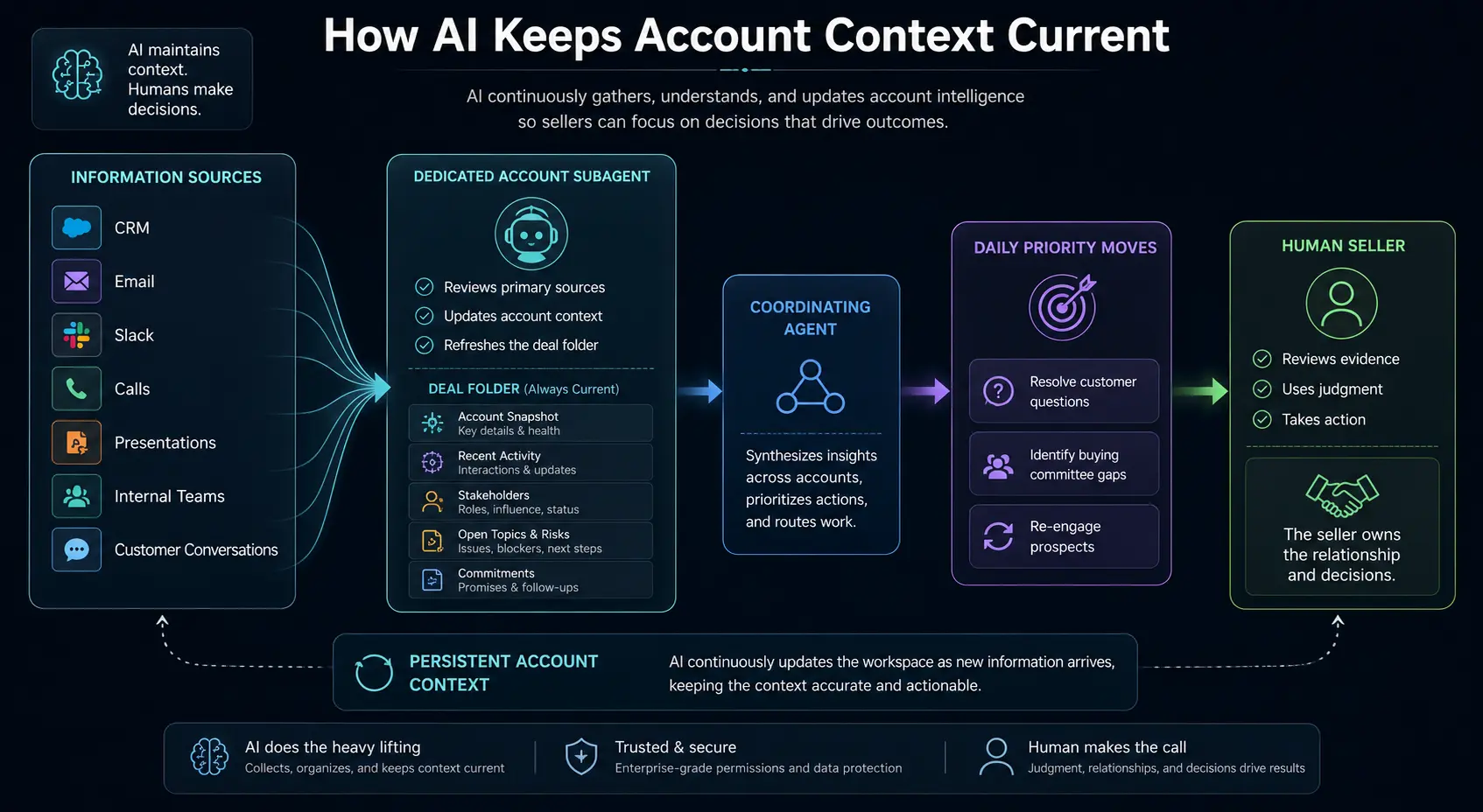
Important customer and deal information often exists across CRM systems, email, Slack, calls, presentations, text messages, and conversations with internal teams or customer champions. The challenge is not necessarily a lack of information. It is maintaining useful context as that information changes.
Clay experimented with a persistent workspace and a dedicated subagent for each account.
Each subagent reviews primary sources and updates its account folder overnight. A coordinating agent then turns those updates into a short list of priority actions for the following day.
Those actions can include answering an unresolved customer question, identifying a missing member of a buying committee, or finding a reason to re-engage with a prospect.
According to Clay, the workflow saves roughly an hour of inbox triage each night.
Another important element is evidence. Supporting information remains close to each recommendation, allowing sellers to inspect the primary sources before deciding what to do.
That creates a useful balance between automation and human judgment. The agent can organize information and identify potential actions, but the person remains responsible for deciding whether the recommendation makes sense.
The source suggests that this shared context could potentially support different members of an enterprise sales organization, subject to existing account permissions.
Clay's example highlights several requirements for AI workflows involving continuously changing information:
A consistent structure for organizing context
A defined refresh cadence
Evidence attached to recommendations
Clear access boundaries
Human judgment at the point of action
This is different from simply adding a chatbot to a sales process. The agent becomes part of an operating system for maintaining and using knowledge about an account.
Exa: Moving from opportunity discovery to tested action
Exa Labs provides another model.
The company builds web search infrastructure for AI agents and wants its search API to be available wherever developers could use it. The source describes this goal as "Exa everywhere." Previously, pursuing integration opportunities required developer relations and account teams to monitor repositories and the wider ecosystem, identify promising opportunities, collect context, and coordinate activity across different systems.
Although individual opportunities could differ, the underlying process followed a consistent sequence.
Exa turned that sequence into a defined workflow for Codex, with clear priorities, access to relevant sources, and human review before anything ships.
The resulting workflow can monitor for high-priority integration opportunities, gather context, create pull requests, run tests, and prepare weekly updates using sources including Slack and Notion. When appropriate, it can also prepare the next step, such as an initial announcement, for human review.
This creates a workflow that can carry an opportunity from an initial signal to a tested artifact.
But the human role remains explicit.
People decide which opportunities matter, what commitments the company should make, and how external relationships should be handled. Tests and review points provide visibility before work is shipped.
This is particularly important as AI systems move closer to consequential actions. The source emphasizes that permissions, evidence, and decision rights become increasingly important as workflows become more consequential.
Three patterns for building AI into operations
The Basis, Clay, and Exa examples represent different stages of workflow design.
Basis focuses on repeatability. A proven onboarding process becomes a reusable skill with defined steps and completion criteria.
Clay focuses on persistent context. An agent continuously maintains an evolving body of account information and presents relevant actions to a seller.
Exa focuses on bounded execution. An agent can take an opportunity through research, implementation, testing, and preparation for human review.
The common thread is that none of these examples treats AI as an isolated assistant.
Instead, the agent is connected to the surrounding workflow.
The source also emphasizes that improvement is built into each model. Exceptions can reveal where an onboarding skill needs refinement. New account activity and seller validation can improve account context. Tests and human review can help refine the boundaries of future execution.
This creates an operating loop:
Define the workflow → Give the agent context and tools → Execute bounded work → Review results → Improve the workflow → Repeat
That pattern may be more important than any individual AI feature because it focuses attention on how work itself is redesigned.
Six steps enterprises can use to experiment
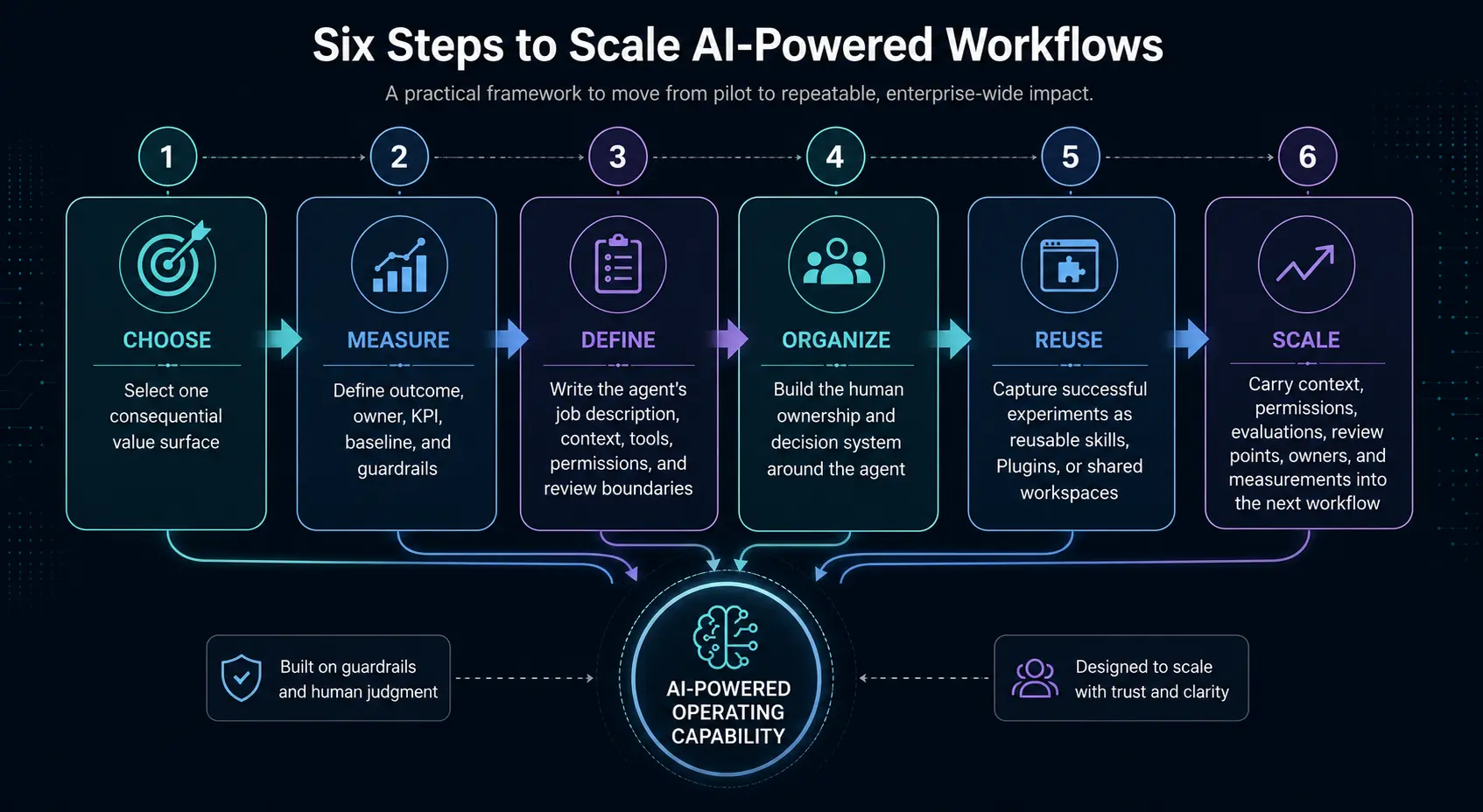
OpenAI's source proposes six steps for enterprise leaders looking to experiment with consequential AI workflows and scale successful practices.
1. Choose one consequential value surface
Start with an end-to-end workflow connected to a strategic priority.
The workflow should involve real systems, handoffs, controls, and measurable outcomes. It should happen frequently enough to provide opportunities for learning and matter enough to justify redesign.
2. Define the outcome and measurement system
Before deploying an agent, identify the accountable owner, KPI, baseline, and guardrails.
The source recommends looking beyond AI output volume. Teams can examine completed tasks, connected context and tools, exceptions, and review load.
Business value can be evaluated through measures such as cycle time, quality, cost, revenue, or risk.
The distinction matters because increased AI activity does not automatically mean improved business outcomes.
3. Write the agent's job description
An agent needs a clearly defined role.
That includes:
What triggers the work
What outcome is expected
What context is required
Which tools it can use
Which permissions it has
How persistently it should work
What evidence it must produce
Where it must stop for human review
This turns an open-ended AI capability into a bounded workflow.
4. Build the human system around the agent
People closest to the workflow should participate in its design.
Organizations need to identify who owns the business outcome, domain logic, access and controls, adoption, and daily use.
The source notes that startups can compress these responsibilities across a relatively small number of people, while enterprises need clearer decision rights as workflows expand.
5. Make experimentation visible and reusable
AI experimentation should not disappear after an individual employee discovers something useful.
The source points to research showing that six months after adoption, early-career employees sent 13 more messages per week than executives. It recommends giving employees room to test new use cases and then capturing the processes and evidence behind successful experiments.
Those successful patterns can be packaged into skills, Plugins, or shared workspaces.
The broader principle is simple: successful experimentation should become organizational knowledge rather than remaining an isolated productivity trick.
6. Carry the operating pattern forward
Once a workflow proves useful, preserve the elements that made it work.
That includes:
Context
Permissions
Evaluations
Review points
Owners
Measures
Enablement
The same operating pattern can then be applied to another business process.
Each experiment can therefore become a foundation for the next one rather than a standalone AI project.
What enterprises can take from these examples
The examples from Basis, Clay, and Exa point to a broader industry shift toward treating AI as part of how work is organized rather than simply as another software interface.
The distinction is important.
A standalone AI assistant can help an employee answer a question or create a draft. A workflow-oriented agent can operate within a defined process, use relevant context, interact with connected tools, produce evidence, and stop when human judgment is required.
That does not eliminate the need for people.
Instead, the source's examples show a division of labor becoming clearer through experimentation. Agents can handle defined and repeatable parts of a workflow, while people retain responsibility for exceptions, business decisions, commitments, and consequential actions.
For enterprises, this could mean that the most useful AI projects are not necessarily the largest or most visible ones. A narrowly defined workflow with measurable value, appropriate controls, and a clear feedback loop may provide a stronger foundation for scaling AI than an attempt to automate an entire business function at once.
The announcement highlights a broader industry shift toward making successful AI workflows repeatable organizational capabilities.
Basis shows how a demonstrated process can become a reusable skill.
Clay shows how persistent context can help agents maintain an evolving body of work.
Exa shows how tools, testing, evidence, and human review can allow agents to move from signals toward bounded execution.
The common lesson is to start with a specific job, establish clear boundaries, measure the result, and use what the organization learns to improve the next workflow.
That is how AI experimentation can begin to become operating capability.
Source: OpenAI
About the Author