
Google Introduces OKF v0.2 to Bring Trust, Verification, and Accountability to AI Knowledge
Google has introduced Open Knowledge Format (OKF) v0.2, adding trust signals, provenance tracking, verification, freshness indicators, and attested computations to enterprise AI. The update helps AI agents deliver more transparent, auditable, and trustworthy business insights.
Xcademia Team
Xcademia Research Team
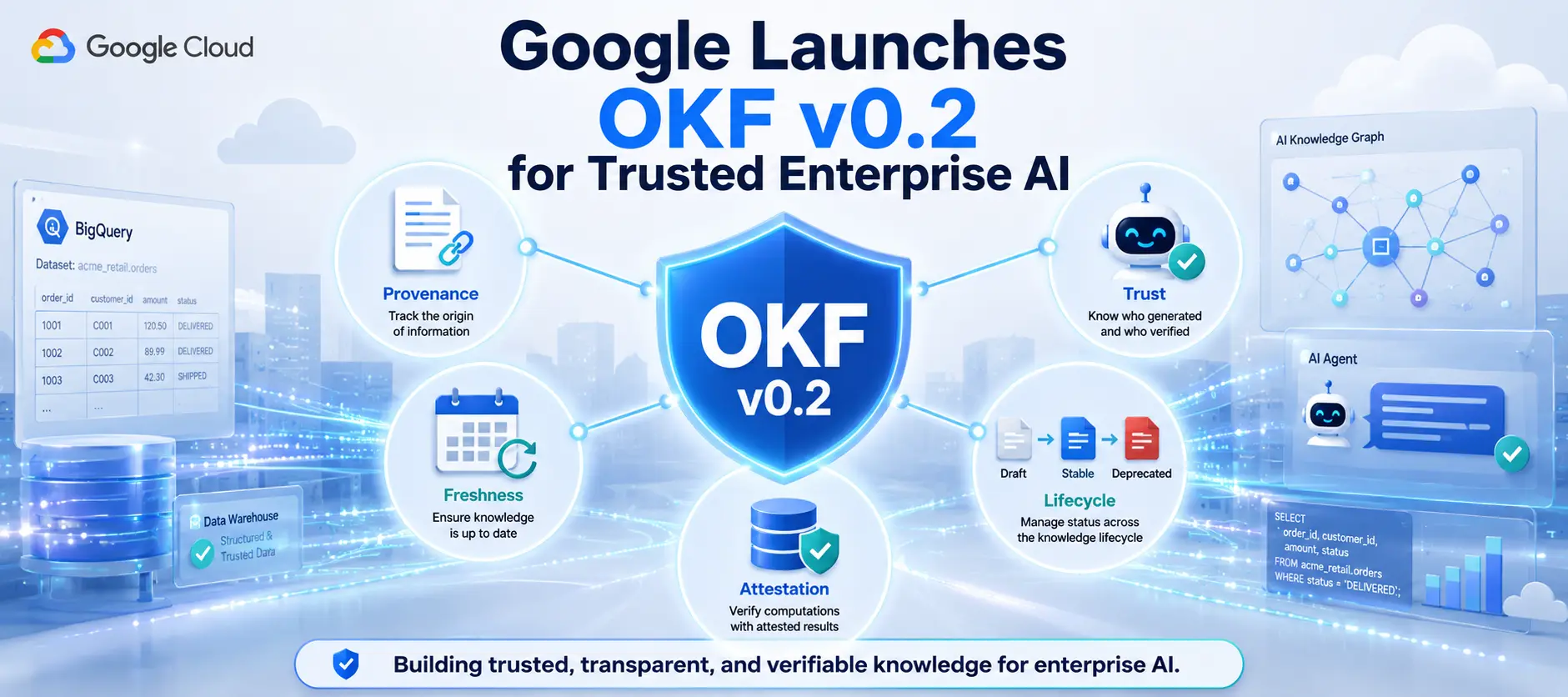
Google Introduces OKF v0.2 to Bring Trust, Verification, and Accountability to AI Knowledge
Artificial intelligence is becoming an essential part of enterprise data platforms, helping organizations answer questions, generate reports, write SQL queries, and automate business decisions. However, as AI agents increasingly generate and consume knowledge without direct human involvement, a new challenge has emerged: How can organizations trust AI-generated information?
To address this growing concern, Google Cloud has announced Open Knowledge Format (OKF) v0.2, the latest version of its open-source framework for organizing structured enterprise knowledge. Rather than focusing solely on documentation, the new release introduces mechanisms that help AI systems determine whether a piece of information is trustworthy before using it.
The update adds provenance tracking, verification records, lifecycle management, freshness indicators, and computation attestation, enabling AI agents to work with enterprise data in a far more transparent and accountable manner.
Unlike proprietary knowledge management systems, OKF continues to use a lightweight combination of Markdown and YAML frontmatter, making it simple for developers to create portable knowledge bundles while remaining compatible with existing workflows.
As organizations adopt AI-powered analytics and autonomous agents, Google believes knowledge should not only be searchable but also verifiable. OKF v0.2 represents an important step toward building AI systems that can explain where their information came from and prove that it is still accurate.
What Is Open Knowledge Format (OKF) v0.2?
Google first introduced the Open Knowledge Format (OKF) in June 2026 as an open specification for storing enterprise knowledge in a structured, AI-friendly format.
Instead of scattering important business information across spreadsheets, internal wikis, SQL files, and documentation, OKF allows organizations to organize everything into reusable knowledge bundles. These bundles can include:
Database table documentation
Business metrics
SQL computations
Company policies
AI skills and runbooks
Knowledge relationships
Verification metadata
The first version, OKF v0.1, focused on simplicity. It required only a small amount of structured metadata while allowing developers to organize knowledge using plain Markdown files.
However, as AI agents began generating thousands of knowledge assets automatically, enterprises raised an important question:
How can another AI agent know whether generated knowledge is accurate, current, and approved?
OKF v0.2 answers that question by introducing standardized trust signals that every AI system can understand.
Rather than replacing existing documentation tools, Google designed OKF as an open layer that works alongside platforms such as BigQuery, enterprise data warehouses, knowledge catalogs, and AI assistants.
This makes the format portable across organizations while avoiding vendor lock-in.
Why Google Created OKF v0.2
Modern AI assistants no longer simply retrieve information - they increasingly generate documentation, define business metrics, summarize datasets, and even create SQL queries.
While this dramatically improves productivity, it also introduces new risks.
Consider an AI agent generating thousands of data definitions overnight. Without additional context, another AI system has no way to determine:
Whether the information came from an official source
Whether a human has reviewed it
Whether company policies have changed
Whether the document is still current
Whether reported business numbers were calculated correctly
Traditional documentation assumes a human author is accountable for the content. In an AI-first environment, that assumption no longer holds true.
Google's goal with OKF v0.2 is to replace assumptions with explicit trust signals.
Instead of asking users to blindly trust AI-generated knowledge, the format provides structured metadata that allows people and AI systems to evaluate credibility before reading the document itself.
This approach is especially valuable for industries such as finance, healthcare, cybersecurity, retail, and government, where inaccurate information can lead to costly decisions.
Google also emphasises that OKF remains intentionally lightweight. The new version introduces additional vocabulary rather than strict rules, meaning organisations can adopt as many or as few of the new features as they need while maintaining compatibility with existing OKF bundles.
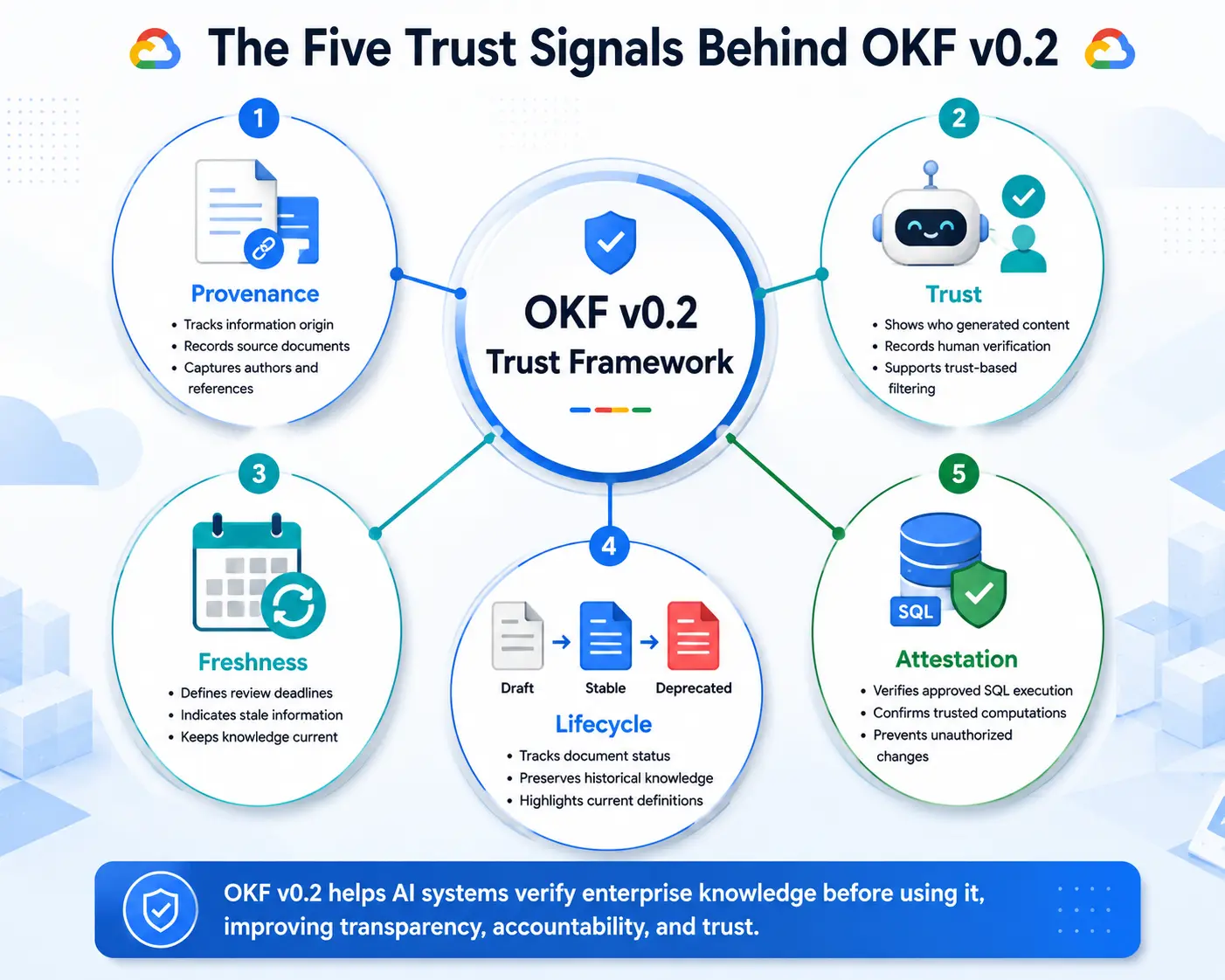
Five Trust Signals That Power OKF v0.2
One of the biggest additions in OKF v0.2 is a collection of five trust signals designed to help AI systems evaluate enterprise knowledge before using it.
Rather than relying on hidden algorithms or proprietary trust scores, Google exposes transparent metadata that any application can inspect.
1. Provenance
Every knowledge asset records where its information originated.
This includes:
Source documents
Internal policies
Database schemas
Documentation links
Original authors
Last modification dates
Instead of assigning a fixed credibility score, OKF provides objective evidence so consumers can decide how much confidence to place in the information.
2. Trust
OKF distinguishes between content generation and content verification.
For example, a document might be generated by Gemini 2.5 Pro, while a finance manager later reviews and approves it.
This separation allows organizations to identify:
AI-generated knowledge
Machine-confirmed content
Human-reviewed information
Applications can then filter results based on the desired level of trust.
3. Freshness
Enterprise knowledge changes over time.
Policies are updated.
Database schemas evolve.
Business definitions are revised.
OKF v0.2 introduces a stale_after date that tells AI systems exactly when knowledge should be reviewed again.
Rather than relying on relative timestamps, the format uses explicit review dates, making freshness checks deterministic and easy to automate.
4. Lifecycle
Not every document should remain active forever.
Some metrics become obsolete.
Legacy formulas remain useful for historical reports but should not appear in new dashboards.
OKF introduces lifecycle states such as:
Draft
Stable
Deprecated
This allows AI systems to prioritise current knowledge while preserving older definitions for auditing and historical analysis.
5. Attestation
Perhaps the most significant addition is Attested Computation.
Instead of allowing AI to generate SQL dynamically, organisations can define approved computations and verify that they were executed exactly as intended.
This prevents accidental modifications to business logic and ensures important financial metrics are always calculated using sanctioned methods.
For enterprises operating in regulated industries, this creates an auditable path from policy to computation to final result, reducing the risk of incorrect AI-generated analytics.
How Google Demonstrates OKF v0.2 with the Acme Retail Example
Understanding the concepts behind OKF v0.2 becomes much easier when looking at Google's sample project. To demonstrate how the format works in practice, Google created Acme Retail, a fictional retail company that uses BigQuery for analytics and AI-powered knowledge management.
Rather than relying on scattered documentation, spreadsheets, and SQL scripts, Acme Retail organises its business knowledge into a structured OKF bundle. Every important business asset, from datasets to financial metrics and computation rules, is stored as an individual knowledge object enriched with trust metadata.
This approach enables both humans and AI agents to discover, understand, and verify business knowledge without depending on proprietary systems.
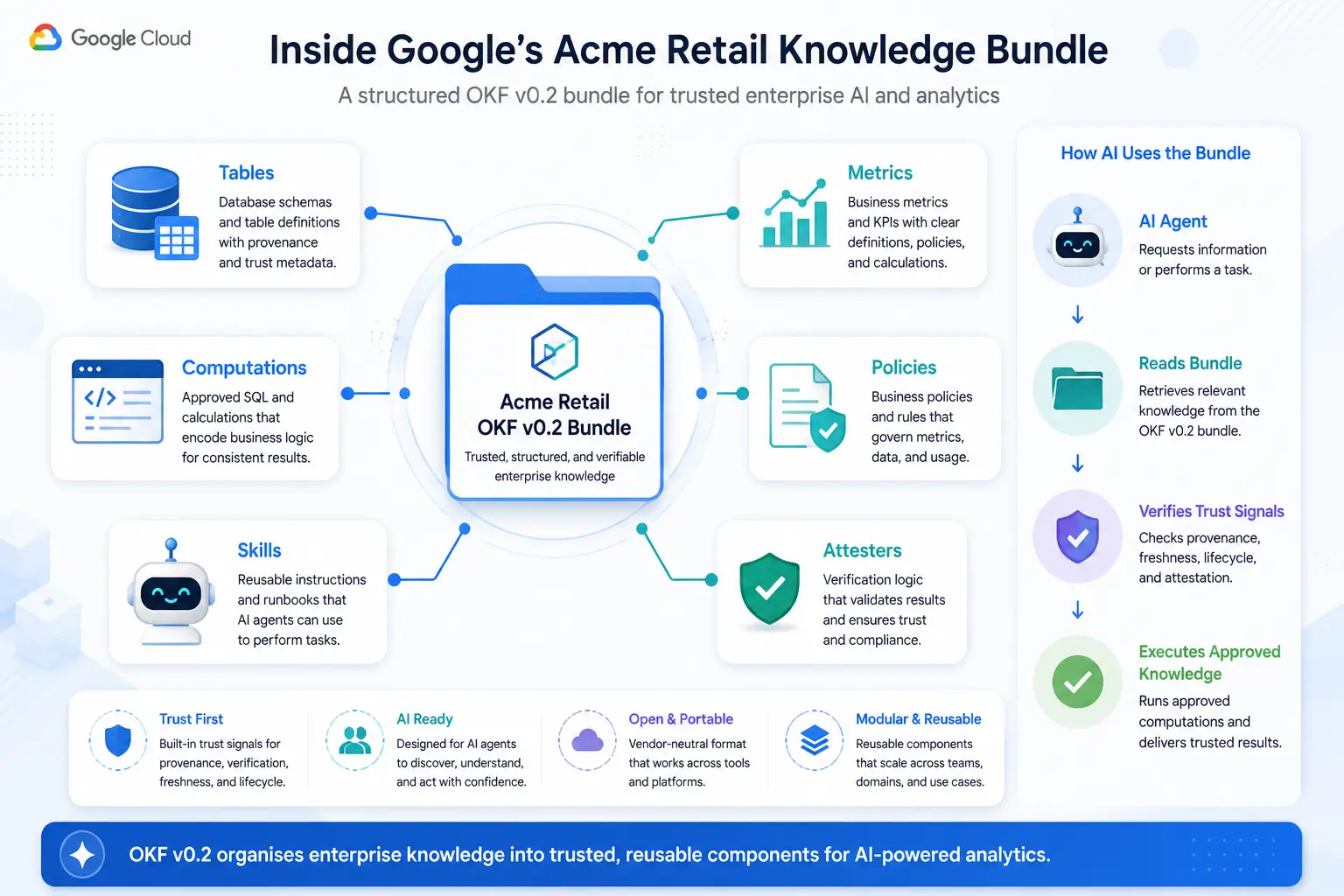
Inside the Acme Retail Knowledge Bundle
The sample bundle shows how enterprise knowledge can be organised into reusable components instead of lengthy documentation.
acme_retail/
├── index.md
├── log.md
├── tables/
│   └── orders.md
├── metrics/
│   ├── revenue.md
│   ├── gross-margin.md
│   └── gross-margin-legacy.md
├── computations/
│   ├── revenue-ytd.md
│   └── gross-margin-period.md
├── skills/
│   └── run-on-bq.md
├── attesters/
│   └── sql_equality.py
└── policies/
    └── revenue-recognition.md
Instead of treating documentation as one large collection of text, OKF separates enterprise knowledge into logical building blocks.
Each folder has a dedicated purpose.
Folder | Purpose |
|---|---|
Tables | Database schema documentation |
Metrics | Business KPIs and financial definitions |
Computations | Approved SQL and business calculations |
Policies | Company governance and finance rules |
Skills | Instructions that AI agents can execute |
Attesters | Verification logic that validates AI results |
This modular approach allows AI agents to retrieve only the information required for a task while preserving relationships between datasets, policies, computations, and business rules.
For enterprise teams managing hundreds or thousands of datasets, this creates a much cleaner knowledge architecture than traditional documentation systems.
Customer Orders: A Practical Example of Trusted Metadata
One of the best examples in Google's sample project is the Customer Orders table.
Instead of documenting only the schema, OKF enriches the table with metadata that explains who created it, where the information came from, who reviewed it, and how long it remains trustworthy.
Example Metadata
type: BigQuery Table
title: Customer Orders

generated:
  by: Gemini 2.5 Pro
verified:
  by: Human Reviewer

status: stable

stale_after: 2026-12-31
Alongside the metadata, the document also references supporting business policies and warehouse documentation.
For example:
Revenue Recognition Policy
Warehouse Sales Schema
Original data platform documentation
Internal finance policies
This means an AI assistant does not simply receive a database description.
It also understands:
where the information originated
who approved it
whether it is still current
which business policies support it
That additional context makes AI-generated answers significantly more reliable.
Why Metadata Matters for AI
Traditional documentation focuses on describing data.
OKF v0.2 focuses on describing trust.
For example, two identical revenue definitions might appear equally correct.
However, one could have been generated yesterday by an AI model without review, while another may have been reviewed by the finance department and verified against company policy.
Without trust metadata, AI cannot distinguish between them.
OKF solves this problem using structured metadata stored directly inside every knowledge object.
Instead of reading the entire document first, AI systems can evaluate trust before deciding whether to use the information.
Understanding the Trust Signals in Practice
The Acme Retail example demonstrates how every trust signal contributes to enterprise AI governance.
Provenance
Every concept records where its information originated.
Examples include:
Internal documentation
Company policies
Database schemas
Data warehouse references
This creates complete traceability from business definition back to its original source.
Trust
Each document records two separate events.
Generation
Who created the content.
For example:
Gemini 2.5 Pro
Reference Agent
Verification
Who confirmed that the content is correct.
Examples include:
Finance Manager
Data Platform Team
Human Reviewer
Separating these responsibilities allows organisations to distinguish AI-generated documentation from human-approved knowledge.
Freshness
Business rules change.
Accounting policies evolve.
Datasets receive new columns.
OKF introduces an explicit review date.
stale_after:
2026-12-31
After that date, AI systems know the knowledge should be revalidated before being trusted.
Lifecycle
Not every business definition remains active forever.
The sample project includes both current and historical revenue metrics.
Possible lifecycle states include:
Draft

↓

Stable

↓

Deprecated
Older definitions remain available for historical reporting while new AI systems automatically prioritise current versions.
Attestation
Perhaps the most important trust signal is Attestation.
Unlike documentation, attestation verifies that AI actually followed the approved business logic during execution.
Instead of allowing AI to write SQL freely, organisations define a sanctioned computation that every execution must follow.
Attested Computation: Protecting Business Logic
One of the biggest innovations in OKF v0.2 is the introduction of Attested Computation.
This feature ensures that business-critical calculations cannot be silently modified by AI.
Google demonstrates this using a revenue calculation for Acme Retail.
Instead of asking AI to generate SQL dynamically, the organisation stores an approved SQL query inside the knowledge bundle.
Only business parameters, such as the fiscal year, are supplied by AI.
The SQL itself remains protected.
This approach ensures that financial metrics are always calculated according to company policy.
How SQL Verification Works
After the SQL query executes in BigQuery, the process does not immediately trust the result.
Instead, it performs a second verification step.
The execution generates a receipt containing:
BigQuery Job ID
Executed SQL
Query Result
This receipt is then analysed by an SQL Equality Attester.
The attester compares:
Approved SQL
Executed SQL
If both queries match exactly, the computation passes verification.
If anything changes, such as:
different table names
missing JOIN statements
additional filters
modified WHERE clauses
changed business logic
the verification fails immediately.
This ensures AI cannot accidentally or intentionally alter business calculations.
For finance, healthcare, government, and regulated industries, this provides a strong foundation for trustworthy AI analytics.
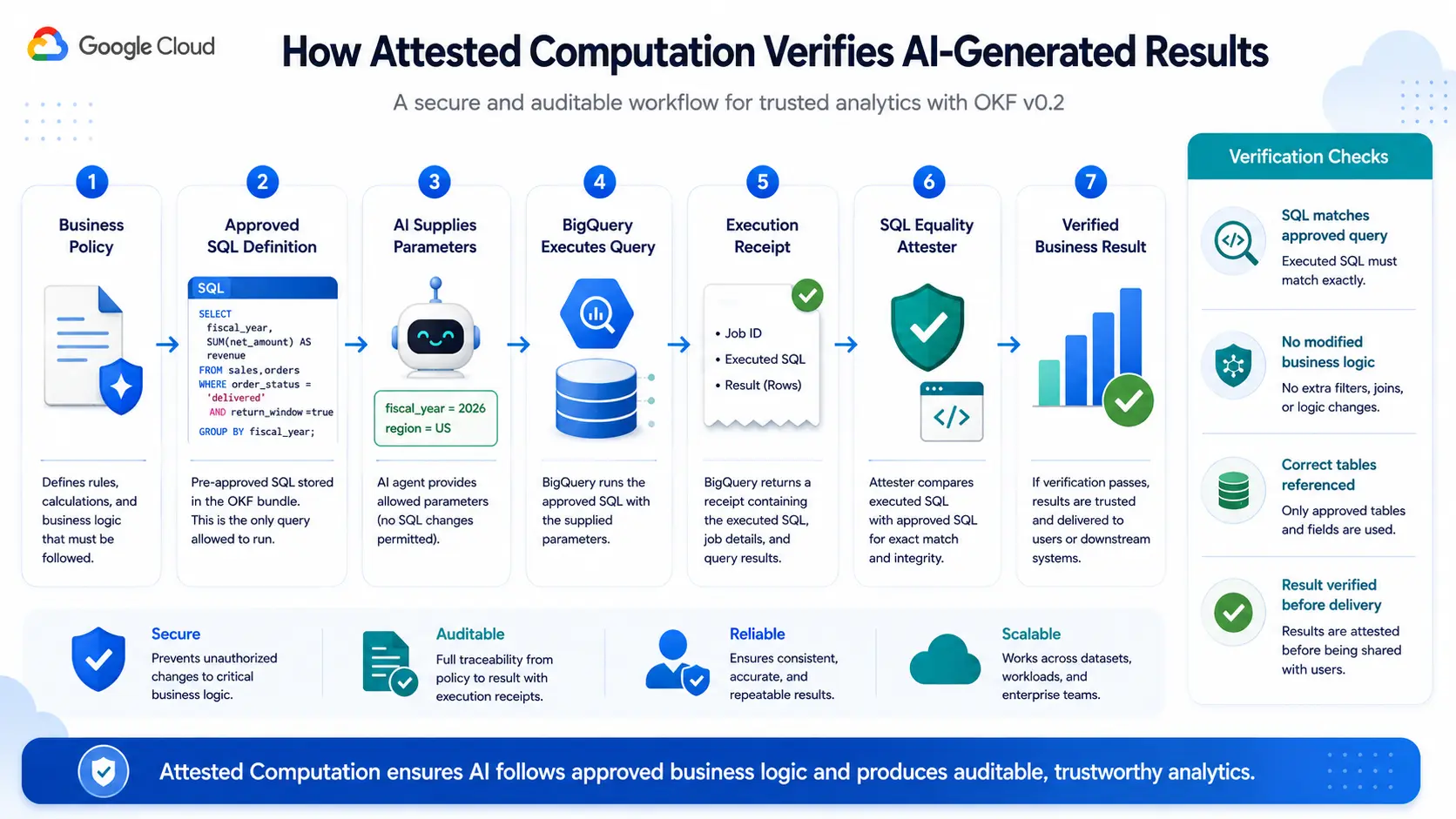
SQL Verification Workflow
Business Policy
        ↓
Approved SQL Definition
        ↓
AI Supplies Parameters
        ↓
Execute in BigQuery
        ↓
Execution Receipt
(Job ID + SQL + Result)
        ↓
SQL Equality Attester
        ↓
Verification Passed
        ↓
Trusted Business Result
This workflow separates policy, execution, and verification, ensuring every reported value can be audited.
What's New in OKF v0.2?
Open Knowledge Format (OKF) v0.2 builds on the lightweight foundation introduced in v0.1 while addressing one of the biggest challenges in enterprise AI: trust. Instead of simply describing datasets and business concepts, the new version enables AI systems to determine whether information is reliable before using it.
Google describes the release as an additive update, meaning developers can adopt the new capabilities gradually without breaking existing implementations.
Some of the most significant improvements include:
1. Provenance Tracking
Knowledge objects can now include detailed source information, such as internal documentation, company policies, database schemas, authors, and modification dates. This makes it easier to trace where information originated and verify its authenticity.
2. Trust Metadata
OKF v0.2 separates content generation from content verification. A document may be generated by an AI model but later reviewed and approved by a human expert, allowing applications to distinguish between AI-generated and human-reviewed knowledge.
3. Freshness Management
Knowledge assets can include a stale_after date, enabling organisations to automatically identify outdated information and schedule reviews. This reduces the risk of AI relying on obsolete documentation or business rules.
4. Lifecycle Status
Documents can now move through clearly defined lifecycle stages, including Draft, Stable, and Deprecated. This helps AI systems prioritise current knowledge while preserving historical definitions for reporting and compliance.
5. Attested Computation
One of the most important additions is the new Attested Computation concept. Instead of allowing AI agents to generate SQL dynamically, organisations can define approved computations and verify that they are executed exactly as intended. This creates a secure and auditable workflow for business-critical analytics.
6. Enhanced Developer Resources
Google has also updated the OKF ecosystem with:
New sample bundles, including the Acme Retail example
Updated reference implementations
A static visualiser displaying trust signals and lifecycle information
A Knowledge Catalog demonstration showing how OKF metadata can move through Google Cloud services while preserving trust information
These enhancements make it easier for developers to experiment with OKF and integrate trusted knowledge into AI-powered applications.
Compatibility with OKF v0.1
A major advantage of OKF v0.2 is that it remains fully backward compatible with version 0.1.
Google intentionally designed the release as an incremental upgrade rather than a complete redesign.
Existing OKF bundles continue to work without modification, while organisations can gradually adopt new metadata fields such as:
generatedverifiedsourcesstatusstale_after
The update also introduces two important terminology changes:
timestamp has been replaced with generated.at
The previous # Citations section is superseded by the new sources field
However, v0.2 consumers can still interpret the older format, ensuring a smooth migration path for existing projects.
This compatibility makes adoption much easier for organisations already experimenting with OKF.
Benefits for Enterprises
As enterprise AI adoption accelerates, organisations need more than intelligent assistants - they need AI systems they can trust.
OKF v0.2 addresses several common enterprise challenges.
1. Improved Data Governance
Every knowledge asset includes information about its origin, approval status, and lifecycle, making governance significantly easier.
2. Better AI Transparency
Instead of producing answers without context, AI agents can explain where information originated and whether it has been verified.
3. Reduced Hallucinations
By encouraging AI systems to retrieve trusted knowledge instead of inventing information, OKF helps reduce factual errors in enterprise workflows.
4. Stronger Compliance
Industries such as finance, healthcare, government, and cybersecurity require auditable processes. Attested Computation ensures important business metrics are calculated using approved logic.
5. Vendor-Neutral Knowledge
Because OKF is based on open standards such as Markdown and YAML, organisations avoid vendor lock-in while keeping knowledge portable across tools and platforms.
6. Easier Collaboration
Business analysts, data engineers, developers, and AI agents can all work from the same structured knowledge base, reducing inconsistencies across teams.
Future Roadmap
Google emphasises that OKF is still in its early stages, and community participation will play an important role in shaping its future.
Since the initial release, developers have already proposed several enhancements, including:
Typed relationship edges
Agent-routing hints
Additional conformance profiles
Improved ignore rules
Expanded ecosystem tooling
Google encourages developers to:
Read the OKF specification
Build knowledge producers
Create intelligent consumers
Experiment with Attested Computation
Contribute new extensions and reference implementations
The company believes that an open ecosystem will help establish OKF as a common language for trusted AI knowledge across different platforms and industries.
As AI agents continue to automate increasingly complex business tasks, trust, transparency, and verification are expected to become just as important as model performance.
Conclusion
With the release of Open Knowledge Format (OKF) v0.2, Google Cloud is taking an important step toward making enterprise AI more transparent and trustworthy. Rather than relying solely on AI-generated outputs, the new version introduces structured trust signals that help both humans and AI systems evaluate the reliability of knowledge before acting on it.
Features such as provenance tracking, verification metadata, lifecycle management, freshness indicators, and Attested Computation provide organisations with the tools needed to build AI systems that are not only intelligent but also accountable.
The fictional Acme Retail example demonstrates how these capabilities can be applied in real-world enterprise environments, showing how datasets, business metrics, policies, and approved SQL computations can work together within a trusted knowledge framework.
As organisations continue integrating AI into analytics, governance, and decision-making, standards like OKF could become an essential foundation for ensuring that enterprise knowledge remains accurate, verifiable, and ready for the next generation of AI agents.
Source: Google Cloud Blog
About the Author