Google Cloud Named a Leader in 2026 Gartner Magic Quadrant for Cloud-Native Application Platforms
Google Cloud says it has been recognized as a Leader in Gartner's 2026 Magic Quadrant for Cloud-Native Application Platforms for the third consecutive year, highlighting cloud-native development and AI agent capabilities.
Xcademia Team
Xcademia Research Team
Google Cloud Named a Leader in 2026 Gartner Magic Quadrant for Cloud-Native Application Platforms
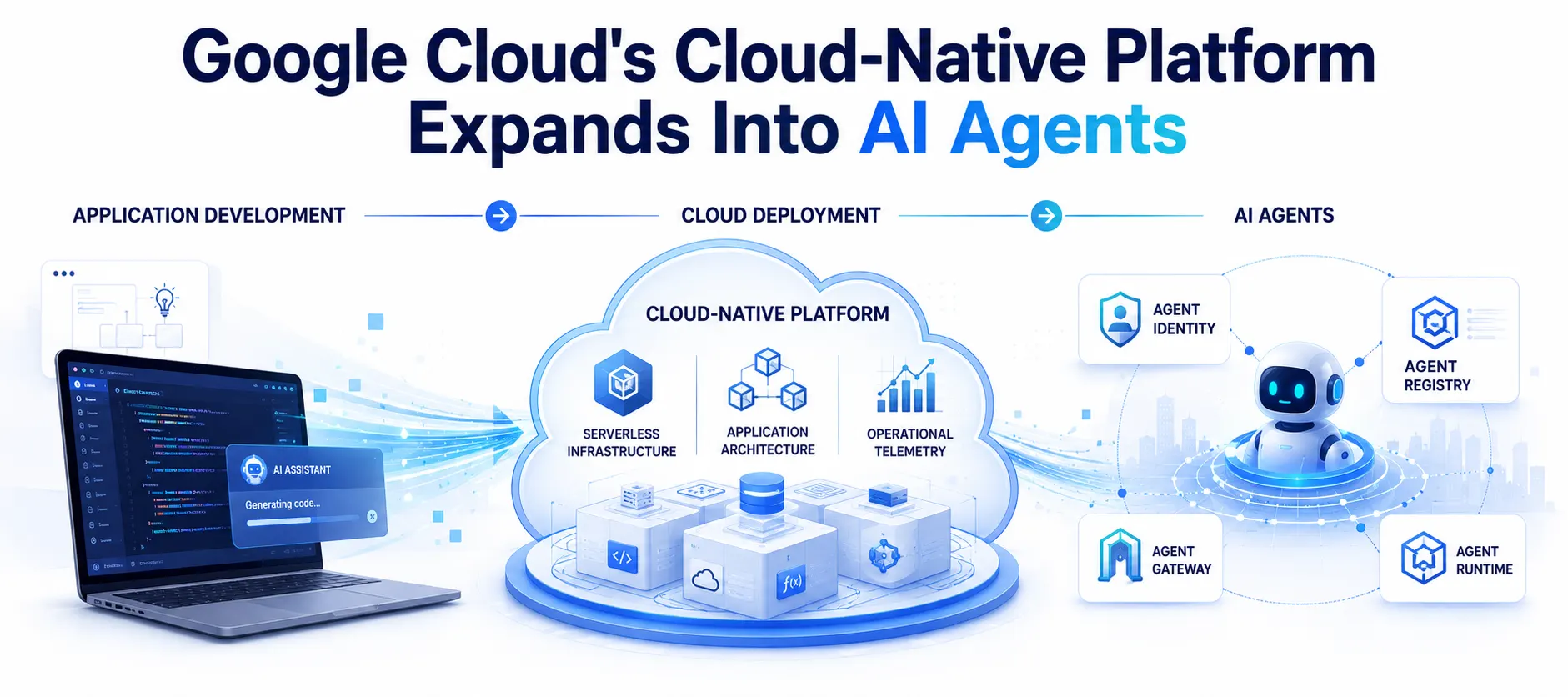
Google Cloud says it has been recognized as a Leader in the 2026 Gartner Magic Quadrant for Cloud-Native Application Platforms (CNAP), marking the third consecutive year the company says it has received the Leader designation.
In an announcement published August 21, 2026, Google Cloud outlined its application-centric cloud strategy, covering serverless and containerized applications alongside emerging agentic workloads.
The company says its platform is designed to reduce infrastructure complexity while helping developers move from application ideas and prototypes toward production deployments and AI agent workloads.
The capabilities highlighted in the announcement span application development, architecture, deployment, operations, cost management, reliability and AI agent infrastructure.
The Gartner recognition should also be viewed in context. Gartner states that its Magic Quadrant research represents the opinions of its research organization and should be evaluated alongside the complete research document. Gartner also says it does not endorse companies, vendors, products or services depicted in its publications.
From Application Ideas to Cloud Deployment
Google Cloud's platform strategy centers on what it describes as an application-centric cloud.
The approach is intended to let developers focus on writing code and building applications or agents while reducing the infrastructure complexity they need to manage directly.
The announcement describes support for several application models, including:
Serverless applications
Containerized applications
Traditional enterprise applications
AI-powered applications
Agentic workloads
Google Cloud presents this approach as a way to support applications throughout their lifecycle, from initial experimentation through enterprise deployment.
AI-Assisted Prototyping With Google AI Studio
Generative AI is changing how developers can approach application prototyping.
Google Cloud says it is integrating its serverless infrastructure with AI-assisted prototyping and "vibe coding" tools to make the transition from an idea to a deployed application more direct.
One example is Google AI Studio. The company says developers can build and deploy full-stack applications within AI Studio and publish those applications to Cloud Run with a single click.
Google Cloud also highlights managed Model Context Protocol servers and agentic skills as ways to give AI systems access to packaged instructions, scripts and resources for specialized workflows.
The emphasis is on reducing friction between experimentation and cloud deployment.
Google-Managed MCP Servers Connect Agents to Cloud Resources
Google Cloud says it provides official, fully managed remote Model Context Protocol (MCP) servers that allow AI agents to interact with cloud resources.
The announcement uses the Cloud Run MCP server as an example. Google says the server can allow developers to launch endpoints and deploy server-side logic through a simplified configuration process.
The company also says its managed MCP servers integrate with:
Identity and Access Management (IAM)
VPC Service Controls
Model Armor
Google Cloud positions these integrations as part of its approach to connecting AI agents with cloud resources while applying existing security and access controls.
Google's Skills Repository Adds Cloud Expertise for Agents
Google Cloud also highlights its official Skills Repository, which provides condensed expertise for Google Cloud technologies.
The company says the repository is published and available through Agent Registry and includes skills for Cloud Run and the Well-Architected Pillar, covering areas such as security, reliability and cost optimization.
These skills are packaged instructions, scripts and resources intended to help AI systems complete specialized, multi-step workflows.
Moving From Prototypes to Enterprise Applications
Google Cloud's platform strategy extends beyond prototyping.
The company describes a broader set of developer, architecture and platform engineering capabilities intended to help teams build, operate and deploy applications throughout their lifecycle.
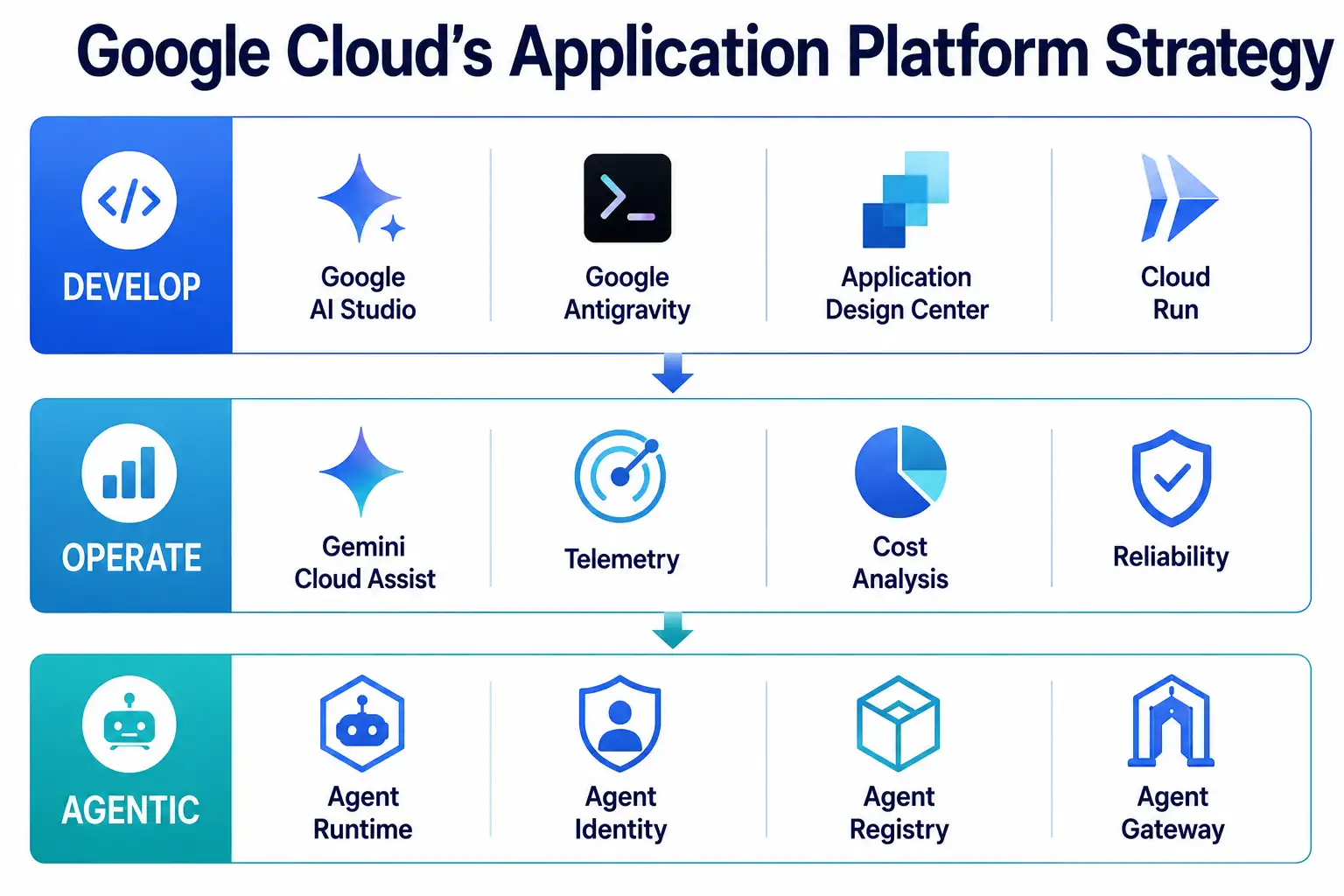
Google groups these capabilities around three broad areas:
Build
Operate
Deploy
Building Applications With Google Antigravity and Application Design Center
Google Cloud highlights Google Antigravity as part of its development ecosystem.
The company describes Antigravity as a unified orchestration layer that brings multi-step AI reasoning into developer workflows and connects local codebase development with cloud-native application platforms such as Cloud Run.
Google Cloud also highlights Application Design Center (ADC).
ADC is designed to help platform engineering teams design, standardize and deploy template-driven applications on Google Cloud while reducing the need for manual Terraform and YAML configuration.
The announcement says ADC can be used to visually design architectures involving:
Cloud Run services
Databases
Event brokers
Google Cloud also says ADC is integrated with Gemini Cloud Assist and published as an MCP server.
The company describes programmatic orchestration as another capability, allowing policy-governed Terraform configurations to be provisioned through automated workflows.
AI-Assisted Operations With Gemini Cloud Assist
Google Cloud is also incorporating AI into application operations.
The announcement describes Gemini Cloud Assist as an AI-driven framework for investigating day-two incidents using native telemetry.
When alerts occur, Google says operators can use Gemini Cloud Assist to synthesize logs and metrics, identify potential root causes and generate remediation suggestions.
Google says IAM permissions govern the AI recommendations and that human approval is required before infrastructure changes are made.
The capability is therefore presented as AI-assisted operations with human oversight rather than unrestricted autonomous infrastructure modification.
Cost Analysis and Optimization
Google Cloud also highlights machine learning-based cost analysis.
The company says its algorithms can learn seasonal traffic patterns and detect cost anomalies, triggering notifications when unusual cost behavior is identified.
The announcement does not provide specific savings figures for this capability.
Additional details were not disclosed in the announcement.
Cloud Run Supports Multi-Region Deployment
Google Cloud also highlights Cloud Run's reliability and deployment capabilities.
Cloud Run is a regional service by default, but Google says applications can be deployed across multiple regions using a single gcloud command.
The announcement says Cloud Run can integrate with service health capabilities to support cross-region failover and failback.
According to Google, when a service in one region becomes unhealthy, traffic can automatically be routed to another healthy region and later returned when the original service recovers.
An Open Approach to Cloud-Native Applications
Google Cloud also emphasizes its involvement with the Cloud Native Computing Foundation (CNCF) and describes its strategy as open-source-first.
The company says integrating community-driven technologies is intended to help support application portability for enterprise customers seeking multi-cloud flexibility.
The announcement does not claim that applications can automatically move between cloud providers without modification.
Google Cloud Expands Its Focus to Autonomous AI Agents
A major section of Google's announcement focuses on AI agents.
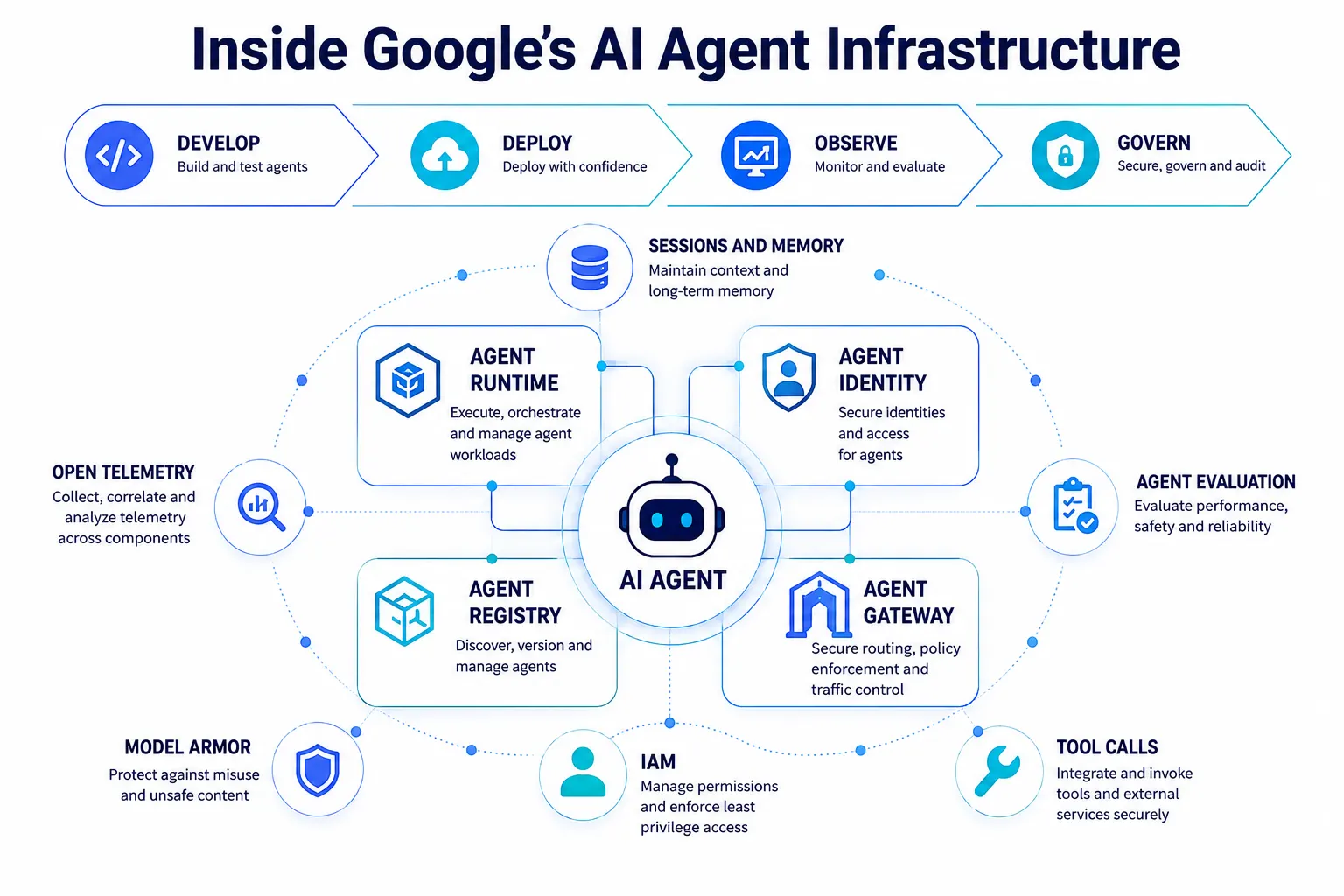
The company describes agents as a new frontier for software and outlines a dedicated infrastructure stack intended to host, govern and secure autonomous agent fleets.
Google says this infrastructure integrates with its Agent Development Kit (ADK) and other agentic frameworks.
At the center of this approach is the Gemini Enterprise Agent Platform and its dedicated Agent Runtime.
Gemini Enterprise Agent Runtime
Google says Agent Runtime provides serverless and containerized deployment options for enterprise agent development.
The announcement highlights several capabilities.
Native Personalization
Google says built-in sessions and memory banks can manage context and long-term state for agents.
Agent Observability and Tracing
The platform uses OpenTelemetry standards and agentic schemas.
Google says its dashboards provide agent topology graphs and interactive trace logs covering areas such as:
Agent topology
Sessions
Tool calls
Reasoning paths
Agent Evaluation and Simulation
Google also highlights automated simulation tools.
The company says these tools can test agents against golden sets and simulate thousands of interactions to examine potential edge cases.
Cloud Run as an Agent Hosting Option
Google says organizations requiring additional flexibility, control or specific regulatory considerations can also use Cloud Run to host agents.
The announcement highlights two capabilities.
Cloud Run Instances
Google describes Cloud Run instances as a coming soon capability.
The company says this feature will manage individual, addressable, long-running singleton resources and support integrated Cloud Storage volume mounts.
Because Google identifies this capability as coming soon, it should not be presented as generally available.
Cloud Run Sandboxes
Google also highlights Cloud Run sandboxes.
The company says these provide hard-isolated environments for executing untrusted, model-generated code and can start in under 500 milliseconds.
Agent Security, Governance and Auditability
As organizations deploy AI agents, controlling their identities, permissions and interactions becomes an important part of managing agent workloads.
Google Cloud highlights three components of its governance approach.
Agent Identity
Google describes Agent Identity as non-human IAM using cryptographic IDs.
The company says this provides an auditable trail of agent actions and reasoning.
Agent Registry
The centralized Agent Registry is designed to manage approved agents, skills, tools and application artifacts.
Agent Gateway
The Agent Gateway is designed to proxy traffic, enforce Model Armor policies and block destructive actions.
Google says these capabilities are available on Agent Runtime today and will become available on Cloud Run and Google Kubernetes Engine in the future.
What the Gartner Recognition Means
Google Cloud says its 2026 recognition validates its focus on developer accessibility, application development and support for modern workloads.
The company also says this is the third consecutive year it has been recognized as a Leader.
However, the recognition should not be interpreted as Gartner endorsing Google Cloud or recommending it as the best platform for every organization.
Gartner's own disclaimer states that the organization does not endorse companies, vendors, products or services depicted in its publications and does not advise technology users to select only vendors receiving the highest ratings or designations.
Gartner also states that its publications represent the opinions of its research organization and should not be construed as statements of fact.
The Gartner research cited by Google is:
"Magic Quadrant for Cloud-Native Application Platforms"
By Mukul Saha, Alex Coqueiro, Prasanna Lakshmi Narasimha and Richard Watson
August 3, 2026
Organizations evaluating cloud-native application platforms should therefore consider the complete Gartner research alongside their own technical, regulatory, security, cost and operational requirements.
What Google Cloud Is Building Around the Application Lifecycle
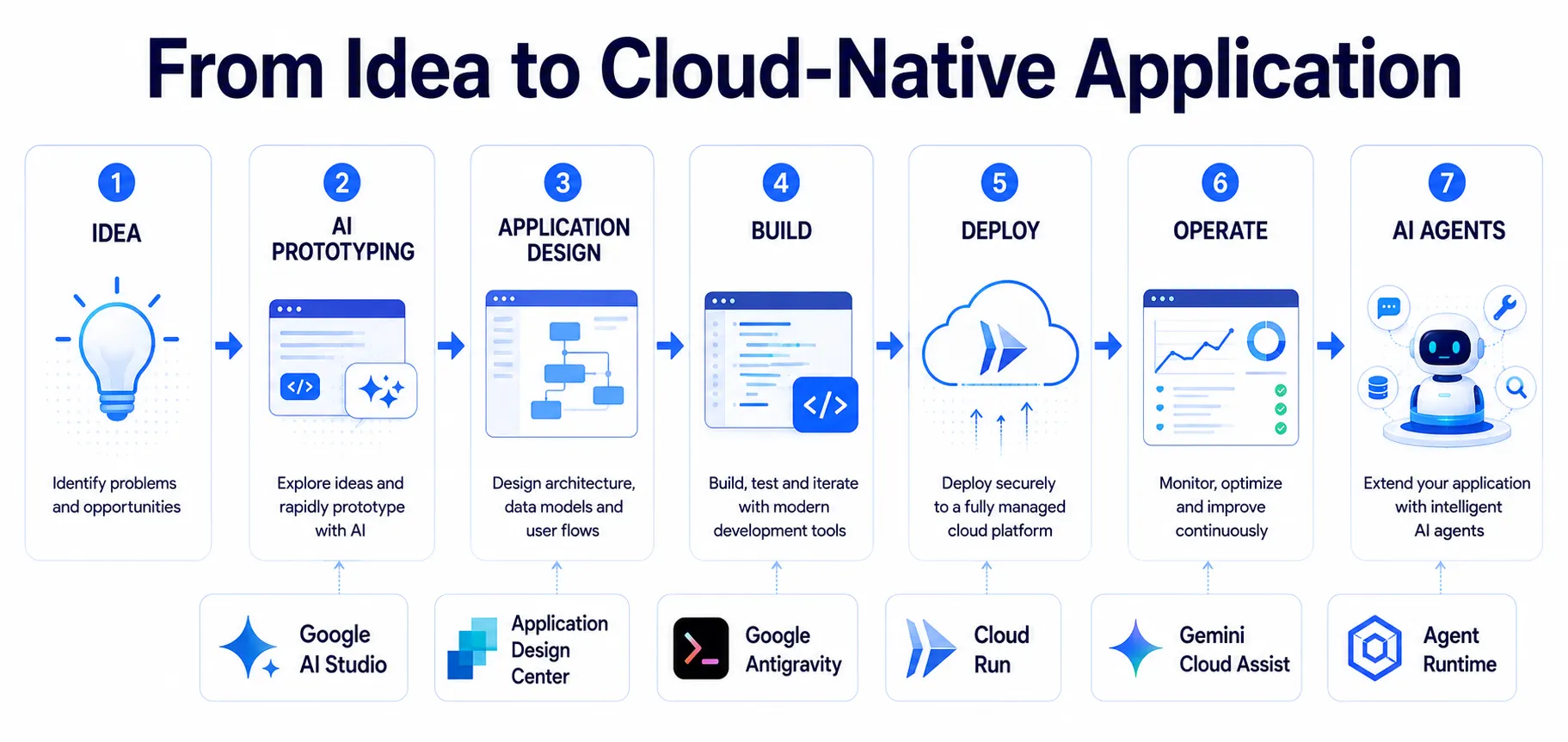
Taken together, the announcement presents Google's application platform strategy as a connected lifecycle:
Idea
↓
AI-Assisted Prototyping
↓
Application Design
↓
Build
↓
Deployment
↓
Operations and Cost Management
↓
AI Agent Deployment
↓
Agent Governance and Security
This progression illustrates how Google Cloud is positioning cloud-native infrastructure alongside AI-assisted development and dedicated agent infrastructure.
This is Google's platform strategy as described in the announcement, rather than a Gartner finding.
Why This Matters for Enterprise Developers
The announcement highlights a broader industry shift toward cloud platforms that combine traditional application development with AI-assisted development and agent infrastructure.
For developers, Google's approach brings prototyping and cloud deployment closer together through tools such as Google AI Studio and Cloud Run.
For platform engineering teams, Application Design Center emphasizes standardized application architectures and infrastructure governance.
For operations teams, Gemini Cloud Assist introduces AI-assisted investigation and remediation workflows based on application telemetry.
For organizations developing AI agents, Google's approach adds dedicated infrastructure for deployment, observability, identity, registry management and traffic governance.
These are editorial implications of the capabilities described in Google's announcement. They should not be interpreted as Gartner findings unless explicitly stated in the Gartner research.
Google Cloud's Cloud-Native Platform Direction at a Glance
Area | Google Cloud capability highlighted |
|---|---|
AI prototyping | Google AI Studio |
AI development | Google Antigravity |
Application design | Application Design Center |
Serverless deployment | Cloud Run |
AI-assisted operations | Gemini Cloud Assist |
Agent deployment | Gemini Enterprise Agent Runtime |
Agent identity | Agent Identity |
Agent governance | Agent Registry |
Agent traffic control | Agent Gateway |
Agent security | Model Armor |
Application portability | Open-source and CNCF technologies |
Outlook
Google Cloud's announcement shows how cloud-native application platforms are expanding beyond traditional application deployment.
The platform capabilities described by the company span AI-assisted prototyping, application architecture, serverless deployment, operational assistance and dedicated infrastructure for AI agents.
One of the most notable themes is the positioning of agent workloads alongside traditional enterprise applications within a broader cloud platform strategy.
For organizations evaluating cloud-native platforms, the decision increasingly involves more than where applications run. It also involves how development workflows, infrastructure management, AI agents, identity, observability and governance fit together.
The Gartner recognition provides an external industry evaluation, while the product capabilities and positioning discussed throughout this article come from Google's own announcement.
Source: Google Cloud Blog
About the Author