
Google Cloud Named a Critical Third Party to Strengthen U.K. Financial Sector Resilience
Google Cloud has been designated as a Critical Third Party (CTP) by the U.K. Treasury, bringing direct oversight from financial regulators and reinforcing operational resilience for banks, insurers, and financial institutions relying on cloud services.
Xcademia Team
Xcademia Research Team

Google Cloud's Expanding Role in Financial Services
The financial services industry is becoming increasingly dependent on cloud computing to power digital banking, payment systems, investment platforms, fraud detection, artificial intelligence, and regulatory compliance. As cloud adoption accelerates, ensuring the resilience and stability of the infrastructure supporting these services has become a national priority.
In a significant development for the United Kingdom's financial ecosystem, the U.K. Treasury has officially designated Google Cloud EMEA as a Critical Third Party (CTP) under the country's Critical Third Party regime.
The designation reflects the growing importance of Google Cloud services across U.K. financial institutions and introduces direct regulatory oversight from the country's leading financial authorities. More importantly, it represents a broader effort to strengthen operational resilience across the financial sector while enabling continued innovation in cloud computing and artificial intelligence.
This milestone reinforces Google's commitment to building secure, resilient, and trustworthy cloud infrastructure for one of the world's most regulated industries.
A New Milestone for Google Cloud
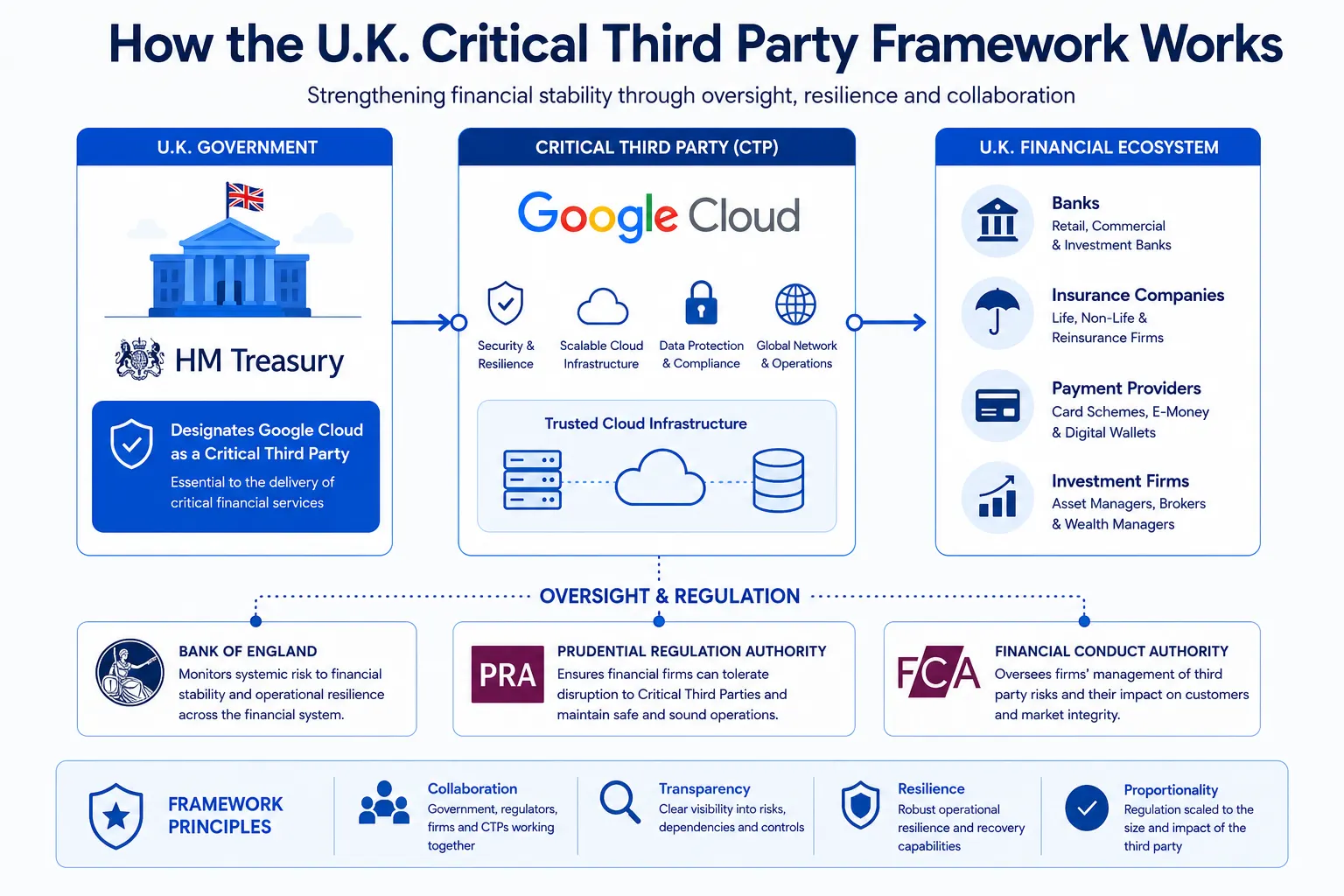
On July 10, 2026, the U.K. Treasury formally designated Google Cloud EMEA as a Critical Third Party to the U.K. financial sector.
The designation recognizes both:
The large number of financial institutions using Google Cloud
The critical nature of workloads running on Google's infrastructure
Rather than focusing on a single organization, the designation reflects the systemic importance of cloud providers whose services support multiple financial institutions simultaneously.
As financial services increasingly migrate mission-critical systems to cloud environments, regulators are placing greater emphasis on ensuring that these infrastructure providers maintain exceptional levels of resilience, security, transparency, and operational reliability.
Google Cloud stated that it welcomes the designation and views operational resilience as a foundation for responsible innovation.
What Is a Critical Third Party?
Modern financial institutions depend heavily on external technology providers.
Instead of operating every IT system internally, banks increasingly rely on cloud providers for:
Core infrastructure
Data storage
Disaster recovery
Artificial intelligence
Data analytics
Identity management
Cybersecurity
High-performance computing
Because many organizations rely on the same cloud provider, a significant outage or cyber incident could affect multiple financial institutions simultaneously.
The Critical Third Party regime was created to address this systemic risk.
Rather than regulating individual banks alone, U.K. regulators can now directly oversee cloud providers whose services are considered essential to financial stability.
This creates an additional layer of protection for the broader financial system.
Direct Oversight from U.K. Financial Regulators
Following the designation, Google Cloud EMEA will now be directly overseen by three major U.K. financial regulators:
Bank of England (BoE)
The Bank of England is responsible for maintaining financial stability and ensuring the resilience of the nation's financial infrastructure.
Its oversight helps ensure that critical technology providers maintain operational continuity during major disruptions.
Prudential Regulation Authority (PRA)
The PRA focuses on ensuring the safety and soundness of financial institutions.
It also oversees resilience requirements designed to reduce operational risks across banking and insurance sectors.
Financial Conduct Authority (FCA)
The FCA regulates financial markets and promotes consumer protection while ensuring market integrity.
Its oversight extends to operational resilience that protects financial services customers.
Together, these regulators will oversee Google Cloud under the Critical Third Party framework to strengthen resilience across the financial ecosystem.
Why Operational Resilience Matters More Than Ever
Digital transformation has fundamentally changed financial services.
Today's banking systems rely on:
Cloud-native applications
AI-powered fraud detection
Real-time payment processing
Digital identity verification
Customer analytics
Open banking platforms
Machine learning
API-driven ecosystems
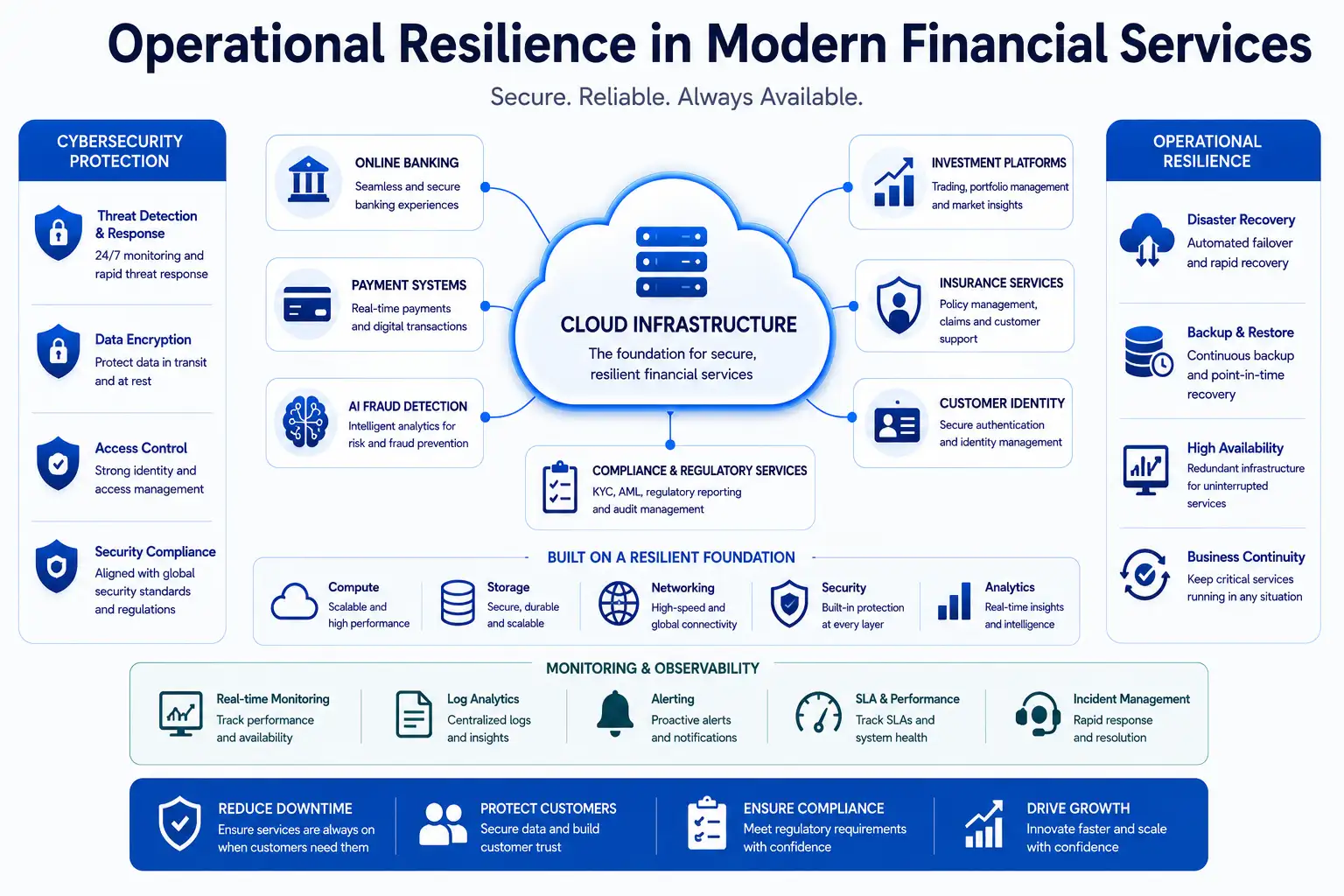
As organizations modernize these services, operational resilience becomes increasingly important.
Operational resilience means ensuring that essential services remain available even during:
Cyberattacks
Infrastructure failures
Natural disasters
Software outages
Hardware failures
Human error
Google Cloud has emphasized that resilience is not only about avoiding outages but also about maintaining confidence in the financial system during unexpected events.
How Cloud Computing Became the Backbone of Modern Financial Services
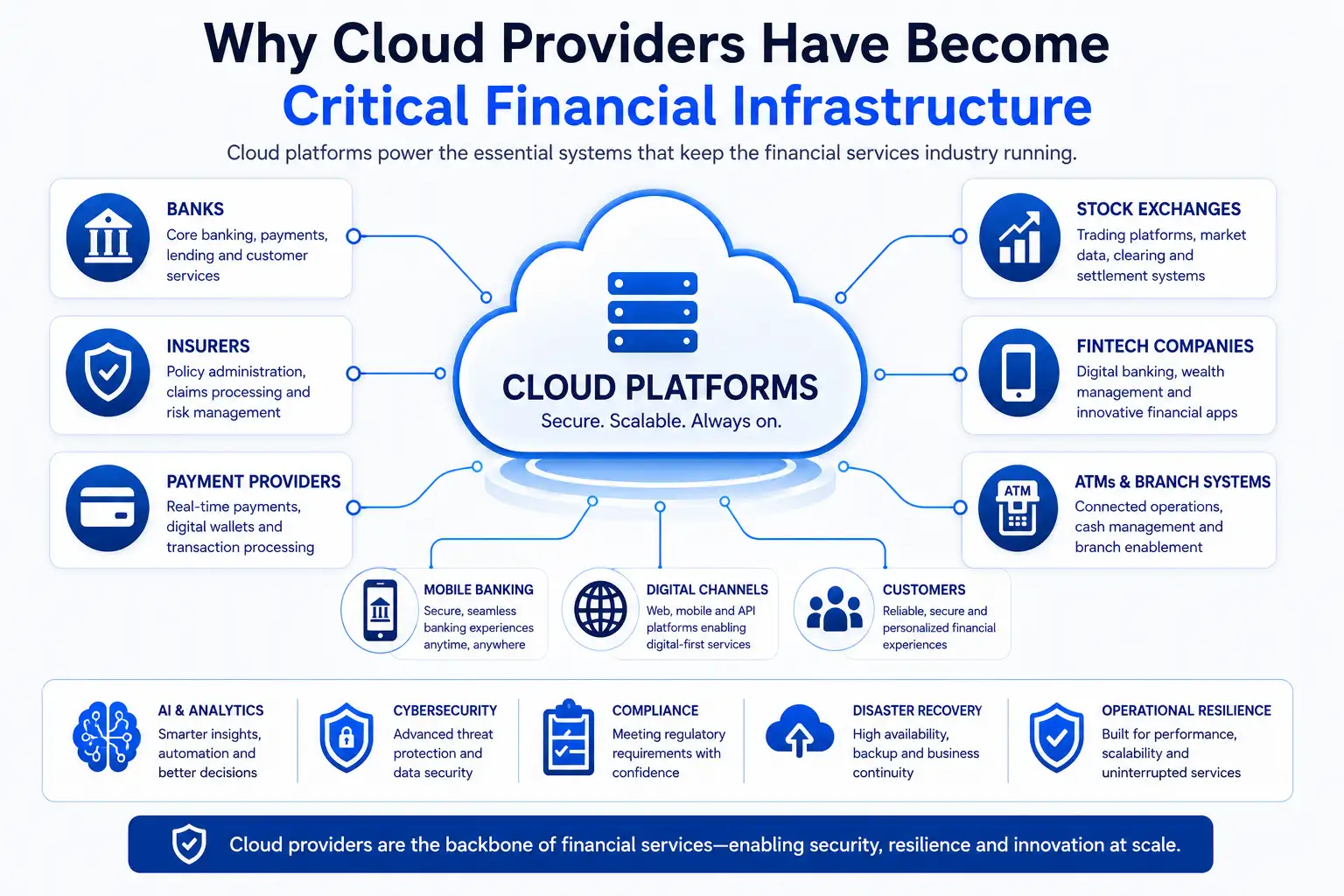
The financial services industry has undergone one of the most significant technology transformations in its history. Over the last decade, cloud computing has shifted from being a supporting technology to becoming the foundation on which many financial institutions build their digital operations.
Banks and financial organizations now rely on cloud platforms to deliver faster services, improve customer experiences, and manage increasingly complex workloads. Traditional data centers often lacked the flexibility and scalability required to support modern digital banking, especially as customer expectations evolved toward always-on services and real-time transactions.
Today, cloud infrastructure powers a wide variety of essential financial operations, including:
Mobile banking applications
Digital payment systems
Fraud detection platforms
Customer identity verification
AI-powered financial analytics
Investment and trading platforms
Open banking APIs
Regulatory reporting systems
Cloud computing enables financial institutions to rapidly scale computing resources during periods of high demand while maintaining strong security controls and operational efficiency.
As more organizations migrate mission-critical systems to cloud platforms, providers such as Google Cloud have become an essential part of national financial infrastructure. This increasing dependence explains why regulators are expanding oversight beyond financial institutions to include technology providers that support the industry's most critical services.
Why Critical Third Party Oversight Matters
Unlike traditional outsourcing arrangements, cloud computing introduces shared infrastructure that supports hundreds or even thousands of organizations simultaneously.
A single cloud platform may host payment processing systems, customer databases, fraud detection engines, regulatory reporting tools, and AI applications for multiple financial institutions at the same time.
This interconnected environment creates tremendous efficiency but also introduces systemic risk. A significant disruption affecting one critical cloud provider could potentially impact multiple financial organizations simultaneously.
The U.K.'s Critical Third Party framework is designed to address this challenge by providing regulators with greater visibility into the operational resilience of major technology providers.
Rather than replacing existing financial regulations, the framework creates an additional layer of oversight that strengthens confidence across the financial ecosystem.
It also encourages continuous collaboration between regulators and cloud providers, helping identify risks before they develop into large-scale operational incidents.
Building Operational Resilience Through Shared Responsibility
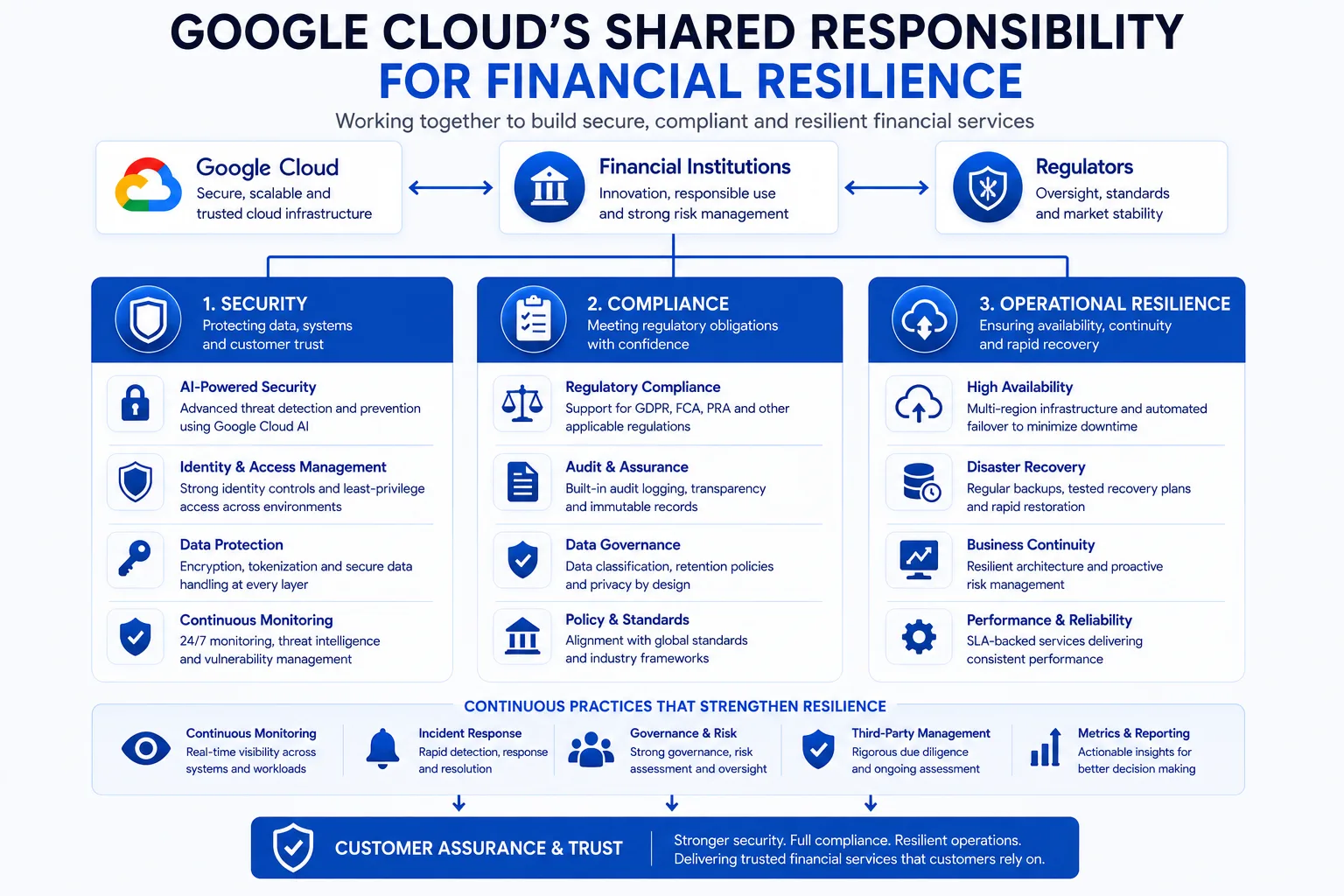
Operational resilience cannot be achieved by regulators or cloud providers alone. It depends on a shared responsibility model involving technology vendors, financial institutions, regulators, and cybersecurity teams.
Cloud providers are responsible for maintaining resilient infrastructure, secure networking, physical data center protection, platform availability, and continuous monitoring.
Financial institutions remain responsible for managing:
Internal governance
Risk assessments
Identity and access management
Application security
Data classification
Compliance programs
Incident response planning
Employee awareness
Regulators provide the oversight needed to ensure both parties maintain appropriate resilience standards while protecting consumers and preserving financial stability.
This collaborative approach creates multiple layers of protection that reduce operational risks throughout the financial ecosystem.
Artificial Intelligence Is Increasing the Importance of Resilient Cloud Platforms
Artificial intelligence is becoming one of the primary drivers of cloud adoption across financial services.
Banks are rapidly integrating AI into daily operations to automate repetitive tasks, improve customer experiences, detect fraud, and strengthen cybersecurity.
Common AI use cases include:
Intelligent fraud detection
Customer service chatbots
Credit risk analysis
Anti-money laundering monitoring
Automated compliance reporting
Document processing
Predictive analytics
Threat intelligence
These AI workloads require enormous computing power and highly scalable infrastructure that only modern cloud platforms can efficiently provide.
As organizations expand their use of AI, maintaining resilient cloud infrastructure becomes even more important. Any disruption could affect not only traditional banking services but also AI-powered decision-making systems that support millions of customers every day.
This makes operational resilience increasingly important as financial institutions embrace next-generation technologies.
Global Financial Regulation Is Entering a New Era
The designation of Google Cloud as a Critical Third Party reflects a broader shift in financial regulation around the world.
Regulators increasingly recognize that technology providers have become integral to maintaining the stability of financial markets.
Across multiple jurisdictions, governments are introducing new frameworks focused on:
Operational resilience
Third-party risk management
Cloud governance
Cybersecurity standards
Incident reporting
Digital infrastructure resilience
Business continuity
Cross-border regulatory cooperation
These initiatives acknowledge that financial stability now depends not only on banks but also on the technology ecosystems supporting them.
As digital transformation accelerates, stronger collaboration between regulators, cloud providers, and financial institutions will become increasingly important in protecting consumers and maintaining confidence in global financial systems.
Supporting the Entire Financial Ecosystem
Google Cloud explained that it supports the objective of building sector-wide resilience.
Rather than viewing regulatory oversight as an obligation alone, the company describes the new framework as an opportunity for deeper collaboration with U.K. regulators.
The company plans to continue engaging closely with regulators to improve transparency, strengthen assurance processes, and enhance operational resilience across the financial sector.
This collaborative approach aims to benefit not only Google Cloud customers but also the broader financial ecosystem.
Helping Financial Institutions Meet Regulatory Requirements
Beyond infrastructure, Google Cloud continues to provide resources that help financial institutions comply with U.K. operational resilience regulations.
The company has published guidance explaining how its cloud services align with existing supervisory requirements.
Among these are:
PRA Supervisory Statement 1/21
This guidance helps financial institutions understand how Google Cloud supports operational resilience obligations.
The whitepaper explains how organizations can build resilient cloud environments while meeting regulatory expectations.
PRA Supervisory Statement 2/21
Google Cloud also provides documentation that maps its contractual commitments to outsourcing and third-party risk management requirements.
This assists organizations in evaluating cloud services within regulated environments.
Importantly, Google Cloud notes that the Critical Third Party regime complements rather than replaces these existing regulatory responsibilities.
Financial institutions must still maintain their own governance, oversight, and risk management processes.
Why the CTP Regime Complements Existing Regulations
The introduction of direct oversight does not remove responsibility from financial institutions.
Instead, it creates shared accountability.
Financial organizations continue managing:
Vendor governance
Risk assessments
Internal controls
Business continuity planning
Incident response
Compliance reporting
Meanwhile, regulators gain greater visibility into cloud providers that support multiple institutions.
This dual approach helps strengthen resilience across the entire financial ecosystem.
Transparency and Trust Remain Central
One of Google's recurring themes is transparency.
The company says it intends to maintain the same level of openness with regulators that it already provides customers through:
Independent security certifications
Compliance reporting
Risk documentation
Security assurance programs
Operational transparency
Continuous monitoring
Trust has become a competitive advantage in cloud computing, particularly for regulated industries.
The CTP designation reinforces Google's commitment to maintaining that trust.
Implications for Financial Institutions
For organizations already using Google Cloud, the designation provides additional confidence that the platform is subject to enhanced regulatory oversight.
Potential benefits include:
Greater operational transparency
Stronger regulatory collaboration
Improved resilience standards
Enhanced confidence in cloud infrastructure
Continued investment in security
Better alignment with financial sector expectations
The designation also reflects broader industry recognition that cloud providers now play an essential role in maintaining national financial infrastructure.
A Growing Trend in Financial Regulation
Governments around the world are increasingly recognizing that cloud providers have become foundational infrastructure for critical industries.
Instead of regulating only financial institutions, regulators are expanding oversight to include technology providers whose services have systemic importance.
This reflects the changing reality of digital finance, where resilience depends on the combined efforts of banks, regulators, and cloud providers.
Google Cloud's designation represents one of the latest examples of this evolving regulatory approach.
Future Outlook: The Next Phase of Financial Cloud Innovation
The financial industry is expected to continue increasing its investment in cloud computing, artificial intelligence, automation, and advanced cybersecurity technologies over the coming years.
Emerging technologies such as generative AI, real-time risk analytics, confidential computing, quantum-resistant encryption, and autonomous security operations will require even greater levels of scalability and resilience.
Cloud providers will play a central role in enabling these innovations while maintaining the security, transparency, and operational continuity expected by regulators and customers alike.
The U.K.'s Critical Third Party regime provides a framework that supports this balance by encouraging innovation without compromising resilience.
For Google Cloud, the designation is more than a regulatory milestone. It represents recognition of the company's growing role in supporting one of the world's most important financial ecosystems while reinforcing its commitment to secure, reliable, and resilient cloud services.
Looking Ahead
As implementation of the U.K.'s Critical Third Party regime progresses, Google Cloud says it will continue working closely with financial regulators to strengthen operational resilience and support innovation across the financial sector.
The company's long-term objective remains unchanged:
To provide secure, scalable, transparent, and resilient cloud infrastructure that enables digital transformation while supporting the stability of the financial system.
As financial institutions continue adopting artificial intelligence, cloud-native architectures, and real-time digital services, operational resilience will become even more central to both innovation and public trust.
As cloud computing and artificial intelligence continue to reshape global finance, operational resilience will become an even greater strategic priority for regulators, cloud providers, and financial institutions alike. The U.K.'s Critical Third Party framework marks an important evolution in financial oversight, helping ensure that the digital infrastructure powering modern financial services remains secure, resilient, and capable of supporting future innovation with confidence.
Source: Google Cloud Blog
About the Author