
Google Unveils Faster, Cheaper AlloyDB AI Functions with Massive 23,000x Performance Boost
Google Cloud has introduced major upgrades to AlloyDB AI Functions, including new AI-powered SQL capabilities, Smart Batching, and optimized AI processing that delivers up to 23,000x faster performance while reducing AI inference costs by up to 6,000x.
Xcademia Team
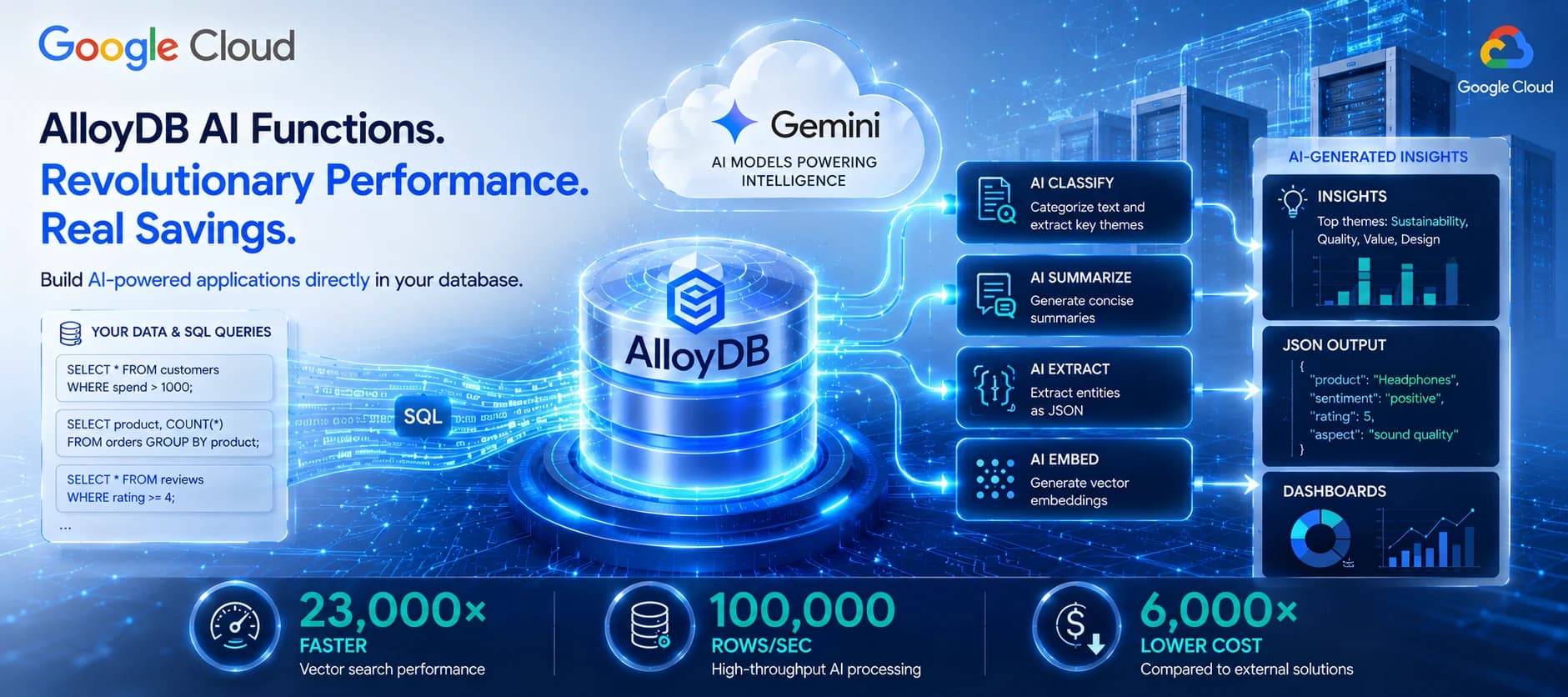
Google Supercharges AlloyDB AI Functions with Massive Performance and Cost Improvements
Google Cloud has announced a significant update to AlloyDB, introducing new AI-native capabilities designed to make large language model (LLM) processing dramatically faster and more cost-effective directly inside the database.
The update expands AlloyDB's growing portfolio of AI Functions with three new capabilities while introducing breakthrough optimization technologies capable of processing up to 100,000 database rows per second in certain workloads.
According to Google Cloud, these innovations eliminate many of the performance bottlenecks organizations face when applying generative AI across millions of database records, enabling developers to build intelligent applications without complex external AI pipelines.
AlloyDB: An AI-Native Database
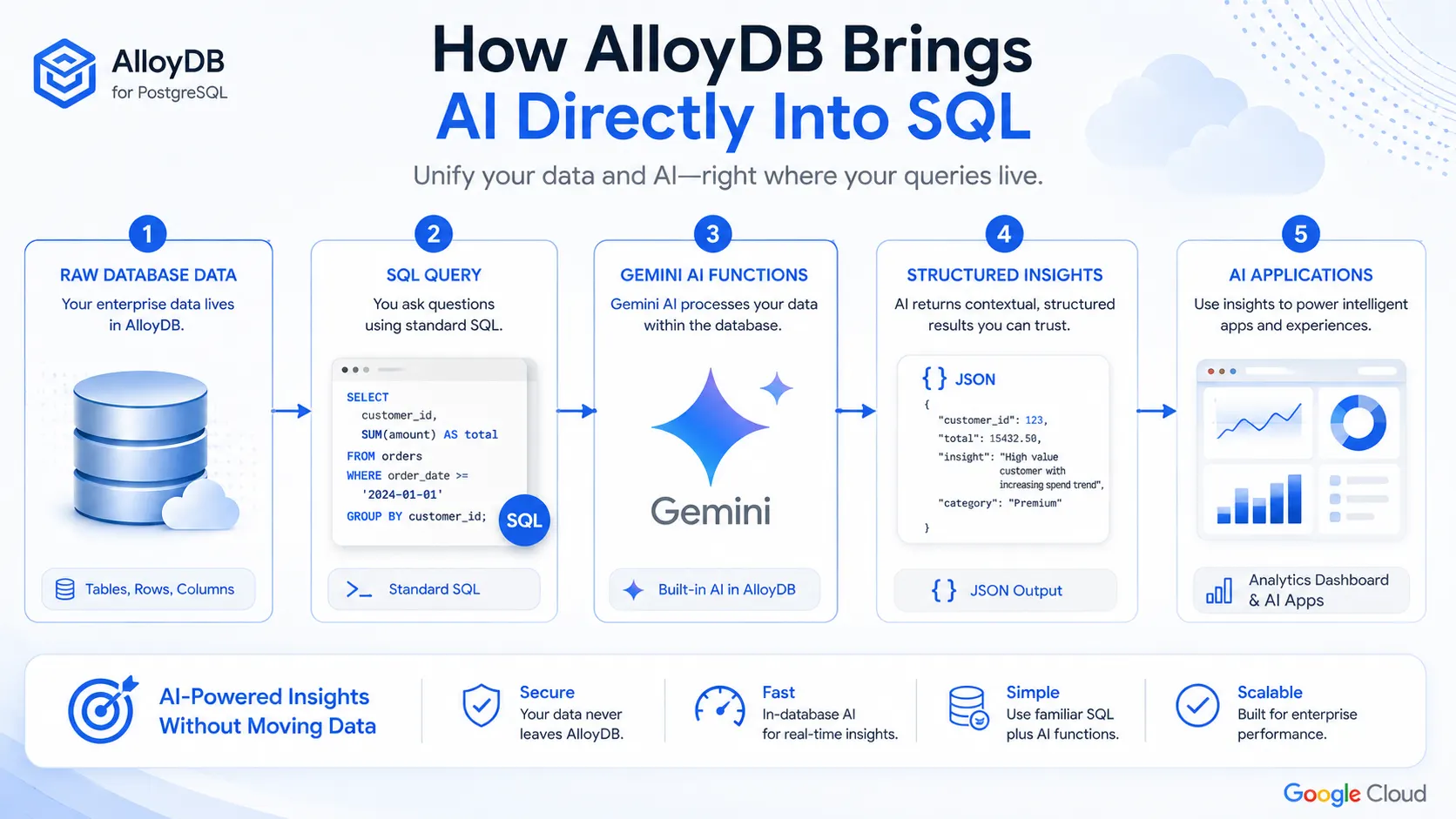
Unlike traditional databases that simply store information, AlloyDB is designed to understand and process data using AI.
The platform integrates Google's Gemini models directly into SQL workflows, allowing developers to perform AI tasks such as:
Natural language-to-SQL conversion
Semantic vector search
Hybrid search
Content generation
Ranking and filtering
Forecasting
Sentiment analysis
Automated summarization
Instead of exporting data to external AI services, developers can invoke Gemini-powered AI functions directly within SQL queries.
This significantly simplifies AI application development while keeping processing closer to enterprise data.
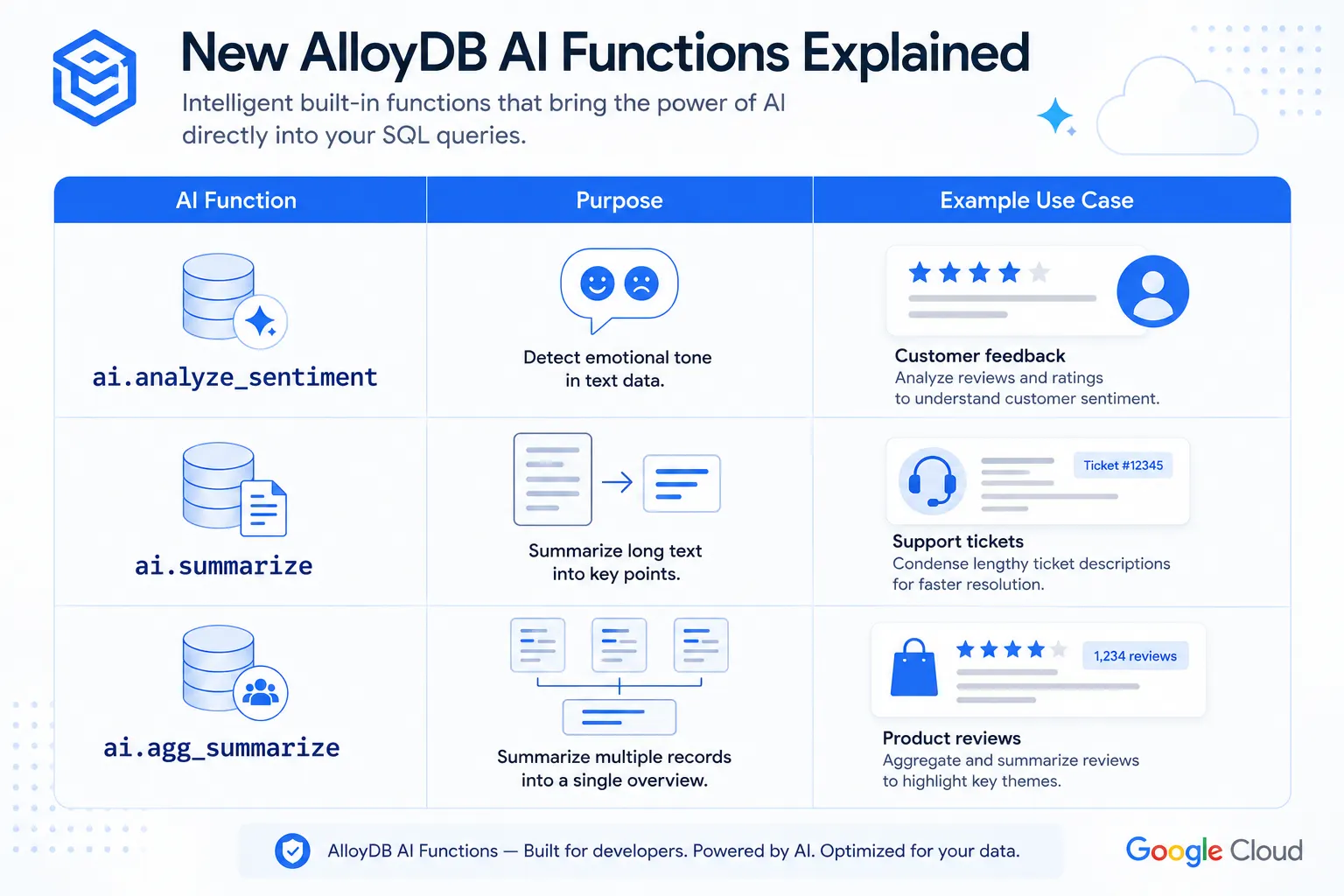
New AI Functions Expand Database Intelligence
Google announced that its original AI Functions ai.generate, ai.rank, ai.if, and ai.forecast, are now generally available.
The company is also introducing three entirely new AI-powered SQL functions.
ai.analyze_sentiment
Automatically classifies text into:
Positive
Negative
Neutral
This makes it easier to analyze customer reviews, support tickets, social media posts, or survey responses at scale.
ai.summarize
Long documents can now be condensed into concise summaries while preserving context and tone.
Potential use cases include:
Customer support conversations
Product documentation
Meeting notes
Legal documents
Knowledge bases
ai.agg_summarize
This new aggregate function summarizes multiple database rows into a single overview.
For example, thousands of customer reviews for a product can automatically become a concise executive summary highlighting common praise and recurring complaints.
Instead of reading thousands of reviews manually, retailers receive an instant product overview.
Gemini AI Turns Unstructured Data into Actionable Information
One of AlloyDB's most powerful capabilities is ai.generate, which leverages Gemini models to transform messy, unstructured text into structured data.
For example, raw application logs containing errors can automatically be converted into structured JSON objects that identify:
Error codes
Service names
Root causes
Without writing custom data processing pipelines, organizations can immediately make this information searchable, analyzable, and useful for downstream applications.
This dramatically simplifies knowledge extraction from enterprise datasets.
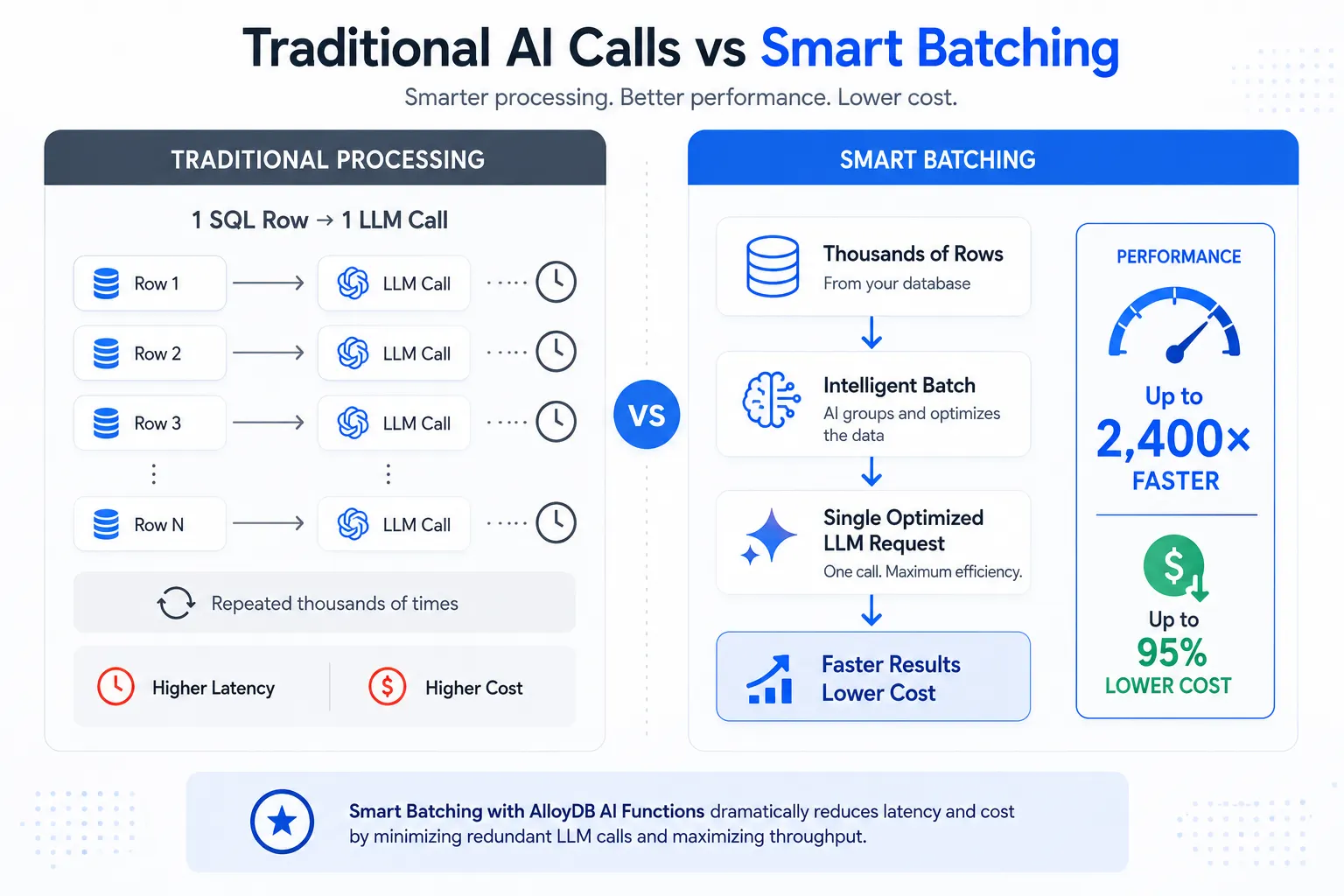
Smart Batching Delivers Up to 2,400x Faster AI Processing
One of the biggest announcements is Smart Batching, a new AI Function Acceleration technology.
Traditionally, every database row required its own individual LLM request, making large-scale AI processing expensive and slow.
Smart Batching changes this by intelligently grouping requests together.
Instead of repeatedly sending identical instructions to the language model, AlloyDB:
Deduplicates prompt instructions
Automatically determines optimal batch sizes
Prevents token-limit issues
Reduces hallucination risks
Handles retries automatically
Google says internal testing demonstrated:
Up to 2,400× faster execution
Approximately 10,000 rows processed per second
Developers don't need to manually tune batching parameters, AlloyDB performs the optimization automatically.
Real-World Example
Imagine an online retailer selling waterproof action cameras.
A customer searches for:
"Show cameras waterproof to at least 60 meters."
Traditional semantic search might return products discussing waterproofing without actually satisfying the depth requirement.
Using AlloyDB's ai.if function, the database understands the intent and verifies product descriptions, returning only cameras that genuinely support diving to 60 meters or deeper.
Optimized AI Functions Push Performance Even Further
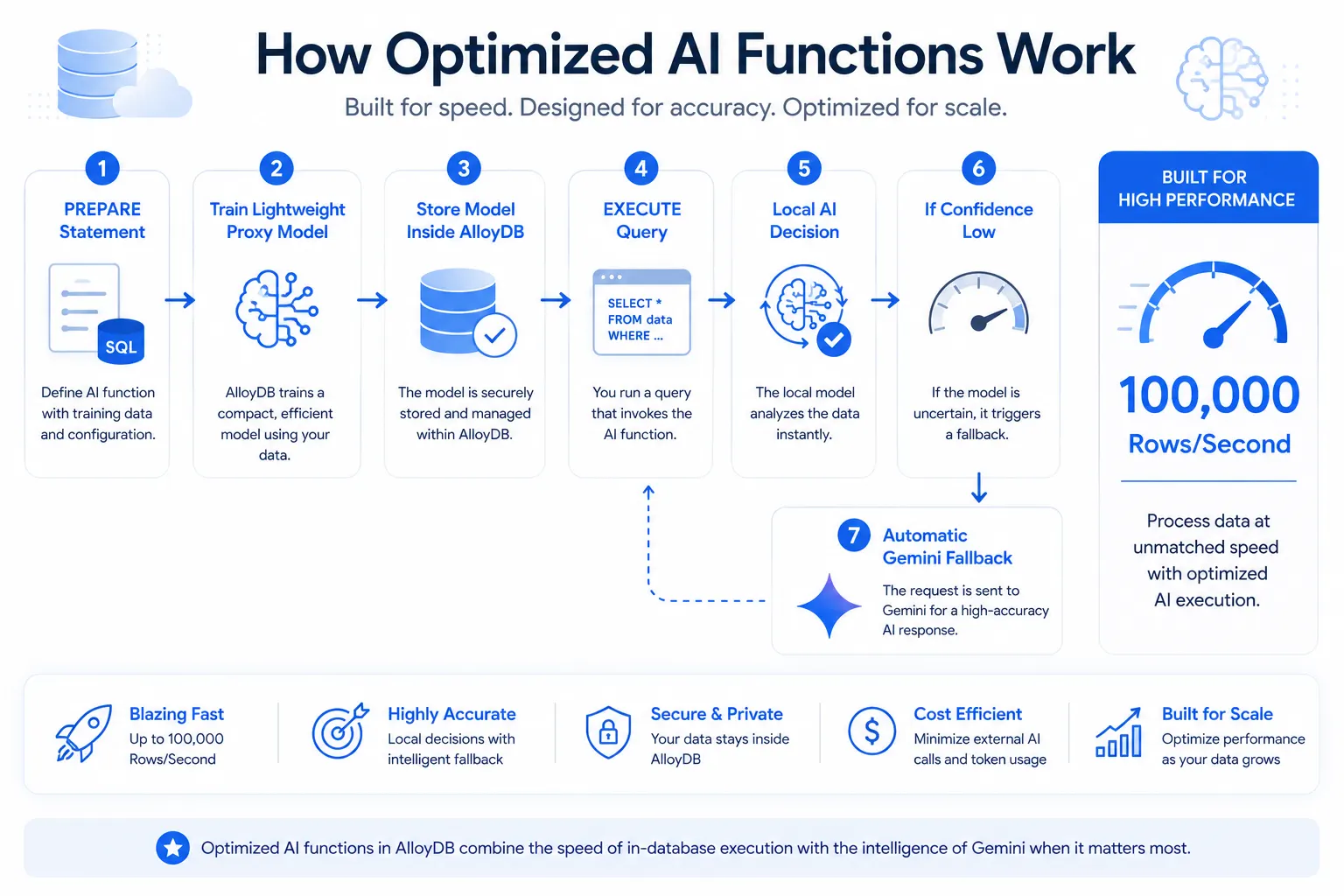
Google also introduced an even more advanced capability called Optimized AI Functions, initially available for ai.if.
Rather than contacting a large language model for every query, AlloyDB trains a lightweight proxy model using previous AI outputs.
The workflow consists of three stages:
Step 1: Train
Developers use SQL's PREPARE statement.
AlloyDB automatically builds a lightweight AI model using embeddings and previous LLM responses.
Step 2: Execute
Future SQL queries run locally against the proxy model.
This eliminates many external AI calls.
Step 3: Automatic Fallback
If confidence falls below acceptable thresholds, AlloyDB automatically routes requests back to Gemini.
This preserves accuracy while maximizing performance.
Massive Performance and Cost Gains
According to Google's internal benchmarks, optimized AI Functions achieved:
Metric | Improvement |
|---|---|
Query Performance | Up to 23,000× faster |
Processing Speed | 100,000 rows/sec |
AI Inference Cost | Up to 6,000× lower |
These improvements could significantly reduce operational costs for organizations running AI across millions of database records.
Simplifying Enterprise AI Development
Google positions AlloyDB as an AI-native platform where developers no longer need to build complex middleware between databases and foundation models.
Instead of moving data between systems, developers can perform AI reasoning directly inside SQL using familiar database operations.
This approach offers several advantages:
Reduced infrastructure complexity
Lower operational costs
Faster query execution
Improved scalability
Easier AI application development
Better integration with enterprise workflows
As organizations increasingly embed AI into operational databases, capabilities like these could significantly simplify production deployments.
Getting Started
Google Cloud has made the new capabilities available through several paths:
General Availability
ai.generate
ai.rank
ai.if
ai.forecast
Array-based AI Functions
New Functions
ai.summarize
ai.agg_summarize
ai.analyze_sentiment
Preview Features
Smart Batching (ai.if and ai.rank)
Optimized AI Functions (ai.if)
Developers can explore AlloyDB through a 30-day free trial and follow Google's AI Functions quickstart guides to begin integrating Gemini-powered capabilities into SQL applications.
Final Thoughts
With this release, Google Cloud is positioning AlloyDB as more than just a relational database, it is evolving into an AI execution platform capable of understanding, analyzing, and transforming enterprise data at scale.
By combining new AI Functions with Smart Batching and optimized proxy models, Google aims to remove two of the biggest barriers to enterprise AI adoption: latency and cost.
If Google's reported benchmark improvements translate into real-world production environments, AlloyDB could become a compelling choice for organizations looking to integrate generative AI directly into their data infrastructure without sacrificing performance or operational efficiency.
Source: Google Cloud Blog
About the Author