
Google Cloud Launches Cortex Framework v7 to Help Enterprises Build AI Agents from SAP Data Without Disrupting ERP Systems
Google Cloud has announced the general availability of Cortex Framework v7, introducing AI-ready SAP data products, modular Dataform orchestration, and native BigQuery integration to help enterprises accelerate agentic AI workflows while preserving core ERP operations.
Xcademia Team
Xcademia Research Team
Introduction
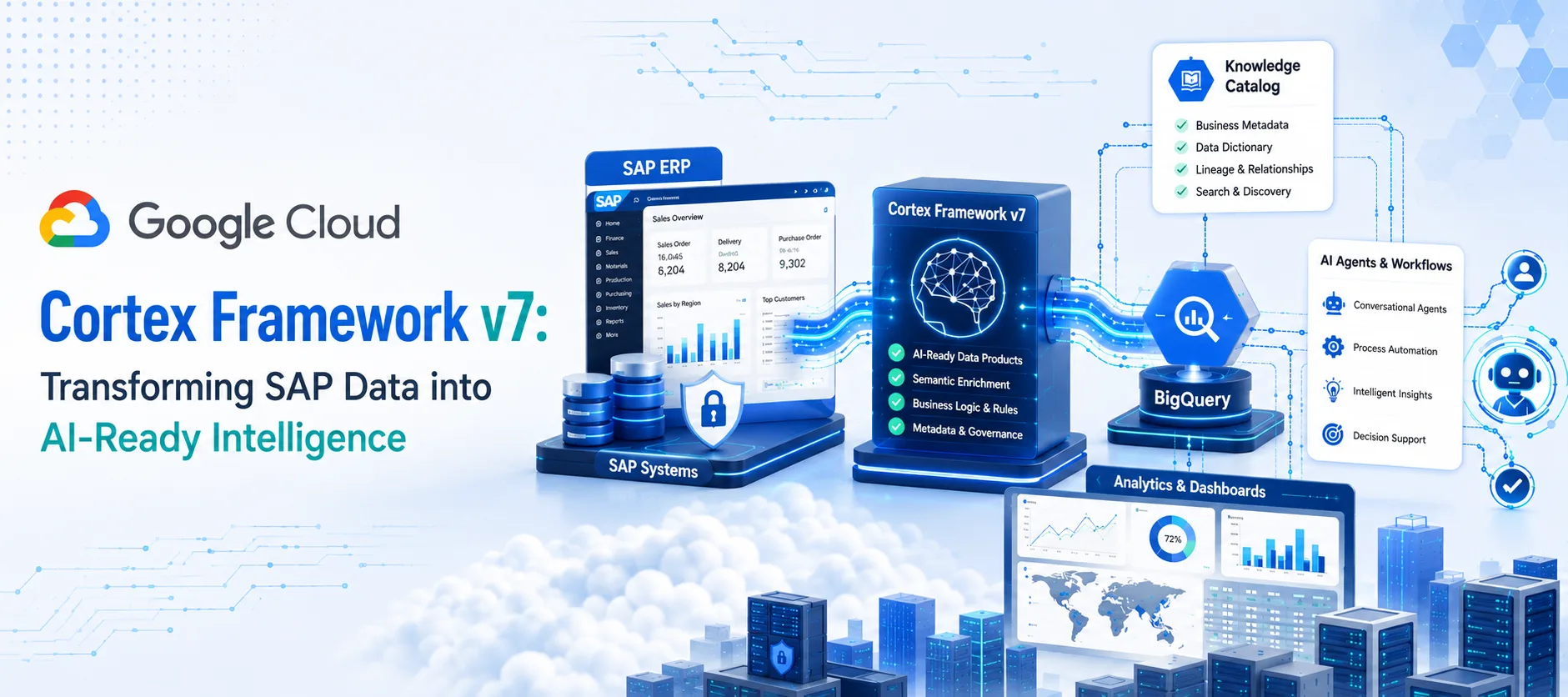
Google Cloud has announced the general availability (GA) of Cortex Framework v7, introducing a major update designed to help enterprises prepare SAP data for the next generation of AI-powered business applications. Announced on August 4, 2026, the release focuses on transforming complex SAP enterprise data into reusable, AI-ready data products that can support intelligent agents without disrupting mission-critical ERP environments.
The announcement reflects a growing enterprise challenge. While organisations increasingly want to deploy AI agents to automate business processes, improve operational efficiency, and generate faster insights, most enterprise resource planning (ERP) systems were built primarily for transactional workloads rather than AI consumption. Converting years of operational SAP data into formats that large language models (LLMs) and AI agents can understand often requires extensive data engineering, custom integrations, and infrastructure management.
Cortex Framework v7 aims to simplify this process by introducing purpose-built SAP data product accelerators, modernising deployment workflows through Dataform, and integrating directly with Google Cloud services including BigQuery, Knowledge Catalog, and the Gemini Enterprise Agent Platform. Together, these capabilities are intended to provide organisations with a reusable semantic data foundation that enables AI systems to interpret business information more accurately while maintaining the integrity of underlying SAP operations.
Rather than requiring organisations to redesign their ERP environments, Google Cloud positions the framework as an interoperability layer that prepares enterprise data for AI workloads while preserving existing business processes.
Key Developments
The general availability of Cortex Framework v7 introduces several architectural enhancements that collectively shift the platform beyond traditional analytics enablement toward enterprise AI readiness.
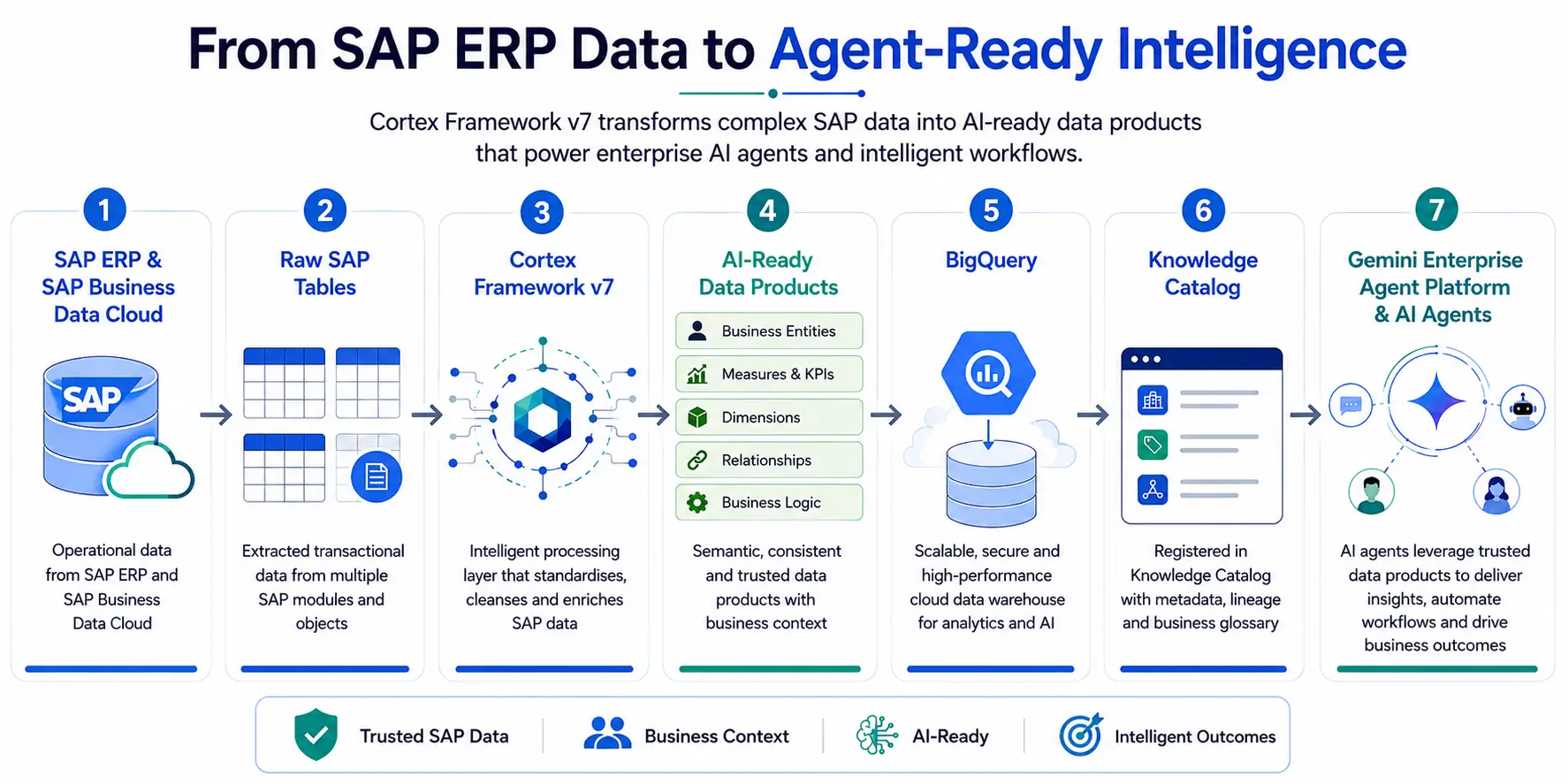
At the centre of the release are agent-ready data products. Instead of exposing AI systems directly to raw SAP database tables, Cortex Framework transforms transactional records into semantically rich business objects containing descriptive metadata. These enriched data products are deployed directly within BigQuery and can be automatically registered in Knowledge Catalog, making them easier to discover, govern, and consume across enterprise AI applications.
Google Cloud says these data products preserve the business meaning behind SAP records by translating technical table structures into understandable business terminology. The framework also supports dynamic ingestion of customer-specific SAP fields and incorporates specialised SAP processing logic, including handling TCURX currency decimal adjustments, helping maintain the level of data fidelity required for enterprise analytics and AI reasoning.
Another significant addition is the Agentic Data Product Builder, which introduces natural language-driven automation for creating custom data products. Using built-in framework content and AI-assisted workflows, data engineers and knowledge engineers can generate new data products with natural language prompts rather than manually building each transformation pipeline. According to Google Cloud, the AI agent can adapt generated models to specific source data structures and customer customisations while automating much of the deployment process.
The release also introduces an improved extensibility model that separates Google-delivered framework content from customer-developed models. This approach enables organisations to adopt future framework updates without overwriting internally developed extensions or custom business logic.
Collectively, these enhancements position Cortex Framework v7 as a foundational data layer intended to support enterprise AI initiatives while reducing the operational complexity traditionally associated with preparing SAP environments for advanced analytics and intelligent automation.
Technical Breakdown
One of the most significant architectural changes in Cortex Framework v7 is its focus on data products rather than datasets.
Traditional enterprise analytics environments often expose AI systems to highly technical database schemas containing thousands of SAP tables with abbreviated field names, complex relationships, and application-specific business logic. While suitable for transactional processing, these structures are difficult for AI models to interpret consistently without additional contextual information.
Cortex Framework v7 addresses this challenge by packaging SAP information into reusable business-oriented data products enriched with descriptive metadata. Instead of relying solely on underlying technical field names, the framework attaches semantic descriptions that help AI systems understand the business meaning of individual records. This additional context is particularly important for large language models, which perform more effectively when supplied with well-described, structured enterprise knowledge rather than isolated transactional data.
The framework deploys these data products directly into BigQuery, Google's cloud-native data warehouse, where they can be governed, queried, and shared across enterprise workloads. Once deployed, organisations can automatically register them in Knowledge Catalog, enabling data discovery and governance while providing AI agents with a trusted source of business context.
Beyond standard SAP tables, the framework is also designed to accommodate customer-specific customisations. Google Cloud states that Cortex Framework v7 can dynamically ingest custom SAP fields, including organisation-specific Z-fields, while preserving compatibility with the delivered data models. This capability helps enterprises extend their SAP environments without losing alignment with future framework updates.
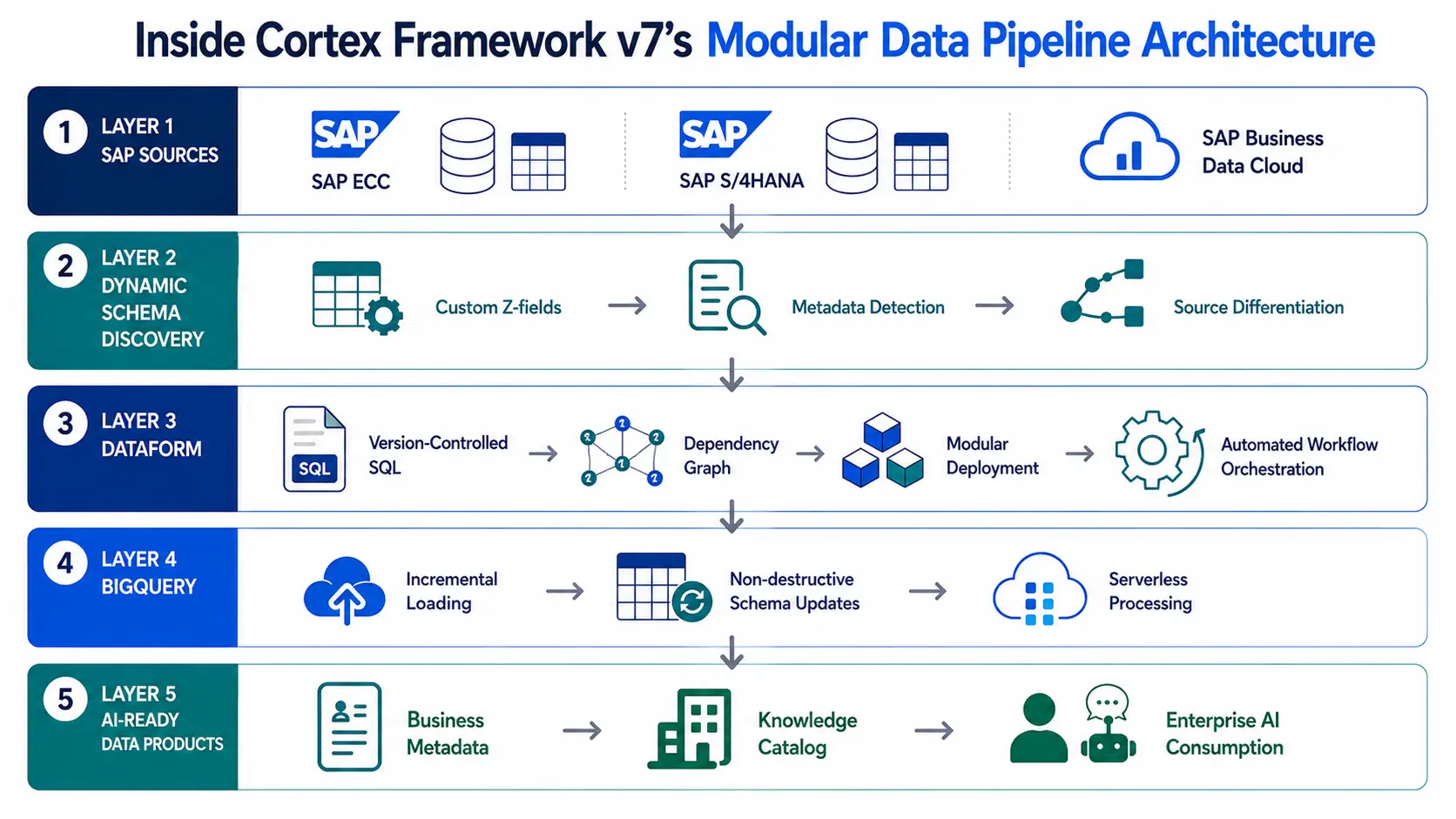
A major architectural enhancement in Cortex Framework v7 is the adoption of Dataform as the foundation for data pipeline orchestration. Rather than relying on traditional extract, transform, and load (ETL) workflows that often require significant operational management, the framework uses Dataform to provide a version-controlled, SQL-based development experience that integrates natively with BigQuery.
According to Google Cloud, each packaged data product includes its own deployment logic. When an organisation selects a data product for implementation, the framework retrieves only the required SAP tables instead of processing an entire source system. Dataform automatically resolves dependencies between datasets, determines the correct execution order, and generates a dependency graph that helps engineers understand how individual data assets relate to one another.
This modular deployment model reduces implementation complexity, particularly for large SAP landscapes where multiple applications and business domains often coexist. It also allows development teams to extend delivered models by introducing additional business logic or custom fields without modifying Google's core framework content. By maintaining this separation, enterprises can continue receiving framework updates while preserving their own customisations.
Google Cloud also designed Cortex Framework v7 to address the reality that many organisations operate more than one SAP environment simultaneously. Large enterprises frequently maintain combinations of SAP ECC, SAP S/4HANA, and newer SAP Business Data Cloud (BDC) deployments during long migration programmes.
To support these hybrid environments, the framework can compile and deploy data products across multiple SAP source systems in parallel. Built-in logic differentiates between source platforms while dynamic schema discovery automatically incorporates customer-defined extensions such as SAP Z-fields. This reduces the amount of manual pipeline refactoring typically required when integrating data from several SAP environments into a unified analytics platform.
Another notable change is the framework's emphasis on operational efficiency. Cortex Framework v7 now defaults to incremental data loading within BigQuery, processing only records that are new or have changed since the previous execution. It also supports non-destructive schema updates, allowing organisations to evolve their data models without rebuilding complete datasets.
Because Dataform executes natively within BigQuery, orchestration remains serverless. Google Cloud says this approach reduces infrastructure overhead by eliminating the need for organisations to manage separate workflow servers while allowing processing capacity to scale with demand.
For enterprises that already operate established change data capture (CDC) pipelines, the framework introduces a bring-your-own CDC option. Rather than replacing existing ingestion strategies, organisations can connect Cortex Framework directly to externally managed CDC pipelines, allowing existing investments in data integration technologies to remain in place.
Industry Impact
1. Source Facts
Google Cloud positions Cortex Framework v7 as a platform for helping organisations operationalise SAP data for AI agents without disrupting existing ERP environments. The framework integrates with BigQuery, Knowledge Catalog, Gemini Enterprise Agent Platform, and the recently released SAP Business Data Cloud Connect for BigQuery.
The release also introduces native support for SAP Business Data Cloud standard and custom data products, enabling organisations to combine Cortex Framework-delivered assets with SAP BDC datasets. Google Cloud says the release includes solution samples spanning both SAP ERP and SAP Business Data Cloud data, allowing organisations to accelerate common business analyses such as evaluating sales pipeline health and identifying procurement inefficiencies.
Google Cloud further notes that Cortex Framework v7 has been tested in collaboration with its Professional Services Organization and enterprise customers, including SLB. In the announcement, Dr Jwan Ibrahim, Director of Data and Analytics at SLB, said the new capabilities have the potential to accelerate the creation of enterprise data products for analytics and agentic AI use cases while making SAP data more semantically meaningful and accessible.
2. Editorial Analysis
The announcement reflects a broader shift in enterprise AI strategy. During the first wave of generative AI adoption, many organisations concentrated on deploying chatbots, copilots, and document assistants. Increasingly, however, enterprises are exploring agentic AI, where autonomous software systems can reason over business information, coordinate multiple tasks, and execute workflows with limited human intervention.
For these systems to operate reliably, the quality of enterprise data becomes as important as the AI models themselves. Large language models are capable of generating sophisticated responses, but their effectiveness depends heavily on receiving accurate, structured, and well-described business information. Raw ERP tables, technical abbreviations, and inconsistent metadata can reduce the reliability of AI-generated decisions and actions.
By emphasising semantic data products rather than simply expanding data ingestion capabilities, Google Cloud is addressing one of the practical barriers to enterprise AI adoption: transforming operational business data into reusable knowledge assets that can be shared across analytics platforms, governance tools, and AI applications.
The integration between BigQuery, Knowledge Catalog, Dataform, and Gemini Enterprise Agent Platform also highlights Google's continuing strategy of connecting its data analytics portfolio with its growing enterprise AI ecosystem. Rather than introducing an isolated AI capability, Cortex Framework v7 strengthens the underlying data architecture required to support future AI-driven business processes.
Why This Matters
Enterprise adoption of generative AI is entering a new phase. Many organisations have already experimented with conversational assistants and productivity tools, but attention is increasingly shifting towards AI agents that can understand business context, coordinate actions across systems, and automate complex operational workflows.
For organisations running SAP environments, achieving that vision depends on more than deploying advanced AI models. Enterprise data must be accurate, governed, discoverable, and described in ways that AI systems can interpret consistently. Decades of transactional ERP data often contain highly technical structures, custom fields, and business-specific logic that are well understood by SAP specialists but difficult for AI models to reason over without additional context.
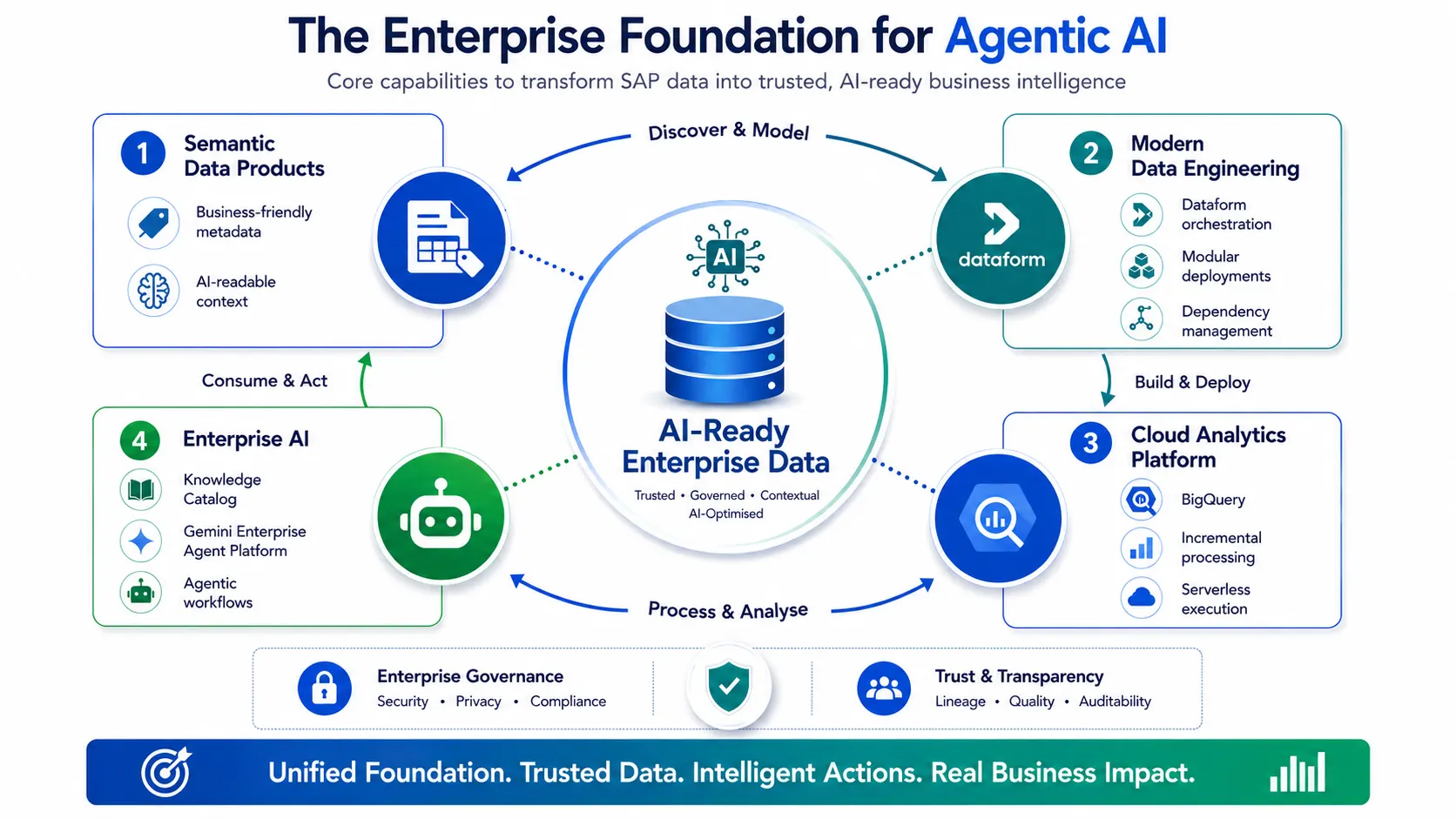
Cortex Framework v7 addresses this challenge by focusing on semantic data products rather than raw datasets. By enriching SAP information with business-friendly metadata and integrating it with Google Cloud's analytics and governance services, the framework provides a reusable foundation that can support analytics, reporting, and AI-driven workflows from the same trusted data source.
Another important aspect of the announcement is its emphasis on preserving operational continuity. Enterprise resource planning systems underpin finance, procurement, manufacturing, supply chain, and numerous other business-critical processes. Organisations are generally cautious about introducing technologies that require extensive changes to these environments. Google Cloud positions Cortex Framework v7 as a layer that modernises data consumption without requiring fundamental changes to the underlying ERP systems.
The release also reflects a broader industry trend towards data products as reusable business assets. Instead of building separate data pipelines for every dashboard, machine learning model, or AI application, organisations are increasingly creating governed datasets that can be reused across multiple teams and business functions. This approach not only improves consistency but also reduces duplication and simplifies governance.
As enterprises continue investing in AI, platforms that combine strong data governance, semantic modelling, and scalable cloud-native infrastructure are likely to play an increasingly important role in enabling reliable business automation.
Challenges and Considerations
While Cortex Framework v7 introduces several capabilities intended to simplify enterprise AI adoption, successful implementation will still depend on broader organisational readiness.
Preparing SAP data for AI involves more than deploying a new framework. Enterprises typically maintain complex landscapes that span multiple SAP versions, custom business processes, and extensive integrations with third-party applications. Although Cortex Framework v7 supports SAP ECC, SAP S/4HANA, SAP Business Data Cloud, and dynamic schema discovery, organisations will still need effective data governance practices to ensure that AI systems operate on accurate and well-managed information.
The introduction of natural language-driven data product generation also places greater emphasis on governance and validation. AI-assisted development can accelerate implementation, but enterprises will need appropriate review processes to verify that generated data products accurately represent business rules and comply with internal data management standards.
Another consideration is change management. Data engineering teams accustomed to traditional ETL pipelines may need to adapt to Dataform's SQL-based, version-controlled workflow model. Similarly, organisations integrating AI agents into operational processes will need clear governance policies defining how agents access enterprise data, execute workflows, and interact with business systems.
Google Cloud's bring-your-own change data capture (CDC) option provides flexibility for organisations with existing integration investments. However, enterprises adopting hybrid architectures may still need to carefully coordinate data synchronisation, monitoring, and lifecycle management across multiple platforms.
Future Outlook
The general availability of Cortex Framework v7 highlights Google's continued investment in connecting enterprise data platforms with agentic AI capabilities.
Rather than focusing solely on model development, the announcement demonstrates increasing attention on the supporting data architecture required for enterprise AI adoption. Semantic data products, integrated governance, modular orchestration, and cloud-native processing are becoming essential components of modern AI platforms, particularly for organisations operating large ERP environments.
The framework's native interoperability with SAP Business Data Cloud Connect for BigQuery also reflects growing collaboration between SAP and Google Cloud around enterprise data accessibility. As organisations continue modernising their analytics environments, platforms that simplify data interoperability while preserving operational stability may become increasingly attractive.
Future adoption will likely depend on how effectively enterprises combine trusted data governance with AI-enabled automation. Organisations evaluating agentic AI initiatives may increasingly prioritise platforms that reduce implementation complexity while maintaining compatibility with existing business systems.
Conclusion
With the general availability of Cortex Framework v7, Google Cloud is expanding its enterprise AI portfolio beyond infrastructure and foundation models to address one of the most significant challenges facing large organisations: preparing operational SAP data for intelligent automation.
The release introduces AI-ready data products, modular Dataform-based deployments, serverless processing in BigQuery, native interoperability with SAP Business Data Cloud, and natural language-assisted data product generation. Together, these capabilities are designed to help organisations build trusted data foundations that support analytics and agentic AI without disrupting core ERP operations.
While enterprises will still need strong governance, data quality, and operational oversight, Cortex Framework v7 represents an important step towards making business-critical SAP information more accessible, reusable, and meaningful for AI-driven workflows. As organisations move beyond experimental AI deployments towards enterprise-scale automation, investments in semantic data architecture are likely to become as important as the AI models themselves.
Source: Google Cloud Blog
About the Author