
Google Cloud Open-Sources Distributed GraphFlow for Autonomous Network Operations
Google Cloud has introduced Distributed GraphFlow, an open-source Python library for end-to-end GNN modeling, connecting Spanner Graph data with machine learning and AI agents for autonomous network operations.
Xcademia Team
Xcademia Research Team
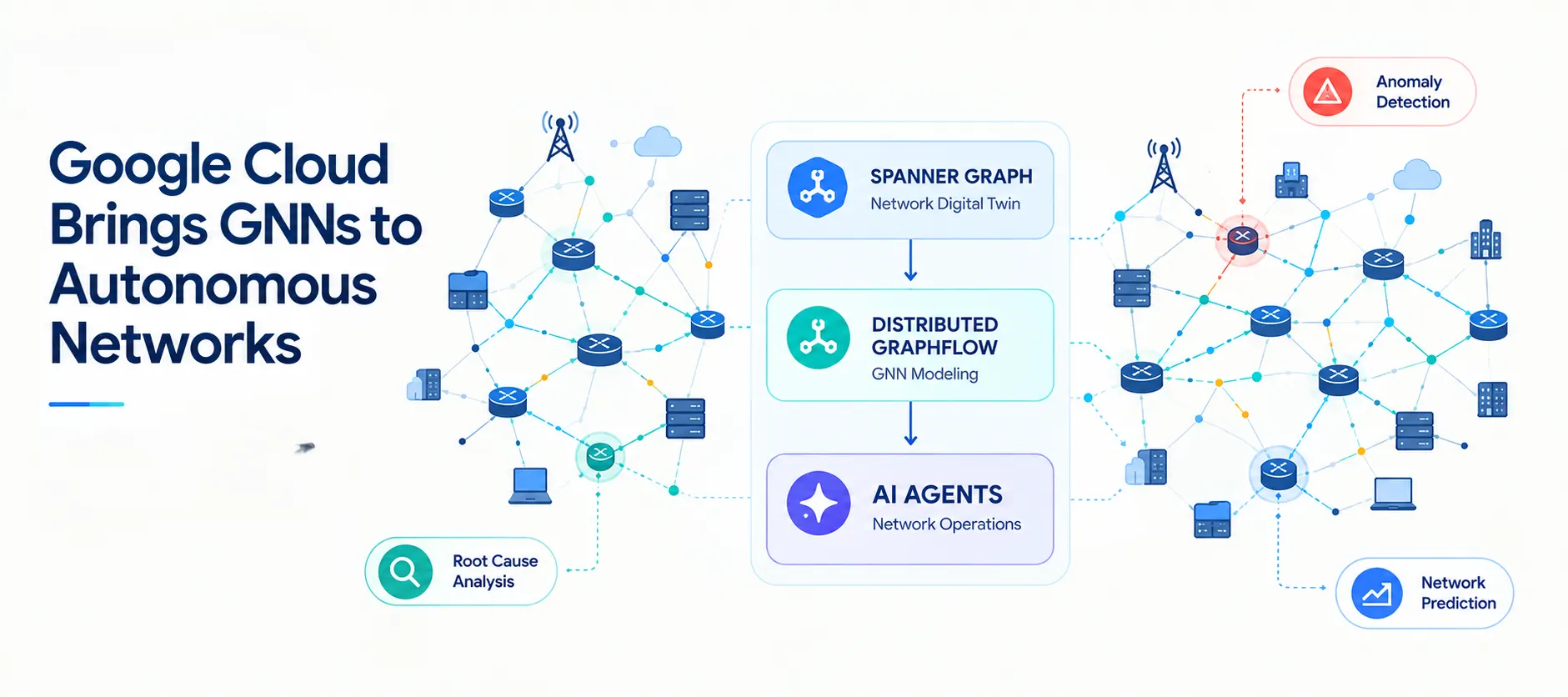
Telecommunications networks are becoming increasingly complex, distributed and difficult to manage through traditional rules-based systems alone.
Google Cloud is addressing part of that challenge with Distributed GraphFlow (DGF), an open-source Python library designed to support the end-to-end lifecycle of Graph Neural Network (GNN) modeling.
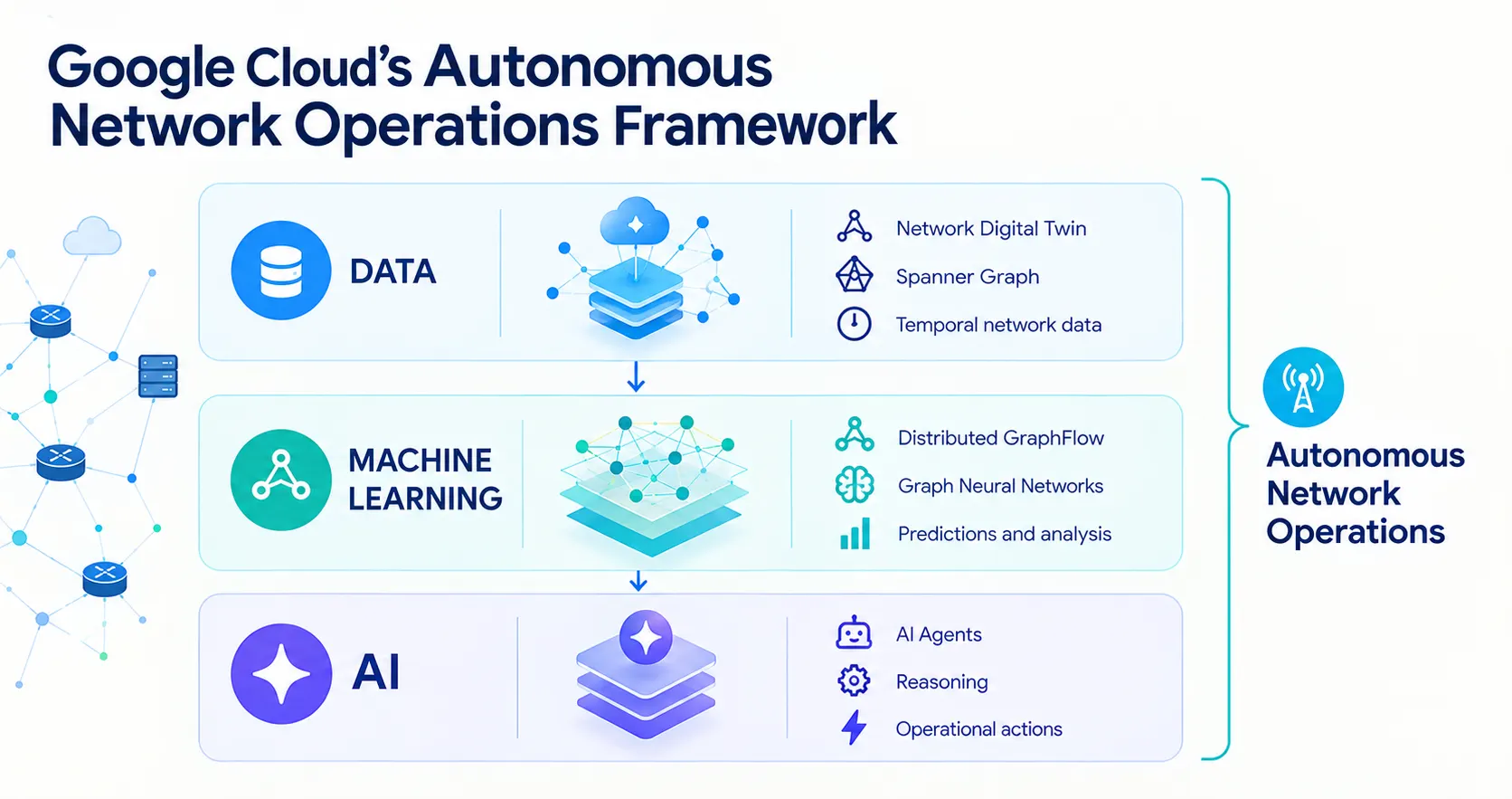
The technology is positioned as the machine learning layer within Google Cloud's broader framework for Autonomous Network Operations. The framework combines a network digital twin, GNN-based machine learning and AI agents to analyze network conditions and support operational decisions.
Google Cloud describes GNNs as a way to work with large volumes of temporal and relational network data. When combined with AI agents, the approach can support tasks including root cause analysis, capacity planning, traffic forecasting, what-if simulations and real-time anomaly detection.
The company says this combination is intended to help networks move toward Level 5 Autonomy, as defined by TM Forum.
The Architecture Has Three Main Layers
Google Cloud's Autonomous Network Operations framework is built around three connected components:
Data: A network digital twin hosted on Spanner Graph.
Machine Learning: Distributed GraphFlow for GNN modeling.
AI: AI agents that can interpret model outputs and support network operations.
The idea is to connect a detailed representation of the network with machine learning models capable of understanding relationships between network components, then make those insights available to AI agents.
Spanner Graph Provides the Digital Twin Foundation
At the foundation of the framework is a network digital twin, which Google Cloud describes as a virtual representation of a telecommunications network that continuously reflects its changing state.
Rather than treating the network as a static model, the digital twin represents it as a dynamic temporal network graph. This captures both the relationships between network components and how those relationships and states change over time.
This historical dimension is important for machine learning. Operators can use historical network information to train and evaluate models, while AI agents can use the digital twin as an operational knowledge layer.
The digital twin can also be used to simulate proposed network changes before they are applied to the live environment.
Google Cloud identifies Spanner Graph as the foundation for this digital twin.
The company highlights three characteristics:
Scalability and availability: Spanner Graph is positioned as a foundation that can scale with network growth, with Google Cloud citing 0-RPO, 0-RTO and five nines of availability.
Multi-model support: Spanner supports relational, graph, vector and full-text search data models in a single platform.
Global consistency: Spanner provides a globally consistent view of network data.
These are capabilities stated by Google Cloud in the announcement and are not independent benchmarks.
Modeling the Network as a Graph
The source illustrates a network topology containing four major node types:
Routers
Interfaces
VPNs
Flows
These nodes are connected through different relationships representing the network stack.
For example, router-interface relationships represent physical containment, interface-interface relationships represent physical links, and router-router relationships can represent control-plane peering through OSPF or iBGP.
Other relationships represent service membership and traffic anchoring.
This graph structure gives the machine learning layer a representation of both network entities and the relationships connecting them.
Distributed GraphFlow Becomes the ML Layer
Above the digital twin sits Distributed GraphFlow, or DGF.
Google Cloud describes DGF as a recently open-sourced Python library designed to manage the complete end-to-end lifecycle of GNN modeling. It was developed by Google CoreML and Google Research.
The library provides both:
High-performance, composable low-level primitives for advanced teams
A higher-level API intended to simplify GNN development
Google Cloud says the higher-level interface can be used without prior GNN expertise.
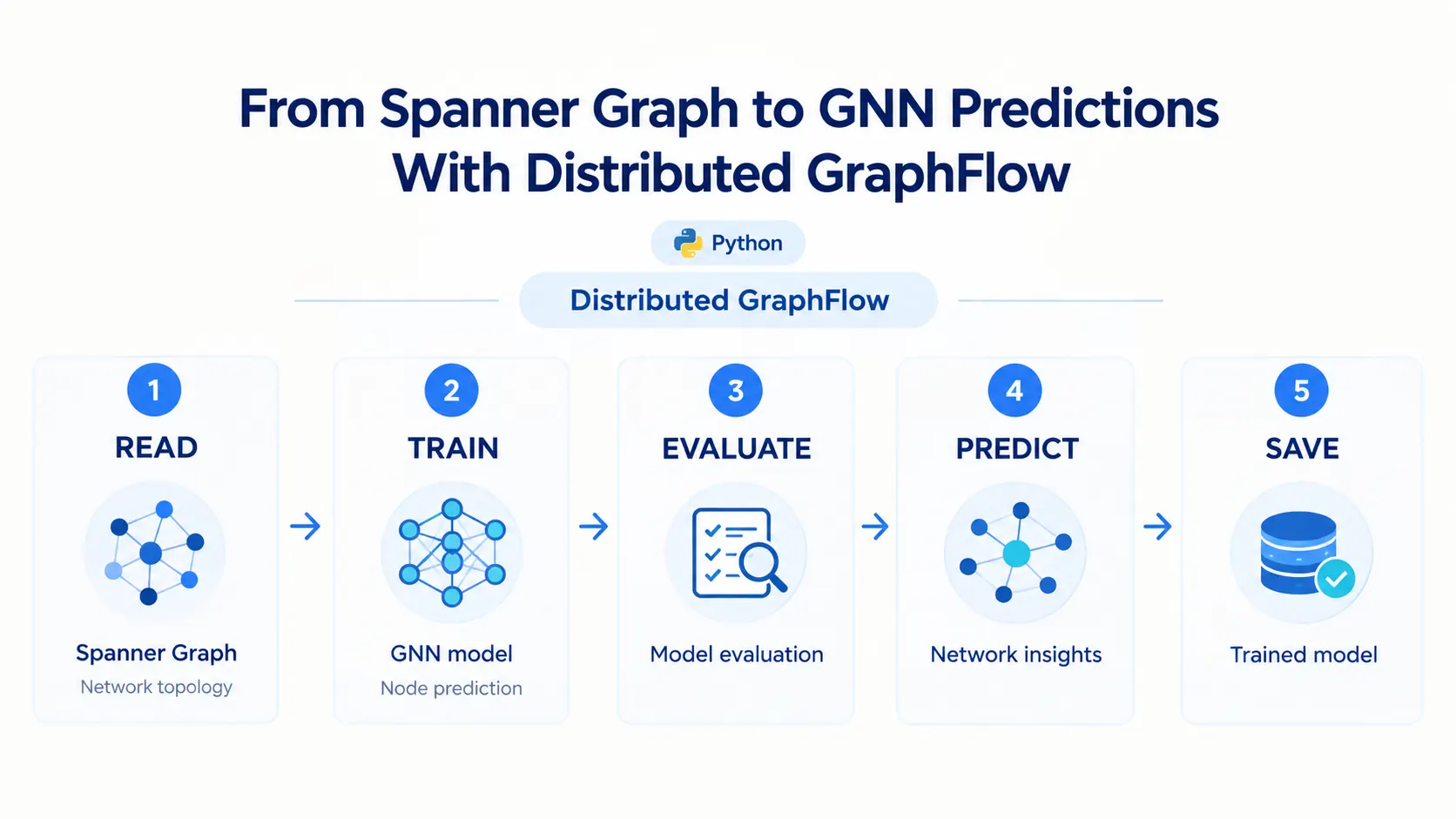
The source demonstrates this with a compact Python workflow that reads graph data from Spanner Graph, trains a node prediction model, evaluates it, generates predictions and saves the model.
The DGF Code Example
import dgf

# Fetch the data from Spanner Graph
graph, schema = dgf.io.read_spanner_graph(...)

# Train a node attribute prediction model
model = dgf.learning.train_node_model(
    graph,
    schema,
    target_column="risk_score"
)

# Evaluate the model
model.evaluate()

# Make predictions
model.predict(graph, seed_node_idxs=[0, 1, 2])

# Save the model for later
model.save("/tmp/model")
The important point is not simply the number of lines. The example shows the intended workflow: load network graph data, train a GNN model, evaluate it, generate predictions and save the model.
Google Cloud provides a separate getting-started tutorial for the full example.
Four Network Operations Use Cases
Google Cloud identifies several areas where GNNs and DGF can be applied to telecommunications operations.
Anomaly Detection
GNNs can generate node and edge embeddings that represent historical patterns and current network health.
The system can then flag anomalous embeddings for review before they result in service degradation, according to Google Cloud.
Root Cause Analysis
DGF can produce specific subgraphs containing the network instances relevant to an incident.
Instead of analyzing an entire network, a troubleshooting agent can work with the smaller section associated with the incident.
Google Cloud gives the example of analyzing attach failures within a specific ZIP code.
Predictive Maintenance
The framework can be used to predict the likelihood of device failures or edge breaks.
The source gives handover failures involving fast-moving equipment as an example.
The resulting predictions can support actions such as load balancing or rerouting. Google Cloud also describes combining agents with human-on-the-loop or human-in-the-loop approaches for remedial actions.
What-If Analysis
GNNs can also model scenarios such as fiber cuts, traffic surges or device configuration changes.
Because the models represent relationships across the network, they can be used to examine how a local change could propagate through connected components.
This provides engineers with a way to test network resilience and evaluate possible mitigation strategies within the digital environment.
How DGF Can Support Root Cause Analysis
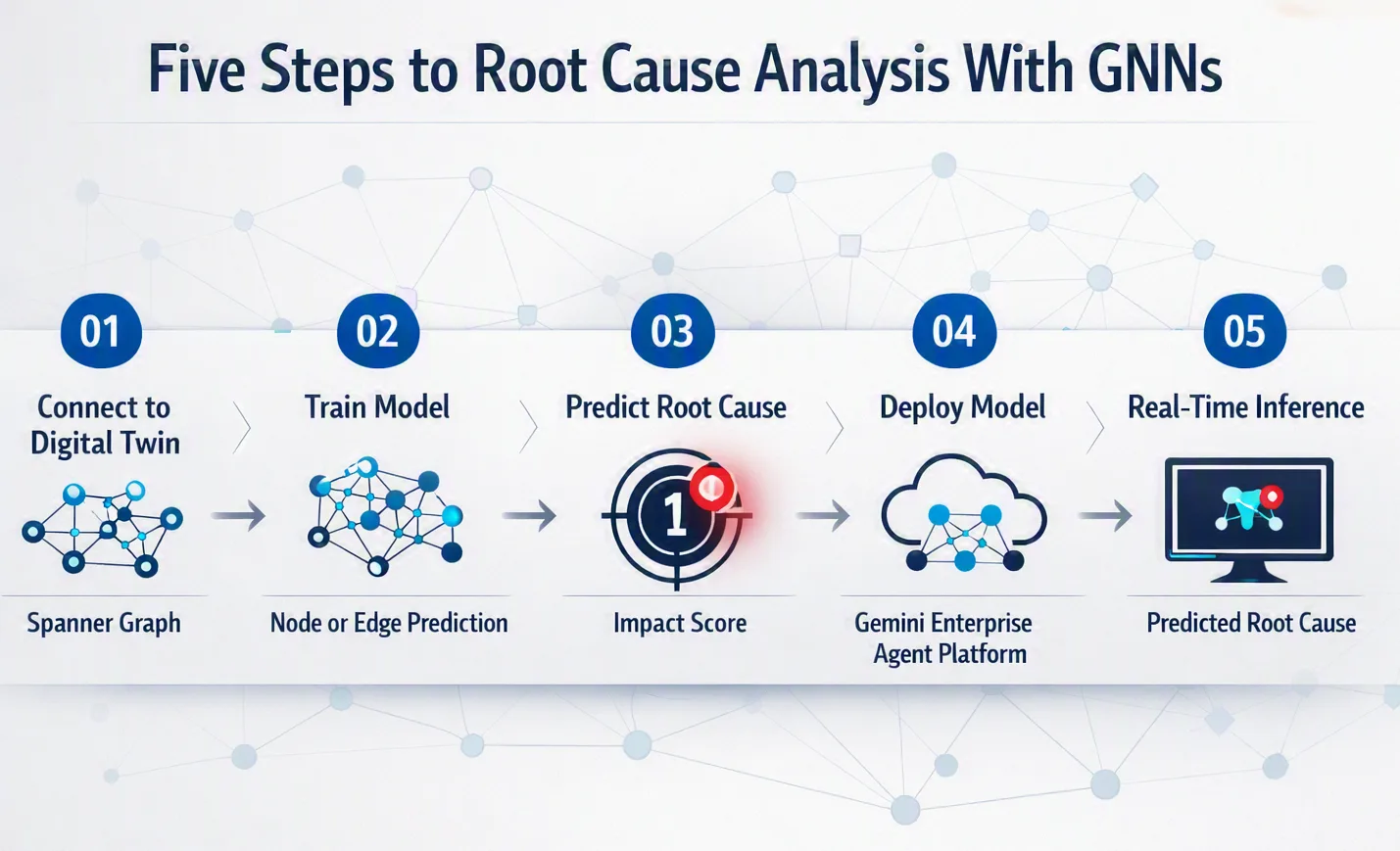
Google Cloud also provides a five-step example for implementing root cause analysis using a network digital twin, GNNs and Distributed GraphFlow.
1. Connect to the Digital Twin
The DGF Spanner Graph connector, dgf.io.read_spanner_graph, loads network topology from the Spanner Graph digital twin into the DGF environment.
2. Train a Prediction Model
Depending on the objective and training data, teams can use node or edge prediction.
In the source example, the high-level dgf.learning.train_node_model API is used to train a supervised node prediction model.
3. Predict the Root Cause
The trained model can produce an impact score for the node associated with an anomaly.
Affected entity nodes with the highest predicted impact scores become candidates for the root cause.
4. Deploy the Model
The model can be exported and hosted on a Gemini Enterprise Agent Platform endpoint, formerly Vertex AI, according to the source.
5. Run Real-Time Inference
Prediction requests can then be sent to the inference endpoint with the anomaly date as input.
The endpoint returns predicted root-cause entity nodes.
Why Graph Neural Networks Matter for Network Operations
Traditional machine learning can identify patterns in structured data, but telecommunications networks also contain complex relationships between devices, services, traffic and infrastructure.
GNNs are designed to work with graph-structured data, making them suitable for scenarios where those relationships are important to the prediction.
Google Cloud's approach therefore connects three different capabilities:
Spanner Graph provides the network representation.
Distributed GraphFlow provides the GNN modeling layer.
AI agents provide a reasoning and operational layer around the resulting insights.
The announcement presents this architecture as part of Google's approach to Autonomous Network Operations rather than as a standalone GNN product.
Open Source and Getting Started
Distributed GraphFlow is available as an open-source library.
Google Cloud says it provides primitives for scalable GNN training and inference.
The company also provides a code sample for building the digital twin and implementing the GNN-based network operations scenario.
For developers and telecommunications teams exploring the framework, the source points to the DGF library, a step-by-step code sample, a TM Forum Moonshot project focused on business-aware GNN healing networks and a whitepaper on self-optimizing autonomous networks.
What This Means for Autonomous Networks
The announcement highlights a broader shift toward combining graph-based machine learning with AI agents for complex infrastructure operations.
The key architectural idea is that AI agents do not need to process every piece of raw network information themselves. Instead, a graph-based ML layer can analyze relationships and historical patterns, then provide more targeted insights for an agent or human operator.
For telecommunications providers, this could create a clearer separation of responsibilities across the infrastructure stack: the digital twin represents the network, GNNs analyze its behavior, and AI agents use those insights as part of operational workflows.
Google Cloud says this approach can help operators move from reactive maintenance toward proactive prevention and support autonomous network operations.
However, the announcement does not provide independent benchmarks or quantified results demonstrating improvements in outage duration, capacity utilization or customer experience. Those claims should therefore be treated as the company's stated expectations rather than independently verified outcomes.
Conclusion
Google Cloud's Distributed GraphFlow brings an open-source GNN modeling layer into its Autonomous Network Operations framework.
The architecture combines Spanner Graph as a network digital twin, Distributed GraphFlow for GNN modeling and AI agents for reasoning and operational workflows.
DGF is designed to cover the GNN lifecycle from reading graph data and training models to evaluation, prediction and model saving. Its integration with Spanner Graph also provides a direct path from network topology data to machine learning models.
The use cases outlined by Google Cloud include anomaly detection, root cause analysis, predictive maintenance and what-if simulations.
For telecommunications organizations exploring autonomous operations, the announcement provides an example of how graph data, machine learning and AI agents can be connected into a single operational architecture.
Source: Google Cloud Blog
About the Author