
Google Cloud Launches C4N: Network-Optimized Compute Engine Delivers Up to 400 Gbps Networking and 1M IOPS
Google Cloud has announced the general availability of C4N, its first network- and storage-optimized Compute Engine VM. Built on Titanium architecture, C4N delivers up to 400 Gbps networking, 1M IOPS, and industry-leading price-performance for enterprise workloads.
Xcademia Team
Xcademia Research Team
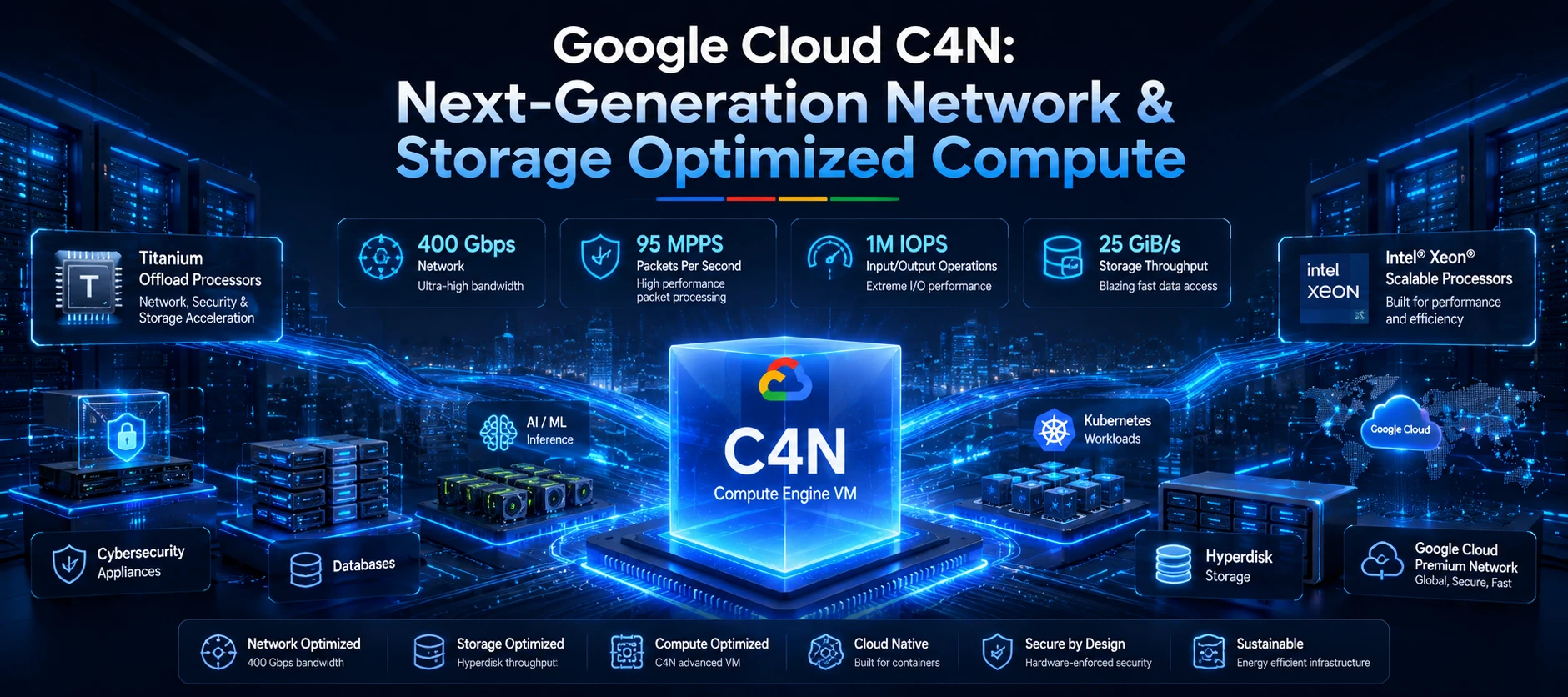
Google Cloud Introduces C4N General Availability with Industry-Leading Network and Storage Performance
As enterprise applications become increasingly data intensive, compute power alone is no longer enough. Modern databases, AI inference, cybersecurity appliances, analytics platforms, and telecommunications workloads demand exceptionally high networking throughput and storage performance. Traditional virtual machines often struggle to keep pace, forcing organizations to overprovision compute resources simply to meet I/O requirements.
To address this challenge, Google Cloud has officially announced the general availability (GA) of C4N, its first network- and block-storage-optimized Compute Engine machine family. Initially unveiled during Google Cloud Next '26, C4N is purpose-built for workloads where networking and storage performance are critical.
Powered by Google's Titanium offload architecture and 5th Generation Intel Xeon Scalable (Emerald Rapids) processors, C4N delivers up to 400 Gbps of networking bandwidth, 95 million packets per second (MPPS), and 1 million Hyperdisk Extreme IOPS, making it Google's highest-performing x86 virtual machine for network-intensive applications.
Why Google Built C4N
Enterprise infrastructure has evolved dramatically over the past decade.
Organizations now operate:
Large-scale distributed databases
AI and machine learning inference platforms
High-performance analytics engines
Software-defined networking
5G core infrastructure
Security appliances
Real-time streaming applications
These workloads continuously move enormous amounts of data between servers, storage systems, and users.
In many cases, networking performance, not CPU utilisation, becomes the primary bottleneck.
C4N addresses this problem by separating networking and storage processing from application compute through Google's custom Titanium offload architecture, allowing CPUs to focus on application execution. At the same time, dedicated hardware manages network and storage operations.
The result is dramatically higher throughput, lower latency, and improved compute efficiency.
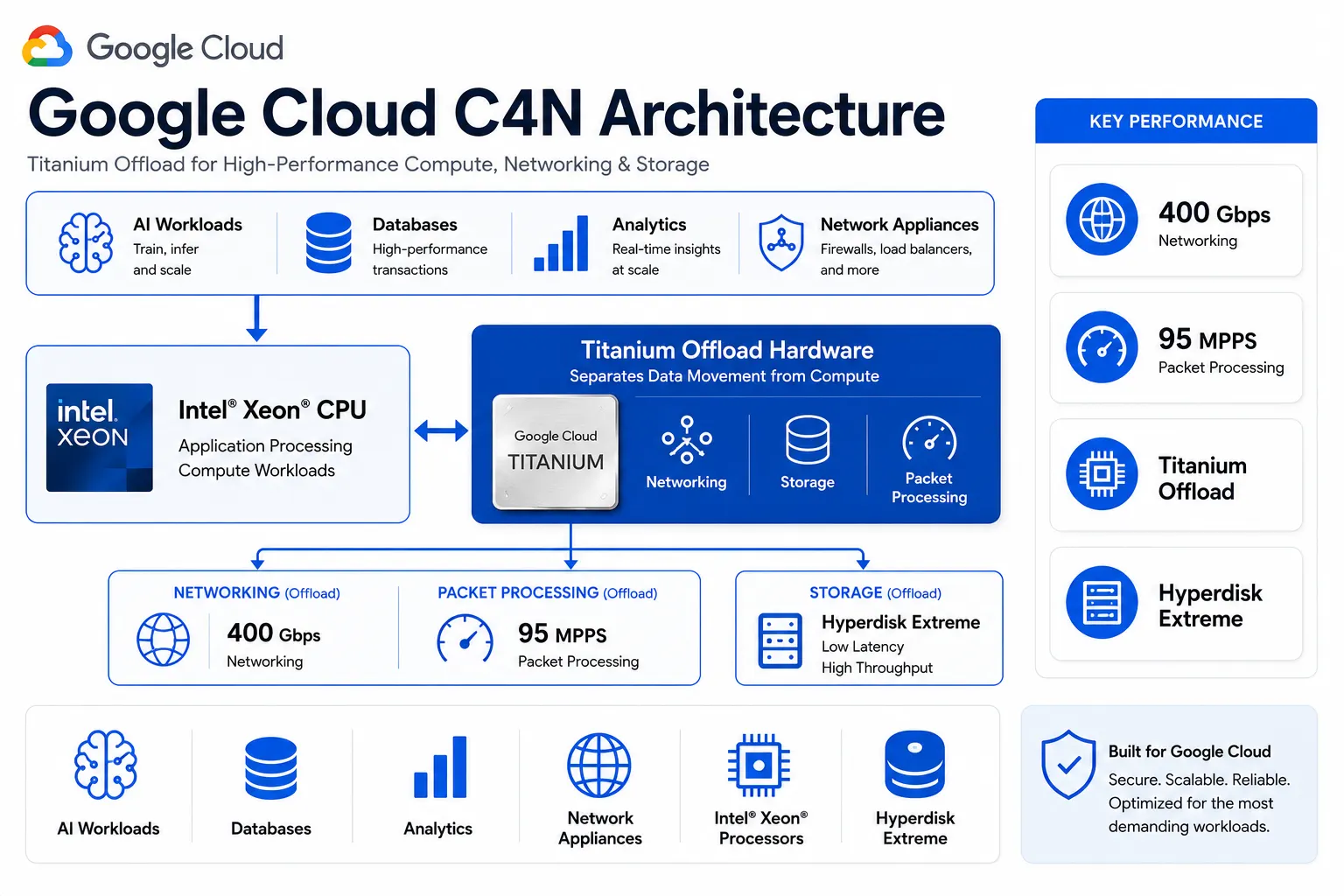
Performance That Redefines Cloud Networking
Google positions C4N as its highest-performing x86 Compute Engine instance for networking workloads.
Key capabilities include:
Up to 400 Gbps VM-to-VM network bandwidth
Up to 200 Gbps internet egress bandwidth
Up to 95 million packets per second
Up to 50 Gbps single-flow bandwidth
Nearly 33% more network bandwidth per vCPU compared to similar Intel-based hyperscaler offerings
Up to 224% faster packet processing performance
Unlike many competing cloud offerings that require premium networking add-ons, C4N delivers these capabilities as standard.
This makes the platform particularly attractive for organizations running bandwidth-intensive applications without additional licensing complexity.
Built for Modern Enterprise Workloads
C4N is optimized for applications that require predictable high-throughput networking and storage performance.
Ideal workloads include:
Network and Security Appliances
Next-generation firewalls
Virtual routers
Load balancers
DDoS mitigation platforms
VPN gateways
Data Platforms
Distributed databases
High-performance file systems
Data lakes
Real-time analytics
Big data processing
Telecommunications
Cloud-native 5G Core functions, including User Plane Function (UPF), benefit from C4N's high packet processing capabilities and deterministic networking.
Artificial Intelligence
CPU-based AI inference, machine learning pipelines, and distributed AI infrastructure can leverage higher network throughput while efficiently accessing massive datasets.
Hyperdisk Unlocks Exceptional Storage Performance
Networking alone is only part of the equation.
Storage-intensive applications often require millions of I/O operations per second while maintaining low latency.
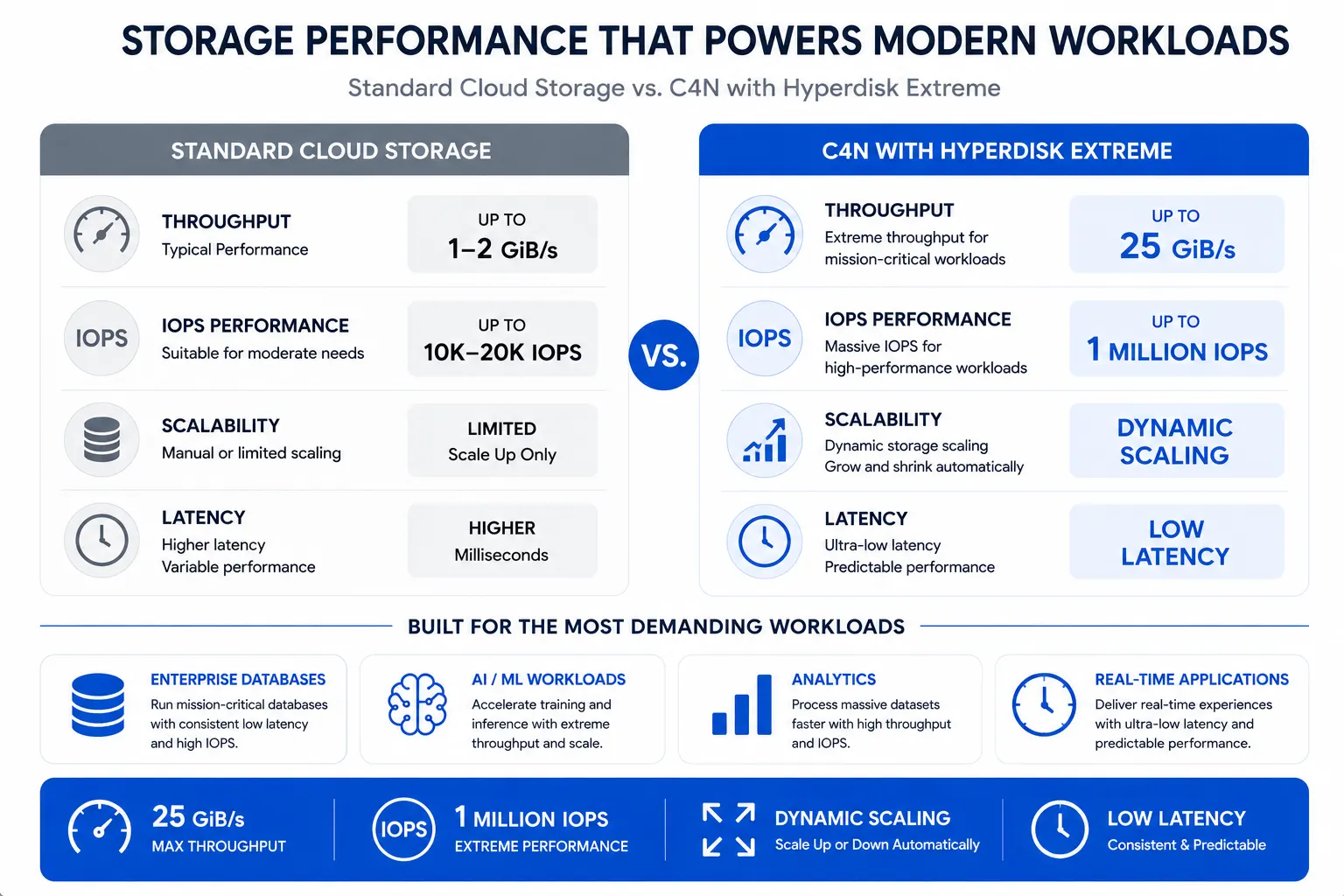
When paired with Hyperdisk Extreme, C4N delivers Compute Engine's highest block storage performance.
Highlights include:
Up to 25 GiB/s storage throughput
Up to 1 million IOPS
Nearly 33% higher storage bandwidth per vCPU
Approximately 39% more IOPS compared with similar Intel-based cloud offerings
Organizations can independently scale storage performance without resizing compute resources, significantly improving infrastructure efficiency.
Google also supports the full Hyperdisk portfolio on C4N:
Hyperdisk Balanced
Hyperdisk Balanced High Availability
Hyperdisk Extreme
Hyperdisk Throughput
Hyperdisk ML
This flexibility enables organizations to optimize performance for different workload requirements.
Faster Networking Across Every Deployment
C4N introduces several networking enhancements beyond raw bandwidth.
Superior VM-to-VM Performance
Internal networking scales up to 400 Gbps, nearly four times the bandwidth per vCPU compared to standard C4 instances.
Faster Internet Connectivity
Internet egress bandwidth increases up to 200 Gbps, while internet packet processing performance improves nearly 32 times, reaching 48 MPPS.
Better Performance for Smaller Instances
Even compact C4N machine types with only 2 to 16 vCPUs receive dedicated networking performance ranging from 25 Gbps to 50 Gbps, reducing the need to purchase oversized virtual machines solely for networking capacity.
Enhanced gVNIC Networking
Google has also increased the default number of transmit and receive queues available through gVNIC interfaces, improving parallel networking performance without manual tuning.
Improved Cloud Storage Transfers
C4N doubles bandwidth when transferring data to and from Google Cloud Storage, benefiting:
AI training
Machine learning inference
Data analytics
Backup operations
Large-scale data ingestion
Real-World Application Performance
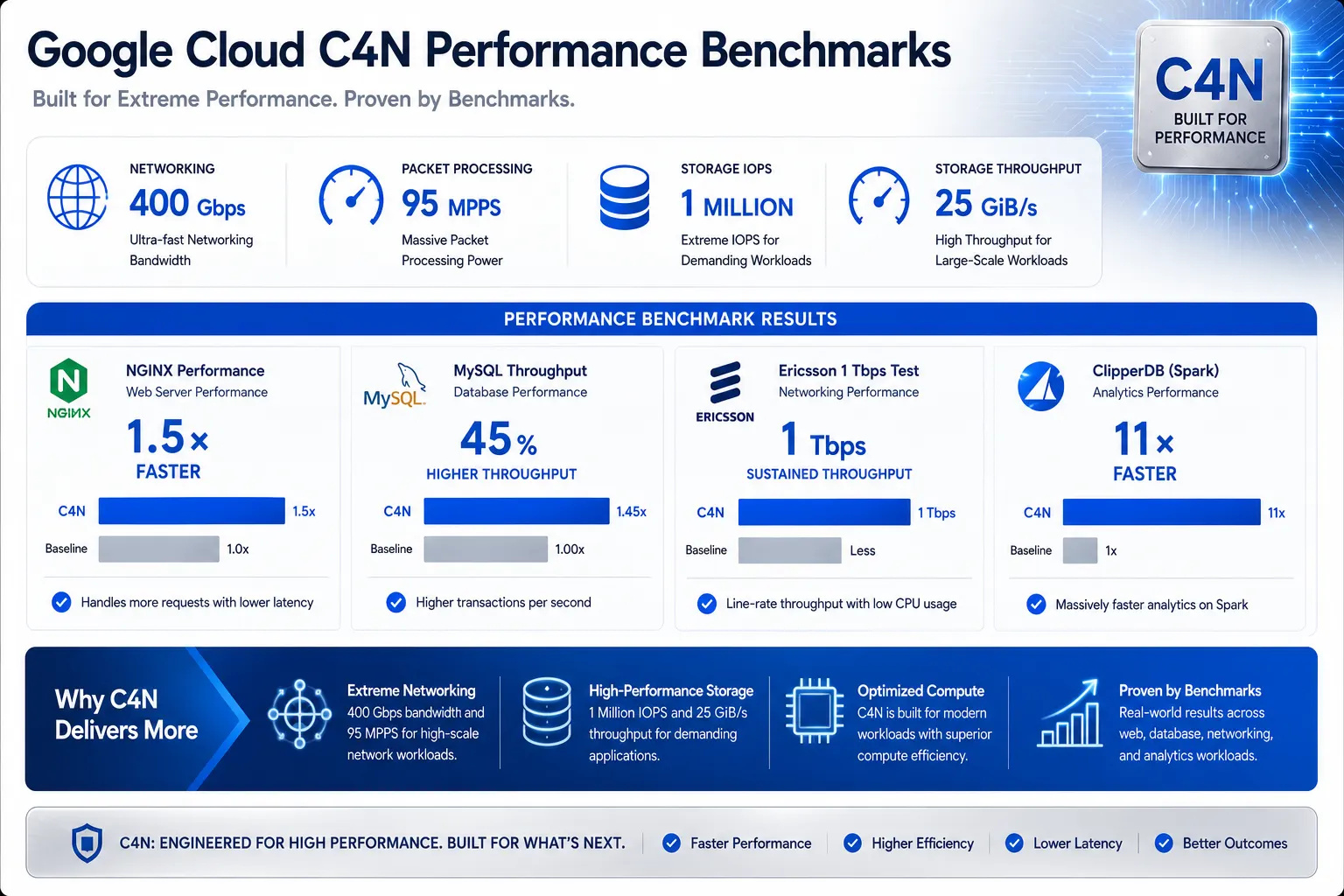
Google shared benchmark improvements demonstrating C4N's capabilities across common enterprise workloads.
Examples include:
Web Serving
Up to 1.5× more NGINX requests per second compared with standard C4 virtual machines.
Database Performance
Up to 45% higher MySQL queries per second when datasets primarily reside on disk.
These improvements allow organizations to handle greater workloads while reducing infrastructure costs.
Customer Success Stories
Several industry leaders are already deploying C4N across demanding enterprise environments.
Ericsson
Ericsson uses C4N to power its cloud-native 5G Core-as-a-Service, achieving 1 Tbps throughput while maintaining carrier-grade reliability for telecommunications workloads.
Teradata
Teradata integrates C4N into its Autonomous Knowledge Platform to improve price-performance for AI, analytics, and mission-critical enterprise databases.
NetApp
NetApp is expanding support for C4N to accelerate data-in-place AI and analytics using Google Cloud NetApp Volumes.
Sycomp
In internal testing, Sycomp achieved:
58.5 GiB/s read throughput using three storage servers
195 GiB/s read and write throughput using ten storage servers
These results reached approximately 97% of theoretical maximum storage performance.
ClipperDB Technologies
Running industry-standard TPC-DS analytics benchmarks, ClipperDB reported:
More than 3× lower cost per query
Up to 11× faster Spark analytics
while maintaining full Apache Spark compatibility.
Flexible Configurations for Every Enterprise
The C4N machine family offers extensive deployment flexibility.
Available configurations include:
2 to 192 vCPUs
Up to 1.5 TB DDR5 memory
High CPU
Standard
High Memory
Local SSD variants
Future enhancements will include:
Up to 12 TiB Titanium Local SSD
Native bare-metal C4N servers
Expanded service support beyond Compute Engine and Google Kubernetes Engine (GKE)
These options allow organizations to tailor infrastructure for everything from lightweight networking appliances to memory-intensive analytics clusters.
Lower Total Cost of Ownership
One of C4N's biggest advantages is eliminating unnecessary overprovisioning.
Traditionally, organizations needing higher networking throughput often had to purchase significantly larger virtual machines simply to obtain additional bandwidth.
C4N separates compute performance from networking and storage scaling, enabling organizations to provision resources more precisely.
This results in:
Better infrastructure utilization
Lower operational costs
Reduced cloud spending
Higher workload density
Improved performance predictability
For enterprises running large-scale production environments, these efficiencies can substantially reduce the total cost of ownership over time.
Final Thoughts
The general availability of Google Cloud C4N marks an important milestone for infrastructure designed around data movement rather than raw compute alone.
By combining Titanium offload architecture, 5th Generation Intel Xeon processors, 400 Gbps networking, and Hyperdisk Extreme, Google delivers one of the industry's most capable x86 cloud platforms for networking, storage, analytics, AI inference, and telecommunications workloads.
As enterprise applications continue demanding higher throughput with predictable performance, C4N provides organizations with a scalable foundation that improves efficiency, reduces infrastructure bottlenecks, and lowers total cost of ownership across modern cloud deployments.
Source: Google Cloud Blog
About the Author