
Google Cloud Enhances BigQuery With Autonomous Performance Optimizations for the Agentic AI Era
Google Cloud has introduced new autonomous capabilities for BigQuery, including self-learning query optimization, advanced runtime enhancements, and fluid scaling to improve performance and reduce costs for AI and analytics workloads.
Xcademia Team
Xcademia Research Team
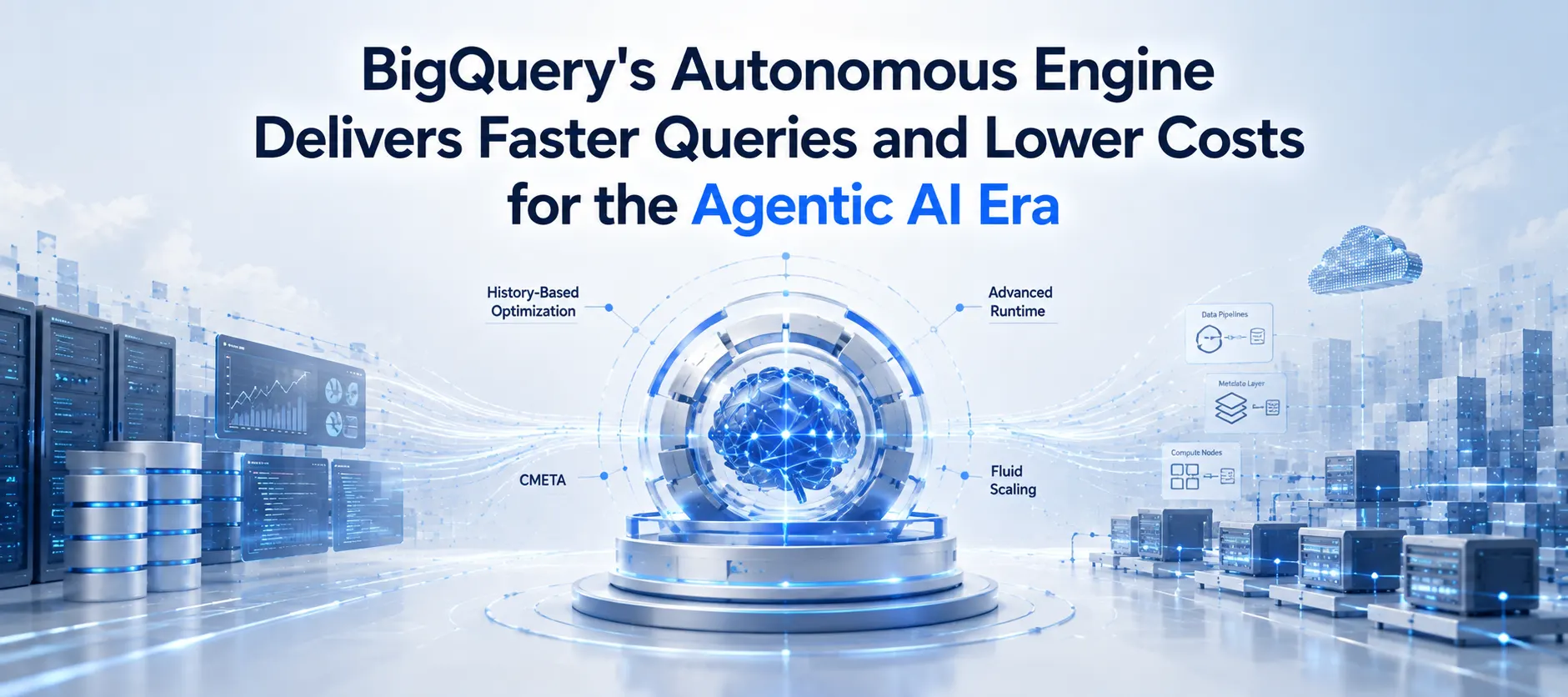
BigQuery Evolves for the Agentic AI Era
As organizations increasingly adopt AI-powered applications and autonomous software agents, the demands placed on modern data platforms continue to grow. Analytics systems are no longer supporting only business analysts running scheduled reports. Instead, they are increasingly serving AI agents that generate thousands of queries every minute, requiring consistent performance, low latency, and efficient resource utilization.
To address these evolving requirements, Google Cloud has announced a series of enhancements to BigQuery, expanding its autonomous query processing capabilities to deliver better price-performance with minimal user intervention.
According to Google Cloud, BigQuery now combines self-learning query optimization, advanced runtime improvements, and enhanced autoscaling to automatically improve query execution while reducing compute costs. The company says these capabilities contributed to up to 35% better query performance and as much as 40% lower query processing costs, measured by slot usage, during 2025.
Rather than requiring administrators to continually tune queries, modify schemas, or analyze execution plans, Google Cloud's latest enhancements are designed to help BigQuery optimize itself automatically as workloads evolve.
The announcement reflects Google's broader vision of building an autonomous data platform capable of supporting both human users and increasingly demanding agentic AI workloads.
The Growing Challenge of Query Optimization
Query performance tuning has traditionally been one of the most time-consuming responsibilities for database administrators and data engineers.
Maintaining optimal performance often requires teams to examine execution plans, adjust schemas, update statistics, and fine-tune SQL queries as datasets continue to grow in size and complexity.
These activities become significantly more difficult as organizations process larger data volumes and support a wider variety of workloads.
According to Google Cloud, the emergence of agentic AI introduces an additional layer of complexity.
Unlike human users who may execute a limited number of analytical queries each day, AI agents can automatically generate thousands of unique queries every minute in response to user interactions or real-time events.
In these environments, manual optimization becomes increasingly impractical.
Google Cloud argues that modern analytics platforms should evolve beyond traditional performance tuning by becoming capable of learning from workloads and optimizing themselves without requiring ongoing administrator intervention.
This vision forms the foundation of BigQuery's autonomous query processor.
BigQuery's Self-Learning History-Based Optimizations
One of the primary enhancements announced by Google Cloud is the continued expansion of History-Based Optimizations (HBO).
Traditional query optimizers typically rely on metadata, table statistics, and cardinality estimates when selecting execution plans. While effective in many scenarios, these approaches can become less accurate when workloads involve complex joins, changing datasets, or uneven data distributions.
Google Cloud explains that History-Based Optimizations introduce a different approach.
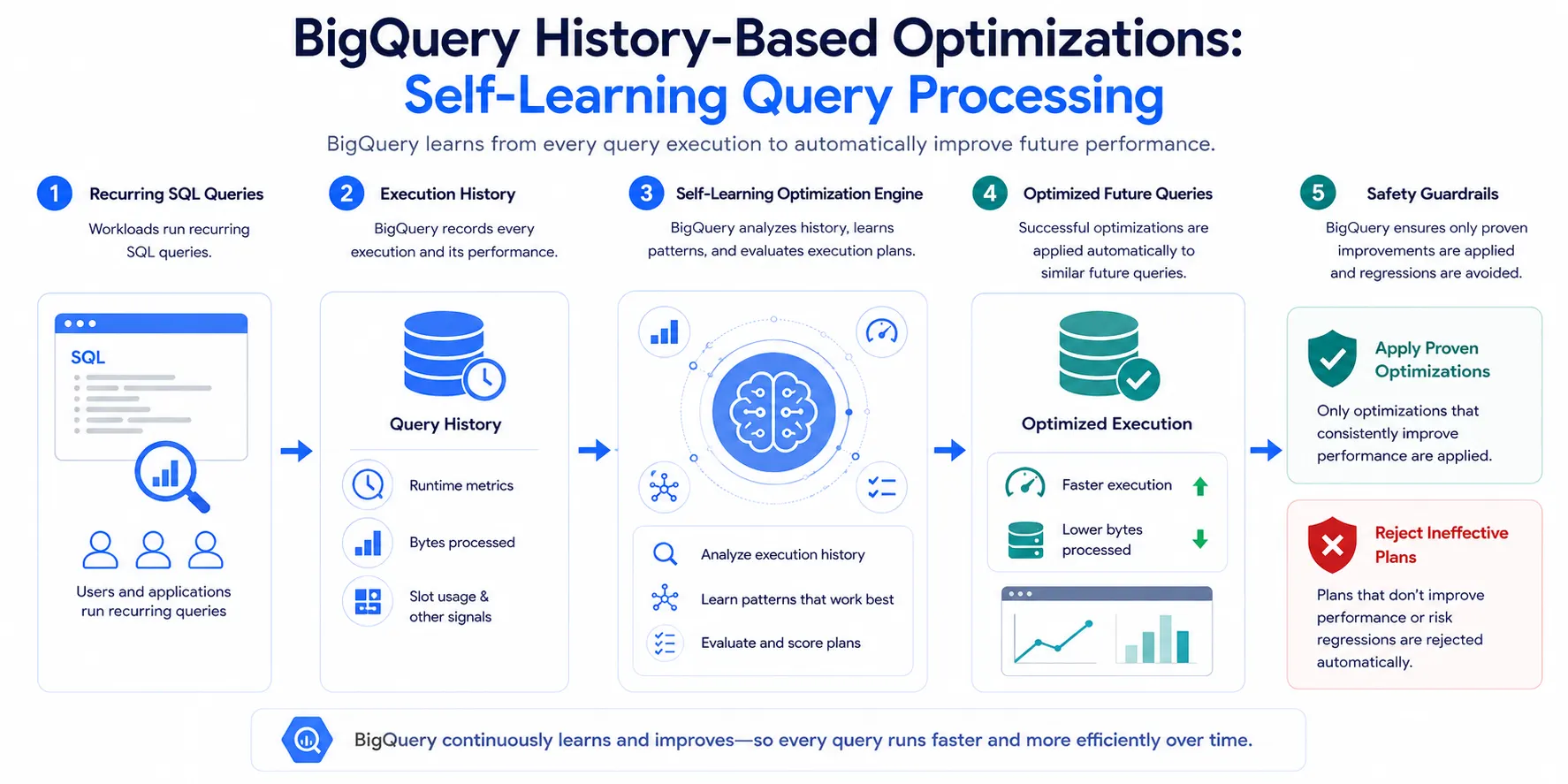
Instead of relying solely on static statistics, BigQuery continuously learns from previous query executions.
The system records runtime behavior, evaluates which execution strategies produced the best outcomes, and automatically applies successful optimizations when similar queries are executed again.
Likewise, if an optimization fails to improve performance or causes regression, BigQuery automatically rejects that strategy and avoids using it for the same query in future executions.
According to Google Cloud, this creates a self-improving optimization cycle that becomes more effective over time without requiring manual tuning.
Unlike traditional optimization methods, users do not need to rewrite SQL statements, redesign schemas, or modify applications to benefit from these improvements.
The enhancements are applied automatically behind the scenes.
Google Cloud says this allows recurring dashboards, ELT pipelines, business applications, and agentic AI workloads to improve performance with no changes to existing workflows.
Built-In Safety Guardrails Reduce Performance Regressions
Google Cloud says History-Based Optimizations are designed as a self-maintaining, closed-loop system that applies optimizations only when there is a high degree of confidence they will improve performance.
After an optimization is applied, BigQuery evaluates the outcome automatically.
If the optimization delivers the expected improvement, it is retained for future executions.
If performance does not improve, or if the optimization introduces regressions or execution failures, BigQuery automatically revokes that optimization and avoids applying it again for similar queries.
The system also detects data skew and parameter-sensitive execution plans, helping prevent situations where changes to query parameters, such as different WHERE clause values, could negatively affect performance.
According to Google Cloud, one enterprise customer reported up to a 50% reduction in P90 query execution times alongside up to a 15% reduction in slot usage, demonstrating improvements in both performance and cost efficiency without observed regressions.
Advanced Runtime Brings Autonomous Performance Improvements
Beyond its self-learning query optimizer, Google Cloud has also enhanced BigQuery's execution engine through Advanced Runtime, enabling the platform to automatically select more efficient execution paths without requiring manual configuration.
According to Google Cloud, these runtime improvements help BigQuery optimize how queries are processed at the execution layer, improving both latency and resource efficiency for a wide variety of analytics workloads.
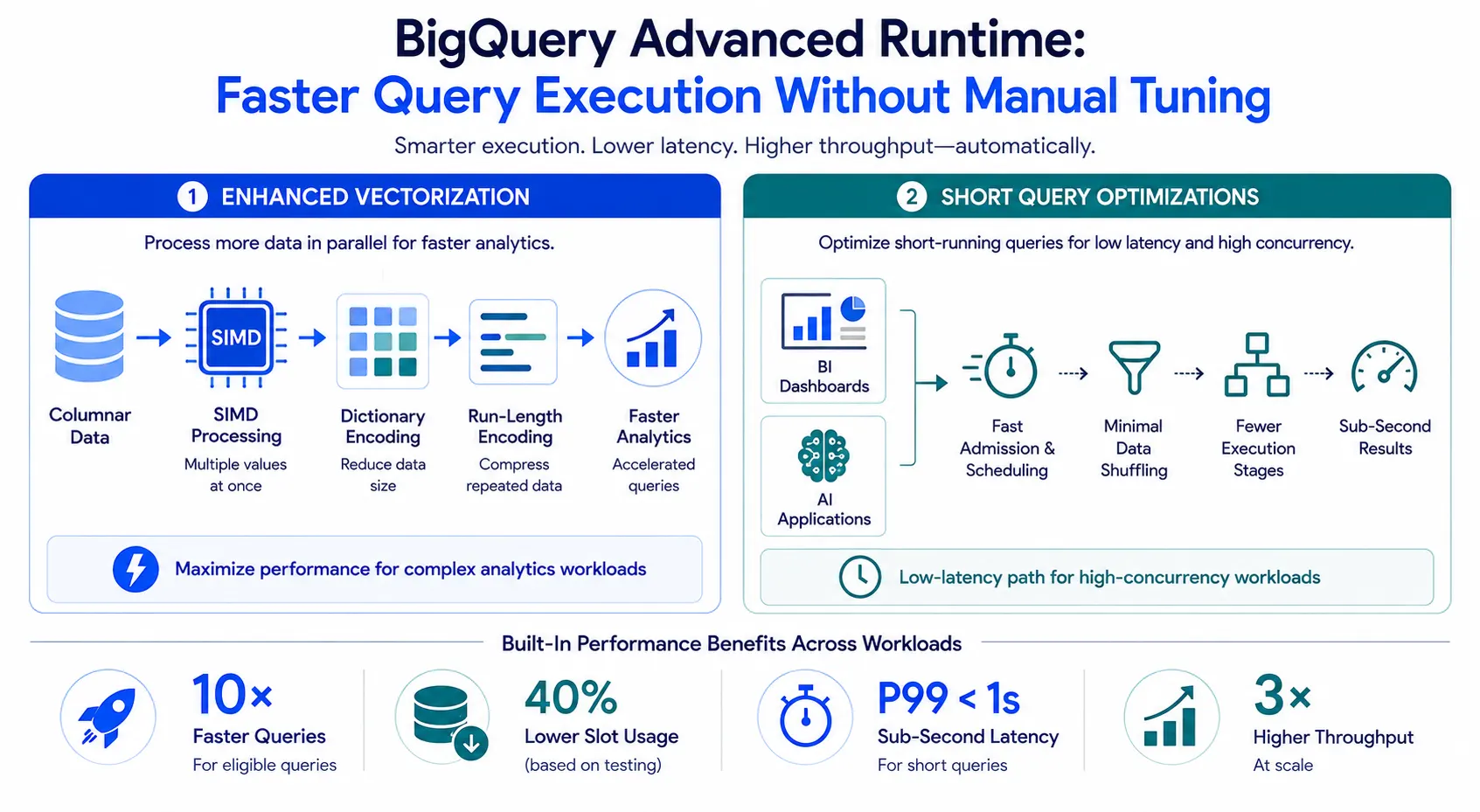
The company highlights two major capabilities introduced within Advanced Runtime: Enhanced Vectorization and Short Query Optimizations.
(1) Enhanced Vectorization Improves Query Execution Efficiency
Vectorized query execution has long been used to accelerate analytical processing by handling multiple data values simultaneously rather than one at a time.
Google Cloud explains that BigQuery has further enhanced this capability by taking advantage of newer processor technologies, including Single Instruction Multiple Data (SIMD) instructions.
Rather than performing repetitive calculations for individual records, the updated execution engine can automatically identify opportunities to avoid duplicate computations while processing data stored in dictionary and run-length encoded formats.
According to Google Cloud, the runtime also combines these optimizations with advanced parallel algorithms, allowing qualifying query stages to execute more efficiently.
These enhancements are applied automatically without requiring developers to modify SQL queries or adjust execution settings.
Google Cloud reports that Enhanced Vectorization can accelerate eligible queries by up to 10 times, while reducing overall slot consumption by up to 40%.
For organizations running large-scale analytical workloads, these improvements can translate into faster execution and lower infrastructure costs without requiring additional administrative effort.
(2) Short Query Optimizations Reduce Latency for High-Concurrency Workloads
Modern business intelligence dashboards and AI-powered applications increasingly depend on thousands of lightweight queries that must complete in milliseconds.
Google Cloud notes that traditional distributed processing architectures can introduce unnecessary overhead for these short-running queries because they involve multiple execution stages and data movement across distributed systems.
To address this challenge, BigQuery now automatically identifies eligible short queries and executes them using a more efficient processing path.
According to Google Cloud, this optimization reduces the number of execution stages and minimizes data shuffling while maintaining compatibility with other concurrent workloads.
The company describes this approach as transparently introducing an efficient symmetric multiprocessing (SMP) execution path within BigQuery's massively parallel processing (MPP) architecture.
Google Cloud says these optimizations can reduce slot usage for eligible short queries by up to 10 times, while helping achieve P99 sub-second query latency.
Because individual queries consume compute resources for shorter periods, some customer workloads have also experienced up to three times higher throughput, allowing more queries to be processed simultaneously without increasing infrastructure complexity.
Like other autonomous capabilities, these optimizations operate automatically and require no application changes.
Autonomous Optimizations Extend to Open Data Formats
Google Cloud also emphasized that BigQuery's autonomous performance improvements are not limited to data stored in its native storage format.
As more organizations adopt open lakehouse architectures using formats such as Apache Iceberg, maintaining consistent query performance across different storage systems has become increasingly important.
According to Google Cloud, BigQuery applies the same autonomous optimization techniques regardless of whether data is stored in native BigQuery Capacitor tables or Iceberg tables backed by Parquet files.
These optimizations include automatic:
Filter pushdown
Column Metadata Index (CMETA) pruning
Page skipping
Asynchronous reads
Enhanced Vectorization
By extending these capabilities to open table formats, Google Cloud aims to ensure that organizations adopting open lakehouse architectures do not have to sacrifice performance or cost efficiency.
This consistent optimization approach allows enterprises to take advantage of open storage formats while continuing to benefit from BigQuery's autonomous query processing engine.
Fluid Scaling Improves Autoscaling Efficiency
In addition to query optimization, Google Cloud has enhanced BigQuery's autoscaling capabilities through Fluid Scaling, designed to improve both performance and infrastructure efficiency for highly variable workloads.
Unlike traditional compute models that allocate fixed clusters or reserved nodes, BigQuery measures compute consumption based on slot-seconds, allowing resources to scale according to actual workload demand.
Google Cloud explains that Fluid Scaling enables true per-second billing for compute resources while dynamically adjusting capacity without requiring administrators to manually manage scaling decisions.
According to the company, this approach lowers infrastructure costs by up to 34% on average for autoscaling workloads.
Google Cloud also shared feedback from RISE, an advertising technology company that processes more than 1 PB of data each day and manages over 3 trillion monthly advertising bids.
According to the company, adopting Fluid Scaling reduced infrastructure costs by 25% while increasing hourly data processing throughput, allowing faster model execution and fresher data for customers.
These improvements complement BigQuery's autonomous query optimization capabilities by ensuring that compute resources scale efficiently alongside changing analytics workloads.
The Foundation for the Agentic Future
Google Cloud positions these autonomous capabilities as foundational technologies for the next generation of modern data platforms.
As organizations continue deploying AI and machine learning solutions, analytics workloads are increasingly shifting toward agentic applications that generate queries autonomously rather than relying solely on human users.
According to Google Cloud, AI agents interact with data very differently from people. They require significantly higher query concurrency and lower latency, often issuing thousands of distinct queries every second to support real-time decision-making.
Traditional analytics platforms were not designed for workloads at this scale, making manual query tuning increasingly impractical.
Google Cloud says BigQuery's self-learning query optimization, adaptive execution engine, and built-in safety guardrails are designed to meet these demands automatically, allowing organizations to focus on developing AI-powered applications instead of continuously managing infrastructure or optimizing individual queries.
BigQuery's Aggregate TCO Impact
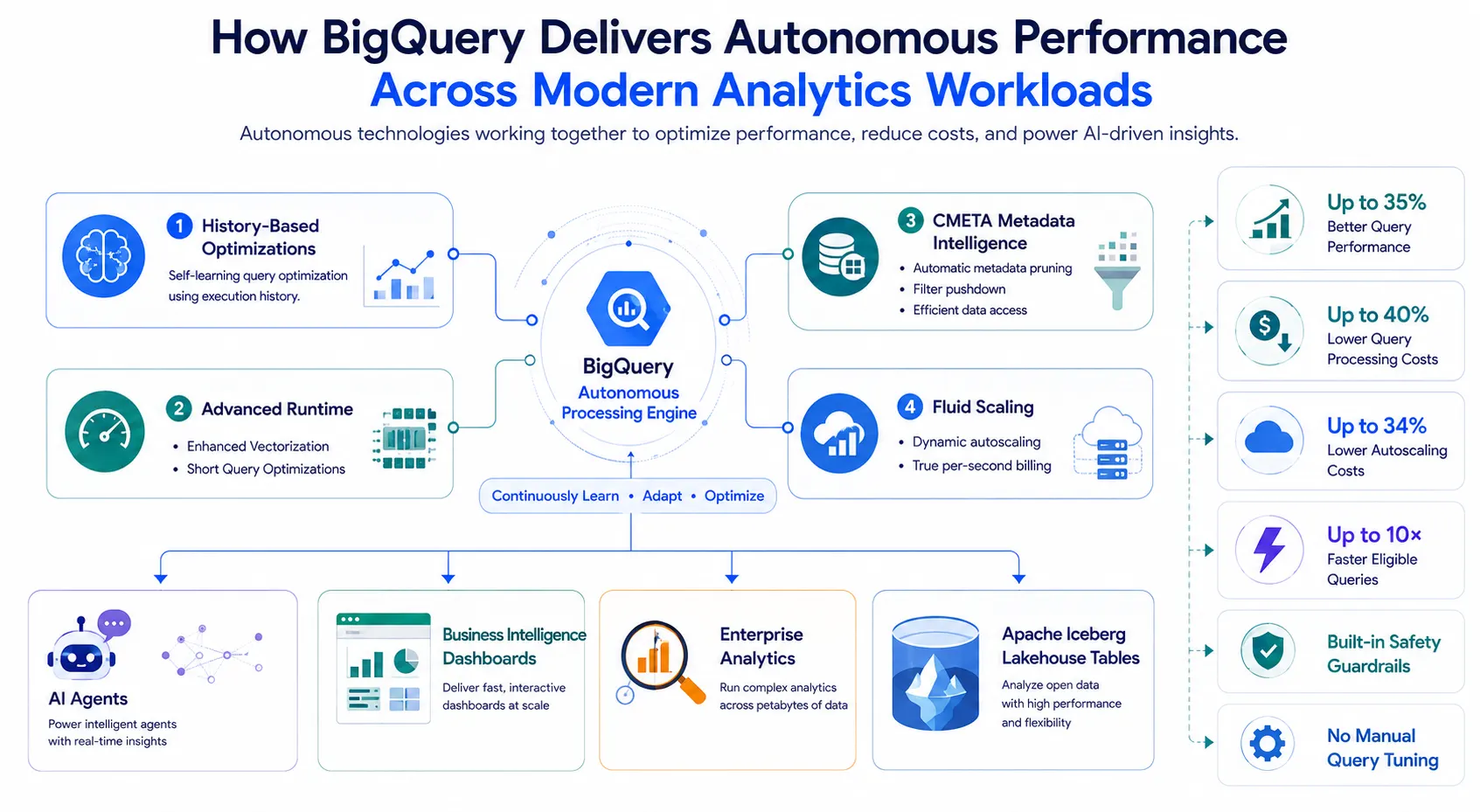
Google Cloud says the overall improvements in BigQuery's price-performance are the result of multiple autonomous capabilities working together.
The company combines History-Based Optimizations, Advanced Runtime, Fluid Scaling, and its highly scalable Column Metadata Index (CMETA) platform to continuously improve query execution while reducing infrastructure costs.
Together, these technologies help optimize execution plans, improve runtime efficiency, minimize unnecessary compute usage, and automatically scale resources based on workload demand.
According to Google Cloud, this integrated approach contributes to better overall performance while lowering total cost of ownership (TCO) for analytics workloads without requiring ongoing manual optimization.
Final Thoughts
Google Cloud's latest BigQuery enhancements represent another step toward autonomous analytics infrastructure designed for the growing demands of the Agentic AI era.
By introducing self-learning query optimization, runtime execution improvements, support for open data formats, and more efficient autoscaling, the company aims to reduce the operational burden traditionally associated with query tuning and infrastructure management.
According to Google Cloud, these capabilities have already contributed to up to 35% better query performance, as much as 40% lower query processing costs, and up to 34% lower autoscaling costs for qualifying workloads.
As AI agents become increasingly responsible for generating large volumes of analytical queries, Google Cloud believes autonomous optimization will become an essential capability for modern data platforms, enabling organizations to improve performance, control costs, and focus on building intelligent applications rather than managing database infrastructure.
Source: Google Cloud Blog
About the Author