
Google Cloud and Panasonic Accelerate Software-Defined Vehicle Development With Virtual Cockpits
Google Cloud and Panasonic Automotive Systems have validated vSkipGen™ on C4A-metal, enabling automakers to build, test, and validate Android Automotive OS cockpit experiences using cloud-based digital twins, reducing reliance on physical vehicle prototypes.
Xcademia Team
Xcademia Research Team
Accelerating Software-Defined Vehicle Innovation With Cloud-Based Cockpit Virtualization
The automotive industry is rapidly moving toward software-defined vehicles, where software plays a central role in delivering advanced driving experiences, connected services, and personalized in-cabin features.
At the heart of this transformation are Cockpit Domain Controllers (CDCs), which combine multiple vehicle functions into powerful computing platforms capable of supporting modern infotainment systems, digital dashboards, connectivity features, and intelligent user experiences.
However, developing and validating CDC software has traditionally depended on expensive physical prototypes. Hardware availability, global engineering collaboration, and the complexity of high-performance graphics environments can slow down development cycles and limit innovation.
To address these challenges, Panasonic Automotive Systems has introduced vSkipGen™, a next-generation CDC virtualization platform now validated on Google Cloud C4A-metal, the company’s Axion-based bare metal infrastructure.
By combining Panasonic Automotive’s Unified HMI™ remote GPU offload technology with support for Android Automotive OS (AAOS) and Android software-defined vehicles, vSkipGen provides a cloud-native environment where automotive teams can develop, test, and validate cockpit software without depending on physical hardware.
This approach enables manufacturers to move from hardware-dependent development toward scalable digital twins that closely replicate real vehicle environments.
Google Cloud C4A-metal Provides High-Performance Infrastructure for Automotive Development
Modern vehicle software requires powerful computing resources capable of handling complex simulations, graphics workloads, and large-scale testing environments.
Google Cloud’s C4A-metal instances are designed for demanding workloads by combining the performance of bare metal infrastructure with the flexibility of cloud deployment.
Built on Google Cloud’s custom Arm-based Axion architecture, C4A-metal provides:
96 vCPUs for high-performance computing workloads
DDR5 memory configurations with up to 768GB capacity
Up to 100Gbps networking bandwidth
Support for Google Cloud Hyperdisk storage options
Titanium-powered infrastructure for security and multi-tier workload offloads
This combination allows automotive developers to run complex cockpit virtualization workloads with performance closer to dedicated hardware environments.
For software-defined vehicle development, this capability is especially important because digital cockpit systems require accurate simulation of real-world behavior before physical vehicle platforms are available.
Cloud-Based Digital Twins Reduce Automotive Hardware Limitations
Traditional automotive software development often requires access to physical cockpit hardware for testing and validation.
This creates several challenges:
Limited availability of prototype vehicles
High hardware costs
Delayed testing cycles
Difficulty supporting distributed global engineering teams
C4A-metal helps overcome these limitations by providing the performance and hardware-level access of bare metal infrastructure while maintaining the scalability of cloud computing.
Panasonic Automotive uses C4A-metal to run vSkipGen workloads, enabling engineering teams to develop production-intent cockpit software in the cloud while maintaining behavior that closely matches target automotive hardware.
This cloud-to-car compatibility helps manufacturers improve validation efficiency, increase testing coverage, and accelerate time-to-market for next-generation cockpit platforms.
“Google Cloud’s Axion Bare Metal has been a game-changer for our vSkipGen™ platform. By providing scalable, high-performance Arm-based infrastructure, C4A-metal allows our teams to develop and test production-intent software in the cloud with behavior that closely matches target automotive hardware.”
Andrew Poliak, CTO, Panasonic Automotive Systems America
By combining vSkipGen, Unified HMI, and C4A-metal, automotive manufacturers can create scalable digital twins for cockpit systems and reduce dependence on physical prototypes.
Why Digital Twins Are Becoming Essential for Software-Defined Vehicles
Software-defined vehicles require frequent software updates throughout their lifecycle, making continuous testing more important than ever. Digital twins allow manufacturers to validate new features, security patches, and interface updates in virtual environments before deploying them to physical vehicles. This reduces development risk while helping engineering teams identify potential issues earlier.
Unlike traditional development processes that depend on limited prototype vehicles, digital twins can be replicated on demand across cloud infrastructure. Multiple teams can work on different software components simultaneously without competing for hardware resources, improving productivity across global engineering organizations.
As automotive software becomes increasingly complex, cloud-based digital twins also support large-scale regression testing. Manufacturers can evaluate how changes to infotainment systems, navigation, connectivity features, or driver interfaces affect the broader software stack before releasing updates to production vehicles.
This combination of scalability, repeatability, and hardware independence makes digital twins an important foundation for the next generation of software-defined vehicle development.
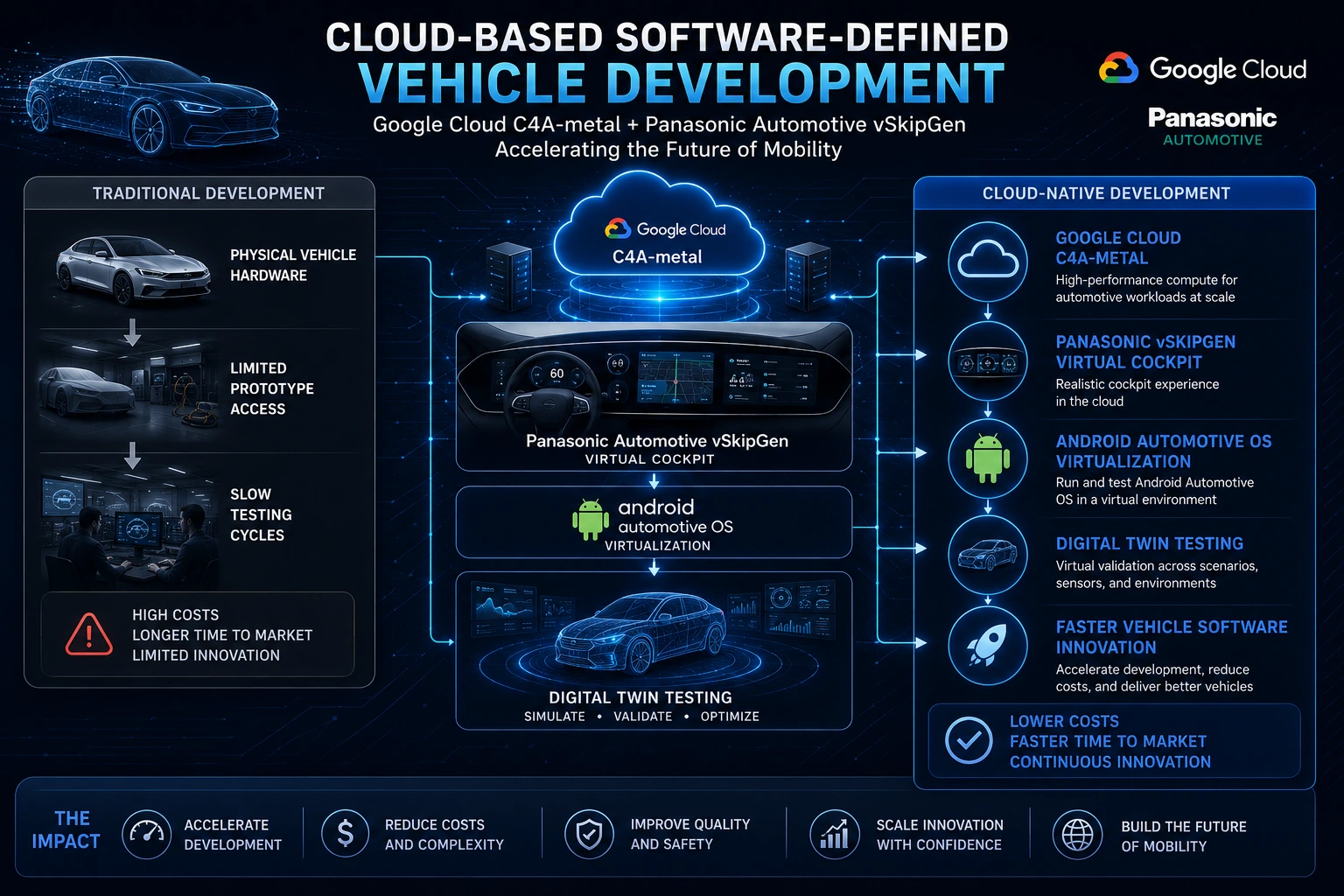
Why Cloud-Native Development Matters for Modern Automotive Engineering
The transition to software-defined vehicles is reshaping how automotive software is built and validated. Unlike traditional vehicle development, where hardware prototypes are required early in the process, cloud-native environments allow engineering teams to begin software development much earlier in the vehicle lifecycle.
By virtualizing cockpit hardware in the cloud, developers can build, test, and refine Android Automotive OS applications before production hardware is available. This shortens development timelines and enables continuous integration and continuous delivery (CI/CD) practices that have become standard across modern software engineering.
Cloud-based development also improves collaboration across globally distributed engineering teams. Developers, testers, and system architects can work within the same virtual environment regardless of their physical location, helping manufacturers accelerate innovation while maintaining consistent testing standards.
For automakers building increasingly complex digital experiences, cloud-native development provides the flexibility needed to iterate quickly without sacrificing reliability or performance.
How vSkipGen Virtualizes the Automotive Cockpit
Panasonic Automotive’s vSkipGen acts as a digital twin of physical Cockpit Domain Controller hardware.
The platform creates a hardware-independent environment where developers can run Android Automotive OS software and validate vehicle experiences before physical systems are available.
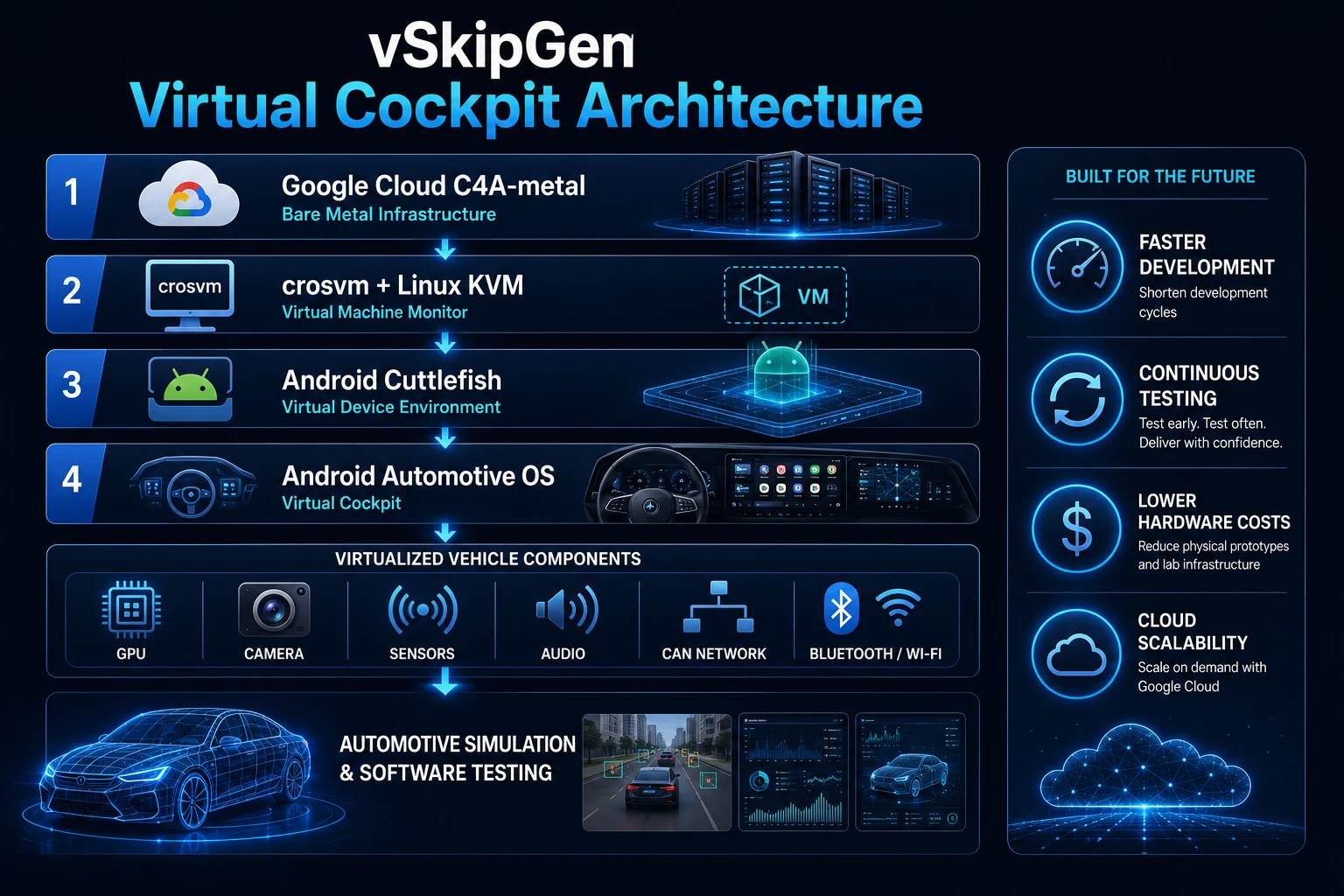
To achieve this, vSkipGen uses components from Android Cuttlefish, an open-source Android virtualization platform designed for running Android environments on virtual hardware.
At the core of vSkipGen is a cloud-optimized Virtual Machine Monitor (VMM) built on crosvm, the security-focused virtualization technology originally developed for Chrome OS.
The VMM uses Linux KVM hardware-assisted virtualization and is implemented in Rust to improve security, scalability, and performance.
Running the complete environment on C4A-metal allows developers to boot a full Android Automotive OS image in the cloud that behaves similarly to software running inside a physical vehicle.
Virtualizing Vehicle Hardware With Cuttlefish and VirtIO
A major challenge in vehicle software development is accurately replicating the hardware environment that applications depend on.
Panasonic Automotive’s vSkipGen addresses this challenge by virtualizing essential cockpit components using the VirtIO standard, allowing software teams to interact with virtual devices in the same way they would with physical vehicle hardware.
The platform virtualizes critical cockpit components, including:
Audio systems
GPU resources
Sensors and cameras
Controller Area Network (CAN)
Bluetooth connectivity
Wi-Fi communication
This hardware-independent approach enables developers to test complete Android Automotive OS stacks without waiting for early vehicle prototypes.
vSkipGen also integrates with automotive simulation platforms and software-in-the-loop (SiL) environments, allowing engineering teams to validate complex driving scenarios, test edge cases, and run automated validation workflows entirely in the cloud.
By removing hardware dependencies, manufacturers can increase test coverage while enabling distributed engineering teams to collaborate more efficiently.
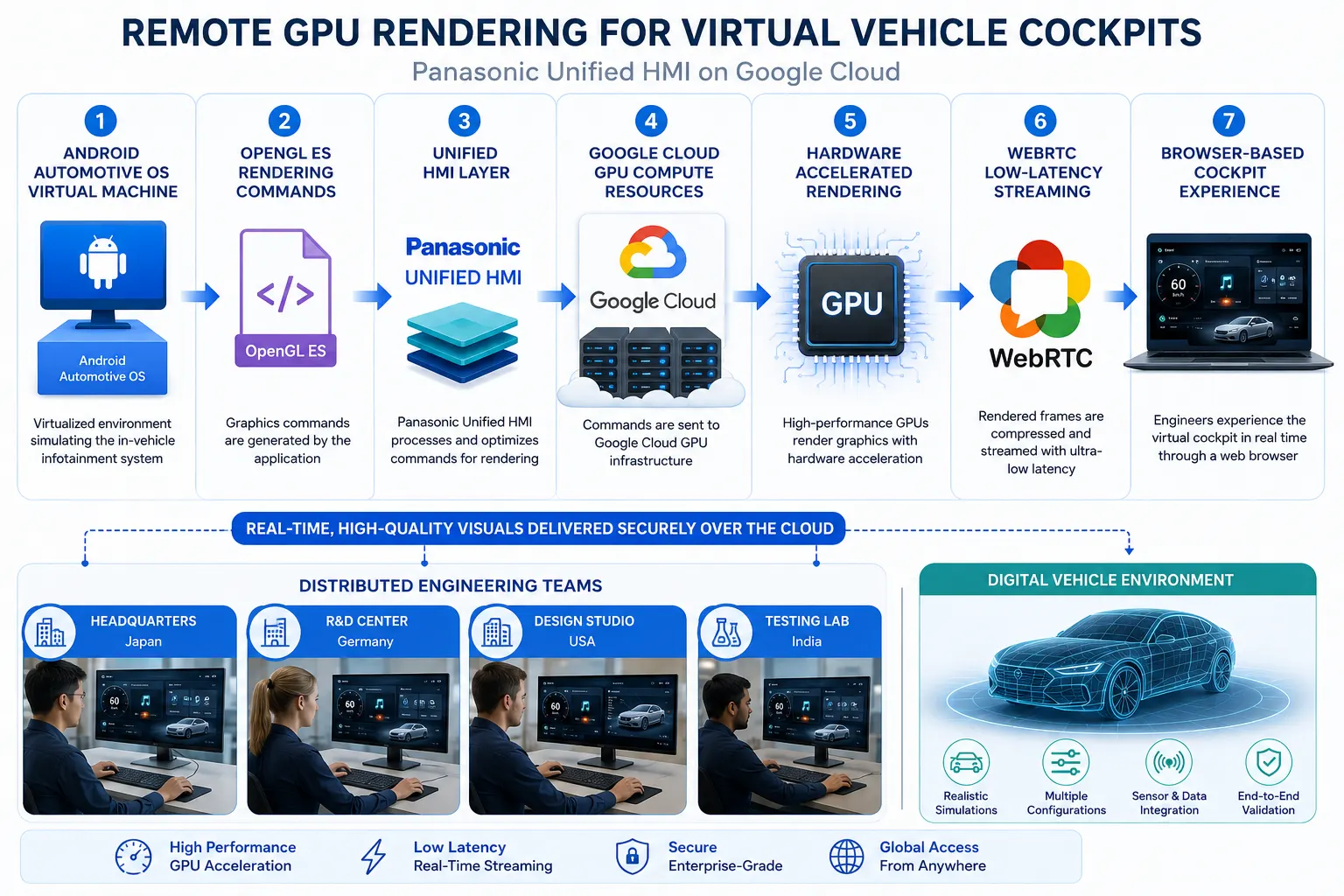
Accelerating Automotive Graphics With Unified HMI Remote GPU Technology
High-performance graphics are becoming a defining element of modern vehicle experiences.
Digital dashboards, infotainment displays, navigation systems, and personalized cockpit interfaces require advanced rendering capabilities. However, delivering realistic graphics inside a virtualized environment remains a significant technical challenge.
Panasonic Automotive’s Unified HMI™ technology addresses this challenge by separating user interface rendering from specific hardware environments.
A lightweight Unified HMI component operates outside the virtual machine and offloads OpenGL ES rendering commands from the Android Cuttlefish instance to GPU-equipped compute resources running on Google Cloud.
The cloud GPU infrastructure handles graphics processing with hardware acceleration, while the final rendered interface is streamed to users through standard browsers using low-latency WebRTC technology.
This allows global engineering teams to experience high-fidelity cockpit visuals in real time, regardless of location.
Unified HMI also creates a unified virtual display layer across multiple Electronic Control Units (ECUs) and virtual machines, enabling applications to render across different displays within the vehicle system.
Enabling Global Collaboration Through Cloud-Based Cockpit Development
One of the biggest advantages of running cockpit virtualization on Google Cloud is the ability to support globally distributed engineering teams. Instead of relying on locally installed development environments or limited physical hardware, developers can securely access the same virtual cockpit environment from anywhere with an internet connection.
Panasonic Automotive's Unified HMI technology further enhances this experience by streaming hardware-accelerated cockpit interfaces to standard web browsers using low-latency WebRTC. This allows engineers, designers, testers, and validation teams to interact with high-fidelity Android Automotive OS environments in real time without requiring specialized workstation hardware. A shared cloud-based environment also improves collaboration between software teams working across different regions. Developers can validate new features, reproduce software issues, and verify fixes using identical virtual cockpit configurations, reducing inconsistencies that often occur when testing across multiple hardware platforms.
For automotive manufacturers, this approach helps accelerate development while improving testing efficiency. Teams can collaborate on software updates earlier in the development cycle, execute validation workflows in parallel, and reduce delays caused by limited prototype availability. As software-defined vehicles continue to evolve, cloud-native collaboration will play an increasingly important role in delivering reliable cockpit experiences to production vehicles.
Supporting Continuous Testing Throughout the Vehicle Software Lifecycle
As vehicle software grows more sophisticated, validation must extend beyond individual applications to the entire cockpit ecosystem. Modern infotainment systems, digital instrument clusters, voice assistants, navigation platforms, and connected services all interact within the same software environment.
Panasonic Automotive's vSkipGen enables manufacturers to run multiple isolated virtual cockpit instances simultaneously, allowing teams to execute automated regression tests, compatibility checks, and large-scale validation workflows without requiring dedicated physical hardware.
This capability is particularly valuable for organizations adopting DevOps methodologies. Engineering teams can integrate virtual cockpit testing directly into CI/CD pipelines, identify software issues earlier, and validate updates continuously throughout development.
By combining virtualization with scalable cloud infrastructure, manufacturers can improve software quality while reducing testing bottlenecks that traditionally delay vehicle programs.
Benefits for Software-Defined Vehicle Development
By combining Google Cloud C4A-metal with Panasonic Automotive’s vSkipGen platform, manufacturers gain a scalable environment for developing next-generation cockpit experiences.
Key benefits include:
Build and validate Android Automotive OS software in the cloud before physical hardware becomes available
Use VirtIO-based virtualization for production-grade cockpit device testing
Stream interactive cockpit experiences to engineering teams through any browser
Run multiple isolated cockpit environments for large-scale automated testing and CI/CD workflows
Reduce dependence on expensive physical prototypes and support more sustainable development practices
Build on open technologies including crosvm and Rust for improved security and long-term adaptability
This cloud-native approach enables automotive companies to accelerate innovation while maintaining the reliability and performance required for production vehicle systems.
Building the Future of Cloud-Native Vehicle Software
Software-defined vehicles require a new approach to automotive engineering.
As vehicles become increasingly software-driven, manufacturers need development environments that support rapid innovation, large-scale testing, and global collaboration.
The collaboration between Google Cloud and Panasonic Automotive demonstrates how cloud infrastructure and automotive virtualization can remove traditional hardware limitations.
With C4A-metal providing high-performance Arm-based infrastructure and vSkipGen delivering a virtualized cockpit environment, engineering teams can create digital twins that closely replicate real vehicle behavior.
This enables manufacturers to accelerate software development, improve validation processes, and deliver advanced cockpit experiences faster.
The future of automotive innovation will depend on the ability to develop, test, and optimize vehicle software before it reaches the road. Cloud-native platforms like C4A-metal and vSkipGen are helping manufacturers move closer to that vision.
Source: Google Cloud Blog
About the Author