
Google Cloud Adds AI-Powered Quick Assessments to Migration Center
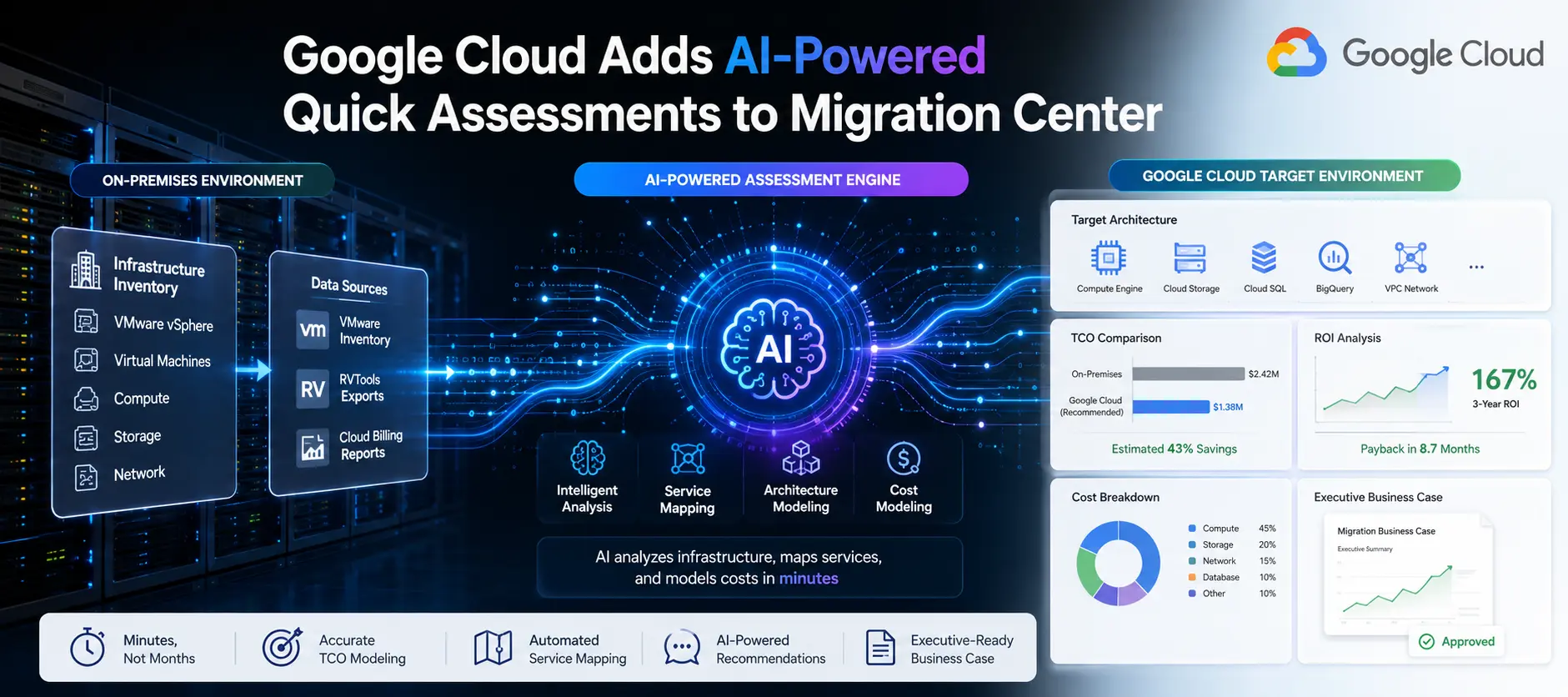
Google Cloud has introduced AI-powered Quick Assessments in Migration Center to accelerate infrastructure discovery, TCO modeling, service mapping and migration business-case development.
Xcademia Team
Xcademia Research Team
Google Cloud Brings AI Into the Early Stages of Cloud Migration
Google Cloud has introduced new AI-powered Quick Assessments in Migration Center, giving organizations a faster way to evaluate infrastructure modernization projects and build migration business cases.
The announcement focuses on a familiar challenge for large IT organizations: before a company can migrate or modernize its infrastructure, it needs to understand what it currently operates, what the target environment could look like and how much that transition may cost.
That discovery process can involve infrastructure inventories, spreadsheets, cloud billing information, service mapping and financial calculations spread across different teams.
Google Cloud says its new capabilities are designed to reduce that manual work through AI-assisted automation.
With the new Quick Assessments, organizations can ingest raw infrastructure data or cloud billing reports and receive migration-related financial and technical outputs. These include a recommended bill of materials (BOM), service mapping coverage and projected savings.
The updated Migration Center also includes an agentic assistant that can explain financial assumptions, recommend technical cost optimizations and generate business-case reports for decision makers.
The company positions the update as a way to help organizations move from infrastructure discovery to migration planning more quickly.
Why Migration Assessment Has Become a Critical Step
Cloud migration is rarely just a technical exercise.
Before workloads move, organizations typically need to establish what infrastructure exists, understand how workloads depend on each other, determine suitable target services and estimate the financial impact of a potential migration.
These activities can become particularly complex in large enterprise environments where infrastructure information and cost data may come from multiple systems and teams.
Google Cloud says traditional assessment processes can involve weeks of manual spreadsheet analysis, infrastructure mapping and reconciliation of fragmented cost estimates.
The company argues that this can slow modernization initiatives before the migration itself even begins.
The new approach attempts to shift that initial process toward automated analysis.
Instead of treating discovery, architecture modeling and financial planning as completely separate activities, Migration Center's Quick Assessments bring these elements together into a more automated workflow.
Google Cloud says organizations can generate comprehensive migration financial models in minutes rather than months.
That does not remove the need for human review or migration planning, but it changes where teams can begin their analysis.
What Are AI-Powered Quick Assessments?
AI-powered Quick Assessments are designed to provide an accelerated assessment of infrastructure and potential cloud migration scenarios.
Organizations can provide raw infrastructure information or cloud billing reports. Migration Center then uses that information to help create a proposed target environment and associated financial model.
The resulting assessment can include:
Recommended target infrastructure
Bill of materials
Automated service mapping
TCO estimates
ROI analysis
Projected savings
Financial assumptions
Technical optimization recommendations
Executive-ready business case information
The workflow is aimed at both technical and business audiences.
Cloud architects and infrastructure teams can use the assessment to understand the proposed technical environment, while decision makers can use the financial model and business case information to evaluate the economics of a migration initiative.
This combination is one of the central themes of Google's announcement.
The assessment is not presented simply as a cloud pricing calculator. It is positioned as a broader modernization planning capability that connects infrastructure information with financial analysis.
How the New Migration Center Workflow Works
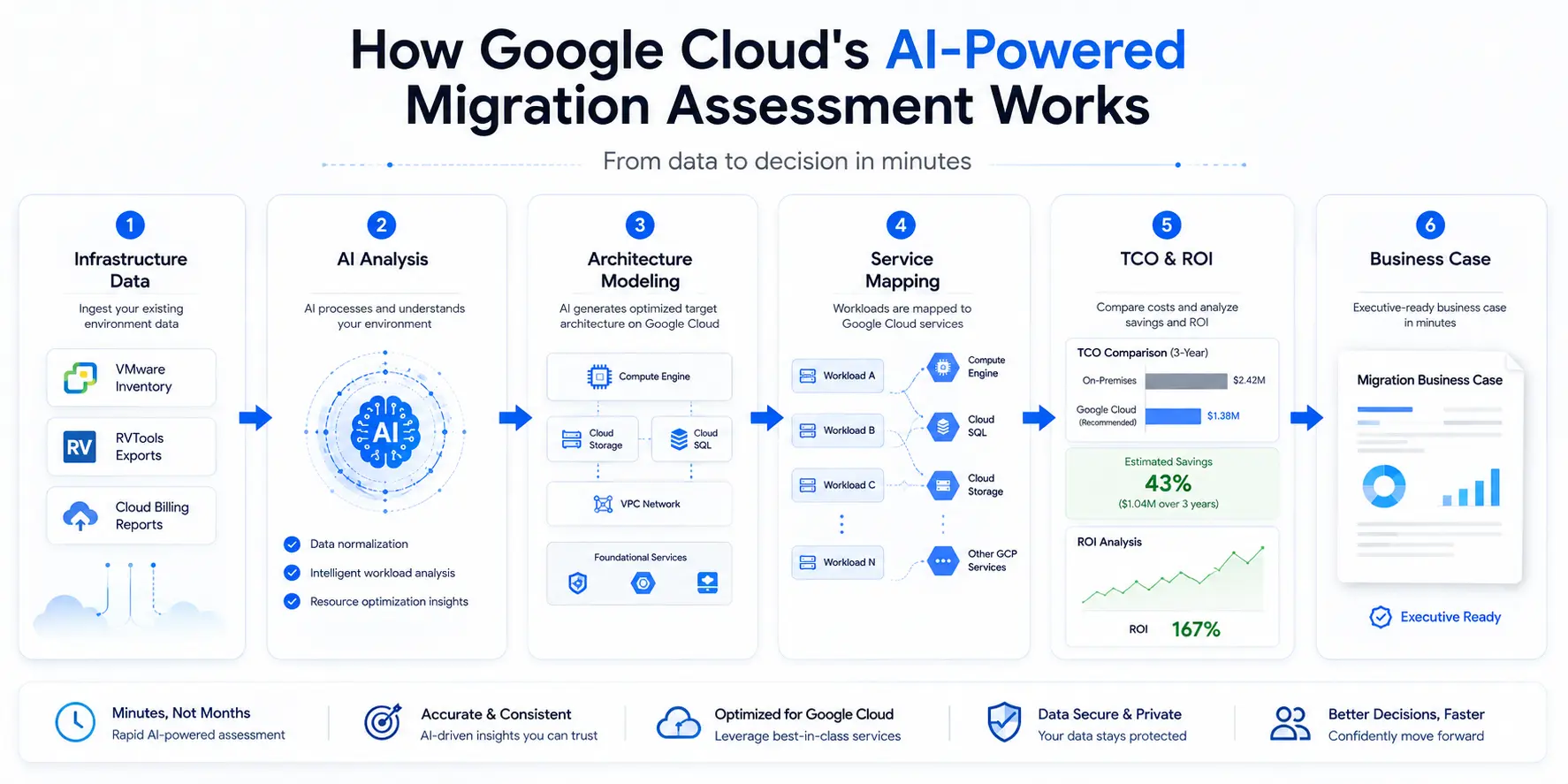
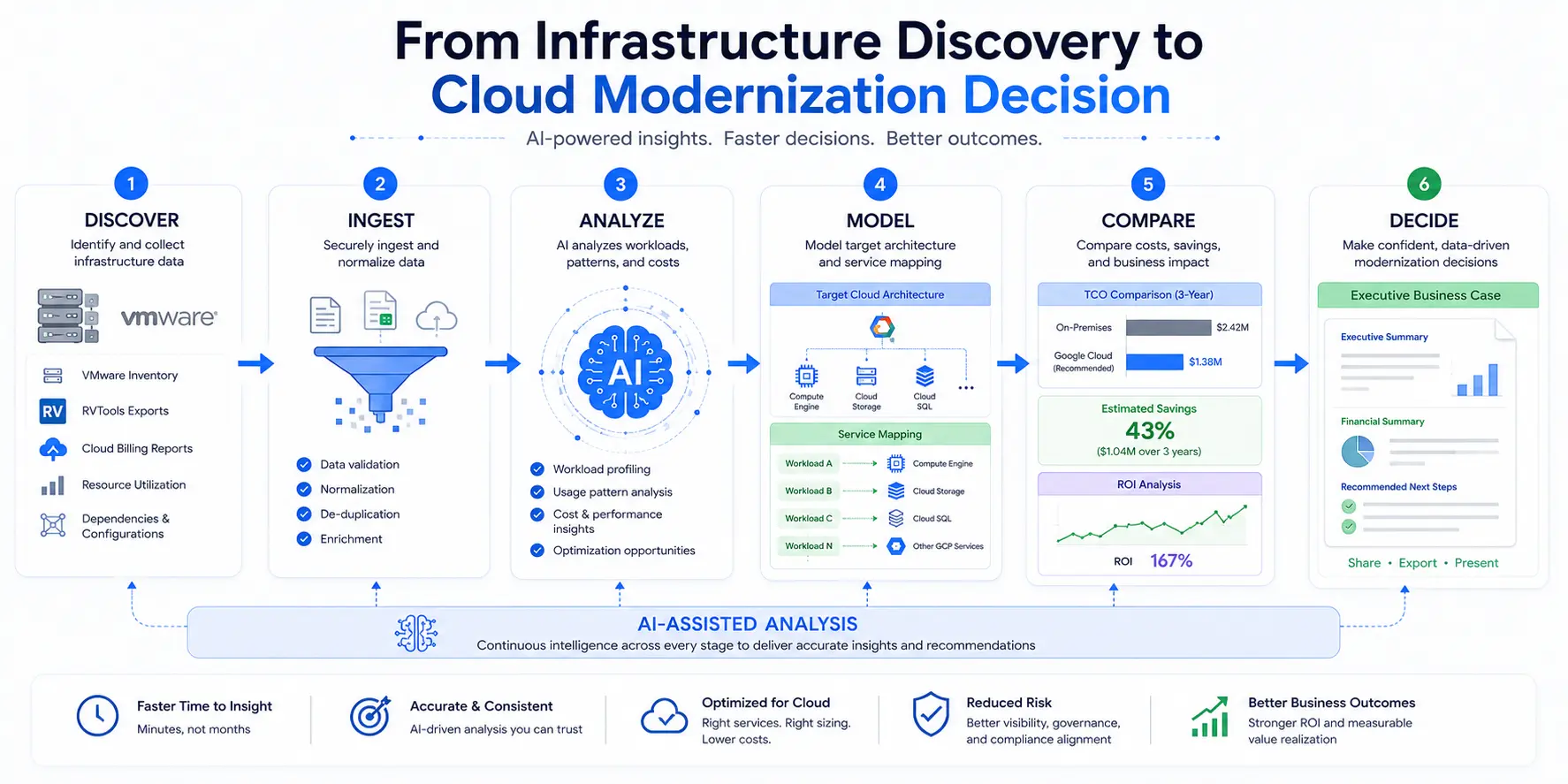
At a high level, the new workflow can be understood as a series of connected stages.
First, organizations provide infrastructure or billing information.
Next, Migration Center processes that information to help model a potential cloud environment.
The system then maps workloads and infrastructure to target services and calculates associated costs.
The resulting model can be reviewed through the Migration Center interface, including through an agentic chat experience.
Finally, organizations can generate a business case containing the recommended infrastructure, TCO comparison and ROI analysis.
This creates a path from raw infrastructure information to a structured modernization proposal.
AI-Assisted Quick Assessments for On-Premises Infrastructure
One of the key capabilities described by Google Cloud is the AI-assisted Quick Assessment for on-premises workloads.
This feature is designed for enterprise customers and partners evaluating existing infrastructure before migration.
Organizations can use VMware inventory exports, including data from RVTools, or aggregated infrastructure inputs as assessment data.
The system then helps translate that information into Compute Engine cost targets.
This addresses an important part of the migration planning process.
Existing infrastructure is often described in terms of physical or virtual machines, CPU and memory resources, storage requirements and other infrastructure characteristics. A cloud migration assessment needs to translate those characteristics into a potential target environment and associated costs.
Google Cloud says its Quick TCO Estimator can perform this analysis more quickly using the provided infrastructure information.
The result is intended to give organizations an initial view of what a potential Compute Engine environment could cost.
Compute Engine TCO Modeling
The new Quick Assessment includes an instant Compute Engine TCO estimation capability.
According to Google Cloud, VMware inventory exports such as RVTools files can be used as an input, along with aggregated infrastructure information.
The assessment then produces Compute Engine cost targets.
TCO, or total cost of ownership, is particularly important in migration planning because the decision is not simply whether a workload can technically run in the cloud.
Organizations also need to understand the financial implications of the target environment.
A TCO model provides a framework for comparing the estimated cost of an existing environment with the projected cost of a target cloud configuration.
Google Cloud's updated capability is intended to automate more of this modeling process.
The announcement does not provide specific accuracy percentages or performance benchmarks for the estimator. Additional details were not disclosed in the announcement.
Support for Newer Compute and Storage Architectures
Google Cloud also highlights expanded architecture modeling within the Quick Assessment experience.
The company says the assessment supports latest-generation Gen4 compute instances as well as high-performance Hyperdisk storage pools.
This is relevant when organizations are building a target architecture rather than simply estimating the cost of moving existing infrastructure without modification.
A migration assessment needs to account for the target infrastructure configuration because different compute and storage choices can affect the resulting financial model.
By incorporating these newer infrastructure options into the assessment, Migration Center can include them when creating detailed results.
Google Cloud's announcement specifically identifies Gen4 compute instances and Hyperdisk storage pools as supported elements.
The company does not provide additional technical performance comparisons between these options and existing infrastructure in the announcement.
Organizations Can Adjust Financial Assumptions
Another important part of the update is the ability to customize financial controls.
Migration projects do not always use the same assumptions when calculating the cost of existing infrastructure.
Organizations may have their own internal accounting standards, baseline costs and financial models.
Google Cloud says teams can adjust on-premises baseline cost assumptions within the Quick Assessment.
This allows the assessment to better reflect an organization's internal accounting approach.
The ability to modify assumptions is important because a migration business case can be heavily influenced by the assumptions used in its financial model.
A cloud estimate based on one set of baseline assumptions may produce a different comparison from an estimate based on another.
Giving teams control over those assumptions provides a way to align the assessment with their internal financial framework.
However, Google Cloud does not disclose a complete list of every financial control available through the feature.
Agentic AI Can Explain Migration Recommendations
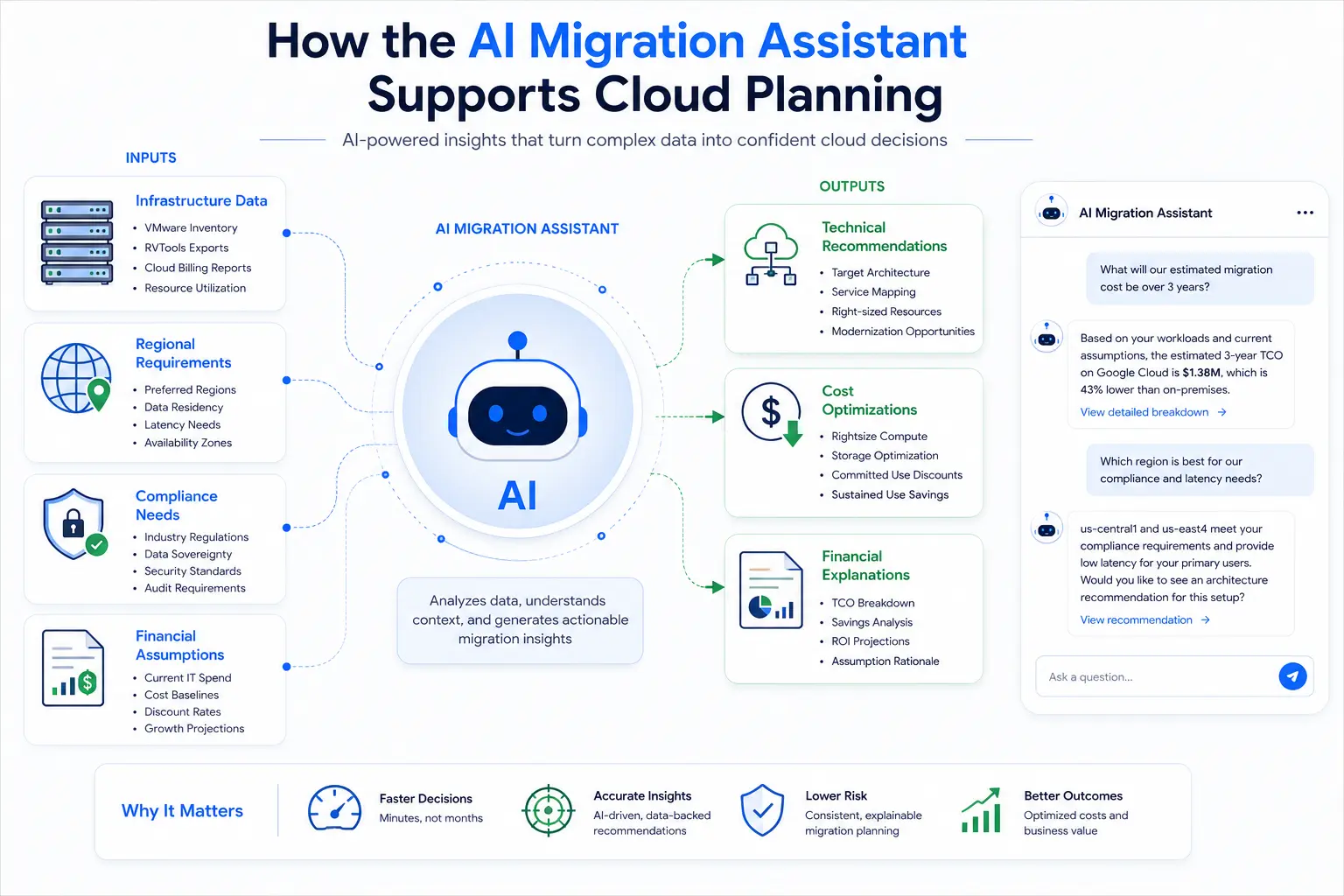
The most AI-focused element of the update is the context-aware agentic chat capability.
Google Cloud says the assistant can recommend technical cost optimizations based on specific business constraints.
Examples mentioned in the announcement include regional location and compliance requirements.
This means the assessment is not limited to displaying a static cost result.
Users can interact with the assistant to understand recommendations and the assumptions behind the financial model.
For example, a decision maker may need to understand why a particular configuration appears in a target architecture or why a certain cost assumption affects the overall TCO.
Google Cloud says the agentic assistant can explain the underlying logic and financial assumptions.
This provides a conversational layer on top of the migration assessment.
Rather than requiring users to interpret every part of the model independently, the assistant is intended to help explain the assessment in context.
From AI Recommendations to a Business Case
The next step after assessing infrastructure is often building a business case.
Technical teams may understand the proposed architecture, but executives and finance teams may need a concise explanation of the financial implications.
Google Cloud says Migration Center can now generate an automated business case containing the recommended bill of materials, TCO comparison and ROI analysis.
This creates a connection between technical assessment and executive decision-making.
The business case can also be exported to Google Sheets.
That export capability provides a familiar format for teams that need to share or further review financial information.
The announcement does not state that the generated business case automatically constitutes an approved financial or investment decision.
Organizations would still need to review the assumptions and information before using the output for internal planning.
Automated Service Mapping
Service mapping is another important component of the Quick Assessment.
A migration assessment needs to determine how existing infrastructure can correspond to services in the target cloud environment.
Google Cloud says Migration Center provides automated service mapping coverage as part of the assessment.
This can help connect the discovery stage with the proposed target architecture.
For infrastructure teams, this means the assessment can move beyond simply identifying existing resources.
It can also provide a structured view of how those resources may map into a cloud environment.
The resulting mapping contributes to the recommended bill of materials and the broader TCO model.
This is particularly relevant when an organization is trying to move from a large infrastructure inventory toward a more understandable migration plan.
Bringing Technical and Financial Teams Closer Together
One of the broader implications of the update is the attempt to bring technical and financial analysis into the same workflow.
Cloud architects typically focus on workload requirements, infrastructure configuration and service selection.
Finance teams may focus on costs, assumptions, ROI and budget implications.
Executives often need a concise business case before approving a modernization initiative.
Migration Center's new capabilities bring these different elements together.
The same assessment can contain technical recommendations, service mapping, infrastructure costs, financial assumptions and ROI analysis.
This could make it easier for different stakeholders to work from a common assessment rather than maintaining separate models.
The announcement highlights a broader industry shift toward using AI to connect technical infrastructure analysis with business decision-making.
Enhanced Cloud Billing Assessment Capabilities
The AI-assisted Quick Assessments are being introduced alongside enhanced Cloud Billing assessment capabilities within the updated Migration Center.
Cloud billing information can provide another source of data for organizations evaluating their environments.
Instead of relying solely on infrastructure inventory, teams can incorporate billing information into their assessment process.
This can help connect existing cloud spending information with broader modernization planning.
Google Cloud does not provide a detailed list of every enhancement included in the Cloud Billing assessment capabilities in the announcement.
What This Means for Cloud Migration Planning
For enterprises, the most significant change may be the speed at which an initial migration business case can be developed.
Traditional assessment processes can involve significant manual effort before decision makers have enough information to evaluate a project.
Google Cloud's new approach attempts to shorten that initial cycle by automating infrastructure analysis, service mapping and financial modeling.
The potential benefit is not limited to saving time.
A faster assessment can allow teams to explore modernization scenarios earlier in the planning process.
It could also make it easier to revisit assumptions and evaluate alternative configurations.
However, the value of an AI-generated assessment remains dependent on the information provided to the system and the assumptions used in the financial model.
AI can accelerate analysis, but organizations still need appropriate governance around migration decisions.
Why TCO and ROI Matter in Modernization Decisions
Infrastructure modernization involves more than selecting a target cloud platform.
Organizations also need to understand the financial implications of that choice.
TCO provides a way to compare the estimated costs associated with different environments.
ROI analysis adds another perspective by examining the potential financial return associated with a modernization initiative.
By combining these elements with infrastructure recommendations, Migration Center aims to give decision makers a more complete picture of a proposed migration.
The business case feature then packages these outputs into a format that can be shared with stakeholders.
Google Cloud's announcement does not provide specific ROI figures or guaranteed savings percentages.
Therefore, organizations should treat the generated financial model as an assessment that requires validation against their own infrastructure, accounting standards and business requirements.
The Role of Human Validation Remains Important
Although the announcement emphasizes AI-powered automation, migration decisions still involve organizational requirements that cannot necessarily be reduced to a single cost estimate.
Infrastructure teams need to understand workload dependencies and technical requirements.
Security and compliance teams may need to evaluate whether the proposed environment meets organizational requirements.
Finance teams may need to validate financial assumptions.
Business leaders may need to determine whether the projected economics support the organization's broader strategy.
The new Migration Center capabilities can help organize and accelerate this analysis, but the announcement does not claim that AI replaces these review processes.
This distinction is important when evaluating AI-assisted infrastructure tools.
Automation can reduce repetitive analysis, while human teams remain responsible for interpreting results and making decisions.
AI Is Moving Deeper Into Cloud Operations
The Migration Center announcement also illustrates a wider direction for enterprise AI.
AI is increasingly being applied not only to customer-facing applications or software development, but also to infrastructure planning and operational workflows.
In this case, AI is being used to analyze infrastructure information, support architecture modeling, explain financial assumptions and assist with modernization decisions.
That represents a shift from AI as a standalone application toward AI as an operational layer within enterprise workflows.
For cloud teams, this could eventually mean more of the repetitive analysis involved in modernization is assisted by intelligent systems.
The announcement highlights one example of that broader movement.
What Organizations Should Consider
The new capabilities could be useful for organizations that are still in the assessment stage of a cloud migration or modernization project.
Potential areas of interest include:
Infrastructure discovery: Teams can use infrastructure information as an input for automated assessment.
Financial modeling: Organizations can generate TCO and ROI information as part of the assessment.
Service mapping: Automated mapping can help connect existing infrastructure with proposed cloud services.
Architecture planning: The assessment can incorporate supported compute and storage configurations.
Business case development: Organizations can generate reports containing recommended infrastructure and financial comparisons.
Interactive analysis: The agentic assistant can provide explanations and recommendations based on the assessment context.
However, the company has not disclosed every implementation detail, validation process or limitation associated with these capabilities.
Google Cloud's Broader Modernization Strategy
Migration Center sits within Google's broader portfolio of cloud migration and infrastructure modernization services.
The latest announcement focuses specifically on making the assessment phase faster and more automated.
That focus is significant because assessment is often one of the earliest stages of a modernization program.
Before workloads are migrated, organizations need to establish a baseline, understand their infrastructure and evaluate potential target environments.
By adding AI to that process, Google Cloud is attempting to reduce the manual effort required to move from raw infrastructure data to a structured migration proposal.
The company describes the new features as Gemini-powered capabilities within Migration Center.
What Happens Next?
Google Cloud says organizations can try Migration Center directly through the cloud console.
The company also points users toward its free migration and modernization assessment offering for organizations that want to evaluate workloads and accelerate their cloud modernization planning.
At this stage, the announcement is primarily about improving the assessment and planning process rather than announcing a new migration execution platform.
The emphasis is on turning infrastructure information into faster technical and financial analysis.
For organizations considering cloud modernization, that could make the early evaluation stage more streamlined.
The actual migration, architecture validation, financial approval and operational planning remain separate parts of the modernization journey.
Conclusion
Google Cloud's new AI-powered Quick Assessments bring infrastructure analysis, service mapping and financial modeling closer together inside Migration Center.
The capabilities are designed to reduce manual discovery work and help organizations move more quickly from infrastructure data to a potential migration business case.
Key additions include AI-assisted assessment of on-premises workloads, Compute Engine TCO estimation, support for Gen4 compute and Hyperdisk storage pools, customizable financial assumptions, automated service mapping, context-aware agentic chat and automated business case generation.
The update reflects a broader industry shift toward AI-assisted infrastructure planning.
For enterprises, this could mean faster access to migration scenarios and financial models. At the same time, organizations will still need to validate infrastructure data, financial assumptions and technical recommendations before making major modernization decisions.
Google Cloud's announcement therefore represents less a replacement for traditional migration planning and more an attempt to automate and accelerate its most time-consuming early-stage analysis.
Source: Google Cloud Blog
About the Author