
Google Cloud: AI Threat Defense Is the New Boardroom Baseline
Google Cloud says AI security is becoming a board-level priority as enterprises adopt AI at scale. Its AI Threat Defense approach helps organizations manage AI-powered threats through automation, business context, unified security, and stronger governance.
Xcademia Team
Xcademia Research Team
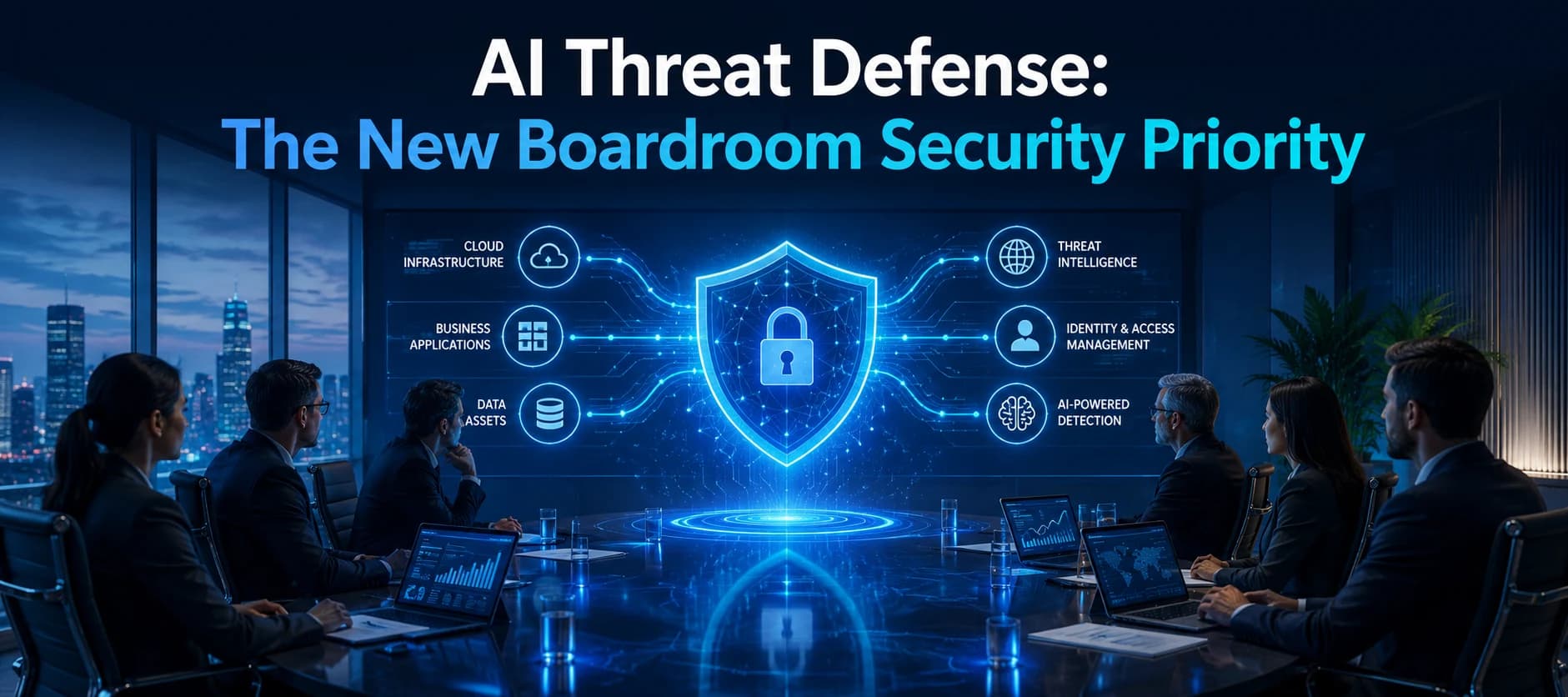
AI Adoption Brings a New Era of Security Challenges
Artificial intelligence is transforming how organizations build products, automate workflows, analyze data, and make business decisions. From generative AI assistants to autonomous AI agents, enterprises are rapidly integrating intelligent systems into their daily operations.
However, the growth of AI adoption is also changing the cybersecurity landscape.
Organisations must now protect more than traditional applications and infrastructure. They must secure AI models, data pipelines, identities, cloud environments, software development processes, and autonomous systems.
Google Cloud believes this shift requires a new approach to enterprise security.
In its latest Cloud CISO Perspectives publication, Chris Betz, CISO at Google Cloud, and Alicja Cade, Senior Director in the Office of the CISO at Google Cloud, explain why AI security should become a board-level priority rather than remain only an operational responsibility for security teams.
The company highlights AI Threat Defense (AITD) as a framework designed to help organizations defend against AI-powered threats while creating the governance needed to adopt AI securely and confidently.
Security Is Becoming a Business Enabler
For many years, cybersecurity was primarily viewed as a function focused on reducing risk, preventing attacks, and protecting enterprise systems.
Google Cloud argues that this perspective is changing.
As organizations accelerate AI adoption, security is becoming directly connected to business growth. Enterprises need secure foundations that allow them to innovate quickly while protecting sensitive information, intellectual property, customer data, and critical operations.
Modern security capabilities can help organizations:
Adopt AI technologies with greater confidence
Protect valuable business information
Improve customer trust
Strengthen regulatory compliance
Reduce operational disruption
Deliver products and services faster
Rather than slowing digital transformation, security is increasingly becoming a capability that enables organizations to move faster.
According to Google Cloud, companies that integrate security into their AI strategies can create stronger foundations for innovation and long-term resilience.
What Is AI Threat Defense?
AI Threat Defense (AITD) is Google Cloud’s approach to helping organizations defend against modern cyber threats in an AI-driven environment.
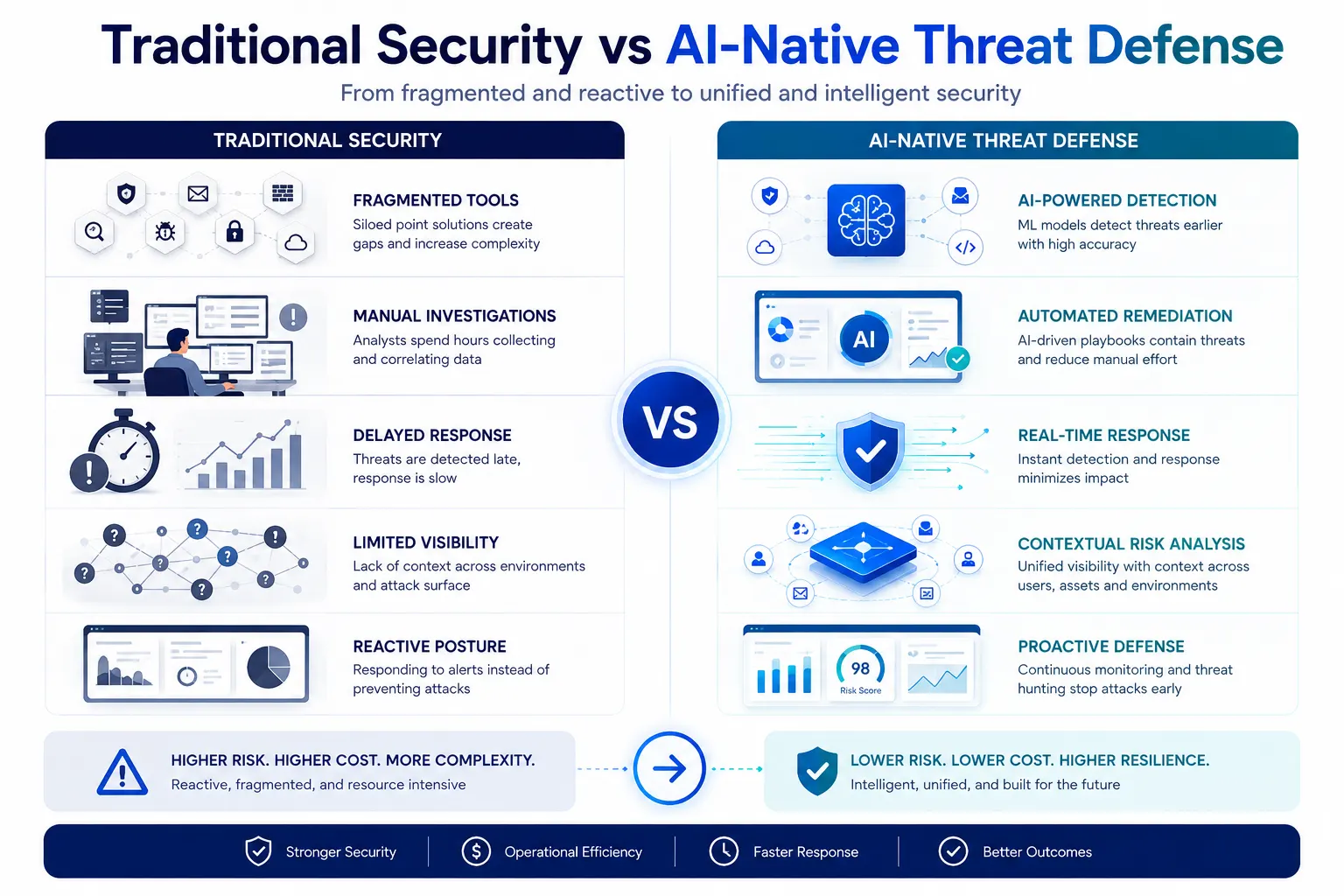
Traditional security operations often depend on manual investigations, disconnected tools, and reactive responses. However, attackers are increasingly using AI to automate reconnaissance, generate sophisticated phishing campaigns, discover vulnerabilities, and accelerate exploitation.
Google Cloud argues that organizations need security systems capable of operating at the same speed as AI-powered attacks.
AI Threat Defense focuses on combining:
AI-powered security automation
Enterprise business context
Threat intelligence
Unified security workflows
Continuous risk analysis
The goal is to move security teams from reactive incident response toward proactive and continuous defense.
Instead of waiting for vulnerabilities to become incidents, AI-powered security can help organizations identify risks earlier, prioritize important issues, and accelerate remediation.
How AI Threat Defense Works
Google Cloud’s AI Threat Defense approach focuses on three major capabilities that help organizations improve security operations in the AI era.
AI-Speed Defense
Cyber attacks are becoming faster and more automated.
Traditional security processes can struggle to keep pace when attackers use AI tools to identify weaknesses and launch attacks rapidly.
Google Cloud believes organizations should automate critical security activities, including:
Threat detection
Vulnerability prioritization
Security analysis
Incident response workflows
By reducing dependence on manual processes, enterprises can respond faster and minimize operational impact.
Context-Driven Intelligence
Security teams often face thousands of alerts, making it difficult to identify which risks require immediate attention.
Google Cloud highlights that AI becomes more effective when it understands enterprise context.
This includes:
Critical applications
Sensitive data assets
User identities
Access privileges
Infrastructure relationships
Business workflows
With this context, AI systems can prioritize vulnerabilities based on actual business impact rather than relying only on technical severity ratings.
This helps reduce alert fatigue and allows security teams to focus on the risks that matter most.
Unified Security Platforms
Many enterprises still rely on multiple standalone security products that create fragmented visibility and complex workflows.
Google Cloud recommends moving toward integrated security platforms that connect:
Vulnerability management
Identity protection
Cloud security
Code security
AI-assisted analysis
A unified approach can help organizations reduce operational complexity and create a clearer understanding of enterprise risk.
Why Boards Need to Lead AI Security Governance
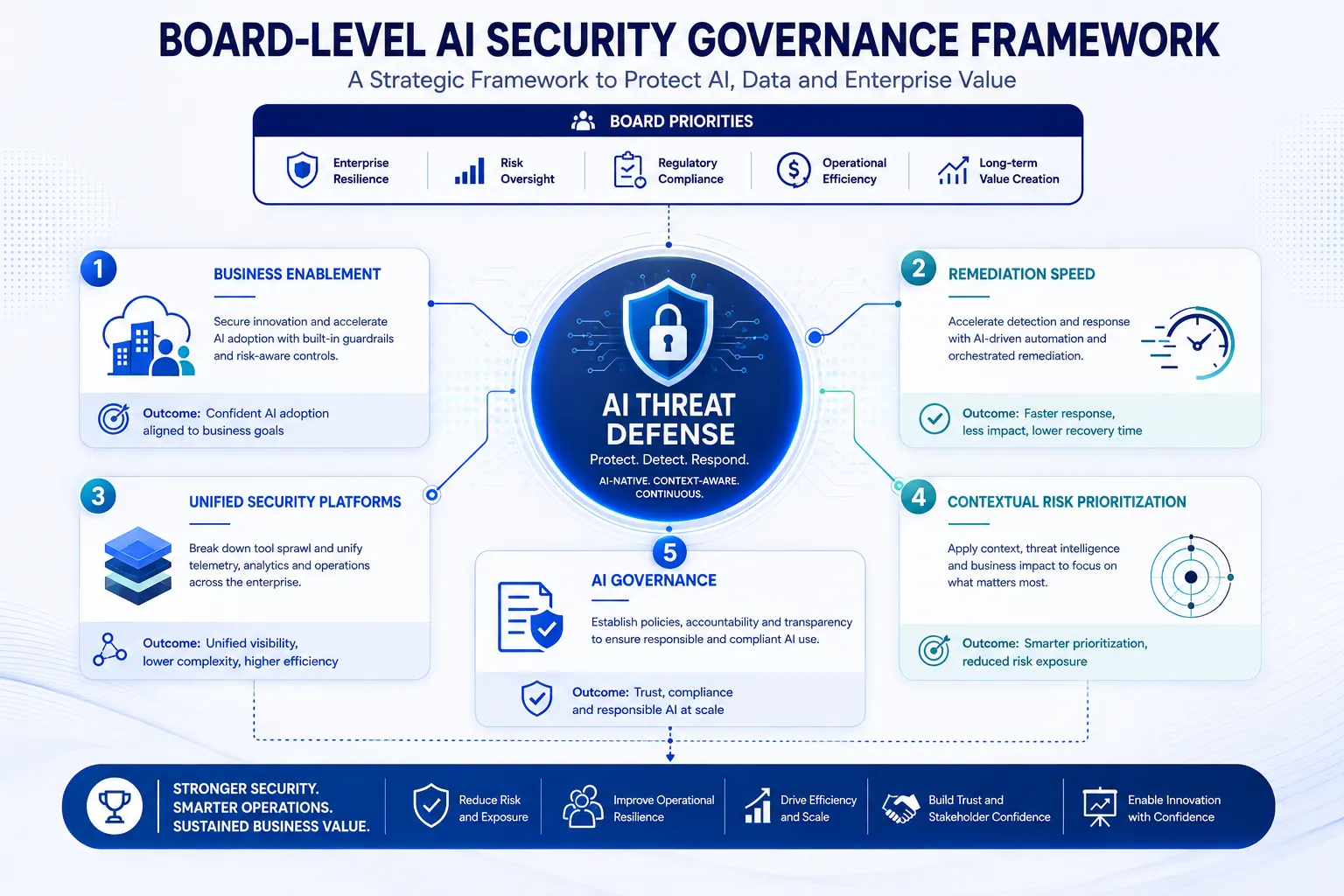
Google Cloud emphasizes that boards of directors do not need to manage daily cybersecurity operations. However, they play an important role in establishing governance, investment priorities, and risk strategies.
As AI becomes central to business operations, security decisions increasingly influence:
Business continuity
Customer confidence
Regulatory compliance
Innovation speed
Competitive advantage
Boards should encourage leadership teams to treat AI security as a strategic business capability rather than simply a technical expense.
By supporting modernization and responsible AI adoption, organizations can improve resilience while continuing to innovate.
Five Governance Questions for Enterprise AI Security
Google Cloud recommends that boards and executive teams focus on five strategic questions when evaluating AI security readiness.
1. Is Security Helping the Business Move Faster?
Security modernization should support business growth, not create unnecessary friction.
Organizations should evaluate whether security investments:
Improve engineering productivity
Accelerate product delivery
Support customer innovation
Create competitive advantages
The objective is to ensure security decisions align with broader business strategy.
2. Are We Reducing the Time Needed to Fix Risks?
In an AI-driven threat environment, speed matters.
Organizations should measure whether security improvements are reducing remediation timelines and improving response capabilities.
AI-powered security can help by:
Prioritizing important vulnerabilities
Automating analysis
Reducing manual investigation time
Improving coordination between teams
A faster remediation process helps reduce exposure before attackers can exploit weaknesses.
3. Are We Moving Toward a Unified Security Platform?
A collection of disconnected security tools can create visibility gaps and operational challenges.
Google Cloud recommends organizations evaluate whether they are building an integrated security environment instead of continuously adding isolated solutions.
A unified platform can help connect:
Risk detection
Vulnerability management
Code security
Identity controls
Threat analysis
4. Does AI Understand Our Business Context?
Not every vulnerability represents the same level of risk.
Organizations already understand their critical applications, sensitive data, and important workflows. AI-powered security systems can use this information to prioritize threats more effectively.
Context-driven security helps teams:
Reduce false positives
Improve prioritization
Focus resources on high-impact risks
5. Are We Governing AI Adoption Securely?
Every AI deployment introduces security considerations.
Organizations need clear policies and controls for:
Secure AI development
Data protection
Access management
Shadow AI monitoring
Compliance requirements
Strong governance allows enterprises to adopt AI responsibly while reducing security and operational risks.
Morgan Stanley Demonstrates the Business Impact of AI Security
Google Cloud highlights Morgan Stanley as an example of how organizations can improve security operations through a unified approach.
Working with Google Cloud and Wiz, Morgan Stanley modernized its security strategy by replacing fragmented tools with an integrated security framework aligned with AI Threat Defense principles.
According to Google Cloud, the organization reduced its mean time to detect threats by 99.9%, moving from approximately 45 minutes to less than 90 seconds.
The example demonstrates how automation, contextual intelligence, and platform consolidation can improve both cybersecurity outcomes and business agility.
Instead of adding more disconnected tools, organizations can create stronger security operations by integrating workflows and improving visibility across the enterprise.
Google Cloud Expands Its AI Security Ecosystem
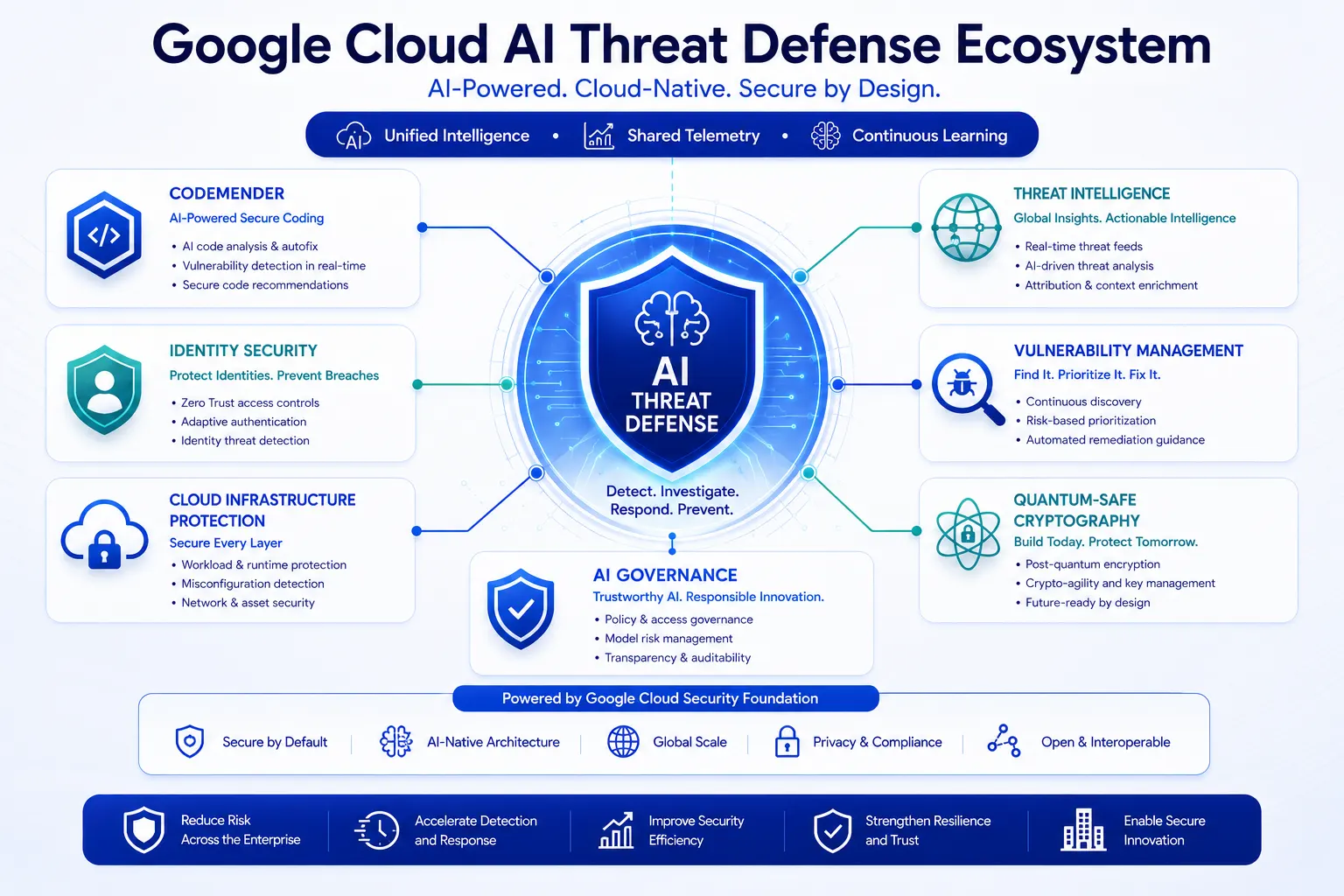
Alongside its AI Threat Defense guidance, Google Cloud highlighted several security initiatives supporting its broader vision for AI-powered protection.
CodeMender Helps Developers Address Vulnerabilities
Google Cloud introduced CodeMender, an AI-powered code security agent available in preview through Agent Platform and AI Threat Defense.
The tool is designed to help identify software vulnerabilities and assist with secure code improvements during development.
By integrating AI into software security workflows, organizations can reduce security debt and improve remediation speed without slowing innovation.
Strengthening Identity and Cloud Security
Google Cloud also highlighted improvements focused on securing enterprise AI workloads, including:
Workforce Identity Federation
Identity-driven access controls
IAM Group Authentication for AlloyDB
Cloud infrastructure protection
As organizations deploy more AI applications, identity security becomes increasingly important for controlling access and protecting sensitive resources.
Preparing for Future Cryptographic Risks
Google Cloud continues expanding post-quantum cryptography support within Cloud Key Management Service.
The company highlighted support for additional digital signature algorithms:
ML-DSA
SLH-DSA
These capabilities help organizations prepare their security infrastructure for future quantum computing challenges.
Threat Intelligence and AI Security Research
Google Cloud also shared updates from Google Threat Intelligence Group and Mandiant focused on emerging cybersecurity challenges.
Key areas include:
AI-assisted vulnerability management
AI coding assistant security risks
Cloud infrastructure protection
Emerging attacker techniques
Research into threats such as exposed Model Context Protocol (MCP) servers and AI coding assistant vulnerabilities highlights the importance of securing AI systems throughout their lifecycle.
Organizations must protect not only AI applications but also the infrastructure, identities, and data that support them.
The Future of Enterprise Security Is AI-Powered
Google Cloud’s latest Cloud CISO Perspectives reflects a broader shift in enterprise cybersecurity.
Security is no longer only about preventing attacks. In the AI era, it is becoming a strategic capability that helps organizations innovate safely, improve resilience, and maintain customer trust.
Through AI Threat Defense, Google Cloud advocates an approach built on:
Automation
Context-aware intelligence
Unified security platforms
Strong governance
For business leaders, the message is clear: AI adoption and cybersecurity strategy can no longer operate separately.
Organizations that combine responsible AI governance with intelligent security capabilities will be better positioned to reduce risk, protect critical assets, and accelerate digital transformation.
Source: Google Cloud Blog
About the Author