
Google Brings Conversational Analytics to the Entire Data Cloud with Enterprise AI, Multi-Cloud Intelligence and Agentic Workflows
Google Cloud has expanded Conversational Analytics across BigQuery, Looker, AlloyDB, Cloud SQL and Spanner, introducing enterprise-grade governance, multi-cloud support, AI-powered insights and Agentic Workflows that transform how organisations interact with business data.
Xcademia Team
Xcademia Research Team
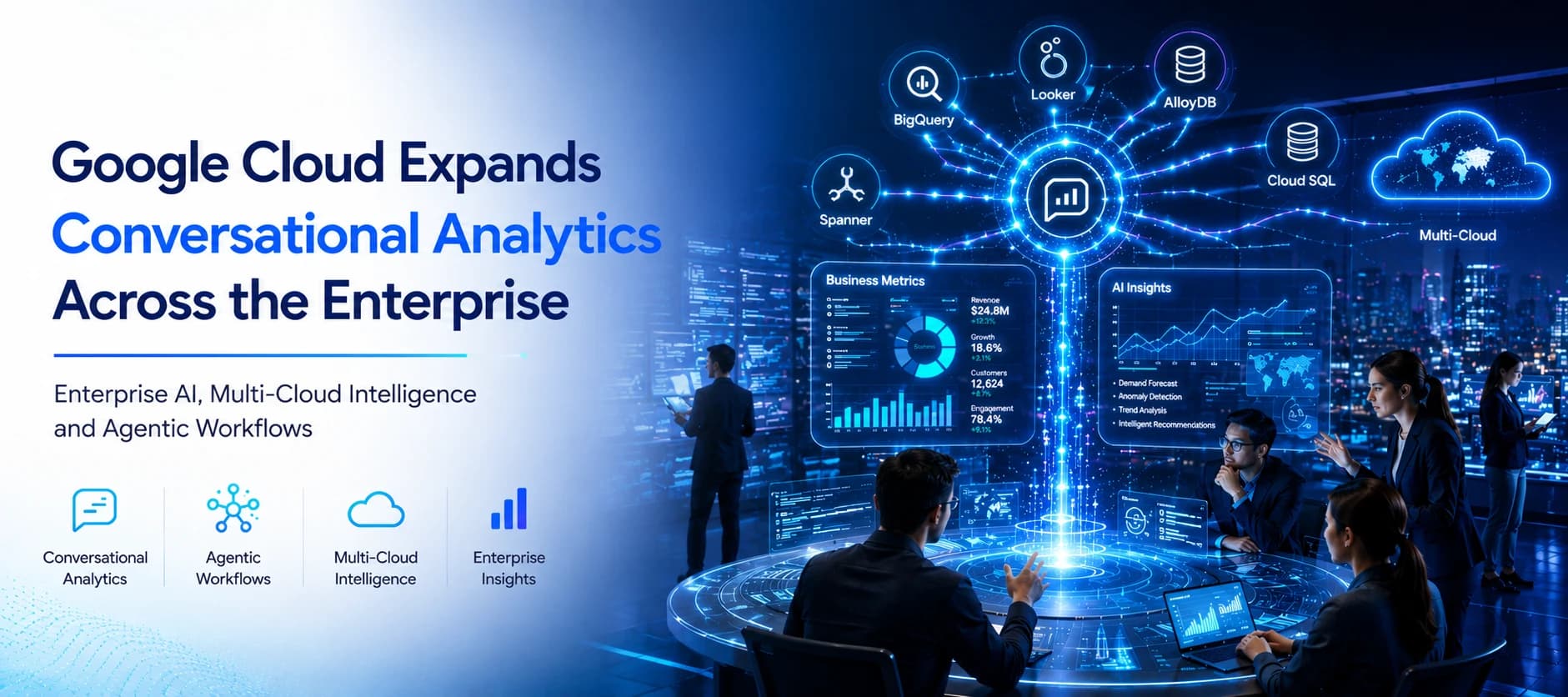
Google Brings Enterprise Conversational Analytics to the Entire Data Ecosystem
Generative AI has rapidly evolved from a productivity assistant into a strategic enterprise platform. While early deployments focused on summarising documents, generating content or answering general questions, organisations are now expecting AI to perform far more sophisticated tasks. Businesses want AI systems that can understand corporate data, retrieve accurate information, analyse trends and support critical decision-making without compromising governance or security.
Meeting those expectations requires much more than connecting a large language model (LLM) to a database. Enterprise data is often distributed across multiple cloud providers, structured and unstructured storage systems, business intelligence platforms and transactional databases. Every query must respect access controls, organisational policies and business semantics while returning trustworthy results.
Recognising these challenges, Google Cloud has significantly expanded Conversational Analytics, transforming it from a collection of AI-powered analytics features into a comprehensive enterprise data intelligence platform. The latest announcement extends Conversational Analytics across Google Data Cloud with broader database support, stronger governance controls, richer developer integrations and new Agentic Workflow capabilities that enable AI to proactively analyse business data.
Instead of requiring users to understand SQL, database schemas or complex dashboard navigation, Conversational Analytics enables employees to ask natural language questions while AI agents securely retrieve, analyse and explain enterprise information.
This represents an important shift in enterprise analytics, where AI increasingly acts as an intelligent data analyst rather than simply a chatbot.
From Experimental AI to Enterprise-Scale Analytics
Over the past year, Google Cloud has steadily expanded its conversational AI capabilities across its analytics portfolio.
What began as isolated AI experiences has now matured into a production-ready platform available across multiple Google Cloud services.
The latest release includes:
General Availability of BigQuery Conversational Analytics
General Availability of the Conversational Analytics API
Continued availability within Looker
Preview support for AlloyDB
Preview support for Cloud SQL
Preview support for Cloud Spanner
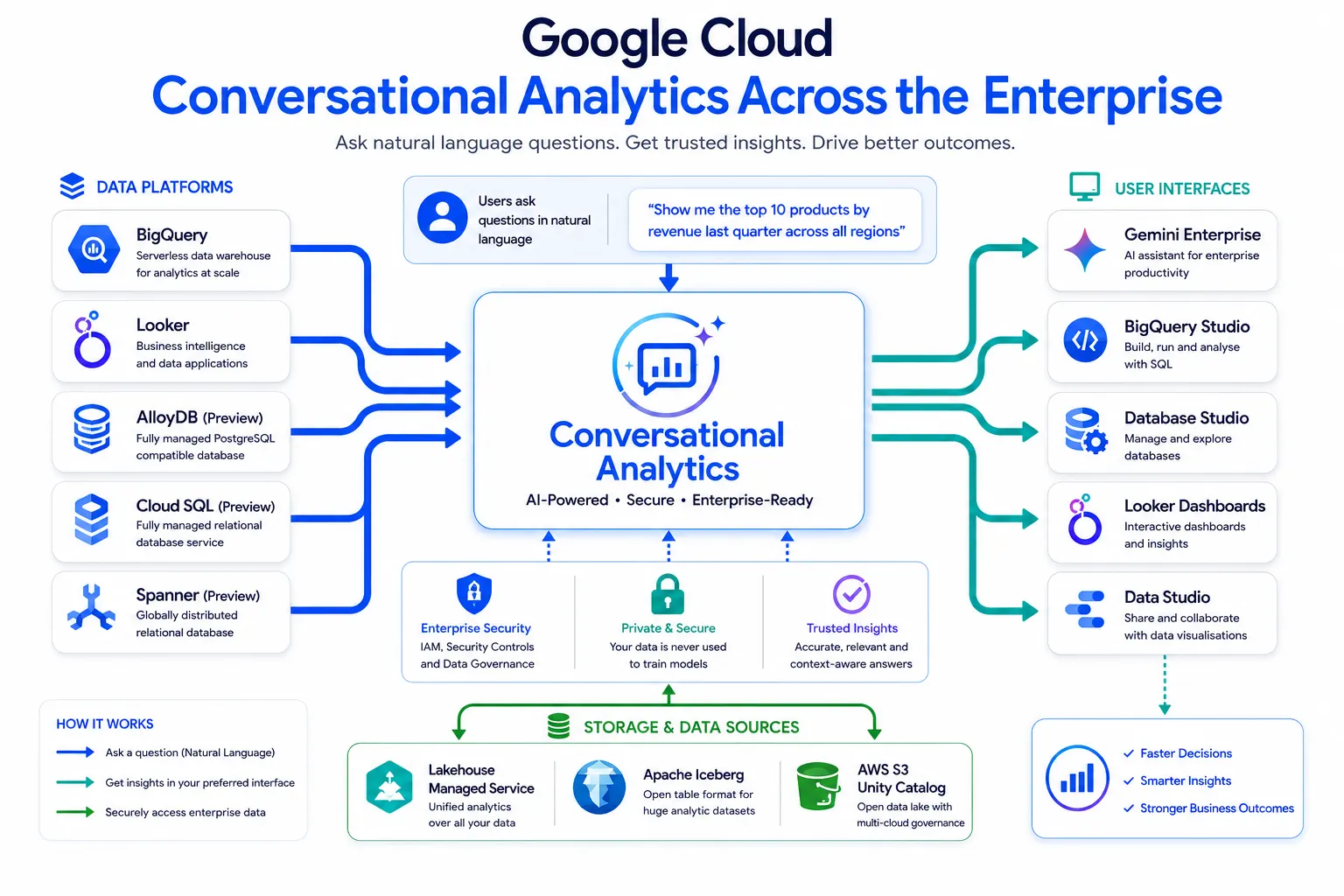
Collectively, these services allow organisations to interact with structured, semi-structured and operational data through conversational interfaces while maintaining enterprise-grade governance.
Rather than creating separate AI assistants for different databases, Google is positioning Conversational Analytics as a unified layer that spans an organisation's entire data estate.
This approach aligns with one of the biggest enterprise technology trends in 2026: reducing fragmentation between data platforms and making AI accessible wherever business users already work.
Breaking Down Data Silos Across Multi-Cloud Environments
One of the most significant announcements is Google's continued investment in multi-cloud analytics.
Modern enterprises rarely operate entirely within a single cloud provider. Acquisitions, regulatory requirements and specialised workloads often result in data being spread across multiple platforms. Analysts may need information from Google Cloud databases, AWS storage services and external data lakes before making a single business decision.
Traditionally, this fragmented architecture introduces several challenges:
Multiple authentication systems
Different query languages
Data duplication
ETL complexity
Increased governance overhead
Delayed reporting
Google aims to reduce these barriers by allowing Conversational Analytics agents to query data natively across supported environments.
The platform now supports analysis of:
BigQuery datasets
Lakehouse Managed Service tables
Apache Iceberg REST Catalogs
Federated AWS S3 Unity Catalogs
AlloyDB databases
Cloud SQL databases
Cloud Spanner databases
Rather than forcing organisations to migrate all data into a single warehouse, Google is enabling AI agents to work across distributed enterprise environments.
This capability is particularly valuable for multinational organisations where data residency regulations, legacy infrastructure and specialised workloads make complete cloud consolidation impractical.
Bringing AI Directly Into Everyday Business Workflows
Another notable enhancement is Google's emphasis on meeting users where they already work.
Historically, analytics platforms required users to open dedicated dashboards, BI tools or SQL editors before asking questions about business performance.
Conversational Analytics changes this interaction model by embedding AI directly into existing productivity and analytics environments.
For technical teams, AI experiences are integrated within:
BigQuery Studio
BigQuery Data Canvas
Database Studio
Business users can access conversational capabilities through:
This creates a shared analytical experience across technical and non-technical users.
For example, a database administrator may use BigQuery Studio to investigate storage performance, while an executive uses Gemini Enterprise to ask:
"Which product line generated the highest quarterly revenue growth across Europe?"
Although both users interact differently, they rely on the same governed enterprise knowledge layer.
This unified approach reduces dependence on specialist analytics teams while making trusted business insights available across departments.
Conversational Analytics as an Enterprise AI Platform
Perhaps the most important aspect of Google's announcement is that Conversational Analytics is evolving beyond a natural language interface.
It is becoming an enterprise AI platform built around specialised data agents.
Unlike generic AI chatbots that generate responses from publicly available knowledge, these agents are designed specifically to understand enterprise metadata, business logic, governance policies and database relationships.
The result is an AI system capable of translating business questions into governed analytical workflows rather than simply generating plausible answers.
For developers, Google also provides APIs and integration options that allow these agents to be embedded inside:
Internal enterprise applications
Customer portals
Slack workspaces
Multi-agent orchestration platforms
Custom AI assistants
This flexibility positions Conversational Analytics not merely as another analytics feature but as foundational infrastructure for the next generation of enterprise AI applications.
Building Trust Through Enterprise Security, Governance and Intelligent Data Grounding
As organisations expand the use of AI across departments, trust becomes the defining factor between successful enterprise adoption and limited experimentation. While generative AI can dramatically simplify data analysis, it also introduces concerns around security, compliance, data privacy and response accuracy.
Google Cloud's latest enhancements to Conversational Analytics directly address these concerns by combining enterprise-grade security controls with intelligent data grounding. Rather than treating AI as an isolated chatbot, Google has designed its platform so every conversation respects existing governance policies, organisational permissions and trusted business logic.
This architecture is intended to give enterprises confidence that AI-generated insights are not only useful, but also secure, explainable and compliant.
Enterprise-Grade Security Designed for Large Organisations
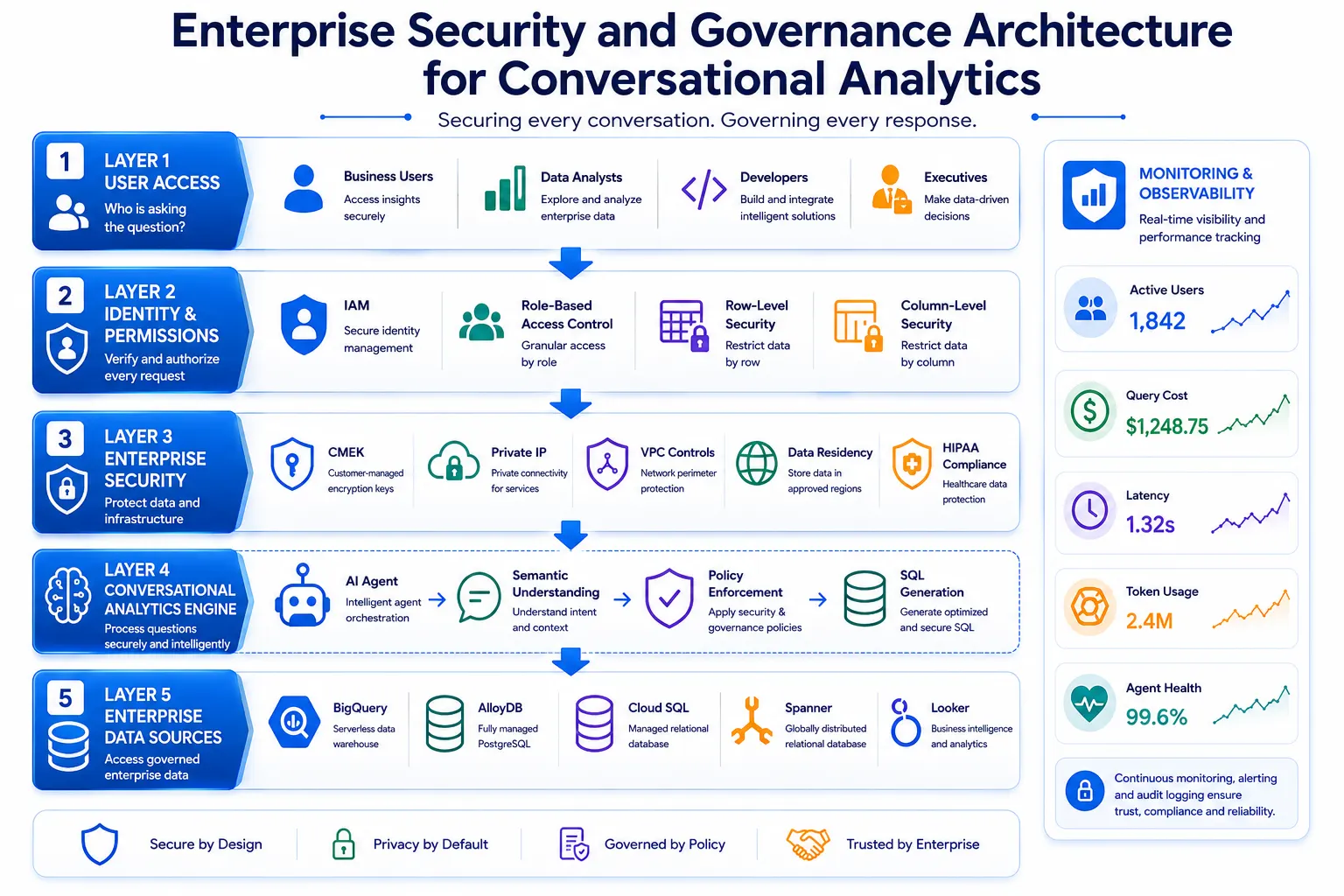
Rolling out conversational AI to thousands of employees requires far more than authentication and encryption. Every user must receive only the information they are authorised to access, regardless of how the question is asked.
Google Cloud has introduced several enterprise controls to support this requirement.
1. Customer Managed Encryption Keys (CMEK)
Many highly regulated organisations require complete control over encryption. Conversational Analytics supports Customer Managed Encryption Keys (CMEK), enabling organisations to manage their own encryption keys instead of relying solely on provider-managed keys.
This provides greater control over key rotation, auditing and compliance with industry regulations.
2. Private IP and VPC Controls
To minimise unnecessary exposure to the public internet, Conversational Analytics supports:
Private IP connectivity
Virtual Private Cloud (VPC) networking
Secure internal communication between AI services and enterprise databases
These capabilities help organisations build AI-powered analytics environments that align with existing cloud security architectures.
3. Data Residency and Compliance
Global enterprises often face strict regulations regarding where data can be processed and stored.
Google Cloud addresses these requirements through:
Regional processing within the European Union
Regional processing within the United States
HIPAA compliance for eligible healthcare workloads
Keeping both stored data and machine learning processing within approved geographic boundaries helps organisations meet regulatory obligations while adopting AI technologies.
Fine-Grained Access Control for Every Conversation
One of the biggest challenges with AI assistants is ensuring users cannot accidentally retrieve information beyond their permissions.
Google Cloud applies existing enterprise security models directly to conversational interactions.
This includes:
Role-based access control (RBAC)
Row-level security
Column-level security
For example, two employees may ask the same question:
"Show quarterly revenue."
A regional sales manager might only see figures for their assigned territory, while a finance executive receives company-wide results. The AI agent automatically enforces these permissions without requiring users to understand database access rules.
This approach helps organisations maintain consistent security policies across traditional dashboards, SQL queries and AI-driven conversations.
Operational Visibility and Cost Management
As conversational AI usage increases, administrators need visibility into performance, costs and system health.
Google Cloud includes several monitoring capabilities to support enterprise operations.
Administrators can:
Define maximum query size limits
Monitor query execution costs
Track query labels within BigQuery
Review Looker system activity logs
Monitor active users
Observe agent health
Analyse latency trends
Review token consumption
These controls help organisations predict infrastructure costs while ensuring AI services remain responsive during periods of heavy usage.
Instead of treating AI as a black box, administrators gain operational insight similar to monitoring any other enterprise application.
Solving AI Hallucinations with Intelligent Data Grounding
One of the most significant technical challenges for enterprise AI is preventing hallucinations.
Large language models excel at generating fluent responses, but they can occasionally produce inaccurate information or incorrect SQL queries when they lack sufficient context.
Google's approach focuses on grounding AI agents within trusted enterprise metadata rather than relying solely on language model reasoning.
Instead of asking an LLM to infer how a database is structured, Conversational Analytics provides it with rich contextual information from Google's data platforms.
This reduces ambiguity and improves the consistency of generated responses.
Knowledge Catalog Gives AI Business Context
Enterprise databases often contain thousands of tables with technical names that mean little to business users.
Knowledge Catalog enriches these datasets by supplying:
Business glossary definitions
Table descriptions
Metadata relationships
Data ownership information
Recommended joins
Governance classifications
When an employee asks:
"Which regions experienced declining customer retention?"
the AI agent understands both the business meaning of "customer retention" and the underlying datasets required to answer the question.
This semantic understanding significantly reduces the risk of incorrect table selection or invalid joins.
Graph Intelligence Connects Complex Relationships
Modern organisations increasingly store highly connected information rather than isolated records.
Google extends Conversational Analytics using:
BigQuery Graph
These graph capabilities allow AI agents to navigate relationships across multiple entities instead of analysing individual tables independently.
For example, an AI investigation into supply chain delays could connect:
Suppliers
Warehouses
Shipping routes
Customer orders
Manufacturing facilities
Financial performance
Rather than issuing a single SQL query, the agent can traverse interconnected datasets to identify hidden relationships contributing to operational issues.
This graph-based reasoning enables deeper analytical investigations that would otherwise require multiple manual queries.
LookML Provides Trusted Business Metrics
Business intelligence often suffers from inconsistent metric definitions.
Different teams may calculate:
Revenue
Profit
Active customers
Customer lifetime value
using different formulas.
Google addresses this challenge through LookML, Looker's semantic modelling layer.
Instead of allowing AI to guess how metrics should be calculated, Conversational Analytics retrieves centrally governed business definitions.
This provides several advantages:
Consistent reporting across departments
Reduced ambiguity
Trusted KPI calculations
Standardised business logic
Improved auditability
For executives relying on AI-generated insights, this consistency is essential.
It ensures that strategic decisions are based on approved organisational metrics rather than dynamically generated calculations.
Built-In AI Functions Expand Analytical Capabilities
Conversational Analytics goes beyond translating natural language into SQL.
Google has integrated a growing portfolio of AI-powered analytical functions directly into the platform.
These capabilities include:
1. Multimodal Data Analysis
Agents can analyse structured information alongside images, documents and other object-based data stored within BigQuery object tables.
2. Embeddings and Semantic Search
Functions such as:
ai.searchai.generate_embedding
enable similarity searches across enterprise knowledge, making it easier to locate related documents, products or records.
3. Classification and Scoring
Using:
ai.classifyai.score
AI agents can categorise records, assign confidence scores and automate business workflows.
4. Forecasting and Anomaly Detection
Powered by Google's TimesFM foundation model, Conversational Analytics supports:
Demand forecasting
Trend prediction
Seasonal analysis
Anomaly detection
Rather than simply reporting historical metrics, AI agents can identify unusual patterns and estimate future outcomes.
5. Key Driver Analysis
One particularly valuable capability is ai.key_drivers, which automatically investigates the factors behind unexpected changes in business performance.
Instead of merely reporting that revenue declined by 12%, the agent can identify the primary contributing factors, such as:
Regional sales decreases
Product availability issues
Marketing campaign performance
Supply chain disruptions
Customer churn
This significantly reduces the manual effort required for root cause analysis.
AI That Understands Business Logic
Perhaps the most important architectural decision is Google's API-first design philosophy.
Rather than allowing conversational agents to invent SQL statements based purely on language model reasoning, the platform relies on trusted business logic, verified queries and semantic metadata.
This approach improves:
Accuracy
Repeatability
Governance
Explainability
User confidence
For enterprises deploying AI across finance, healthcare, retail and manufacturing, these qualities are often more valuable than raw conversational ability.
By combining governed data models with intelligent AI agents, Google Cloud is positioning Conversational Analytics as a trusted decision-support platform rather than simply another chatbot interface.
From Conversational AI to Autonomous Analytics
As enterprise AI matures, organisations are increasingly looking beyond conversational interfaces toward systems that can monitor data continuously, identify emerging issues and recommend actions with minimal human intervention. Google Cloud's latest enhancements to Conversational Analytics reflect this shift by introducing Agentic Workflows, expanding developer integration options and strengthening support for enterprise automation.
Rather than waiting for users to ask the right question, Google envisions AI agents that proactively analyse business data, surface meaningful insights and integrate directly into existing operational workflows.
Moving Beyond Question-and-Answer Analytics
Traditional business intelligence platforms are fundamentally reactive. Users must recognise a problem, formulate an appropriate query and interpret the resulting dashboards before deciding what action to take.
This approach works well for known questions but often fails to identify unexpected issues hidden within large and complex datasets.
Google's Agentic Workflows, currently available in preview, aim to change this model.
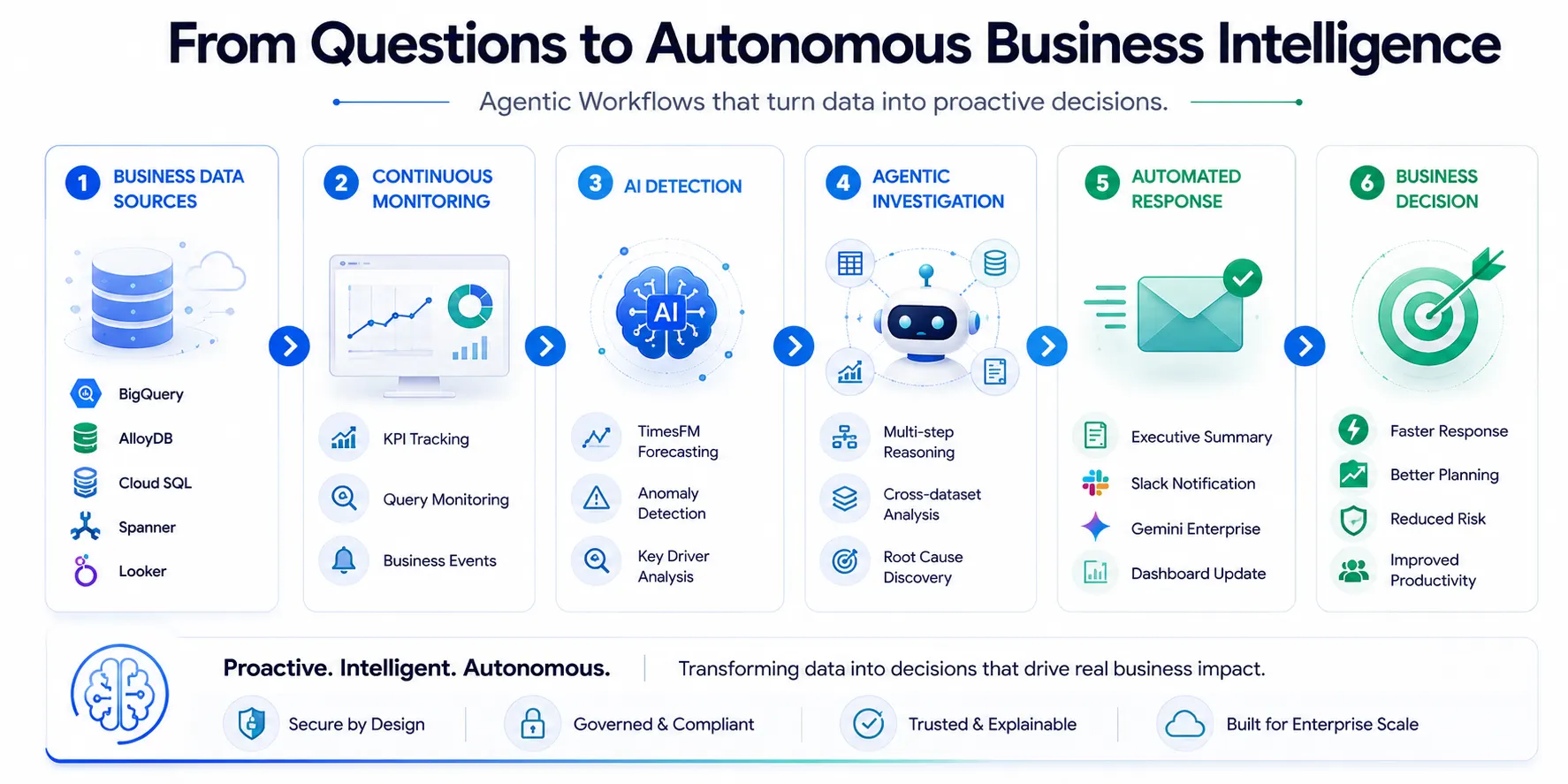
Instead of relying solely on user prompts, AI agents can continuously monitor predefined business metrics, detect unusual patterns and automatically launch deeper investigations.
For example, if weekly sales suddenly decline in a specific region, the agent can:
Detect the anomaly automatically
Investigate multiple contributing factors
Analyse relationships across datasets
Summarise its findings
Deliver a report directly to stakeholders
This reduces the time between identifying a problem and understanding its root cause.
Automated Reporting for Modern Enterprises
Many organisations spend considerable time preparing recurring reports for leadership teams.
Weekly performance updates, operational dashboards and monthly business reviews often require analysts to gather information from multiple systems before producing presentations.
Agentic Workflows automate much of this repetitive work.
Organisations can schedule AI-powered reporting routines that:
Monitor operational KPIs
Generate executive summaries
Deliver scheduled reports
Highlight significant changes
Recommend areas requiring investigation
Instead of manually reviewing dashboards every morning, managers receive concise AI-generated summaries directly within their preferred collaboration tools.
This allows analysts to spend more time solving business problems rather than compiling routine reports.
Intelligent Anomaly Detection
One particularly valuable capability is continuous anomaly detection.
Using Google's AI models, Conversational Analytics can identify unexpected deviations in business metrics without requiring users to configure complex statistical models.
Examples include:
Sudden decreases in online sales
Unexpected infrastructure costs
Inventory shortages
Customer churn spikes
Website traffic anomalies
Supply chain disruptions
When an anomaly occurs, the AI agent can automatically begin a deeper investigation instead of simply issuing an alert.
This transforms analytics from passive monitoring into intelligent business assistance.
A Developer-Friendly Platform
Enterprise AI succeeds only when developers can integrate it into existing applications and workflows.
Google Cloud has invested heavily in making Conversational Analytics accessible through APIs and software development tools.
The Conversational Analytics API is now generally available and includes native SDKs for:
Node.js
Python
Java
Go
PHP
Ruby
.NET
Developers can embed conversational data experiences directly into:
Internal enterprise portals
Customer applications
Business dashboards
Industry-specific software
Mobile applications
Rather than forcing users to switch between different tools, organisations can bring AI-powered analytics directly into the applications employees already use every day.
Building Multi-Agent Enterprise Systems
Another major announcement is support for the Agent Development Kit (ADK) and the Model Context Protocol (MCP).
These technologies make it easier to connect Conversational Analytics with other specialised AI agents.
Instead of relying on one general-purpose assistant, enterprises can build collaborative AI systems where each agent performs a specialised role.
For example:
A supply chain agent monitors inventory.
A finance agent calculates profitability.
A logistics agent tracks shipping delays.
A customer service agent measures support performance.
A Conversational Analytics agent retrieves trusted business data.
Together, these agents can exchange information and coordinate responses to complex business events.
Imagine a shipment delay affecting several regions. A supply chain agent detects the issue, requests financial analysis from a finance agent and then uses Conversational Analytics to calculate the projected impact on revenue and delivery commitments. Executives receive a consolidated summary without manually combining data from multiple systems.
This type of orchestration represents a significant step toward autonomous enterprise operations.
Real-World Enterprise Use Cases
Google Cloud's expanded platform addresses a wide range of industry scenarios.
1. Financial Services
Banks and insurance providers can investigate transaction trends, identify anomalies and generate governed reports while maintaining strict access controls and regulatory compliance.
2. Healthcare
Healthcare organisations can analyse operational data within compliant environments, helping administrators understand resource utilisation, patient flow and service performance without exposing sensitive information to unauthorised users.
3. Retail and E-commerce
Retailers can monitor inventory levels, forecast demand, analyse customer purchasing behaviour and investigate changes in sales performance using natural language instead of complex SQL queries.
4. Manufacturing
Manufacturers can combine operational, logistics and production data to identify bottlenecks, optimise supply chains and improve forecasting accuracy.
5. Technology Companies
Software organisations can analyse engineering metrics, cloud infrastructure usage, product adoption and customer engagement while enabling both technical and non-technical teams to access governed insights.
Competitive Landscape
Google's latest announcement places Conversational Analytics in direct competition with several enterprise AI and analytics platforms.
1. Microsoft Fabric
Microsoft continues to strengthen its AI-powered analytics through Fabric and Microsoft Copilot, particularly for organisations invested in the Microsoft ecosystem.
Google differentiates itself through deeper integration with BigQuery, Looker and Gemini Enterprise, along with extensive multi-cloud data access.
2. Snowflake Cortex AI
Snowflake has expanded Cortex AI to provide natural language querying and AI-assisted analytics.
Google's advantage lies in its broader integration across operational databases, semantic layers, graph analytics and developer tooling.
3. Databricks AI/BI
Databricks focuses heavily on data engineering, lakehouse architecture and machine learning.
Google positions Conversational Analytics as an enterprise-wide conversational layer spanning business users, analysts and developers.
4. Amazon Web Services
AWS continues to invest in AI-powered analytics across services such as Amazon QuickSight and Amazon Bedrock.
Google's strategy centres on providing a unified conversational experience that spans multiple Google Cloud data services while also supporting selected external data platforms.
Although competition in enterprise analytics is becoming increasingly intense, Google's focus on governance, semantic grounding and proactive AI workflows helps distinguish its offering.
What This Means for the Industry
The latest announcement highlights several broader trends shaping enterprise analytics.
First, natural language interfaces are becoming a standard capability rather than a differentiator.
Second, organisations increasingly expect AI systems to understand business context instead of simply translating prompts into database queries.
Third, trusted governance is emerging as a critical requirement for enterprise AI adoption. Accuracy, security and compliance are now just as important as conversational capabilities.
Finally, autonomous AI agents are likely to become an increasingly common part of enterprise operations, supporting analysts rather than replacing them.
The future of analytics will not revolve around replacing human expertise. Instead, AI will help professionals focus on strategic decisions by reducing repetitive analytical work and surfacing insights more quickly.
Final Thoughts
Google Cloud's expansion of Conversational Analytics represents a significant milestone in the evolution of enterprise AI. By extending support across BigQuery, Looker, AlloyDB, Cloud SQL, Spanner and multi-cloud data sources, Google is moving beyond conversational interfaces toward a comprehensive intelligence platform for modern organisations.
The introduction of stronger governance controls, semantic data grounding, graph-based reasoning and Agentic Workflows demonstrates a clear emphasis on trust, scalability and operational value. Combined with developer-friendly APIs, SDKs and support for multi-agent architectures, these capabilities position Conversational Analytics as a powerful foundation for building the next generation of AI-powered business applications.
While organisations will still need thoughtful governance, high-quality data and skilled implementation teams to realise the full value of these technologies, Google's latest innovations show how enterprise analytics is evolving from static dashboards into intelligent systems capable of continuously monitoring data, uncovering meaningful insights and helping businesses make faster, more informed decisions.
As AI becomes more deeply integrated into enterprise workflows, Conversational Analytics offers a glimpse of a future where interacting with business data is as natural as having a conversation, yet as reliable and secure as the underlying systems that power it.
Source: Google Cloud Blog
About the Author