
Why 95% of AI Apps Never Reach Production and How Google Solved the Enterprise AI Deployment Challenge
Only 5% of AI prototypes make it into production. Discover how Google and YouTube built a secure AI prototyping stack using Google AI Studio to accelerate enterprise AI development without compromising reliability.
Xcademia Team
Xcademia Research Team
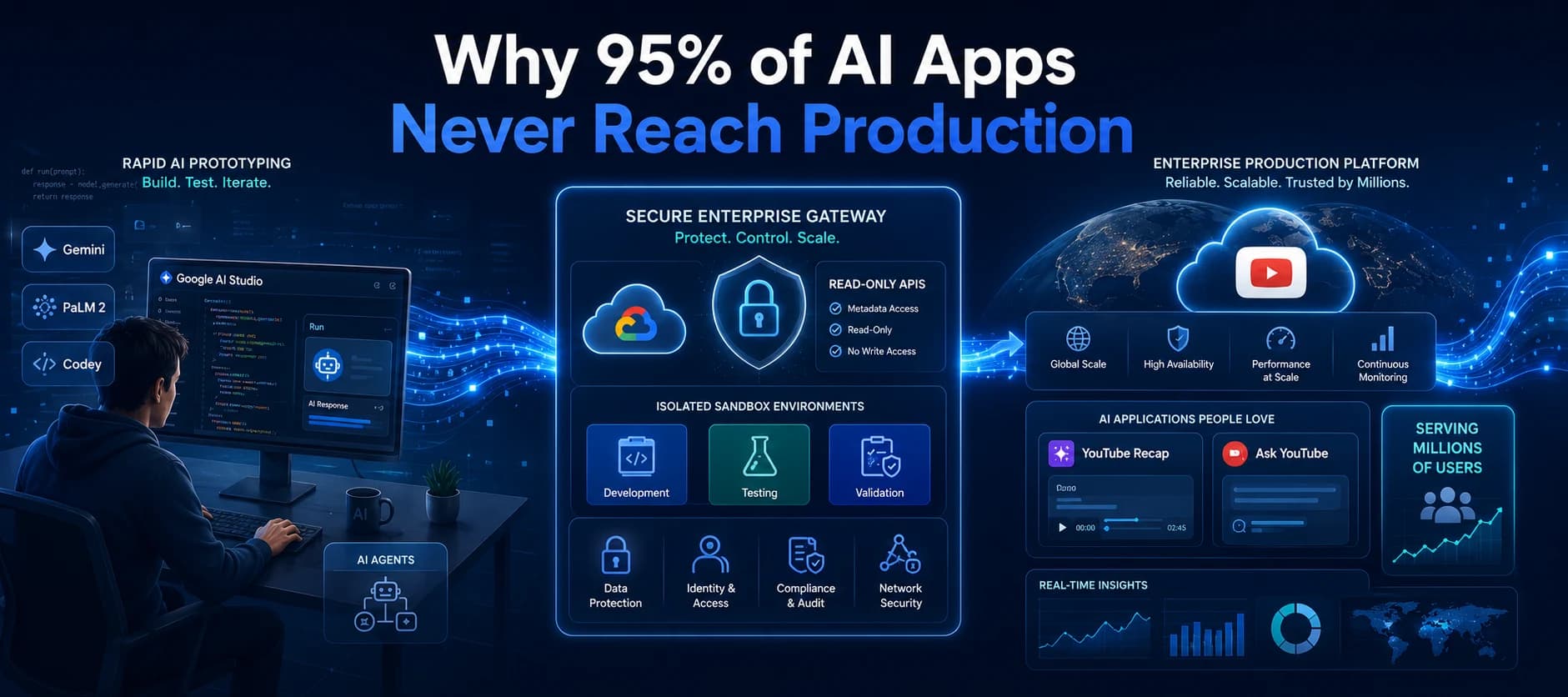
Why AI Apps Fail in Production and How Google Changed the Enterprise AI Playbook
Artificial intelligence has dramatically shortened the time needed to build applications. With modern large language models (LLMs), AI agents, and agentic engineering tools, developers can transform an idea into a working prototype within hours instead of months. Yet despite this rapid progress, Industry data suggests that only around 5% of AI prototypes successfully make it to production, while most remain stuck in experimentation stages.
Google recently shared how its engineering teams, including YouTube developers, overcame this challenge by redesigning the AI software development lifecycle (SDLC). Rather than trying to speed up traditional approval processes, Google built an entirely different infrastructure that separates rapid experimentation from production systems while maintaining access to realistic enterprise data.
The result is an approach that enables developers to innovate quickly without putting large-scale production services at risk.
The Enterprise AI Deployment Gap
Building an AI application on a local machine is relatively straightforward. Developers can quickly test prompts, generate code, and iterate with minimal consequences if something breaks.
Enterprise environments are fundamentally different.
Production systems support millions or even billions of users while operating under strict security, compliance, reliability, and governance requirements. Every new feature must pass multiple validation stages before deployment.
Common enterprise challenges include:
Complex infrastructure dependencies
Security and compliance reviews
Operational stability requirements
Large-scale production reliability
Risk of cascading failures across services
These safeguards protect mission-critical platforms but also slow AI innovation significantly.
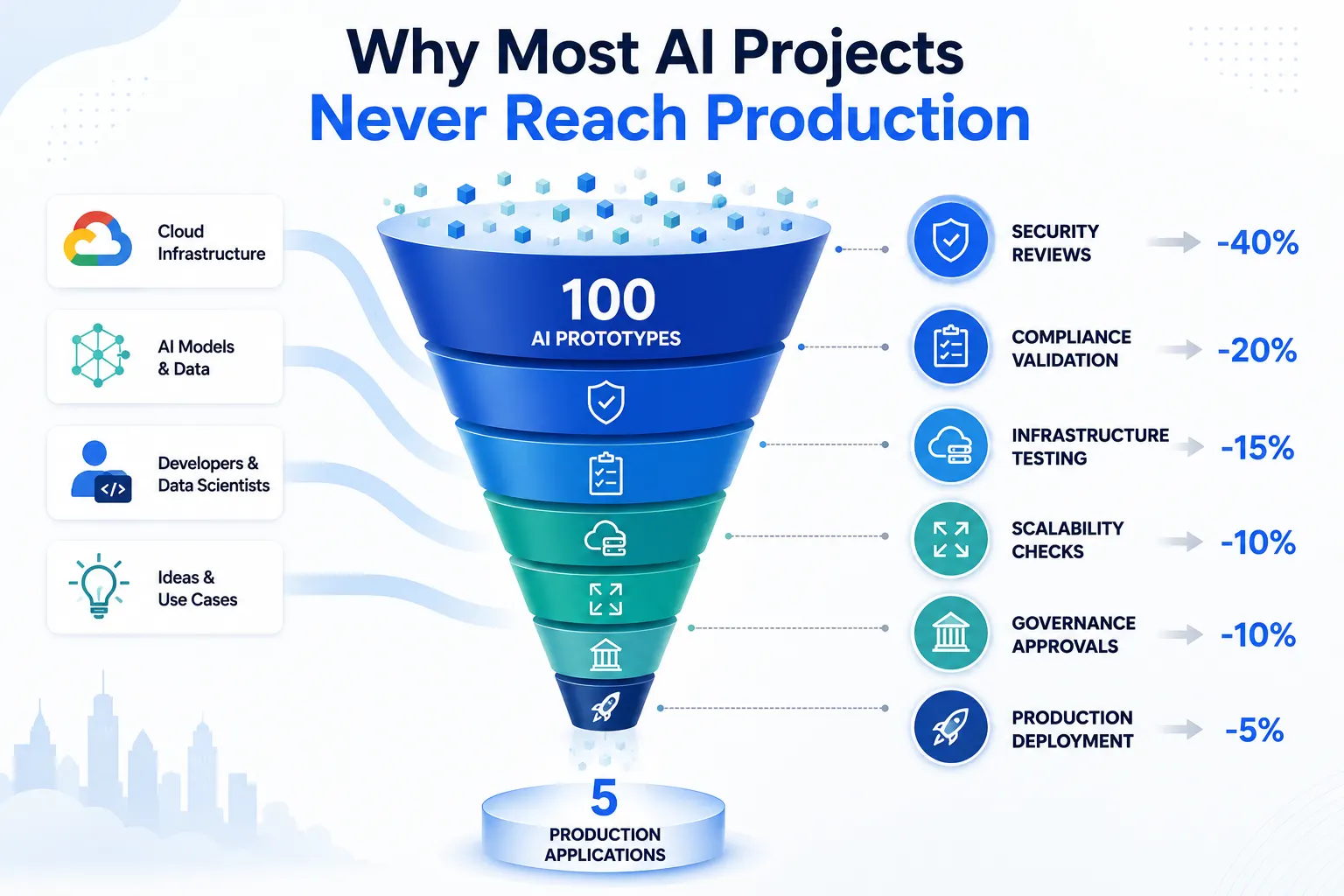
Why Enterprise AI Projects Rarely Reach Production
The gap between a successful prototype and a production-ready AI application is much larger than many developers initially expect. Building a working proof of concept often demonstrates that an idea is technically feasible, but enterprise deployment requires meeting a completely different set of operational standards.
Organizations must evaluate whether an AI application can scale reliably, protect sensitive data, integrate with existing infrastructure, and comply with internal governance policies. Even applications that perform well during testing may require significant architectural changes before they can support production workloads.
Another challenge is the rapid pace of AI innovation itself. Development teams often spend weeks validating a prototype through security reviews, infrastructure testing, and stakeholder approvals. By the time those processes are complete, a newer foundation model or development framework may already offer better performance, making the original implementation outdated before it reaches users.
Enterprise teams must also balance innovation with operational stability. Unlike startups that can tolerate occasional failures, large organizations operate customer-facing platforms where downtime directly affects user trust, revenue, and business continuity. As a result, AI deployment is no longer just a software engineering task. It becomes a multidisciplinary effort involving security specialists, platform engineers, compliance teams, and product leaders working together to ensure every deployment is safe and sustainable.
This explains why many AI initiatives stall after the prototype stage. The challenge is rarely the model itself. Instead, it is building the infrastructure, governance, and deployment processes needed to support AI applications at enterprise scale.
Why Speed Becomes Risk at Enterprise Scale
Google explains this challenge through the contrast between personal AI development and enterprise engineering.
A solo developer can rapidly iterate on AI-generated code, discard failed experiments, and restart within minutes. The consequences of mistakes are limited.
However, platforms like YouTube operate at an entirely different scale.
Its infrastructure has evolved over more than two decades and serves billions of users worldwide. Even a small experimental change has the potential to affect massive production workloads if proper safeguards are absent.
Google AI engineering leader Addy Osmani notes that unconstrained AI agent orchestration can quickly accumulate technical debt, especially when multiple autonomous agents modify code simultaneously. While manageable in personal projects, similar behavior inside enterprise systems could introduce widespread operational risks.
This creates the central dilemma for enterprise AI:
How can developers move at AI speed without compromising production reliability?
Google's Solution: A Dedicated AI Prototyping Stack
Instead of accelerating traditional enterprise approval pipelines, Google developed a dedicated AI prototyping stack using Google AI Studio templates and Google Cloud infrastructure.
Former YouTube engineer Benji Bear and engineering teams designed a unified design-to-code lifecycle platform that allows developers to validate ideas safely before production integration.
The architecture focuses on two major capabilities:
Secure access to production-like data
Safe experimentation within live user interfaces
By isolating prototypes from core systems, teams can innovate much faster while minimizing operational risk.
Read-Only Production Data Without Production Risk
One of the biggest obstacles in enterprise AI development is obtaining realistic data.
Completely isolated development environments often lack the production context necessary to evaluate AI applications accurately. Conversely, unrestricted access to production databases introduces unacceptable risks.
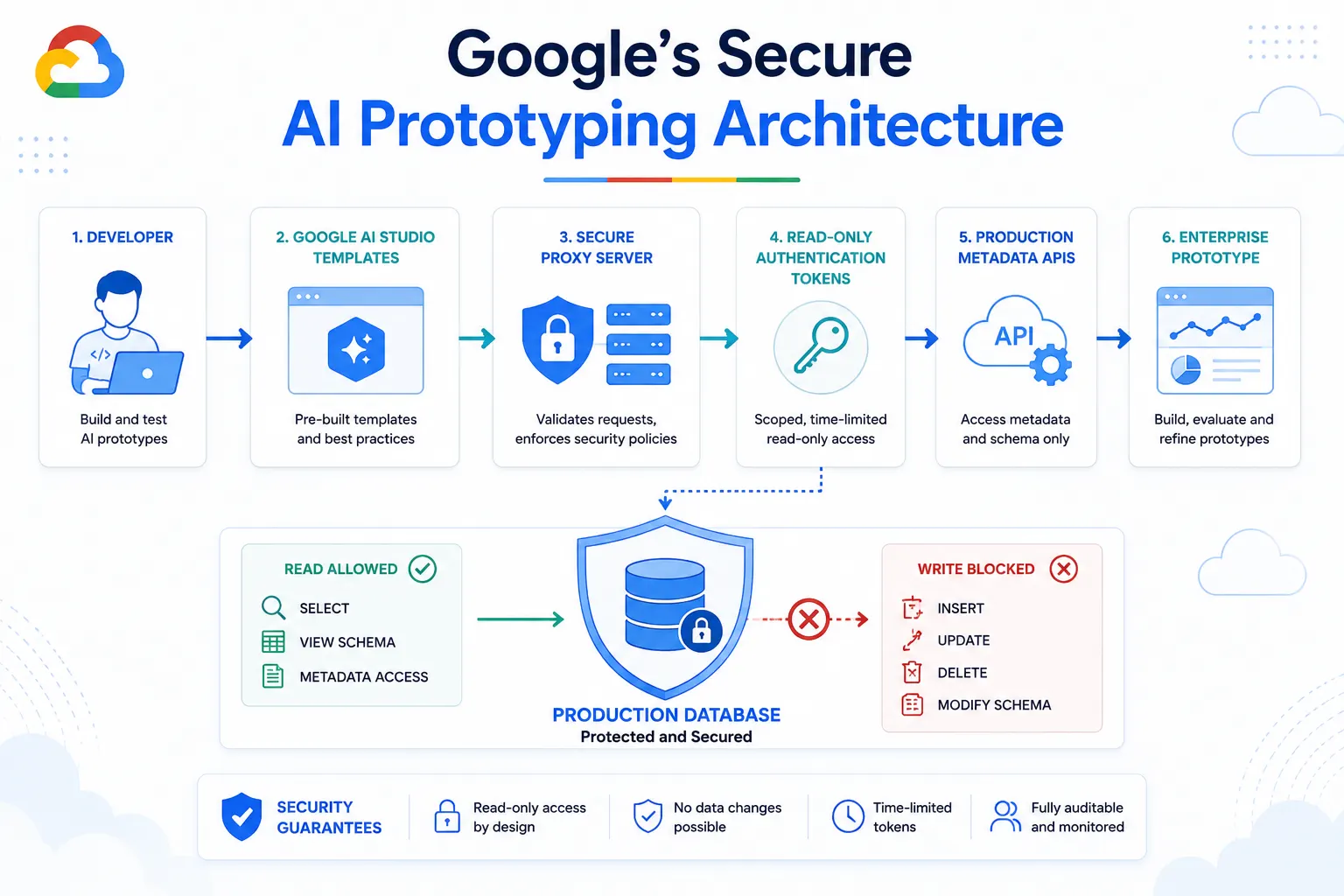
Google addressed this by creating a workflow where Google AI Studio templates connect to a Google Cloud-hosted proxy layer that provides controlled, read-only access to production metadata.
Developers receive:
Preconfigured AI Studio templates
Authenticated read-only API access
Live production metadata
Strict authentication tokens
No write permissions to production systems
This architecture allows prototypes to interact with real playlists, videos, channels, and metadata while preventing accidental modifications to production databases.
Developers gain realistic testing environments without exposing enterprise systems to unnecessary risk.
Testing Features Inside the Live YouTube Experience
Some AI applications require testing within real user experiences before full deployment.
To support this, Google's engineering platform includes client-side YouTube Extension wrappers.
Rather than modifying production application binaries directly, these wrappers inject experimental functionality into the live interface while keeping prototype code isolated through code-splitting and staging safeguards.
This enables developers to:
Validate user experience rapidly
Deploy experimental updates within minutes
Isolate prototype code from production binaries
Conduct user research safely
Using this approach, Google significantly shortened development timelines.
Features such as YouTube Recap and Ask YouTube progressed from early prototypes to user research studies within weeks instead of requiring multiple development quarters.
Why Google Encourages Throw-Away Code
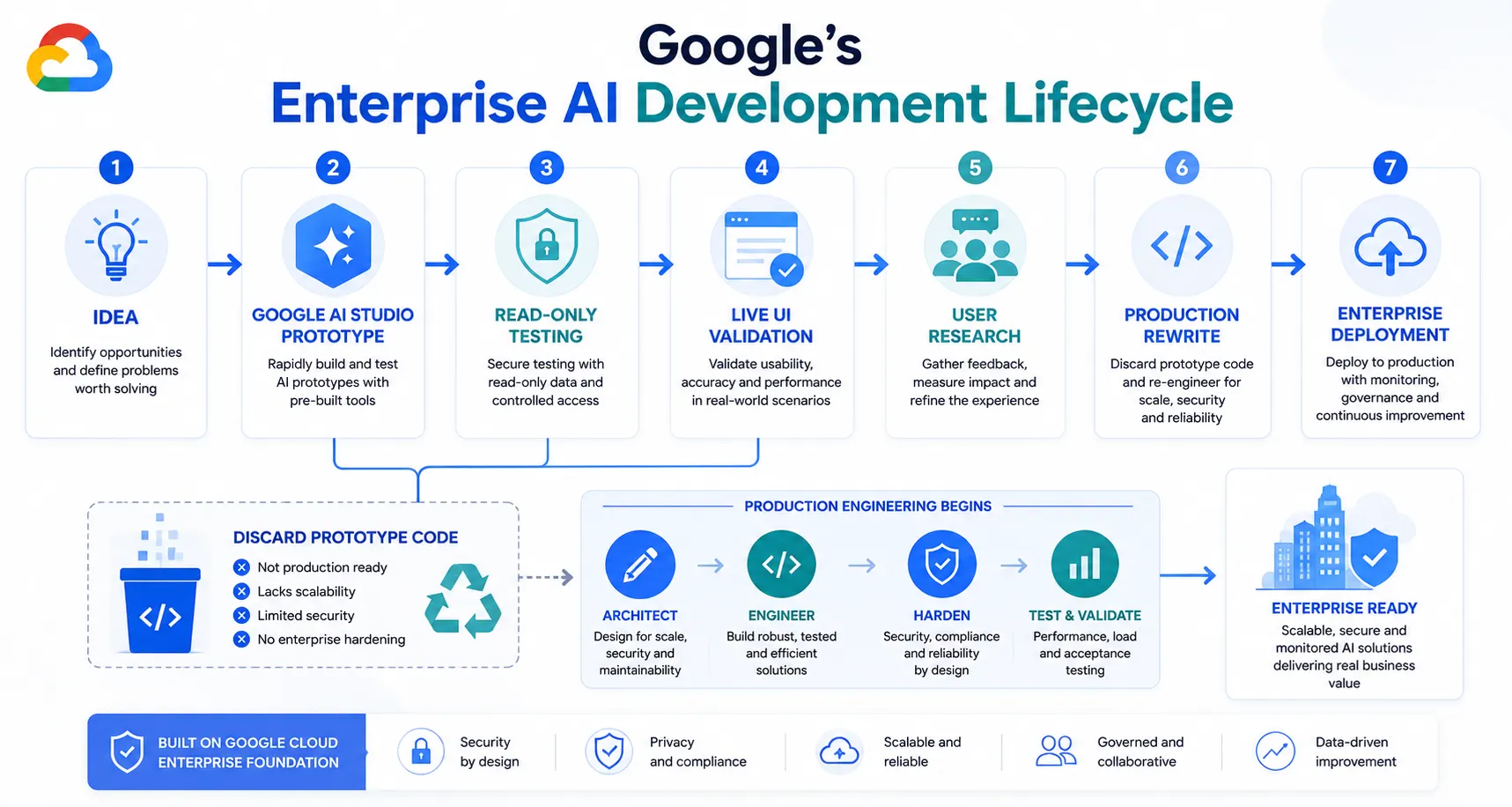
One of the most surprising lessons from Google's engineering philosophy is that prototype code is not intended to become production code.
Traditional software engineering emphasizes writing clean, maintainable, long-term code from the beginning.
AI-assisted development changes that assumption.
Google encourages developers using AI Studio to build quickly, accept temporary technical debt, and focus entirely on validating whether an idea delivers value.
Once an experiment proves successful, engineers rebuild the solution using production engineering standards instead of attempting to refactor AI-generated prototype code.
Because the prototype already runs against production-like infrastructure, developers begin the production rewrite with a verified architectural blueprint rather than starting from scratch.
This significantly reduces redevelopment effort while maintaining enterprise-quality standards.
Lessons Enterprise Teams Can Learn From Google's AI Approach
Enterprise organizations looking to scale AI adoption can apply several lessons from Google's approach. The first is that innovation requires dedicated environments where developers can experiment without introducing unnecessary production risks.
Instead of treating every prototype as a future production application, teams should separate discovery from engineering hardening. Early experiments should focus on answering one question: does this idea create measurable value for users?
A second lesson is the importance of realistic testing environments. AI systems often behave differently when connected to real data, workflows, and user interactions. Secure access to production-like environments allows teams to discover limitations earlier in the development process.
Organizations should also rethink how they measure engineering productivity. In traditional software development, success is often measured by completed features and production releases. In AI development, success increasingly depends on how quickly teams can test ideas, learn from failures, and identify the solutions worth investing in.
Google's approach shows that the future of AI engineering is not about eliminating failure. It is about creating systems where failure happens quickly, safely, and at a low cost.
The Role of User Research in AI Prototyping
One important advantage of Google's prototyping approach is that it allows teams to validate user value much earlier.
In traditional software development, teams often invest significant engineering effort before understanding whether users actually need a feature. With AI applications, this approach can become inefficient because AI capabilities evolve rapidly and many early ideas may not justify long-term investment.
Google's prototyping stack enables teams to move from concept to user research much faster.
By combining production-like data access with controlled interface experiments, developers can test how users interact with AI-powered features before building a complete production system.
Examples such as YouTube Recap and Ask YouTube demonstrate this approach. Instead of spending multiple development cycles building fully integrated features, teams were able to create prototypes, study user reactions, and determine whether the ideas provided meaningful value.
Designing for Safe Failure
Google argues that the industry's high AI prototype failure rate should not be viewed as a weakness.
Instead, it represents an effective innovation strategy.
As AI dramatically reduces the cost of generating software, engineering priorities shift from simply writing code toward designing systems that allow experimentation without threatening production stability.
This includes building:
Read-only development environments
Secure infrastructure bridges
Isolated deployment pipelines
Controlled production validation workflows
By making experimentation inexpensive and failures safe, organizations enable developers to explore significantly more ideas while protecting mission-critical services.
The Future of Enterprise AI Development
Google's approach demonstrates that successful enterprise AI adoption depends less on faster coding and more on better development infrastructure.
Rather than forcing AI innovation through traditional software delivery processes, enterprises can create dedicated prototyping environments that balance speed with governance.
As AI-generated code becomes increasingly common, the organizations that innovate fastest will likely be those that invest in secure experimentation platforms, realistic testing environments, and isolated deployment pipelines.
For enterprises, the challenge is no longer generating software quickly. It is building development systems where rapid experimentation and operational reliability can coexist.
Google's approach suggests that the biggest risk for enterprises is not failed experiments, but slow validation cycles that prevent teams from discovering valuable AI opportunities quickly. By creating environments where experimentation is fast, isolated, and low-risk, organizations can learn faster, identify promising ideas earlier, and move successful AI applications toward production with greater confidence.
The next generation of enterprise AI development will not be defined only by more powerful models or faster code generation. It will depend on the infrastructure organizations build around those technologies. Companies that create safe environments for experimentation will be able to test more ideas, learn faster, and move successful AI applications into production with greater confidence.
Source: Google Cloud Blog
About the Author