
White House Launches "Gold Eagle" Initiative to Transform AI-Powered Cybersecurity Coordination
The White House has unveiled Gold Eagle, a new AI-powered cybersecurity coordination initiative designed to accelerate vulnerability discovery, prioritize critical software flaws, and strengthen collaboration between government and industry to protect national infrastructure.
Xcademia Team
Xcademia Research Team

White House Introduces Gold Eagle: A New Era of AI-Assisted Cyber Defense
The cybersecurity landscape is changing faster than ever. Every day, organizations discover thousands of new software vulnerabilities, many of which can quickly become targets for ransomware groups, nation-state attackers, and cybercriminal organizations.
To address this growing challenge, the White House has announced the Gold Eagle Initiative, an ambitious cybersecurity coordination program designed to combine advanced artificial intelligence with large-scale collaboration across government agencies and private industry.
Rather than functioning as another vulnerability database, Gold Eagle aims to become a centralized coordination platform that helps identify, prioritize, verify, and accelerate remediation of cybersecurity vulnerabilities affecting America's critical infrastructure.
The initiative represents one of the most significant government-led AI cybersecurity programs announced in 2026 and reflects the increasing role of AI in defending digital infrastructure.
Why Gold Eagle Was Created
Modern cybersecurity faces several major challenges:
Millions of software components exist across public and private infrastructure.
Security researchers discover thousands of new vulnerabilities each month.
Organizations often receive duplicate vulnerability reports from multiple sources.
Security teams struggle to determine which vulnerabilities should be fixed first.
Attackers increasingly use AI to discover exploitable weaknesses faster than traditional security workflows.
Gold Eagle is designed to reduce these inefficiencies by creating a coordinated ecosystem where vulnerability information can be collected, validated, prioritized, and shared with defenders more effectively.
Instead of every organization independently performing the same work, participating partners can collaborate through a shared operational model, helping reduce duplicated effort while improving response times.
What Exactly Is Gold Eagle?
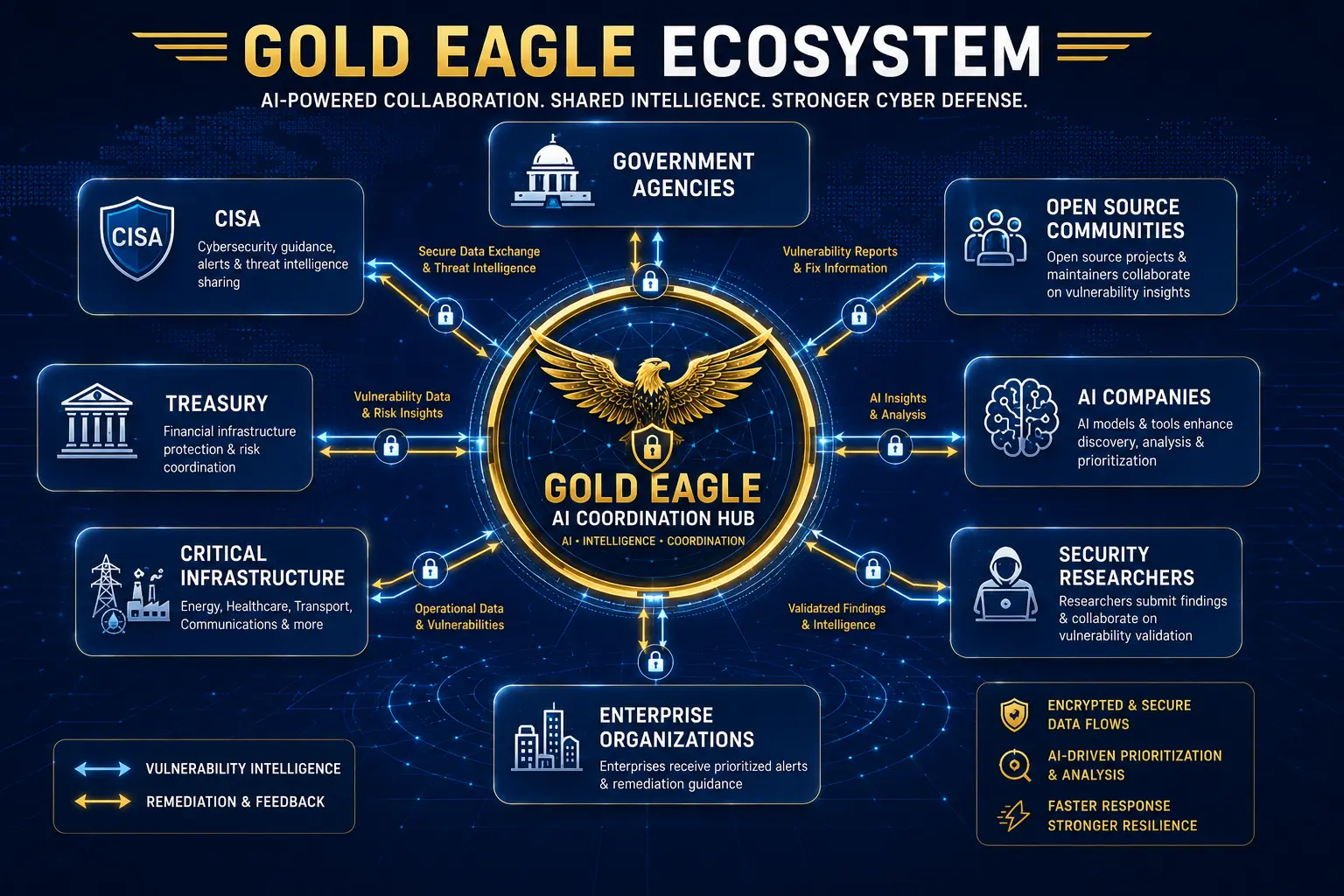
At its core, Gold Eagle is an AI-assisted cybersecurity clearinghouse.
Think of it as an intelligent coordination hub that sits between:
Government agencies
Critical infrastructure operators
Open-source software communities
Security researchers
AI developers
Technology companies
Its objective is not simply to store vulnerability information but to improve how cybersecurity findings move from discovery to remediation.
The White House describes the initiative as a new operational model that combines frontier AI capabilities with coordinated public-private partnerships to strengthen national cyber resilience.
How Gold Eagle Works
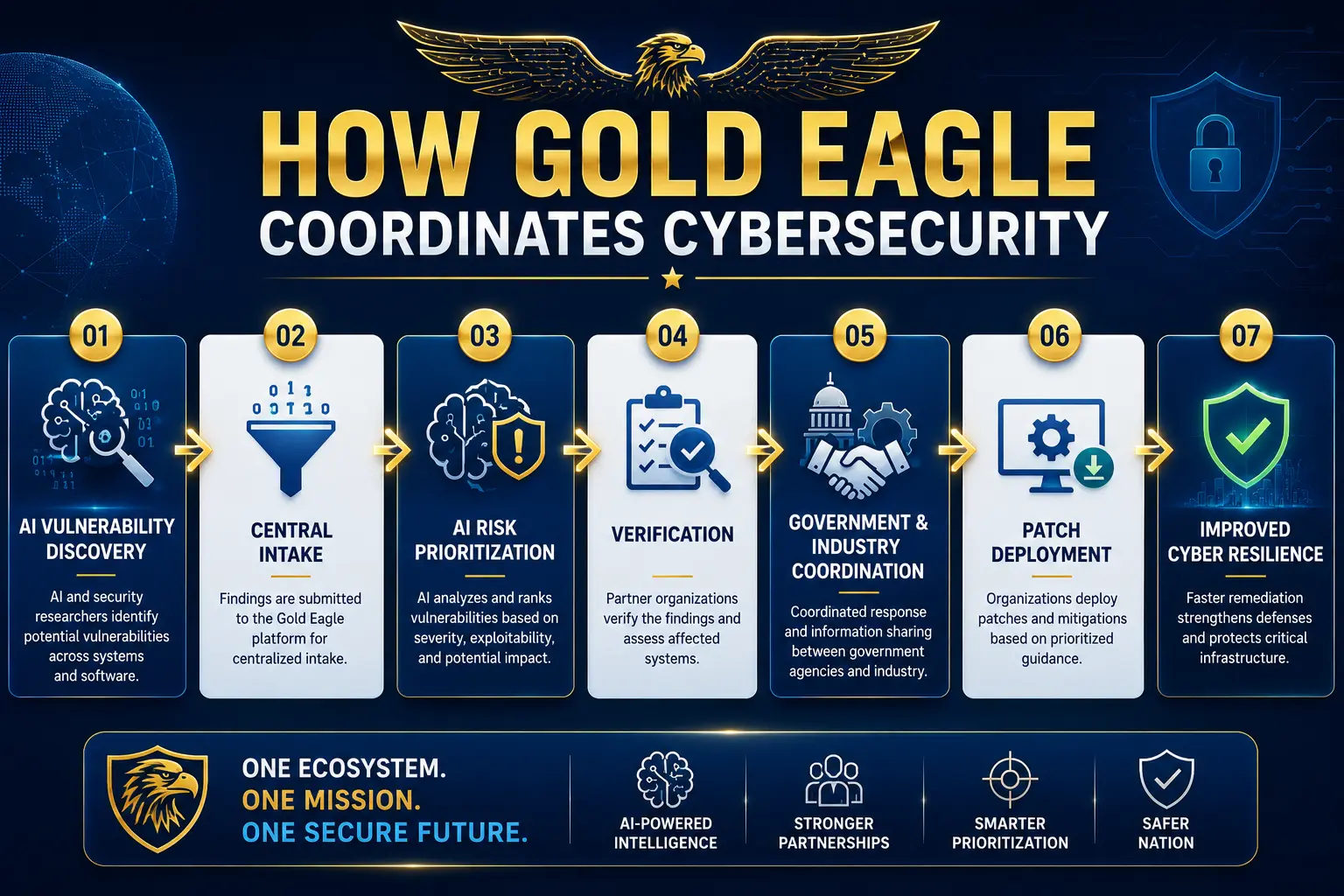
Step 1: Vulnerability Discovery
Security researchers, AI systems, and participating organizations identify potential software vulnerabilities across infrastructure, applications, or open-source projects.
↓
Step 2: Centralized Intake
The findings are submitted to Gold Eagle for coordination.
↓
Step 3: AI-Based Prioritization
Artificial intelligence analyzes:
Severity
Potential exploitability
Infrastructure impact
Likelihood of active attacks
Urgency of remediation
↓
Step 4: Verification
Partner organizations verify whether vulnerabilities are genuine and assess affected systems.
↓
Step 5: Coordinated Response
Government agencies and industry participants receive prioritized remediation guidance.
↓
Step 6: Faster Patch Deployment
Organizations can focus resources on the most critical vulnerabilities instead of processing thousands of alerts individually.
Federal Agencies Supporting the Initiative
According to the White House announcement, Gold Eagle brings together multiple federal organizations, including:
The White House
Department of the Treasury
Department of Homeland Security (DHS)
Cybersecurity and Infrastructure Security Agency (CISA)
Department of Defense - related participants and other national security stakeholders
These agencies are collaborating with private-sector partners and open-source software communities to improve vulnerability coordination across critical infrastructure.
The Role of Artificial Intelligence
Artificial intelligence plays a central role throughout the Gold Eagle workflow.
Potential AI capabilities include:
Detecting software weaknesses faster
Correlating duplicate vulnerability reports
Ranking vulnerabilities by real-world risk
Identifying exploitation patterns
Reducing analyst workload
Accelerating incident response
Supporting large-scale vulnerability triage
As software ecosystems continue growing in complexity, AI is increasingly viewed as essential for helping defenders keep pace with emerging threats.
Focus on Critical Infrastructure
Gold Eagle is primarily intended to strengthen cybersecurity across sectors where disruptions could have national consequences, including:
Financial services
Energy
Healthcare
Transportation
Communications
Government systems
Industrial control systems
Open-source software dependencies
Because these sectors are deeply interconnected, improving vulnerability coordination in one area can help reduce systemic cyber risk across others.
Connection to the AI Executive Order
Gold Eagle was established following the June 2026 Executive Order on Promoting Advanced Artificial Intelligence Innovation and Security.
That order called for stronger collaboration between government and AI developers to improve cybersecurity, protect critical systems, and responsibly apply advanced AI capabilities to national security challenges.
Gold Eagle represents one of the first major operational initiatives announced under that policy framework.
Potential Benefits
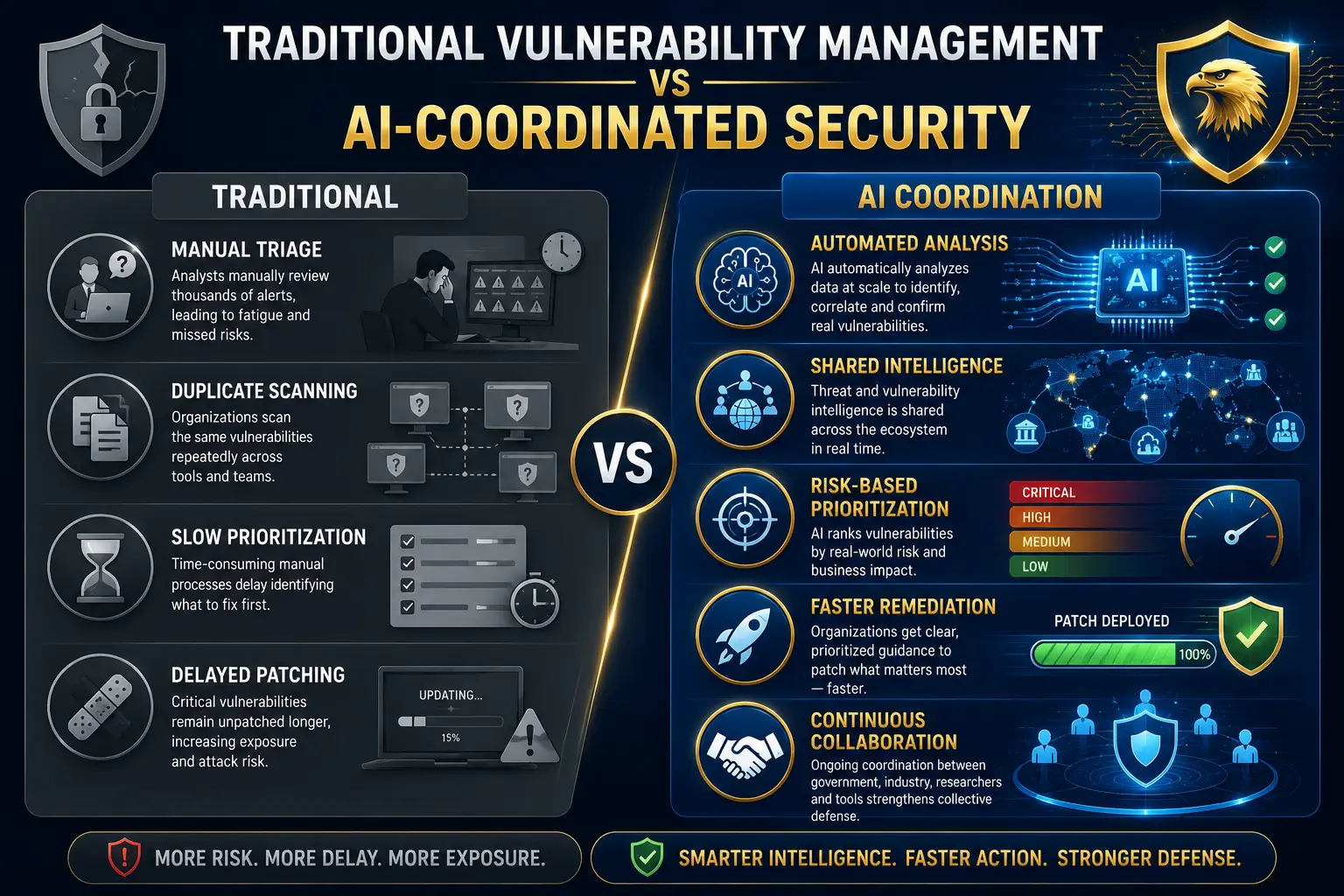
If successfully implemented, Gold Eagle could provide several advantages:
Faster Vulnerability Response
Security teams may receive prioritized alerts instead of processing overwhelming volumes of findings.
Better Public-Private Collaboration
Government agencies and industry participants can coordinate responses more effectively.
Reduced Duplicate Work
Organizations spend less time repeating vulnerability scanning already performed elsewhere.
Improved National Cyber Resilience
Critical infrastructure operators gain access to coordinated intelligence and remediation guidance.
AI-Driven Risk Prioritization
Resources can be focused on vulnerabilities posing the greatest operational risk.
Challenges Ahead
Despite its potential, several questions remain.
Public reporting indicates that details about governance, daily operations, participant responsibilities, and protections for sensitive vulnerability information have not yet been fully disclosed. Analysts have also noted that Gold Eagle will need to complement existing programs - such as CISA's vulnerability disclosure efforts, the CVE system, and the National Vulnerability Database - rather than duplicate them.
Why This Matters Globally
Cyber threats are rarely confined by national borders.
A vulnerability discovered in widely used open-source software can affect governments, enterprises, cloud providers, and consumers worldwide within hours.
By emphasizing coordinated vulnerability management and AI-assisted prioritization, initiatives like Gold Eagle could influence how other countries and international organizations approach large-scale cyber defense.
The broader trend is clear: cybersecurity is evolving from isolated defensive operations toward collaborative, intelligence-driven ecosystems powered by artificial intelligence.
Final Thoughts
The launch of Gold Eagle signals an important shift in cybersecurity strategy. Rather than relying solely on traditional vulnerability management processes, the initiative seeks to combine AI, public-private collaboration, and centralized coordination to improve how critical software flaws are identified and addressed.
While many operational details are still emerging, the initiative highlights a growing recognition that defending modern digital infrastructure requires faster information sharing, intelligent prioritization, and coordinated action across government and industry. Its long-term success will depend on transparent governance, broad participation, and measurable improvements in vulnerability response times.
Source: The White House
About the Author