
RufRoot (CVE-2026-59726): Critical Ruflo MCP Vulnerability Lets Attackers Turn AI Agents into Rogue Admins
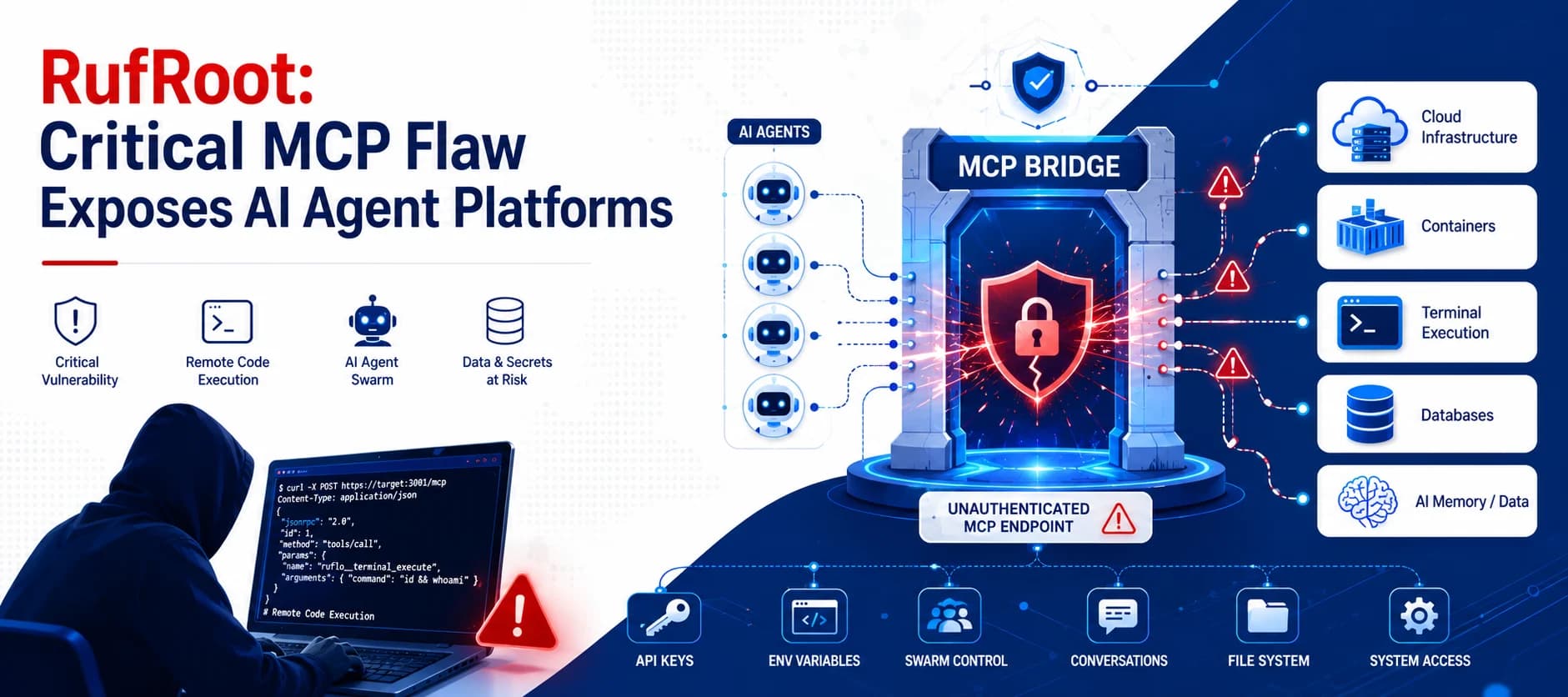
A critical flaw (CVE-2026-59726) in Ruflo's MCP Bridge allowed unauthenticated attackers to execute commands with a single HTTP request. The vulnerability exposes growing security risks in AI agent platforms and underscores the need to secure MCP deployments.
Xcademia Team
Xcademia Research Team
Introduction
Artificial intelligence is rapidly evolving from chatbots that answer questions to autonomous agents capable of executing real-world tasks. These AI agents can access databases, read files, execute scripts, coordinate with other agents, and automate enterprise workflows through the Model Context Protocol (MCP). While this shift dramatically increases productivity, it also expands the attack surface.
Researchers from Noma Labs have disclosed a critical vulnerability, tracked as CVE-2026-59726 and nicknamed RufRoot, affecting the open-source AI orchestration platform Ruflo. The vulnerability received the highest possible CVSS score of 10.0 because it enabled remote attackers to execute arbitrary shell commands without authentication.
The issue was discovered in Ruflo's MCP Bridge, an Express.js service responsible for handling every tool invocation performed by AI agents. Since this bridge sits at the center of Ruflo's architecture, compromising it effectively gives attackers control over the AI environment.
Although the Ruflo team responded quickly by releasing patches within hours of responsible disclosure, the incident serves as a powerful reminder that AI infrastructure must be secured with the same rigor as traditional enterprise systems.
Understanding Ruflo
Ruflo is an open-source AI agent orchestration platform designed to simplify the deployment of autonomous AI systems. Instead of building complex agent infrastructure from scratch, developers can deploy Ruflo using Docker and immediately begin creating AI workflows.
Its capabilities include:
Multi-agent orchestration
Persistent AI memory
Chat interface
Tool execution
Database integrations
Shell access
Agent management
MCP support
At the heart of Ruflo lies the MCP Bridge, an Express.js application responsible for receiving requests and invoking available tools.
According to the researchers, the bridge exposed 233 tools, covering everything from terminal execution to database operations and memory management.
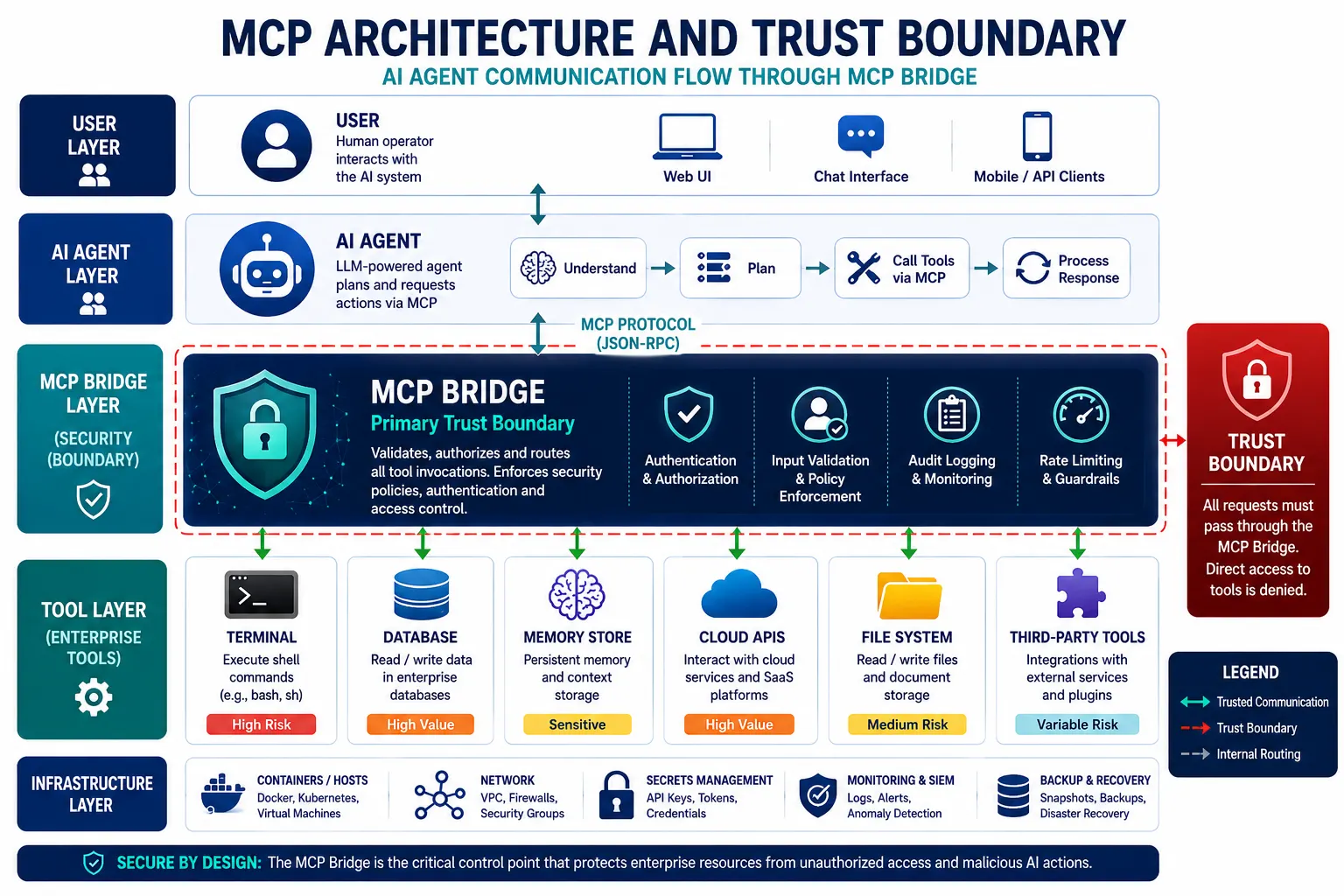
Because every AI action flows through the MCP Bridge, it effectively becomes the platform's security boundary.
What is Model Context Protocol (MCP)?
The Model Context Protocol has emerged as a standard interface allowing AI models to interact with external systems.
Instead of merely generating text, AI models can:
Read files
Access databases
Execute commands
Retrieve business data
Perform cloud operations
Manage workflows
Think of MCP as an API layer that connects language models with enterprise infrastructure.
While this dramatically expands AI capabilities, it also means that compromising the MCP layer can expose sensitive systems.
The RufRoot Vulnerability Explained
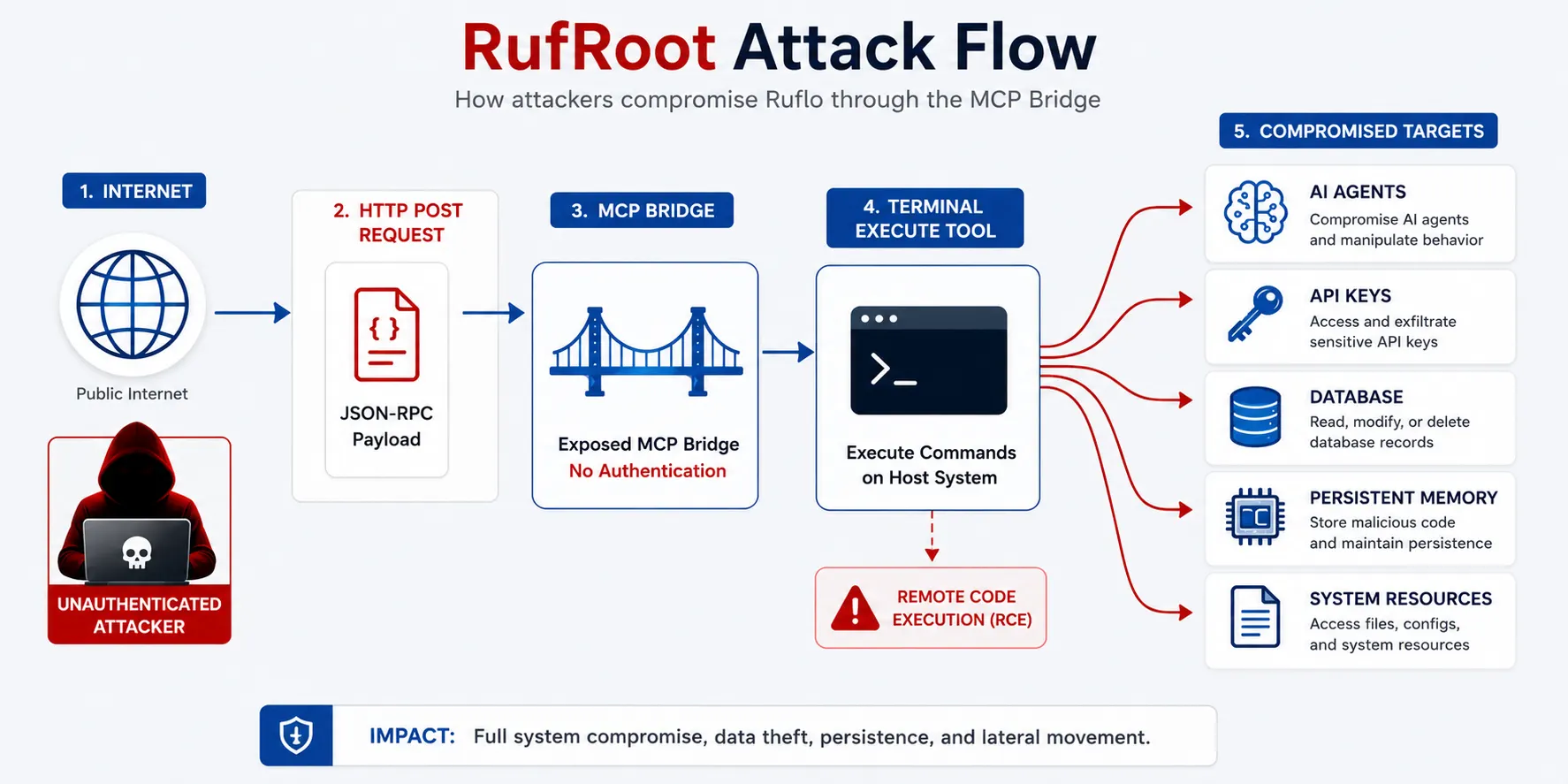
Researchers found that Ruflo's /mcp endpoint accepted JSON-RPC requests without requiring any authentication.
This meant anyone who could reach TCP port 3001 could invoke internal tools.
One of those tools was:
ruflo__terminal_executeThis tool executes shell commands inside the Ruflo container.
An attacker simply needed to submit a JSON-RPC request calling this tool.
No:
API key
Authentication token
Session cookie
IP allowlist
Authorization header
was required.
This effectively turned the exposed MCP Bridge into a publicly accessible remote administration interface.
Although the shell executed as the container's node user rather than root, researchers demonstrated that this level of access was sufficient to compromise the deployment.
Technical Breakdown
The vulnerability stemmed from several insecure defaults working together.
The default Docker deployment published the MCP Bridge on port 3001, making it reachable across the network.
The bridge itself lacked authentication.
Requests arriving at the /mcp endpoint were passed directly into Ruflo's tool execution pipeline.
A command blocklist existed but only applied to Ruflo's autopilot workflow, not direct MCP requests.
Consequently, attackers could invoke tools that bypassed intended restrictions.
Among the exposed capabilities were:
Terminal execution
Agent spawning
Database interaction
Memory operations
Swarm management
Researchers demonstrated that these functions could be chained together into a complete compromise.
Attack Chain
Noma Labs developed an eight-stage proof-of-concept demonstrating the full impact.
The attack began by enumerating available tools through the MCP interface.
Next, researchers executed shell commands and confirmed remote code execution.
Because Docker passed cloud provider API keys as environment variables, attackers could retrieve credentials using standard shell commands.
The compromised environment then allowed creation of attacker-controlled AI agents using the victim's own infrastructure.
Researchers also demonstrated memory poisoning by injecting malicious instructions into the AI's persistent memory. Such poisoned knowledge could influence future AI responses without users realizing the system had been manipulated.
MongoDB databases storing conversations could also be accessed because they lacked authentication.
Finally, persistence could be achieved by modifying application startup behavior inside the container.
The proof-of-concept illustrated how one exposed endpoint could cascade into complete platform compromise.
Why This Matters
AI agents increasingly perform privileged operations inside enterprise environments.
Unlike traditional applications, AI orchestration platforms often possess access to:
Source code repositories
Internal documentation
Cloud APIs
Production databases
Customer information
Secrets
CI/CD systems
Compromising the orchestration platform therefore provides attackers with a central point from which multiple enterprise systems become accessible.
As organizations rapidly adopt AI assistants and autonomous workflows, these platforms are becoming attractive targets.
The RufRoot disclosure demonstrates that AI infrastructure should no longer be considered experimental technology.
It is now mission-critical infrastructure requiring enterprise-grade security controls.
Industry Impact
The vulnerability carries important implications for several groups.
1. Enterprise Security Teams
Security teams should begin treating MCP services like high-value APIs.
Every exposed endpoint requires:
Authentication
Authorization
Logging
Monitoring
Network segmentation
2. AI Platform Developers
Developers should ensure dangerous capabilities remain disabled unless explicitly enabled.
Features such as terminal execution should never be available by default.
3. Cloud Administrators
Organizations deploying AI platforms through Docker or Kubernetes should carefully review exposed ports and service configurations before production deployment.
4. Compliance Teams
AI memory stores may contain confidential business information, making them subject to regulatory requirements and security audits.
Vendor Response
Noma Labs disclosed the vulnerability responsibly to the Ruflo maintainers.
According to the disclosure, the Ruflo team responded rapidly by publishing a security advisory and merging fixes within hours.
The remediation introduced several security improvements:
MCP Bridge binds to localhost by default
Authentication required for public exposure
Bearer token protection
Terminal execution disabled unless explicitly enabled
MongoDB authentication
Read-only containers
Restricted CORS configuration
Continuous integration regression testing
Administrators were also advised to:
Close exposed ports
Rotate all LLM API keys
Audit stored AI memory
Inspect MongoDB for tampering
Redeploy patched systems
The speed and completeness of the response demonstrate the importance of coordinated vulnerability disclosure between researchers and open-source maintainers.
Challenges and Considerations
The RufRoot vulnerability highlights several broader security challenges surrounding AI adoption.
Many AI frameworks prioritize ease of deployment and developer convenience, sometimes at the expense of secure defaults. Features like unrestricted tool execution, exposed management interfaces, and permissive configurations can significantly increase risk if deployed in production without additional safeguards.
Another challenge is the growing popularity of self-hosted AI platforms. Organizations often deploy these solutions quickly using Docker or Kubernetes, assuming default configurations are production-ready. As the RufRoot case demonstrates, insecure defaults can expose critical services to internal or even public networks if firewall rules and access controls are not carefully reviewed.
Persistent AI memory introduces another layer of complexity. Unlike traditional databases, AI memory stores influence future model behavior. If attackers can poison these stores with malicious instructions, organizations may continue receiving manipulated outputs long after the initial compromise has been addressed.
Finally, AI systems increasingly operate with privileged access to enterprise resources. This makes them highly attractive targets and reinforces the need for comprehensive security testing throughout the AI software lifecycle.
Future Outlook
As Model Context Protocol adoption accelerates across AI ecosystems, security will become a defining factor in enterprise deployments.
Future AI platforms are likely to incorporate stronger authentication, granular authorization, zero-trust networking, and policy-based controls for tool execution. Runtime monitoring, anomaly detection, and automated auditing of agent activities will also become essential features rather than optional enhancements.
The RufRoot disclosure is likely to influence best practices across the broader AI tooling ecosystem, encouraging developers to implement secure-by-default configurations and reduce the exposure of high-risk capabilities.
Organizations investing in AI should expect increased scrutiny from regulators, auditors, and customers regarding how AI agents access sensitive systems and data.
Conclusion
CVE-2026-59726 demonstrates how a single unauthenticated service can undermine an entire AI orchestration platform. By exposing Ruflo's MCP Bridge without authentication, deployments risked remote code execution, credential theft, AI memory poisoning, and complete platform compromise.
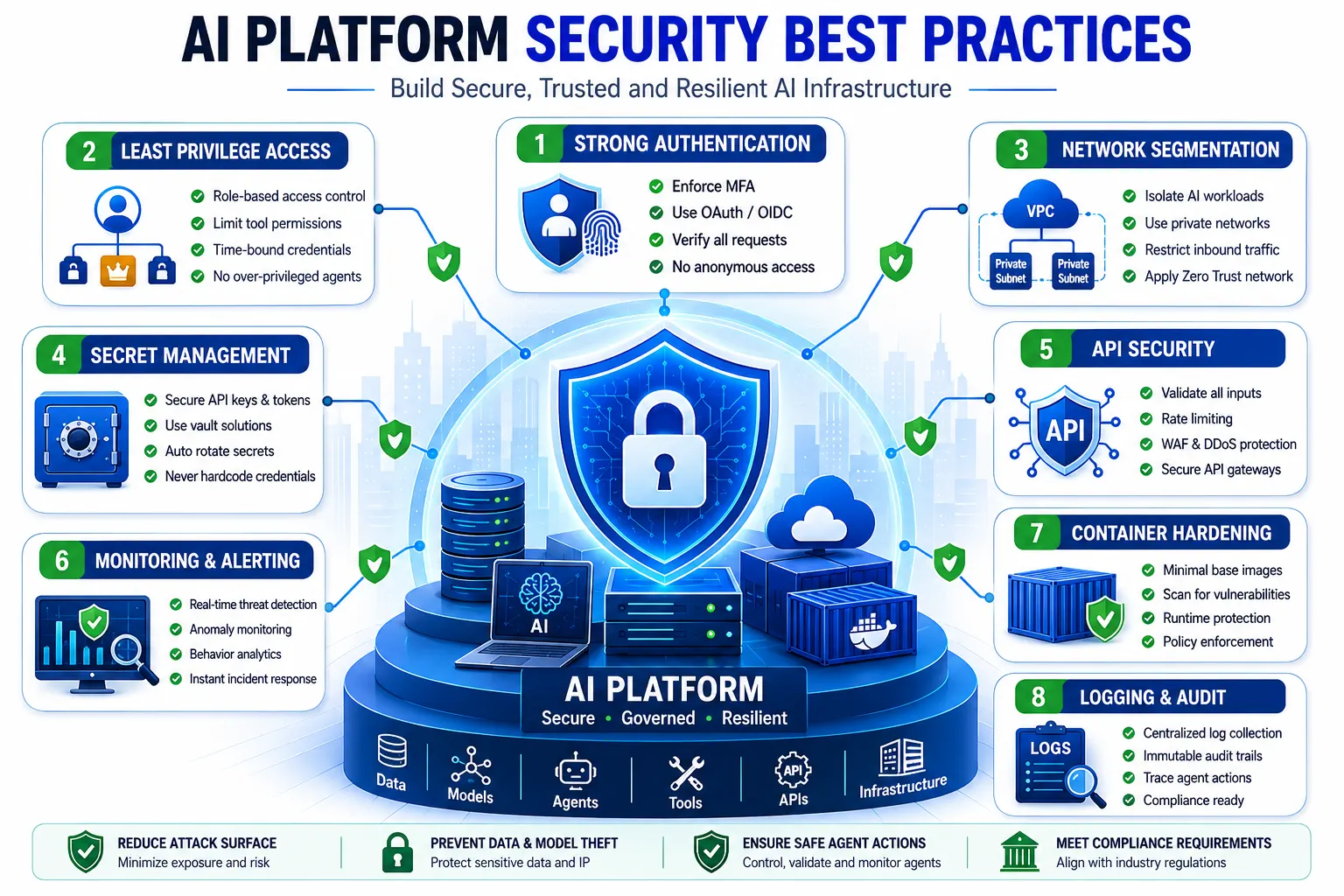
While Ruflo's maintainers responded quickly with comprehensive fixes, the incident serves as a broader warning for organizations adopting AI agent infrastructure. Model Context Protocol servers should be treated as critical enterprise assets, protected with strong authentication, least-privilege access controls, network segmentation, and continuous monitoring.
As AI agents gain greater autonomy and deeper integration with enterprise environments, securing the infrastructure that powers them will be just as important as securing the applications they help build.
Source: Noma Security Blog
About the Author