
NVIDIA Says Physical AI Needs Safety at Every Layer
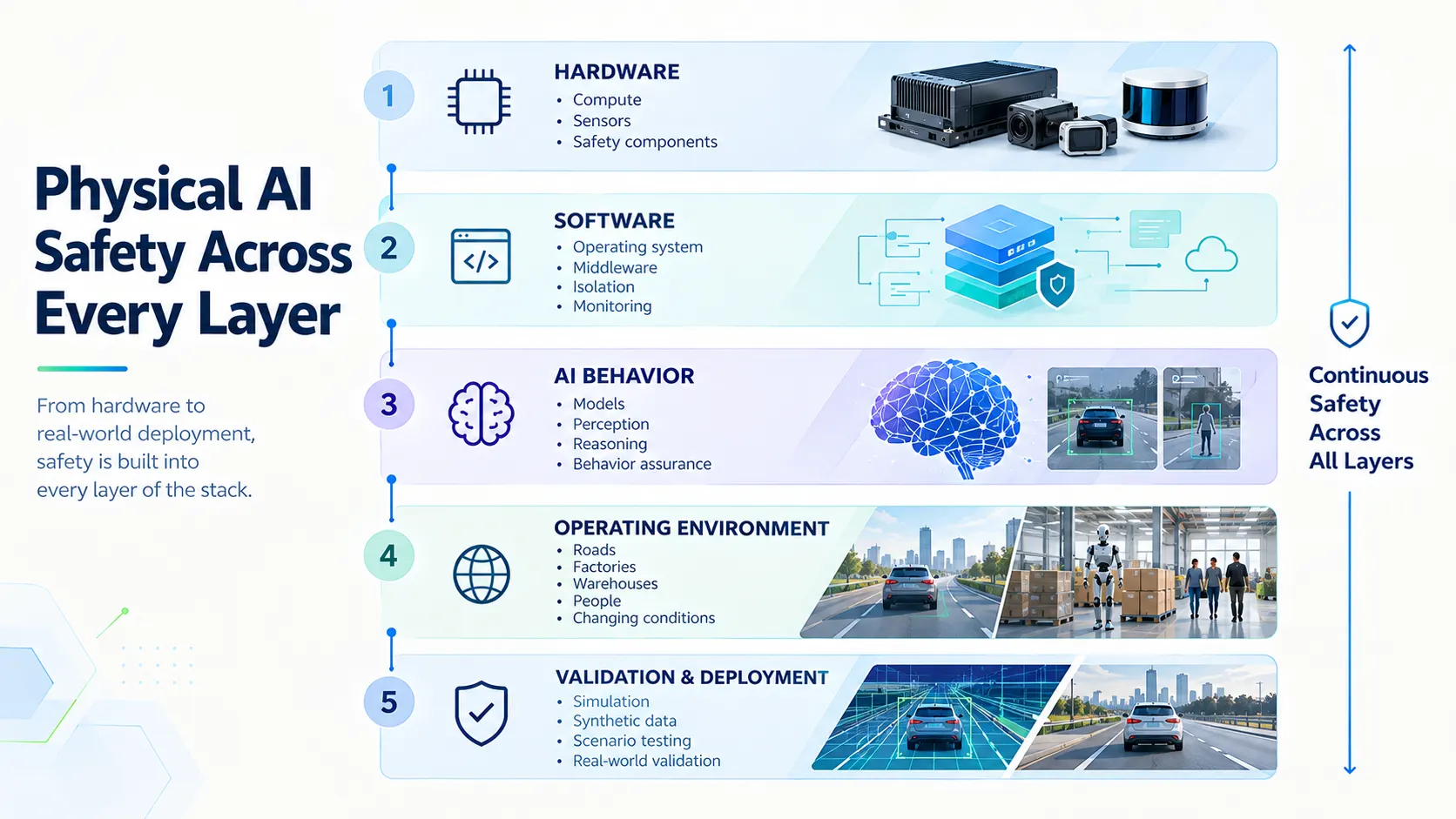
NVIDIA says scaling autonomous vehicles and robots requires safety across hardware, software, AI behavior, operating environments and the full deployment lifecycle, with simulation and validation supporting real-world deployment.
Xcademia Team
Xcademia Research Team
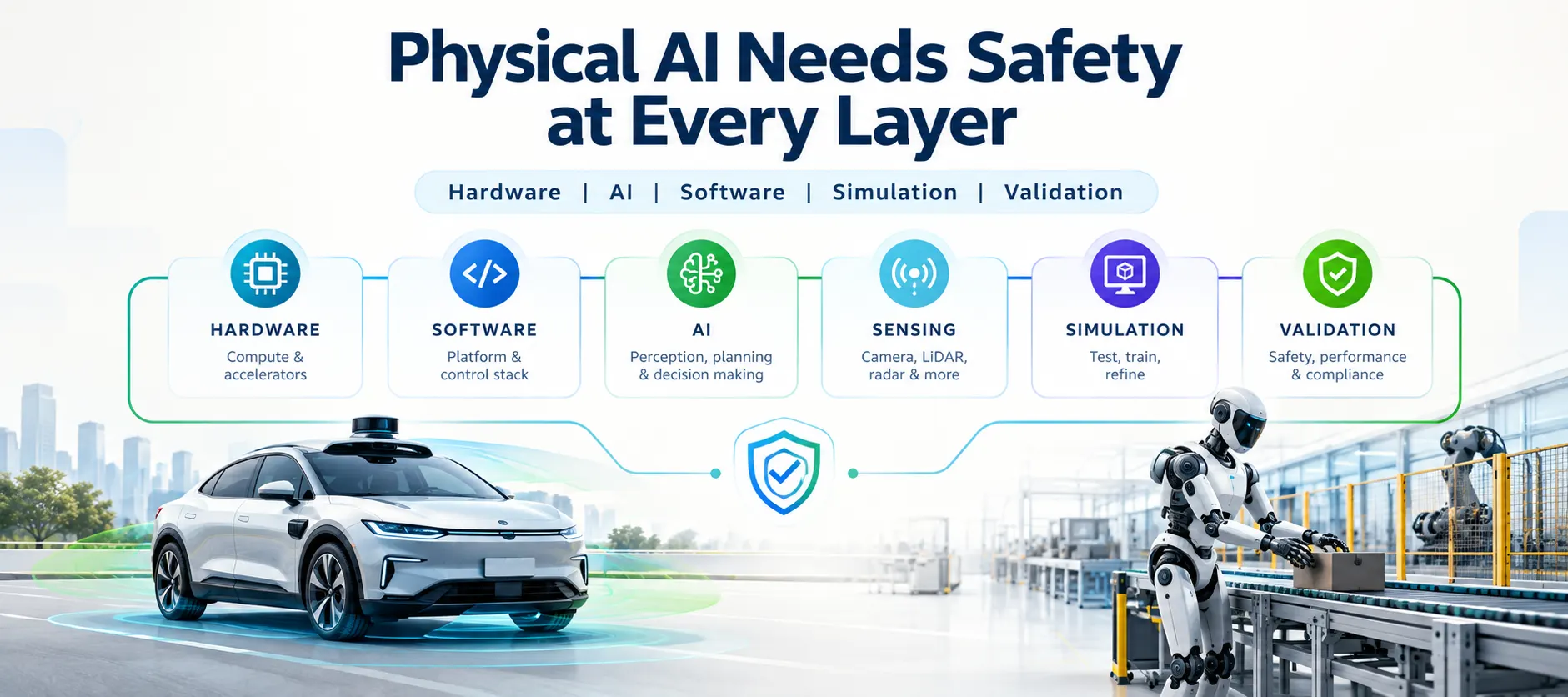
As autonomous vehicles, robots and other AI-driven machines take on increasingly complex tasks in physical environments, safety cannot be treated as a final validation step.
In a September 21, 2026 NVIDIA Blog post, Riccardo Mariani argues that physical AI systems need safety across hardware, software, AI behavior, operating environments and the deployment lifecycle.
NVIDIA points to autonomous vehicles, humanoid robots and industrial robots as examples of systems where AI decisions can directly produce physical actions. That creates safety requirements that extend beyond traditional software testing.
The company says its NVIDIA Halos safety architecture is designed to address these requirements across design, validation and deployment.
The broader approach combines functional safety, AI behavior assurance, simulation, sensor processing and real-world validation.
Physical AI Is Moving Into Real-World Environments
NVIDIA cites external research to illustrate the expected expansion of physical AI.
ABI Research projects an installed base of 49 million Level 3-5 autonomous vehicles by 2035, while Omdia estimates that approximately 60 million industrial robots will be deployed between 2026 and 2035.
These figures are third-party projections cited by NVIDIA, rather than measurements of current deployments.
As autonomous machines enter roads, factories, warehouses and other environments shared with people, NVIDIA says safety needs to scale alongside deployment.
Physical AI safety involves demonstrating that AI-driven machines can behave safely when their decisions become physical actions. That includes accounting for hardware and software failures, AI-specific risks, changing operating conditions and limitations in intended functionality.
Why Physical AI Requires a Different Safety Model
NVIDIA identifies four changes that are shaping the safety requirements for physical AI.
1. Dynamic Environments Require Context-Aware Safety
Roads, factories and warehouses cannot always be controlled through static zones or physical barriers.
Autonomous systems need to perceive changing conditions, adapt their behavior and reach a safe state when unexpected situations occur.
This means safety has to account for the environment in which the machine operates, rather than focusing only on the machine itself.
2. AI Behavior Requires Its Own Assurance
Traditional functional safety remains important, but NVIDIA says AI software also requires dedicated assurance.
The company's approach includes guardrails at design time, runtime and validation time.
NVIDIA also points to emerging standards such as ISO/IEC TS 22440, which is beginning to address AI-specific safety risks.
3. Deployment Is an Ongoing Process
Physical AI systems do not necessarily remain static after deployment.
Autonomous vehicles and robots can receive software and model updates, take on new tasks and operate under changing conditions.
NVIDIA says material changes may therefore require additional safety testing.
4. Validation at Scale Requires Simulation
The number and complexity of possible real-world scenarios can make physical testing alone difficult.
NVIDIA says simulation, synthetic data generation and scenario reconstruction need to complement real-world testing.
This allows developers to evaluate systems across a wider range of conditions and edge cases while building safety evidence.
NVIDIA's Halos Safety Foundation
NVIDIA says its physical AI safety foundation draws on more than a decade of work in areas including autonomous vehicle safety, functional safety, sensor fusion, AI behavior assurance, vision AI, simulation and real-world validation.
The company describes NVIDIA Halos as a full-stack safety system for physical AI.
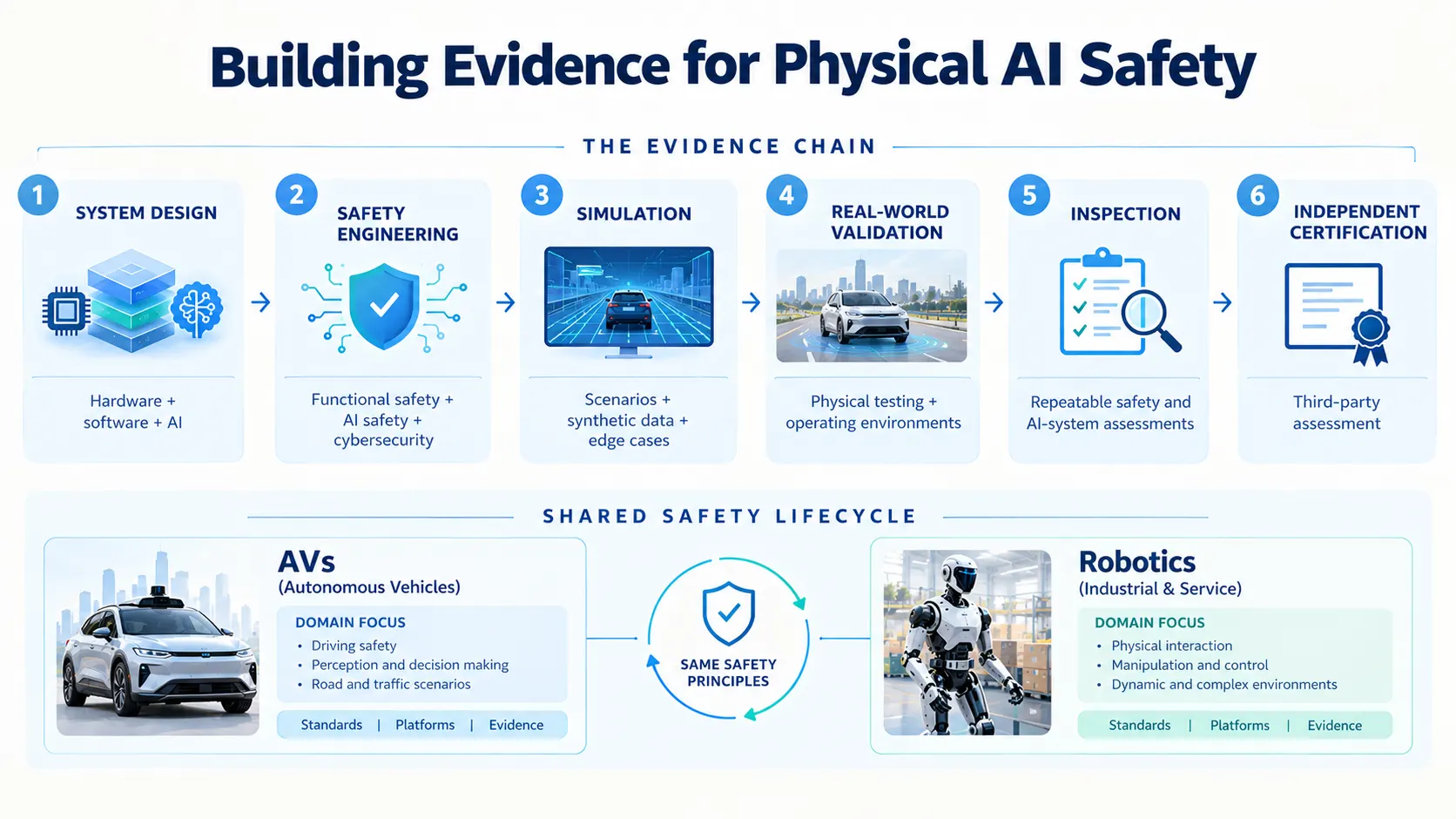
The principles are intended to span autonomous vehicles and robotics, while the specific platforms, standards and safety evidence remain dependent on the application domain.
For autonomous vehicles, the Halos architecture covers several layers.
Hardware
NVIDIA DRIVE AGX Thor provides safety-engineered accelerated compute.
NVIDIA Hyperion provides a vehicle platform and reference architecture for Level 4 autonomous vehicles.
Operating System and Middleware
Halos OS provides a software foundation built on ASIL-D certified DriveOS.
NVIDIA says Halos Core and Halos Middleware support system isolation, monitoring and deterministic communication.
AI Models
NVIDIA Alpamayo provides open reasoning vision-language-action models designed for autonomous driving.
NVIDIA says the models are intended to bring explainability to long-tail scenarios.
Simulation and Validation
The NVIDIA Halos Safety Evaluation Framework provides tools and guidelines for generating evidence that can support autonomous vehicle safety cases across different levels of automation.
Together, these components connect cloud-based AI development and simulation with vehicle deployment, allowing safety evidence to remain traceable across the vehicle lifecycle.
NVIDIA Halos for Robotics
NVIDIA says the same safety principles extend into robotics, with different hardware, standards and evidence requirements.
Hardware
NVIDIA IGX Thor combines accelerated computing and functional safety on one platform and includes a dedicated Functional Safety Island.
NVIDIA says the platform is designed to support systems developed for standards including IEC 61508 and ISO 13849.
Software
Halos Core for IGX provides software for safety-related operating functions, including fault detection, monitoring and reporting.
It also provides communication and processing capabilities connecting sensors, actuators and other safety components.
Real-Time Sensing
NVIDIA Holoscan Sensor Bridge connects sensor data with AI and safety-related processing.
NVIDIA says it can help systems identify invalid information and execute defined safety responses.
Simulation and Validation
NVIDIA Isaac Lab and NVIDIA Omniverse libraries allow developers to test robot behavior across relevant conditions and edge cases.
These simulation capabilities complement physical-world validation.
Outside-In Safety
NVIDIA also highlights its open-source Halos Outside-In Safety Blueprint.
The blueprint uses external cameras and vision AI agents to extend awareness beyond onboard sensors and support facility-level monitoring and functional safety use cases.
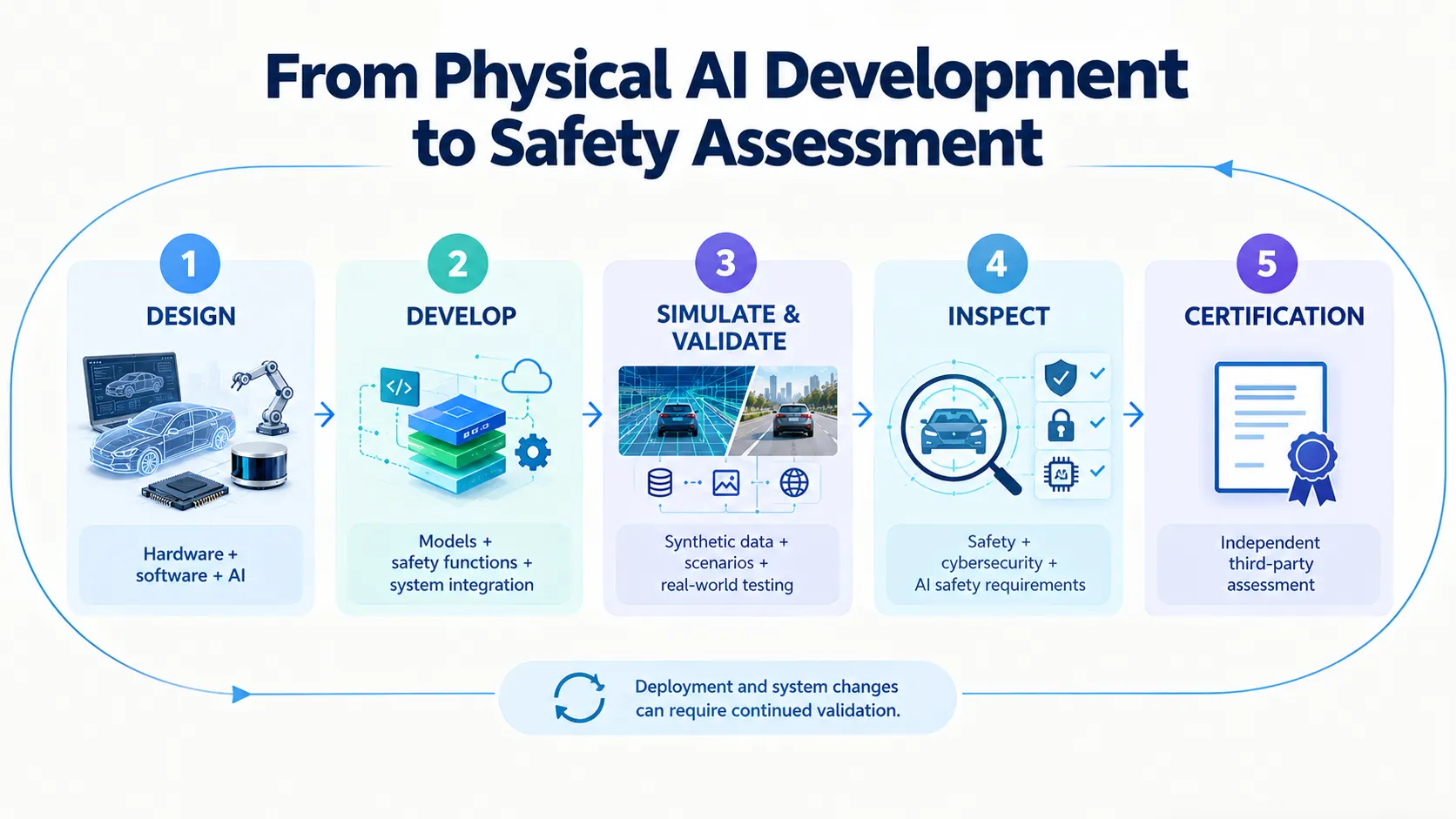
A Safety Inspection Layer for Physical AI
Across autonomous vehicles and robotics, NVIDIA says its Halos AI Systems Inspection Lab turns safety, cybersecurity and AI safety requirements into repeatable inspections.
The lab is intended to help prepare Halos integrations for final system-level certification by third-party agencies.
This adds another layer to the overall safety process: developers can build safety-related systems, generate evidence through testing and simulation, and then prepare integrations for independent assessment.
Companies Building Around the NVIDIA Halos Ecosystem
NVIDIA describes Halos as an ecosystem involving companies that build, integrate, assess and deploy physical AI systems.
This includes product developers, embedded software providers, sensor and silicon companies, safety solution developers and certification bodies.
Autonomous Vehicles
NVIDIA says Geely, Isuzu, Nissan, powered by Wayve software, and Einride are building Level 4-ready vehicles on NVIDIA Hyperion, supported by Halos OS.
The company also says Uber, Grab and Lyft, among other mobility providers, are using Hyperion to scale robotaxi development and deployment.
Members of the NVIDIA Halos AI Systems Inspection Lab listed by NVIDIA include:
AUMOVIO
Bosch
Gatik
Hesai
Lucid
MIRA
onsemi
PlusAI
Sony
Valeo
Wayve
NVIDIA describes these organizations as spanning autonomous-driving development, advanced driver-assistance systems, sensors, silicon, systems integration, validation and safety assurance.
Robotics
In robotics, NVIDIA identifies acontis and QNX as embedded software providers supporting safety functions.
Advantech and NexCOBOT are building safety-designed NVIDIA IGX systems.
NVIDIA also identifies Infineon, NXP, STMicroelectronics and Texas Instruments as contributors of sensor, safety-microcontroller and other semiconductor technologies.
KION Group is developing functional safety agents for autonomous forklifts.
NVIDIA says Agility is integrating NVIDIA IGX Thor and Halos Core into the safety system for its Digit 5 humanoid robot.
These examples illustrate how the safety architecture extends beyond NVIDIA hardware and software into sensors, embedded systems, robotics platforms and certification processes.
How NVIDIA Halos Is Being Independently Assessed
NVIDIA's source also describes independent assessments and certification-related work involving third-party organizations.
For autonomous vehicles, NVIDIA says TÜV SÜD certified its Automotive Product Lifecycle software process and DriveOS 6.0 to ISO 26262 ASIL D. TÜV SÜD also assessed NVIDIA's automotive engineering processes against ISO/SAE 21434.
NVIDIA says TÜV Rheinland independently assessed NVIDIA DRIVE AV against UNECE safety requirements.
For robotics, NVIDIA says TÜV Rheinland is inspecting NVIDIA IGX Thor, Halos OS and Holoscan Sensor Bridge for functional-safety certification readiness.
The company also says TÜV SÜD inspected the Thor SoC and Halos Core for ISO 26262.
Across physical AI, NVIDIA says ANAB has accredited the NVIDIA Halos AI Systems Inspection Lab as an ISO/IEC 17020 inspection body.
According to NVIDIA, the lab inspects scoped Halos integrations and helps companies prepare for final certification by independent third-party bodies.
Why Safety Has to Continue After Deployment
One of the central points in NVIDIA's article is that physical AI safety is not limited to the moment a system is first deployed.
Autonomous vehicles and robots can change through software updates, model updates, new tasks and different operating conditions.
That creates an ongoing validation requirement.
The article also highlights the importance of connecting development and simulation environments with real-world deployment so that safety evidence can remain traceable throughout the system lifecycle.
For physical AI, this means safety engineering has to account for both the system itself and the environment in which it operates.
The more autonomous the system becomes, the more important it is to understand how hardware, software, AI behavior, sensors and operating conditions interact.
What NVIDIA's Approach Shows About Physical AI Safety
NVIDIA's article highlights a broader industry shift toward treating AI safety as part of the engineering lifecycle rather than as a single pre-deployment test.
For autonomous vehicles and robots, the challenge is not only whether an AI model produces an appropriate output. The complete system must also translate that output into physical action while accounting for hardware behavior, sensor information, software functions and changing environmental conditions.
The NVIDIA Halos approach addresses this through a combination of hardware, software, AI models, simulation, validation and inspection.
The company's AV and robotics implementations are not identical. NVIDIA explicitly notes that the platforms, standards and evidence remain specific to each domain.
That distinction is important because physical AI systems operate under different safety requirements depending on where and how they are deployed.
The Role of Simulation and Real-World Validation
Simulation is another important part of the approach described by NVIDIA.
Physical AI systems can encounter a large number of environmental conditions and edge cases. NVIDIA says simulation, synthetic data generation and scenario reconstruction can complement real-world testing by expanding the conditions developers can evaluate.
However, the source presents simulation as part of a broader validation process rather than a replacement for physical testing.
The safety lifecycle described by NVIDIA connects simulation with real-world validation, inspection and certification.
What the NVIDIA Halos Ecosystem Covers
The source presents Halos as a multi-layer safety ecosystem covering:
Functional safety
AI behavior assurance
Sensor processing
Hardware safety
Operating-system and middleware functions
Simulation
Synthetic data
Real-world validation
Safety inspection
Certification readiness
The ecosystem also involves organizations across autonomous vehicles and robotics, including vehicle manufacturers, robot developers, semiconductor companies, software providers, sensor companies and safety assessment organizations.
Final Takeaway
NVIDIA's latest discussion of physical AI safety focuses on a simple engineering principle: autonomous machines need safety mechanisms across the full system, not only at the AI model layer.
Its Halos architecture brings together hardware, software, AI behavior, sensing, simulation, validation and inspection for autonomous vehicles and robotics.
The company also emphasizes that safety continues after deployment because software, models, tasks and operating environments can change.
For organizations developing physical AI, the source highlights the importance of building safety evidence throughout the lifecycle, from system design and simulation through real-world validation and independent assessment.
As physical AI expands into roads, factories, warehouses and other human environments, safety becomes an engineering requirement that has to scale alongside the systems themselves.
Source: NVIDIA Blog
About the Author