
Mandiant Cyber Snapshot Report Urges Enterprises to Build Resilience Beyond Security Toolchains
Mandiant's latest Cyber Snapshot Report warns that most successful cyber intrusions still stem from human and systemic weaknesses. The report urges organizations to prioritize cyber resilience, strengthen enterprise architecture, and prepare for inevitable security incidents.
Xcademia Team
Xcademia Research Team
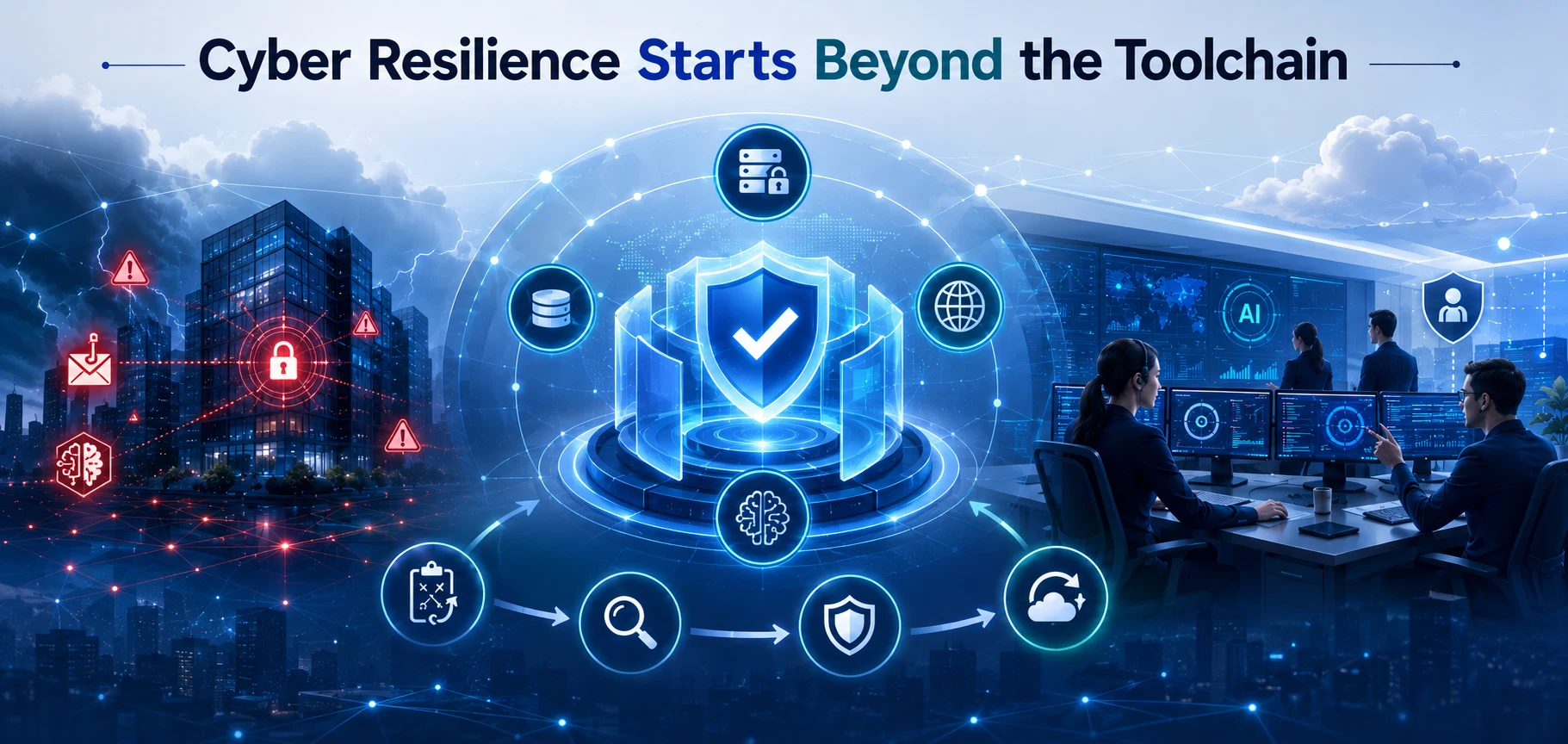
Mandiant Says Enterprise Resilience Must Go Beyond Security Toolchains
Machine-speed attacks and AI-powered threats may dominate today's cybersecurity headlines, but according to Google Cloud's Mandiant, most successful cyber intrusions still stem from fundamental human and systemic failures. Rather than relying solely on expanding security toolchains, organizations need to strengthen enterprise resilience through secure architecture, operational readiness, and intelligence-led defense.
To help organizations better prepare for today's threat landscape, Google Cloud's Mandiant has released The Defender's Advantage: Cyber Snapshot Report, Issue 8. The report encourages business and security leaders to rethink how they approach cyber defense by shifting from prevention-focused strategies to resilience-based security models that assume compromise is inevitable.
Drawing on frontline incident response experience and findings from the M-Trends 2026 Report, Mandiant argues that organizations should focus not only on stopping attackers but also on limiting the impact of intrusions, strengthening recovery capabilities, and improving organizational readiness.
According to the report, long-term cyber resilience depends on combining secure architecture, intelligence-led operations, continuous preparedness, and cross-functional collaboration rather than relying solely on security technologies.
This shift reflects the increasingly complex environments organizations must defend, where cloud services, distributed workforces, and interconnected business systems expand the attack surface and make prevention alone insufficient. As digital environments become more interconnected, organizations face a broader attack surface that cannot be protected through technology alone. Mandiant argues that resilience should become an ongoing operational capability that enables businesses to anticipate attacks, limit disruption, recover efficiently, and continuously strengthen their defenses through intelligence and experience.
Cyberattacks Still Exploit Fundamental Weaknesses
While artificial intelligence is changing how both attackers and defenders operate, Mandiant's frontline observations suggest that many successful attacks continue to exploit basic security weaknesses.
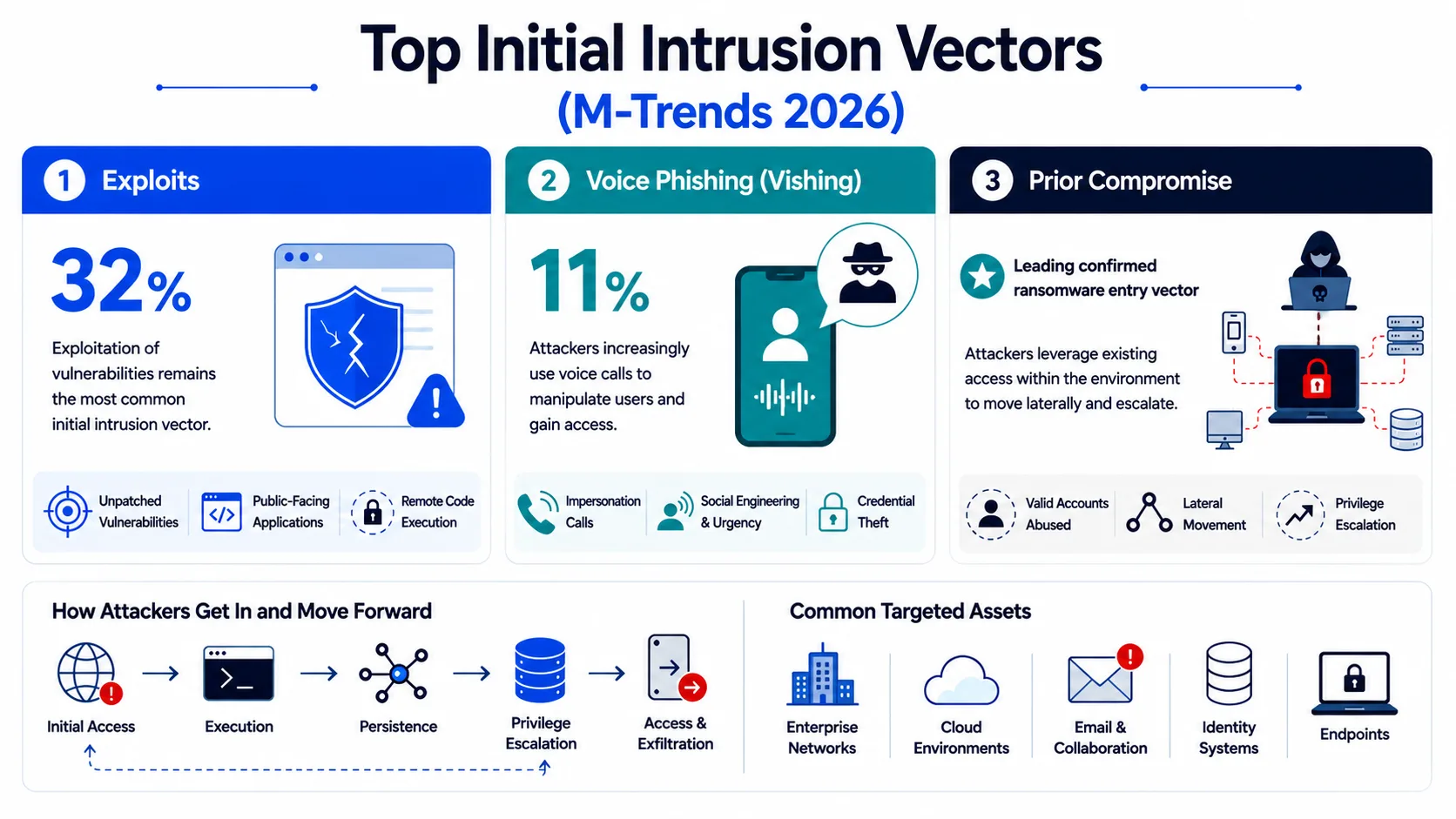
The report highlights several key findings from the M-Trends 2026 Report:
Exploits remained the most common initial infection vector, accounting for 32% of investigated intrusions for the sixth consecutive year.
Voice phishing (vishing) rose to the second most common initial infection vector, representing 11% of incidents.
Prior compromise was identified as the leading confirmed entry vector for ransomware-related investigations.
These findings indicate that many organizations continue to struggle with long-standing security challenges despite advances in defensive technologies.
Rather than focusing exclusively on preventing every attack, Mandiant recommends adopting an operating model that assumes attackers will eventually gain access to enterprise environments.
The findings reinforce that attackers continue to succeed by exploiting weaknesses organizations have struggled to address for years, including unpatched vulnerabilities, social engineering techniques such as voice phishing, and previously compromised environments. Rather than viewing these incidents as isolated events, Mandiant encourages organizations to strengthen foundational security practices while improving their ability to detect, contain, and recover from attacks.
Moving Beyond Prevention to Cyber Resilience
Traditional cybersecurity strategies often prioritize preventing attackers from entering enterprise networks.
Mandiant argues that this mindset is no longer sufficient.
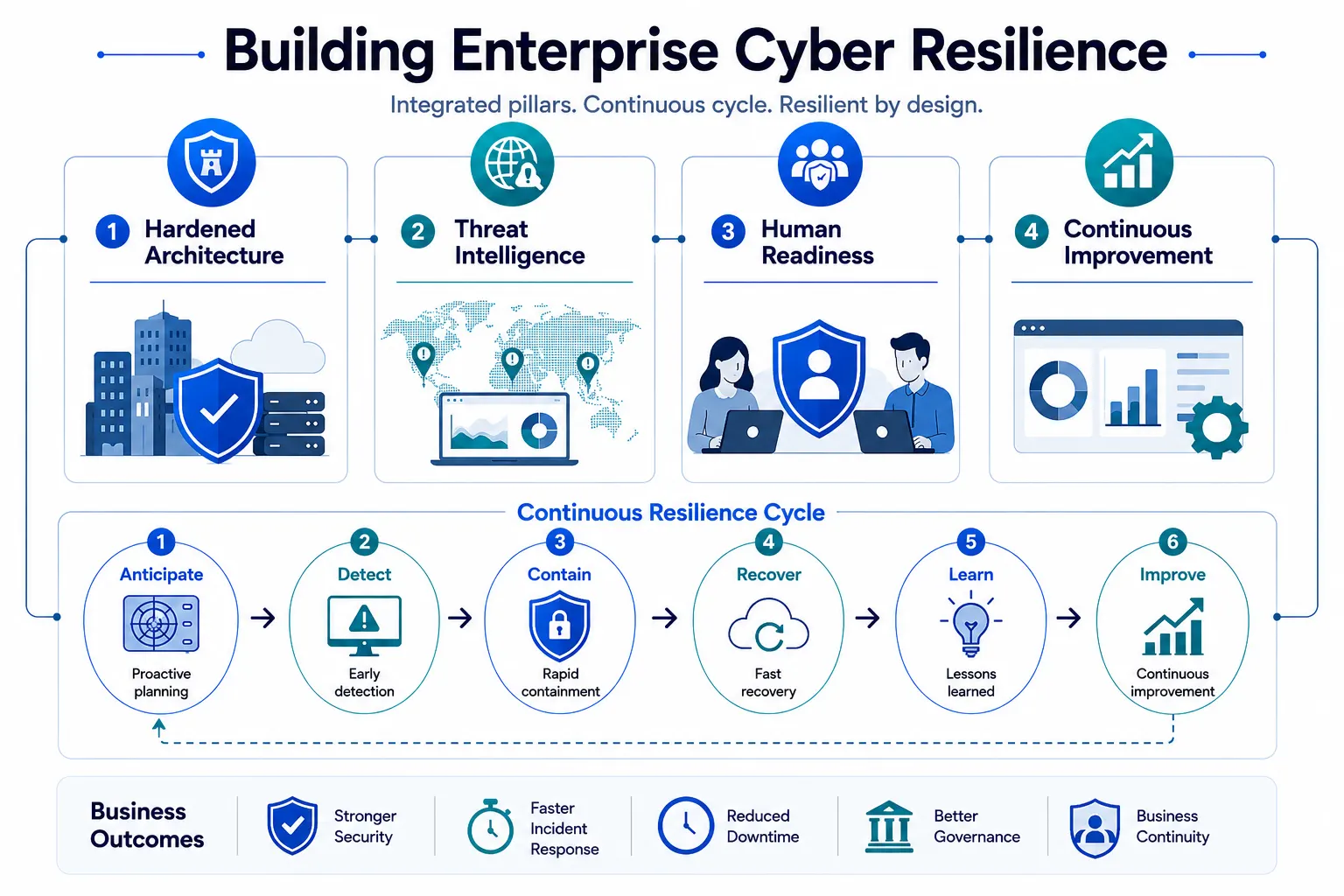
Instead, organizations should recognize that some compromises are unavoidable and build security programs capable of detecting, containing, and recovering from attacks quickly.
The report recommends shifting toward an intelligence-led operating model where:
Security teams anticipate compromise.
Exploitation is treated as inevitable.
Threat intelligence continuously improves defensive strategies.
Lessons from incidents strengthen future resilience.
This continuous feedback cycle allows organizations to evolve their defenses as attackers adapt their techniques.
According to Mandiant, cyber resilience should become a shared responsibility across business leadership, security operations, IT teams, and executive decision-makers.
This approach also encourages organizations to establish a continuous feedback cycle between incident response, threat intelligence, security operations, and executive leadership. Lessons learned from real-world incidents can help security teams refine defensive controls, prioritize investments, and improve organizational decision making. Rather than treating cyber incidents as isolated failures, resilient organizations use each event to strengthen their overall security posture.
Reducing the Blast Radius Through Stronger Architecture
Accepting that attacks will occur changes the primary objective of cybersecurity.
Instead of focusing solely on preventing intrusions, organizations must also limit the damage attackers can cause after gaining access.
The report notes that ransomware groups increasingly target recovery infrastructure to maximize disruption and pressure victims into paying ransom demands.
Rather than attacking only production systems, threat actors are now actively seeking to compromise:
Virtualization hypervisors
Backup environments
Privileged Access Management (PAM) vaults
Administrative credentials
Recovery systems
If these critical recovery assets are compromised, organizations may lose the ability to restore operations even after detecting an attack.
To reduce this risk, Mandiant recommends strengthening enterprise architecture by implementing:
Strict credential separation
Air-gapped Isolated Recovery Environments (IRE)
Secure backup strategies
Independent recovery validation
Segmented administrative access
These architectural safeguards help ensure that attacks affecting production environments cannot easily spread into recovery infrastructure.
Cybersecurity Must Extend Beyond the Corporate Network
The report also highlights an increasingly important challenge for enterprise security teams.
Threat actors are no longer limiting their focus to traditional corporate infrastructure.
Executives, senior leaders, and other high-value personnel are increasingly targeted through their personal digital environments.
Attackers may attempt to gain indirect access to enterprise systems by compromising:
Personal devices
Home networks
Personal email accounts
Family members
Online digital footprints
Because these individuals often have elevated privileges or access to sensitive information, they present attractive targets for sophisticated threat actors.
Mandiant recommends expanding executive protection strategies beyond physical security to include digital footprint management and protection of personal technology ecosystems.
By protecting these softer entry points, organizations can reduce opportunities for attackers to reach critical corporate infrastructure.
Building Human Readiness for the Inevitable Crisis
Technology plays a critical role in cybersecurity, but the report emphasizes that successful incident response ultimately depends on people.
Architectural controls can limit how far attackers spread, but organizational readiness determines how effectively teams respond under pressure.
Mandiant argues that crisis response capabilities cannot be developed through policies alone.
Instead, organizations should create opportunities for teams to gain practical experience before real incidents occur.
The report encourages organizations to foster a culture of safe failure, where teams can practice responding to cyber incidents, learn from mistakes, and improve coordination without real-world consequences.
Immersive exercises, mentoring, and realistic simulations help build the collective experience needed to make effective decisions during high-stress security events.
Cross-functional exercises also help organizations clarify roles and responsibilities before an actual crisis occurs. Security teams, IT operations, legal departments, communications teams, executive leadership, and business stakeholders all play different roles during a cyber incident. Practicing together enables faster decision making, improves coordination, and reduces confusion when responding to real attacks.
According to Mandiant, this preparation enables organizations to respond faster, recover more effectively, and reduce the operational impact of cyber incidents.
AI Changes the Threat Landscape
Artificial intelligence is reshaping cybersecurity for both defenders and attackers.
According to the report, adversaries are increasingly embracing automation to accelerate their operations and identify new opportunities for exploitation. Google Cloud notes that recent research from the Google Threat Intelligence Group (GTIG) identified the first known zero-day exploit developed with AI, highlighting how AI is beginning to influence offensive cyber capabilities.
The emergence of AI-assisted attacks has prompted many organizations to search for technology that can automatically counter these evolving threats. However, Mandiant cautions that there is no single technological solution capable of eliminating cyber risk.
Instead, AI should be integrated into a mature cybersecurity program where technology, people, and operational processes work together.
The report explains that AI-assisted vulnerability discovery and automated security tools can significantly improve detection and response capabilities. However, organizations will achieve the greatest value when these technologies support structured risk management, well-defined incident response processes, and skilled security teams.
By combining AI-driven automation with human expertise, organizations can reduce alert fatigue, improve operational efficiency, and respond to threats at machine speed while maintaining strategic oversight.
Technology Alone Will Not Deliver Cyber Resilience
While organizations continue to invest in advanced cybersecurity technologies, Mandiant emphasizes that tools alone cannot determine security outcomes.
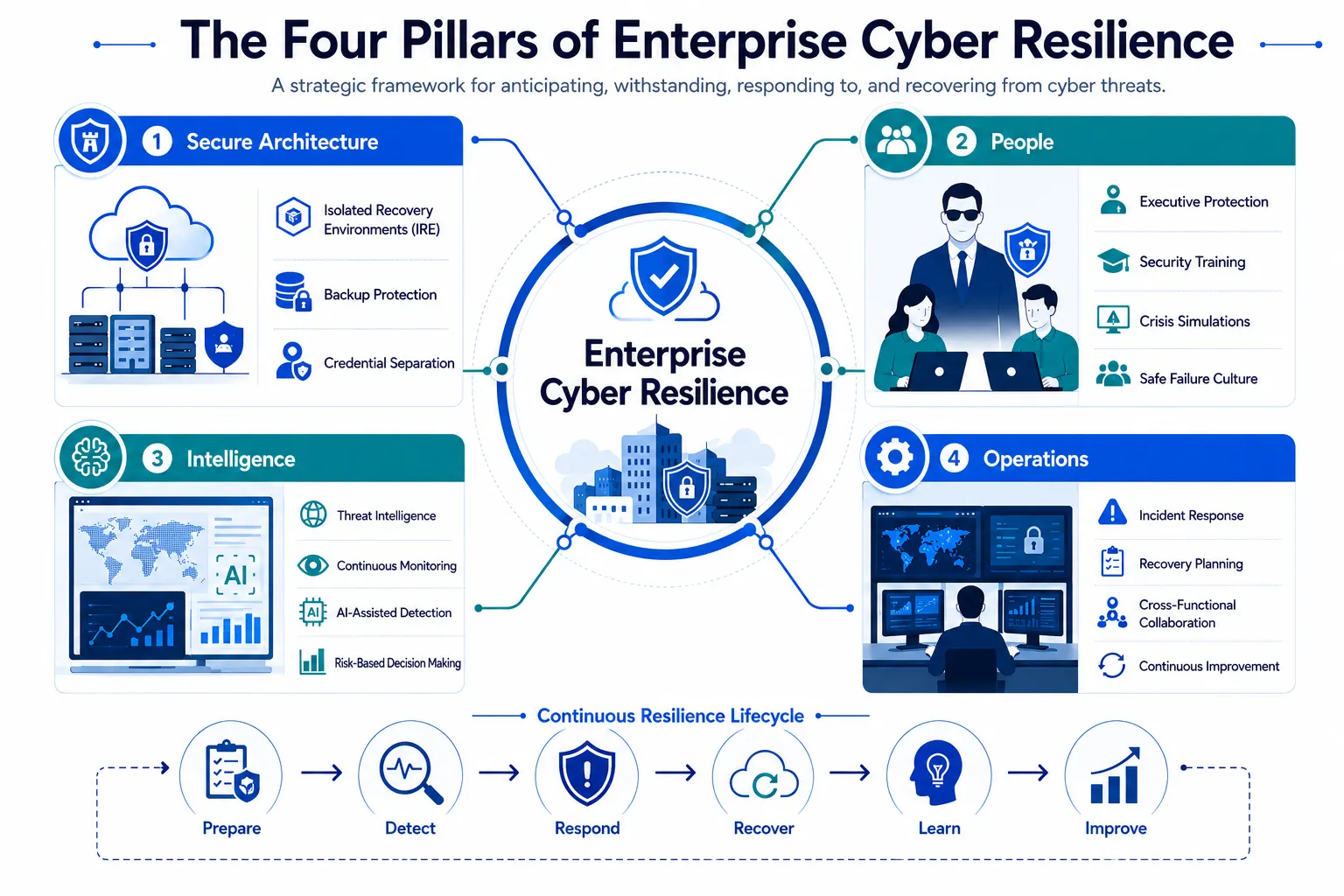
According to the report, true cyber resilience depends on combining multiple capabilities, including:
Secure and resilient enterprise architecture
Intelligence-led security operations
Skilled incident response teams
Continuous training and simulation exercises
Strong organizational security culture
Executive support and cross-functional collaboration
Organizations that prepare for cyber incidents before they occur are better positioned to contain attacks, recover operations, and minimize business disruption.
Rather than viewing cybersecurity as a technology challenge alone, the report encourages business leaders to treat resilience as an enterprise-wide responsibility that combines technical controls with operational readiness.
Defender's Advantage: Cyber Snapshot Report
To help organizations navigate today's rapidly evolving threat landscape, Mandiant has published The Defender's Advantage: Cyber Snapshot Report, Issue 8.
The report brings together frontline incident response insights, current threat intelligence, and practical recommendations for strengthening enterprise resilience against modern cyber threats.
Rather than focusing solely on deploying additional security tools, the report encourages organizations to:
Anticipate that compromises will occur.
Build resilient architectures that limit the impact of attacks.
Protect executives and other high-value personnel beyond the corporate network.
Develop experienced incident response teams through continuous practice.
Integrate AI capabilities into mature security programs supported by strong governance and operational processes.
According to Mandiant, organizations that combine these elements are better equipped to transform potential cyber crises into manageable operational events.
Conclusion
Mandiant's Defender's Advantage: Cyber Snapshot Report, Issue 8 highlights an important shift in enterprise cybersecurity. As cyber threats become more sophisticated and AI accelerates both attack and defense capabilities, organizations can no longer rely solely on prevention-focused security strategies or expanding security toolchains.
Drawing on findings from the M-Trends 2026 Report, Mandiant argues that lasting resilience comes from assuming compromise is inevitable and preparing accordingly. This means strengthening enterprise architecture, protecting critical recovery systems, securing executives and other high-value personnel, fostering a culture of continuous learning, and integrating AI into structured security operations.
Ultimately, the report emphasizes that technology is only one part of effective cyber defense. As organizations face increasingly automated and AI-assisted threats, resilience is becoming a strategic business capability rather than a purely technical objective. Mandiant's report suggests that enterprises which anticipate compromise, minimize the impact of attacks, recover quickly, and continuously improve their defenses will be better positioned to navigate an increasingly dynamic threat landscape.
Rather than encouraging organizations to purchase more security tools, Mandiant's Cyber Snapshot Report emphasizes building a resilient operating model that combines secure architecture, intelligence-led decision making, skilled people, and continuous learning. As cyber threats continue to evolve, enterprises that can anticipate compromise, reduce the blast radius of attacks, and recover quickly will be far better positioned to protect critical operations and maintain business continuity.
Source: Google Cloud Blog
About the Author