
Google Unveils CodeMender: An AI Security Agent That Finds, Verifies, and Fixes Software Vulnerabilities Automatically
Google has launched CodeMender in preview, an AI-powered security agent that scans code, verifies exploitability, and generates tested fixes. The platform marks a major step toward autonomous vulnerability management and self-healing software development.
Xcademia Team
Xcademia Research Team
Google Takes Aim at the Vulnerability Management Challenge with CodeMender
Cybersecurity teams are facing a difficult reality. Software is being written faster than ever, AI-assisted coding tools are accelerating development cycles, and threat actors are increasingly using artificial intelligence to discover and exploit vulnerabilities at unprecedented speed.
While organizations have invested heavily in vulnerability scanners, application security platforms, and developer security tooling, one problem continues to persist: finding vulnerabilities is often easier than fixing them.
Security teams routinely face thousands of findings, limited resources, alert fatigue, and growing remediation backlogs. Developers, meanwhile, must balance security fixes with feature delivery and operational demands. The result is a widening gap between vulnerability discovery and vulnerability remediation.
Google believes artificial intelligence can help close that gap.
The company has announced the preview launch of CodeMender, a managed AI-powered code security agent designed to automate vulnerability discovery, exploit validation, and code remediation. Built on Google DeepMind research and integrated into the Gemini Enterprise ecosystem, CodeMender aims to transform vulnerability management from a largely manual process into an intelligent, automated workflow capable of operating at machine speed.
The announcement reflects a broader shift occurring across the cybersecurity industry. Organizations are increasingly exploring agentic security systems that can perform tasks autonomously while keeping human experts in control of final decisions.
Google's vision extends beyond vulnerability scanning. The company sees CodeMender as a foundational building block for a future where software continuously monitors, validates, and repairs itself before vulnerabilities reach production environments.
The Growing Security Crisis in the Age of AI
The timing of CodeMender's launch is significant.
Artificial intelligence has fundamentally changed how software is developed. Developers increasingly rely on AI coding assistants to accelerate application delivery, automate repetitive tasks, and improve productivity.
At the same time, adversaries are leveraging many of the same technologies.
Modern threat actors can use AI to:
Analyze source code faster
Identify vulnerable components
Generate exploit code
Automate reconnaissance
Discover attack paths
Scale vulnerability research
As AI lowers the technical barriers associated with cyberattacks, security teams must defend increasingly complex software ecosystems using traditional processes that often depend heavily on manual investigation.
Many organizations already struggle with:
Vulnerability overload
Resource constraints
Security talent shortages
Growing software supply chain risk
Delayed patch deployment cycles
Alert fatigue from excessive findings
This imbalance creates a dangerous environment where attackers can move faster than defenders.
Google's answer is simple: fight AI-powered attacks with AI-powered defenses.
Why Traditional Vulnerability Management Is No Longer Enough
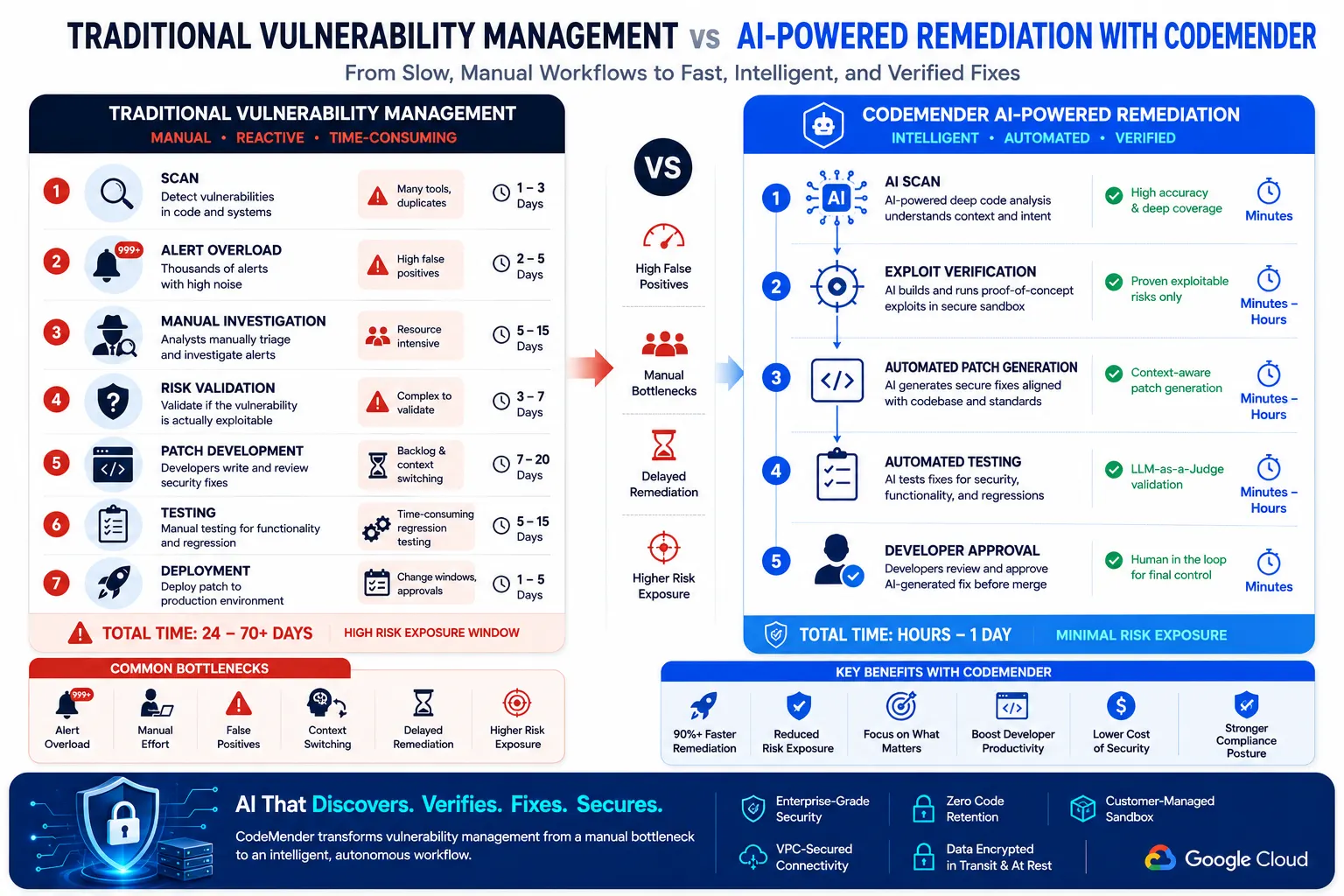
For decades, vulnerability management has followed a familiar process:
Scan applications
Generate findings
Investigate alerts
Validate risks
Prioritize issues
Develop patches
Test fixes
Deploy updates
While effective, this workflow can be slow and resource-intensive.
Traditional security scanners frequently generate large numbers of alerts. Many of these findings require manual review before organizations can determine whether they represent genuine business risk.
This process often creates significant delays.
Security teams may identify vulnerabilities quickly, but remediation can take weeks or months depending on resource availability, business priorities, and technical complexity.
CodeMender attempts to eliminate many of these bottlenecks through automation.
Rather than simply identifying vulnerabilities, the platform seeks to understand risk, verify exploitability, generate fixes, and validate remediation outcomes.
This represents a shift from passive security analysis toward active vulnerability resolution.
What Is CodeMender?
CodeMender is Google's managed code security agent designed to discover, verify, and remediate software vulnerabilities.
The platform is available through the Gemini Enterprise Agent Platform and can also function as a core component within Google's broader AI Threat Defense architecture.
Unlike traditional vulnerability scanners that stop after identifying potential weaknesses, CodeMender is designed to support the entire vulnerability management lifecycle.
Its key capabilities include:
Vulnerability discovery
Exploit simulation
Risk validation
Automated patch generation
Functional testing
Workflow integration
Developer-assisted remediation
Google says the platform can help organizations move from passive scanning toward automated vulnerability management without sacrificing development velocity.
A key differentiator is Google's multi-model strategy.
Organizations can select models optimized for:
Cost efficiency
Processing speed
Deep security analysis
Coding performance
Google has also announced plans to support third-party frontier AI models later this year, providing additional flexibility for enterprise deployments.
How CodeMender Fits Into Google's Broader Security Strategy
CodeMender is not an isolated product announcement.
It represents part of Google's larger effort to build an AI-native cybersecurity ecosystem.
Over the past several years, Google has significantly expanded its security portfolio through investments in:
Gemini Enterprise
Google DeepMind security research
Cloud security platforms
Threat intelligence capabilities
Security operations automation
Software supply chain protection
AI Threat Defense
Wiz integration initiatives
Rather than treating AI as a productivity assistant alone, Google increasingly positions AI as an active security operator capable of participating directly in defensive workflows.
This approach reflects the emergence of what many industry experts call agentic security.
Agentic security systems do more than analyze information. They perform actions, execute workflows, make recommendations, and assist practitioners in resolving issues at scale.
CodeMender serves as one of Google's clearest examples of this strategy in action.
How CodeMender Works
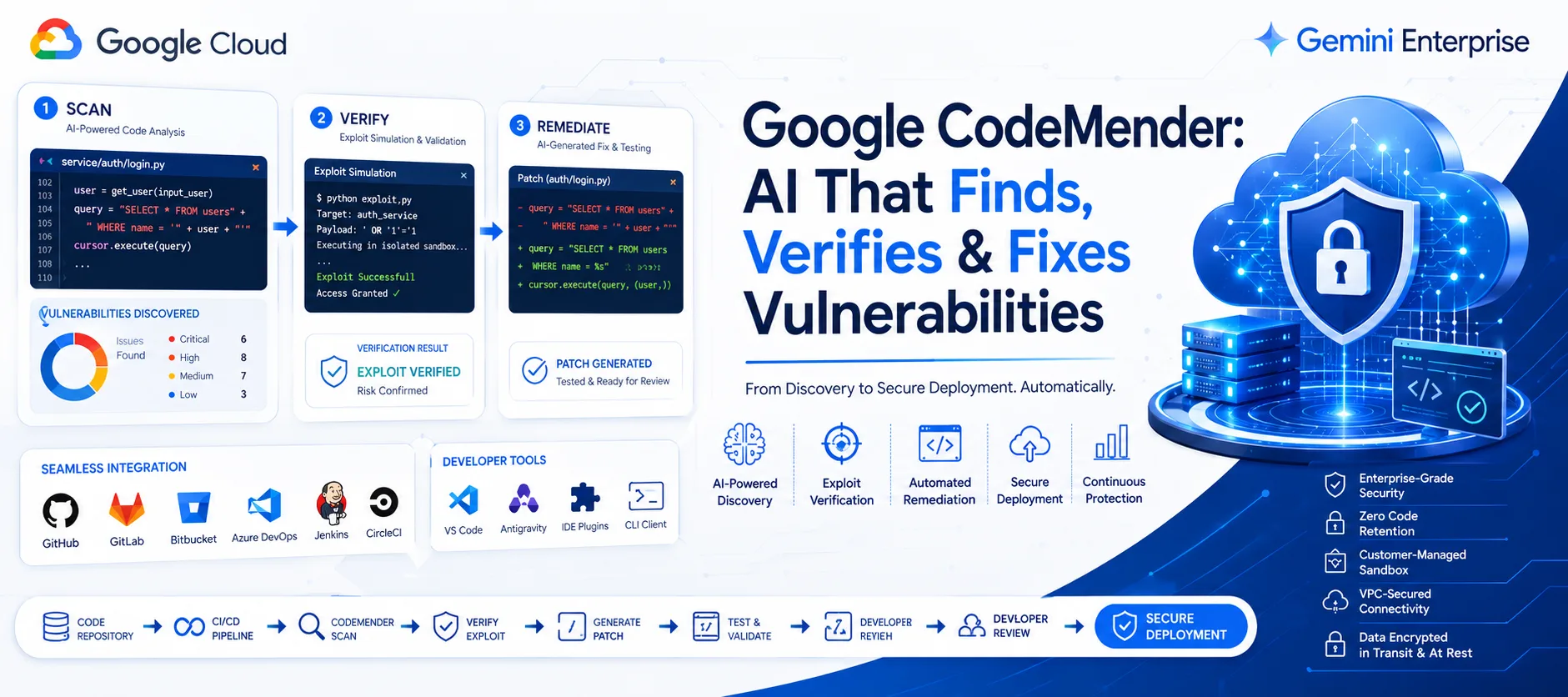
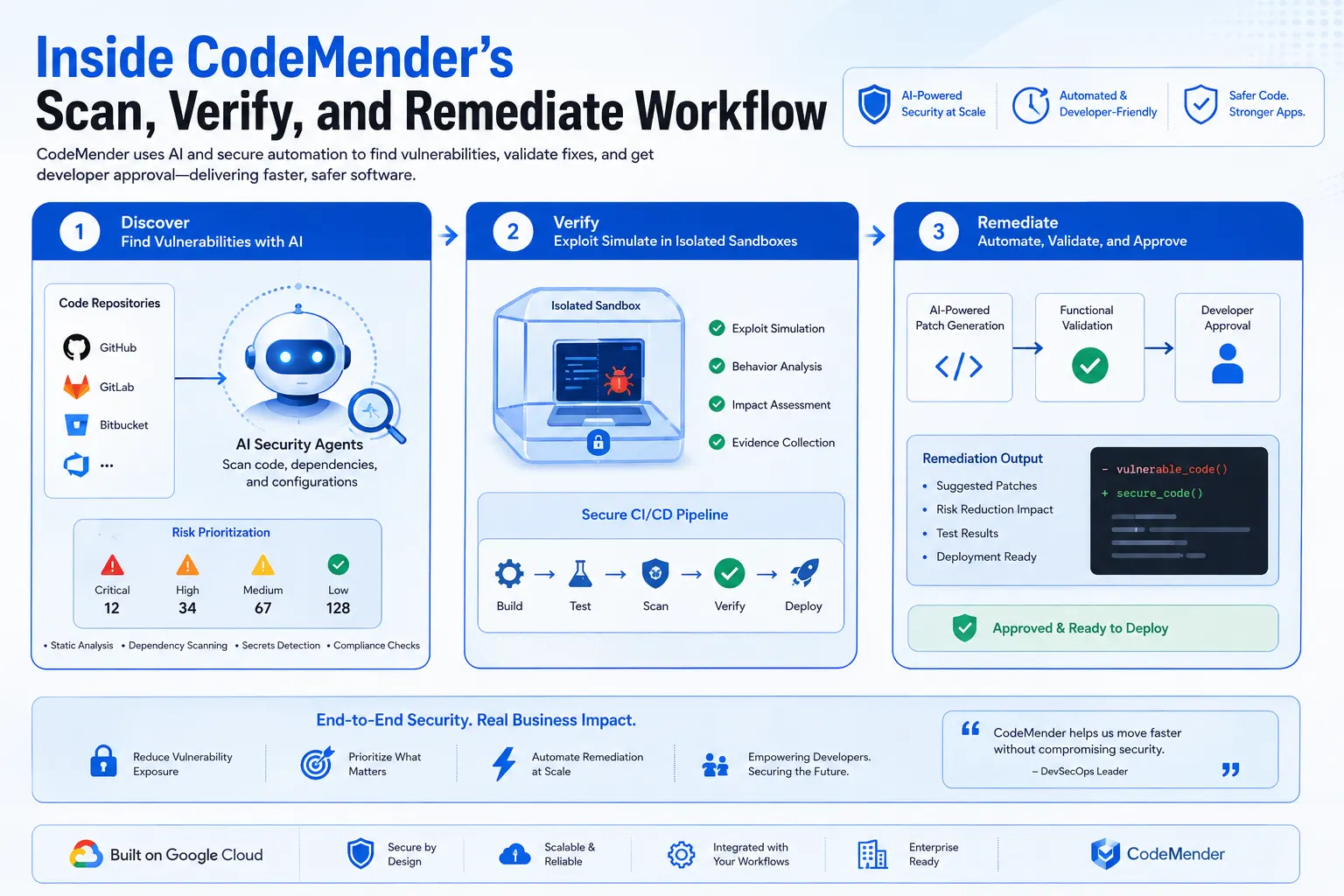
At its core, CodeMender operates through three primary phases:
1. Scan
2. Verify
3. Remediate
Together, these stages create a closed-loop vulnerability management workflow.
Phase One: Scan - Finding Vulnerabilities That Other Tools Miss
The first stage focuses on vulnerability discovery.
CodeMender analyzes software repositories and attempts to understand the broader context surrounding applications, business logic, and development patterns.
This differs from many traditional security tools that rely primarily on signatures, rules, or pattern matching.
Google says CodeMender's security-aware AI harness enables it to identify sophisticated vulnerabilities that may be difficult for conventional scanners to detect.
Supported languages include:
C/C++
Go
Java
Python
Ruby
Rust
TypeScript
The platform can identify issues such as:
Memory corruption vulnerabilities
Injection attacks
Web application security flaws
Cryptographic weaknesses
Insecure data handling
Software supply chain risks
Understanding Context-Aware Security Analysis
One of the most important aspects of modern vulnerability discovery is context.
A line of code may appear safe in isolation but become vulnerable when interacting with authentication systems, third-party libraries, APIs, or business workflows.
Traditional scanners often struggle to understand these relationships.
CodeMender attempts to bridge that gap by analyzing:
Application behavior
Data flows
Trust boundaries
User permissions
Dependency relationships
Business logic
This context-aware approach may enable the discovery of vulnerabilities that do not match known attack patterns.
Examples include:
Authorization bypasses
Privilege escalation paths
Multi-stage attack chains
Logic flaws
Supply chain weaknesses
These issues are frequently among the most difficult vulnerabilities for organizations to identify and remediate.
Why Traditional Security Scanners Miss Critical Risks
Static Application Security Testing (SAST) tools remain essential, but they have limitations.
Many tools:
Generate excessive false positives
Lack exploitability analysis
Struggle with business logic vulnerabilities
Cannot simulate attacks
Dynamic testing tools provide additional visibility but often require significant configuration and operational effort.
First-generation AI security tools introduced improved code understanding but frequently remained limited to theoretical analysis.
CodeMender attempts to combine AI reasoning with exploit validation to create higher-confidence findings.
Instead of simply asking:
"Could this code contain a vulnerability?"
The platform attempts to answer:
"Can this vulnerability actually be exploited?"
That distinction may significantly improve security prioritization.
Phase Two: Verify - Proving Exploitability Before Prioritizing Risk
One of CodeMender's most innovative capabilities is exploit verification.
False positives remain a persistent challenge for security teams.
Many vulnerability findings require manual validation before organizations can determine whether a security issue represents genuine risk.
CodeMender attempts to automate this process.
Rather than relying exclusively on code analysis, the platform generates proof-of-concept exploits and executes them within isolated customer-managed sandbox environments.
This approach enables the system to test whether a vulnerability can actually be exploited.
The verification process includes:
Attack simulation
Exploit generation
Controlled execution
Validation testing
Risk confirmation
By proving exploitability, organizations gain greater confidence that remediation efforts are focused on vulnerabilities that genuinely matter.
For security teams managing thousands of findings, this capability could dramatically improve prioritization efficiency.
Phase Three: Remediate - Automatically Generating Secure Fixes
Discovering vulnerabilities is only half of the challenge.
For most organizations, remediation remains the largest bottleneck in vulnerability management.
Security teams often identify issues quickly, but developers must still:
Investigate root causes
Understand exploit paths
Develop fixes
Perform code reviews
Conduct regression testing
Validate production readiness
This process can consume days or weeks depending on application complexity.
CodeMender is designed to accelerate this phase significantly.
Once a vulnerability has been validated, the agent automatically generates a proposed remediation and presents it as a code difference (diff) directly within existing development workflows.
This allows developers to review proposed changes using familiar tools and processes.
Context-Aware Patch Generation
Unlike traditional automated patching systems that rely on generic templates, CodeMender attempts to understand the specific coding practices and architectural patterns used within an organization.
Developers can provide:
Coding standards
Internal development guidelines
Naming conventions
Repository-specific practices
Security requirements
The system then generates patches aligned with those standards.
This capability aims to reduce friction during developer review and improve adoption within enterprise development environments.
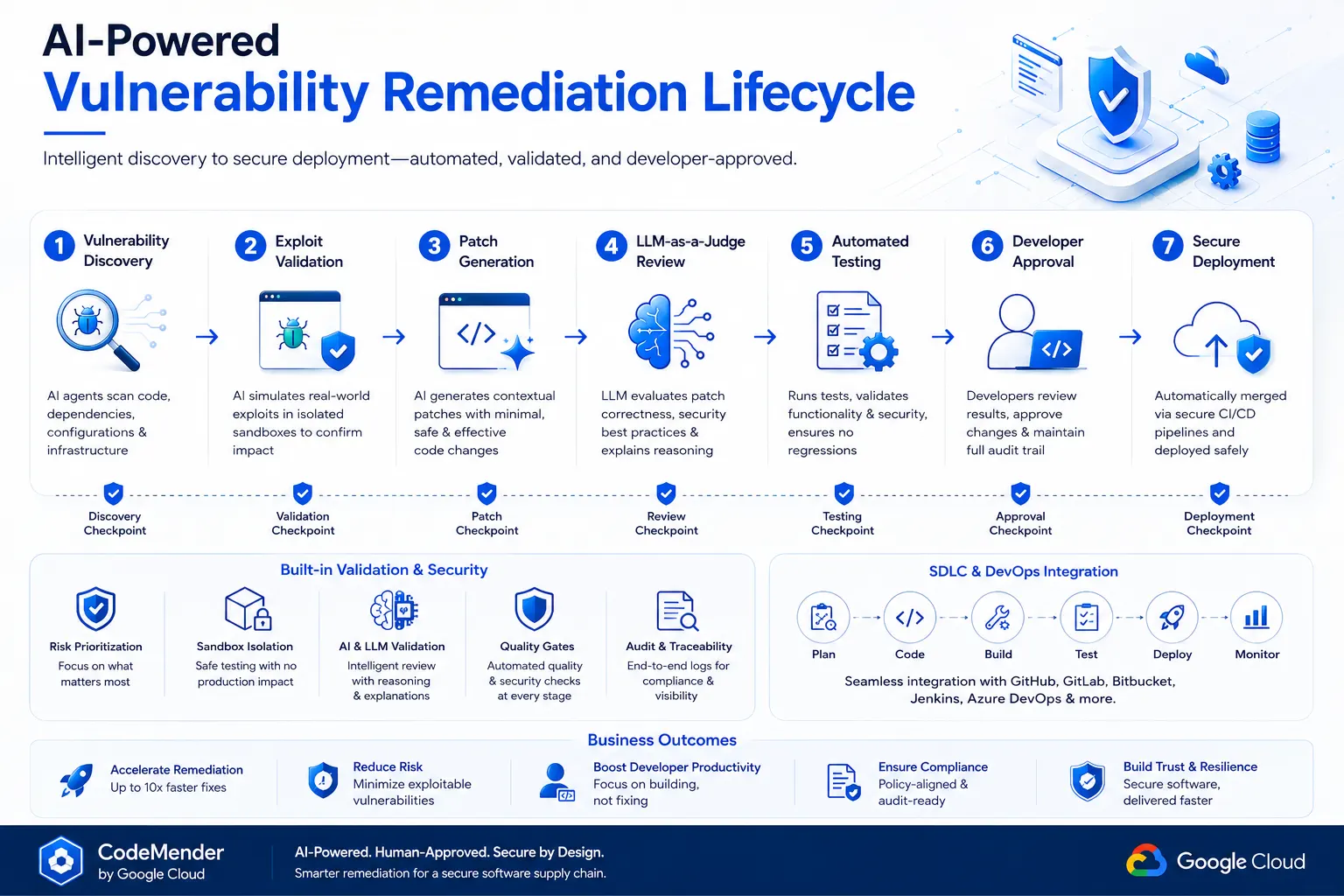
LLM-as-a-Judge: Validating Fixes Before Human Review
One of the more interesting aspects of CodeMender is Google's use of what it calls LLM-as-a-Judge validation.
Generating a patch is not enough.
The patch must also avoid introducing:
New vulnerabilities
Logic errors
Functional regressions
Performance issues
Application instability
To address this challenge, CodeMender evaluates its own proposed fixes before presenting them to developers.
The validation process examines whether a patch:
Resolves the vulnerability
Preserves intended functionality
Aligns with coding standards
Avoids introducing unintended side effects
While developers retain ultimate approval authority, this additional verification layer may significantly reduce remediation workloads.
The approach highlights a broader trend in AI engineering where multiple AI systems evaluate, validate, and improve each other's outputs before human review.
Security, Privacy, and Governance by Design
Enterprise adoption of AI security tools often depends on trust.
Organizations want assurance that sensitive source code remains protected throughout the analysis process.
Google says CodeMender was designed with enterprise governance requirements in mind.
Security controls include:
Secure Traffic Routing
CodeMender supports secure communication through customer Virtual Private Clouds (VPCs), helping organizations maintain network isolation.
Data Isolation
Source code and security data remain isolated from other environments.
Encryption
Data is protected through encryption mechanisms designed to meet enterprise security requirements.
Zero Source Code Retention
Google states that CodeMender does not retain customer source code after processing.
Customer-Managed Sandboxes
Exploit simulations and testing occur within customer-controlled sandbox environments.
These capabilities are particularly important for highly regulated industries such as:
Financial services
Government
Healthcare
Critical infrastructure
Defense
Telecommunications
As organizations increasingly adopt AI-powered development tools, governance and privacy protections are becoming just as important as technical capabilities.
Flexible Deployment Across Developer Workflows
Google designed CodeMender to integrate with existing development processes rather than forcing teams to adopt entirely new workflows.
The platform supports:
CI/CD Integration
CodeMender can operate within existing Continuous Integration and Continuous Delivery pipelines.
This allows vulnerability discovery and remediation activities to occur earlier in the software development lifecycle.
Developer Workstations
Developers can interact with CodeMender directly through a lightweight command-line interface.
IDE Integrations
The platform supports developer environments including:
Visual Studio Code
Antigravity
Repository management systems
Enterprise development platforms
This flexibility helps reduce disruption while improving security coverage.
CodeMender's Role in Google's AI Threat Defense Platform
While CodeMender can operate independently, Google also positions it as a key component of its broader AI Threat Defense strategy.
AI Threat Defense represents Google's vision for an integrated, AI-native cybersecurity ecosystem capable of continuously identifying, validating, prioritizing, and resolving security risks.
Within this architecture, CodeMender becomes part of a larger security workflow involving multiple intelligent agents.
Building a Closed-Loop Security Ecosystem
Google's AI Threat Defense architecture incorporates several major components:
CodeMender
Responsible for:
Vulnerability discovery
Exploit verification
Patch generation
Remediation workflows
Wiz Security Graph
Provides contextual intelligence by correlating:
Applications
Infrastructure
Assets
Identities
Exposure paths
Wiz Red Agent
Focuses on offensive security operations.
Capabilities include:
AI-powered penetration testing
Attack simulation
Exploit path validation
Risk confirmation
Wiz Green Agent
Acts as the remediation orchestrator.
Responsibilities include:
Coordinating patch generation
Managing remediation workflows
Prioritizing fixes
Tracking resolution progress
Together, these components create a feedback loop where vulnerabilities are discovered, validated, prioritized, fixed, and monitored continuously.
This architecture moves organizations closer to autonomous security operations.
Why This Matters for Software Development Teams
Software engineering teams are under growing pressure.
Organizations want faster release cycles, greater innovation, and stronger security simultaneously.
Historically, security requirements often slowed development.
CodeMender aims to reduce this tension.
Potential benefits include:
Reduced Security Debt
Organizations can address vulnerabilities more quickly before they accumulate.
Faster Remediation
Developers spend less time investigating and patching known issues.
Better Prioritization
Verified vulnerabilities receive immediate attention while false positives are filtered out.
Improved Developer Productivity
Engineers can focus more on building features and less on repetitive remediation tasks.
Stronger Collaboration
Application security teams and developers gain a shared workflow for managing risk.
These advantages may become increasingly important as AI-generated code continues to increase software development velocity.
Strategic Implications for CISOs and Security Leaders
The launch of CodeMender has implications beyond application security teams.
For Chief Information Security Officers (CISOs), vulnerability management remains one of the most visible indicators of security program effectiveness.
Security leaders are often evaluated on:
Mean Time to Remediate (MTTR)
Critical vulnerability backlog
Risk reduction metrics
Compliance readiness
Incident prevention
AI-powered remediation platforms could significantly improve these metrics.
Potential benefits include:
Reduced MTTR
Validated vulnerabilities can be fixed faster.
Improved Risk Prioritization
Security teams focus on exploitable risks.
Greater Operational Efficiency
Automation reduces repetitive manual tasks.
Better Compliance Posture
Organizations can remediate vulnerabilities before audit deadlines.
Enhanced Security Resilience
Faster remediation reduces exposure windows.
As threat volumes continue growing, automation may become essential rather than optional.
Entering a Competitive AI Security Market
Google is not alone in pursuing AI-powered cybersecurity.
The market is becoming increasingly competitive as major technology and security vendors integrate generative AI into their platforms.
Industry initiatives include:
GitHub Advanced Security
Microsoft Security Copilot
CrowdStrike Charlotte AI
SentinelOne Purple AI
Palo Alto Networks AI-driven security capabilities
Cisco Security AI initiatives
Most platforms currently focus on:
Threat detection
Security investigations
Incident response
Analyst assistance
CodeMender distinguishes itself through its emphasis on:
Exploit validation
Automated remediation
Developer workflow integration
End-to-end vulnerability management
This focus positions the platform within the rapidly emerging category of agentic application security.
The Rise of Agentic Security
One of the most important themes surrounding CodeMender is the industry's transition toward agentic cybersecurity.
Traditional security tools provide visibility.
Agentic systems provide action.
Instead of merely identifying risks, AI agents increasingly:
Investigate alerts
Analyze evidence
Generate recommendations
Execute workflows
Coordinate remediation
The goal is not to replace security professionals but to augment them.
Security teams remain responsible for:
Governance
Strategic decisions
Risk acceptance
Compliance oversight
Final approvals
However, repetitive operational tasks increasingly become candidates for automation.
CodeMender exemplifies this evolution.
The Future: Toward Self-Healing Software
Perhaps the most ambitious aspect of Google's announcement is its long-term vision.
Google describes CodeMender as a step toward a continuous, self-healing software development lifecycle.
In this future model:
Vulnerabilities Are Identified Automatically
AI continuously monitors applications and code repositories.
Exploitability Is Validated Instantly
Automated testing determines whether vulnerabilities represent genuine risk.
Patches Are Generated Autonomously
Remediation occurs without extensive manual intervention.
Fixes Are Tested Automatically
Functionality and security are validated before deployment.
Developers Maintain Oversight
Human experts approve changes while AI handles repetitive tasks.
The result is a dramatically shorter window between vulnerability discovery and remediation.
While fully autonomous software security remains a long-term objective, CodeMender represents a meaningful step in that direction.
Industry Outlook
The launch of CodeMender arrives during a period of rapid transformation across cybersecurity and software engineering.
Several trends are converging:
Increased AI-generated code
Rising software supply chain attacks
Larger codebases
Developer shortages
Growing regulatory scrutiny
More sophisticated threat actors
Organizations are seeking ways to scale security operations without proportionally increasing headcount.
AI-powered security agents offer a potential solution.
Over the next several years, the industry is likely to see increased adoption of:
Agentic application security
Autonomous vulnerability management
AI-assisted code review
Automated exploit validation
Self-healing software architectures
CodeMender places Google at the center of this emerging market.
Conclusion
Google's preview launch of CodeMender represents one of the company's most significant cybersecurity announcements of 2026.
Rather than focusing solely on vulnerability detection, the platform addresses the entire vulnerability management lifecycle through AI-powered discovery, exploit verification, and automated remediation.
Its integration with Gemini Enterprise, alignment with Google's AI Threat Defense strategy, support for multi-model deployments, and emphasis on enterprise-grade governance position CodeMender as more than another security scanner.
The platform reflects a broader industry transition toward agentic cybersecurity, where AI systems actively participate in identifying, validating, and resolving security risks.
While human oversight remains essential, CodeMender offers a glimpse into a future where software security increasingly operates at machine speed.
For organizations struggling with growing vulnerability backlogs and increasingly sophisticated AI-driven threats, that future may arrive sooner than expected.
Source: Google Cloud Blog
About the Author