
Google Introduces Co-operative Time-Slicing in llm-d to Boost Reinforcement Learning GPU Utilization by Up to 70%
Google has introduced co-operative time-slicing in llm-d to improve reinforcement learning infrastructure by increasing GPU utilization from about 40% to 70%. The Kubernetes-native approach reduces idle accelerators, lowers AI training costs, and improves resource efficiency.
Xcademia Team
Xcademia Research Team
Introduction
The rapid evolution of large language models (LLMs) has shifted the artificial intelligence industry beyond simply training larger models toward making existing infrastructure significantly more efficient. While advances in model architectures continue to attract attention, another challenge has quietly become just as critical: efficiently utilizing increasingly scarce and expensive AI accelerators.
Reinforcement learning (RL) has emerged as one of the most important stages in modern LLM development. It is widely used to improve reasoning abilities, coding performance, tool use, and alignment after initial model pretraining. However, RL workloads introduce unique infrastructure challenges that conventional cloud scheduling platforms were never designed to handle.
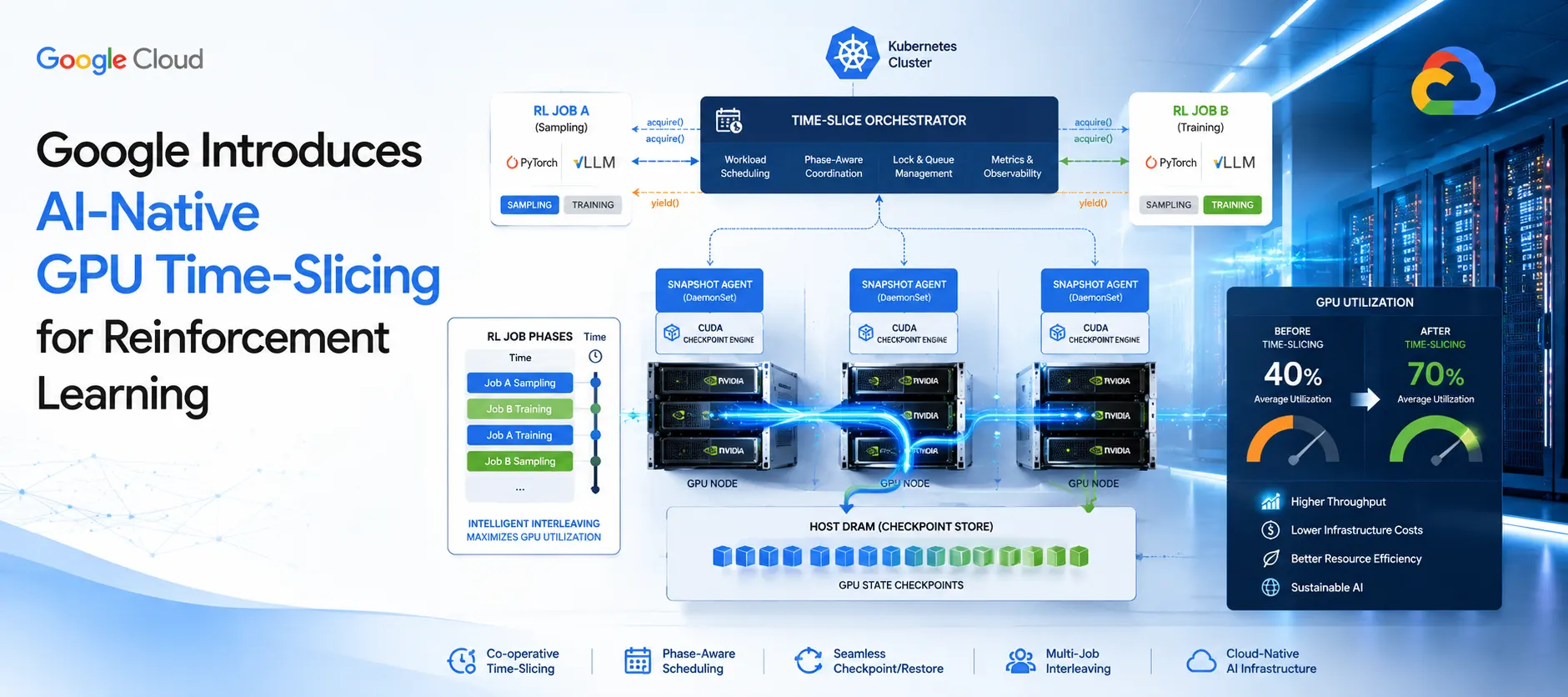
To address this problem, Google has announced co-operative time-slicing as part of its open-source llm-d project. The new capability allows independent RL jobs to dynamically share the same physical GPU resources by alternating execution at natural phase boundaries instead of reserving dedicated accelerators throughout an entire training run. According to Google's initial benchmarks, the approach increases aggregate accelerator utilization from approximately 40% to 70% without negatively affecting model convergence or accuracy.
Rather than focusing solely on acquiring additional GPU capacity, Google's latest work emphasizes improving infrastructure efficiency, enabling organizations to extract significantly more value from existing hardware investments while reducing overall training costs.
As AI infrastructure becomes one of the industry's largest capital expenses, innovations in resource scheduling may prove just as valuable as advances in model architectures themselves.
Key Developments
Google's latest announcement introduces a platform-level scheduling mechanism specifically designed for reinforcement learning post-training workloads.
Unlike conventional GPU scheduling, which assigns hardware exclusively to a single workload until completion, co-operative time-slicing recognizes that RL jobs naturally alternate between different computational phases. During these transitions, portions of expensive accelerator infrastructure frequently remain idle while waiting for other stages of the pipeline to finish.
Instead of allowing GPUs to sit unused, llm-d dynamically switches accelerator ownership between multiple independent RL jobs.
The initial release includes three major components:
Snapshot Agent for accelerator state management
Accelerator Orchestrator for workload coordination
Python client libraries that simplify integration into existing RL pipelines
Together, these components allow researchers to continue using familiar machine learning frameworks such as PyTorch and vLLM without modifying core training logic. Developers simply identify accelerator-intensive phases while the underlying platform manages scheduling, checkpointing, and restoration automatically.
Google also outlined several roadmap items that extend beyond the initial release, including:
Faster checkpoint and restore mechanisms
Selective memory snapshotting
Automated workload pairing
Cross-platform support extending beyond GPUs to TPUs and custom accelerators
These enhancements indicate that Google views time-slicing not as a standalone optimization but as a foundational capability for future AI infrastructure.
Why Reinforcement Learning Creates Infrastructure Bottlenecks
Training modern language models is no longer a single continuous computation.
After pretraining, models often undergo reinforcement learning to improve reasoning quality, coding ability, safety behavior, and response accuracy. Popular optimization techniques such as Group Relative Policy Optimization (GRPO) repeatedly alternate between two major computational stages:
Sampling (Rollout Generation)
The model generates responses to prompts, executes tools or code when required, and collects trajectories that will later be evaluated.
Training (Gradient Optimization)
Those trajectories are processed to calculate rewards, update model parameters, and produce improved weights.
These stages occur repeatedly throughout the RL process.
The challenge is that they rarely consume GPU resources simultaneously.
During rollout generation, training accelerators may sit idle.
During optimization, inference hardware often waits for updated model weights.
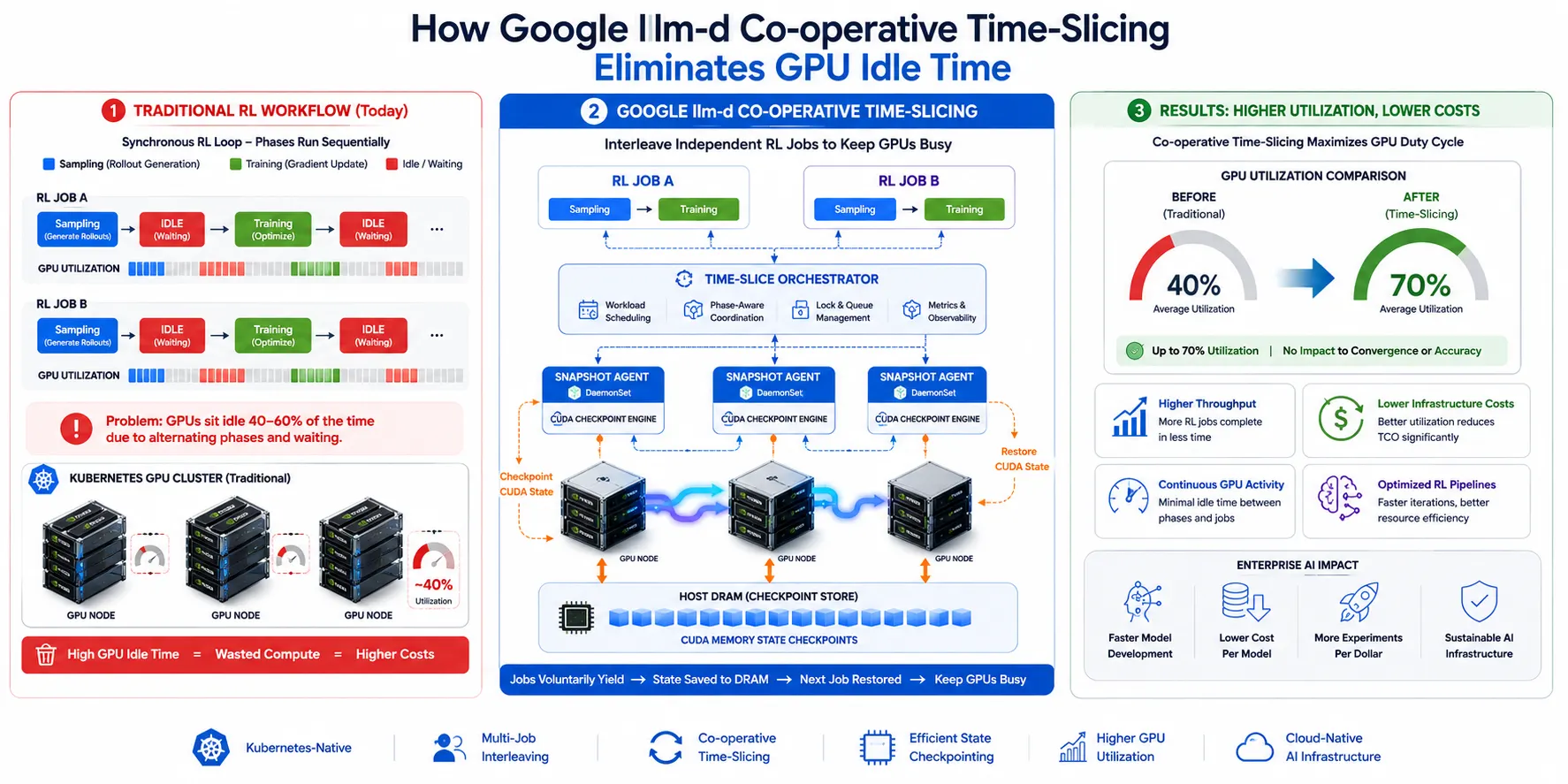
Traditional Kubernetes scheduling assumes workloads consume resources continuously, making it difficult to reclaim these inactive periods dynamically. As a result, accelerators remain allocated even when performing little or no useful work. Google estimates that this structural inefficiency can leave GPU clusters idle for 40% to 60% of their lifecycle, representing substantial wasted infrastructure investment.
Asynchronous RL pipelines attempt to overlap these phases, but they do not eliminate the underlying issue. Training still depends on fresh rollout data, creating unavoidable synchronization delays that reduce accelerator utilization.
For organizations operating hundreds or thousands of GPUs, even modest utilization improvements can translate into millions of dollars in annual infrastructure savings.
Technical Breakdown
Google's implementation introduces co-operative time-slicing, a scheduling model that treats each reinforcement learning phase as an independently schedulable workload rather than locking GPU resources to an entire training job.
Instead of dedicating hardware permanently to one RL process, the system allows multiple independent jobs to alternate execution on the same accelerator cluster.
The workflow is conceptually straightforward:
Job A completes its current sampling or training phase.
The workload voluntarily releases accelerator ownership through a yield() call.
The orchestrator checkpoints the GPU state into host DRAM.
Another waiting RL job immediately restores its previously saved GPU state.
Execution resumes exactly where that job stopped.
No container restarts occur.
No frameworks are reinitialized.
Models do not reload from storage.
Instead, accelerator memory is simply swapped between workloads through checkpoint and restore operations, allowing GPUs to remain productive even while individual RL jobs temporarily pause.
Google organizes the architecture into three coordinated layers:
1. Workload Layer
This is where users run familiar frameworks such as PyTorch, vLLM, or custom RL code.
A lightweight client library introduces two APIs:
acquire() requests exclusive GPU access.
yield() voluntarily releases GPU ownership after completing an accelerator-intensive phase
Importantly, developers do not need to modify their underlying machine learning frameworks.
Example: Integrating Time-Slicing into an RL Pipeline
from timeslice import TimeSliceOrchestratorClient# Connect to the llm-d Time-Slice Orchestratororchestrator = TimeSliceOrchestratorClient( target="orchestrator:50051")# GPU-intensive training phase@orchestrator.on_accelerators(group_id="trainer-group")def train_phase(model, trajectories): return model.update(trajectories)# GPU-intensive sampling phase@orchestrator.on_accelerators(group_id="sampler-group")def generate_phase(model, prompts): return model.generate(prompts)# Standard sequential RL training loopfor epoch in range(EPOCHS): trajectories = generate_phase(policy, dataset) rewards = compute_rewards(trajectories) train_phase(policy, rewards)2. Cluster Orchestration Layer
The orchestrator coordinates groups of workloads sharing the same physical accelerators.
Only one workload actively owns GPU resources at a time.
When execution finishes, ownership passes to the next workload waiting in the scheduling queue, ensuring continuous utilization across the cluster.
3. Node Layer
On each GPU node, a Snapshot Agent performs low-level checkpoint and restore operations.
The agent freezes accelerator processes, saves CUDA device state into host memory, and restores another workload's state when scheduled.
Google designed the Snapshot Agent with pluggable backends, enabling future optimization techniques such as selective memory swapping for LoRA adapters instead of full device snapshots.
This layered architecture allows scheduling intelligence to remain largely independent from the machine learning frameworks themselves, making the system easier to extend across different hardware platforms over time.
Industry Impact
Google's introduction of co-operative time-slicing represents more than another optimization for Kubernetes. It reflects a broader shift in how the AI industry is approaching infrastructure efficiency as reinforcement learning becomes central to building increasingly capable foundation models.
For years, conversations around AI infrastructure have focused primarily on acquiring more GPUs. The explosive demand for NVIDIA accelerators has driven unprecedented capital expenditure across hyperscale cloud providers, AI startups, and enterprise organizations. However, simply expanding hardware capacity is becoming increasingly expensive and, in many cases, impractical due to supply constraints.
The next competitive advantage is likely to come from extracting greater performance from existing infrastructure rather than continuously adding new hardware.
Google's approach directly addresses this challenge by treating GPU utilization as a scheduling problem rather than solely a hardware limitation. Instead of accepting idle periods as an unavoidable consequence of reinforcement learning, the company is redesigning how workloads interact with accelerator resources.
This philosophy aligns with a broader trend across cloud computing, where infrastructure efficiency has become a major differentiator. Just as virtualization dramatically improved CPU utilization in traditional data centers, AI infrastructure is beginning to evolve toward more intelligent resource sharing for accelerators.
For organizations operating large-scale AI clusters, even modest improvements in utilization can significantly reduce operational costs.
For example, increasing effective accelerator usage from approximately 40% to 70% means organizations can potentially complete substantially more reinforcement learning work using the same physical infrastructure. This not only improves return on investment but also shortens experimentation cycles, allowing researchers to iterate on models more rapidly without waiting for additional hardware capacity. Google's benchmarks indicate this increase in utilization is achieved without compromising model convergence or accuracy.
Implications for Enterprise AI
Although Google's announcement targets reinforcement learning infrastructure, its implications extend far beyond frontier AI laboratories.
Many enterprises are now building:
Internal AI copilots
Agentic AI platforms
Code generation assistants
Customer support agents
Industry-specific language models
Retrieval-Augmented Generation (RAG) systems
As these organizations increasingly adopt reinforcement learning to improve reasoning, tool usage, and domain-specific performance, they will encounter many of the same infrastructure bottlenecks currently faced by leading AI companies.
Traditional Kubernetes clusters excel at scheduling long-running services and batch workloads but are less suited to reinforcement learning's alternating execution patterns. Google's llm-d project demonstrates how Kubernetes-native scheduling can evolve to better support modern AI workloads without requiring developers to abandon familiar cloud-native tooling.
This is particularly significant for enterprises already invested in Kubernetes. Rather than deploying specialized infrastructure stacks exclusively for reinforcement learning, organizations may eventually be able to extend their existing Kubernetes environments with more intelligent accelerator scheduling.
Lowering the Total Cost of AI
Infrastructure spending has become one of the largest operational expenses associated with developing advanced language models.
GPU acquisition is only part of the equation.
Organizations must also account for:
Cloud compute costs
Power consumption
Cooling requirements
Data center capacity
Networking infrastructure
Operational management
Engineering time spent optimizing distributed training
When expensive accelerators remain idle for nearly half of a training cycle, the financial impact extends well beyond unused GPU time.
By increasing accelerator duty cycles, co-operative time-slicing contributes to lower Total Cost of Ownership (TCO) while improving overall price-performance. Google positions this capability as a way to reduce wasted compute accumulated over time, making reinforcement learning pipelines more economically sustainable.
Why This Matters
Google's announcement highlights a subtle but important shift in AI infrastructure priorities.
The industry is gradually moving from an era defined by hardware acquisition toward one focused on infrastructure intelligence.
Historically, cloud schedulers have been designed around relatively stable workloads:
Web services
Databases
Batch processing
Data analytics
These workloads typically consume resources continuously throughout their execution.
Reinforcement learning behaves very differently.
Instead of maintaining constant computational demand, RL alternates between periods of intensive sampling, optimization, synchronization, and waiting. Conventional schedulers lack visibility into these application-level transitions, leaving hardware reserved even when workloads temporarily stop performing useful accelerator computation.
Google's co-operative time-slicing effectively introduces phase-aware scheduling.
Rather than viewing an entire training job as a single monolithic workload, the scheduler recognizes individual computational phases as opportunities for resource sharing.
This concept could influence future generations of Kubernetes scheduling, particularly as AI-specific orchestration becomes increasingly important across cloud platforms.
Reinforcement Learning Is Becoming Mainstream
The importance of reinforcement learning has grown substantially over the past two years.
Modern reasoning models, coding assistants, autonomous agents, and tool-using AI systems increasingly rely on post-training optimization techniques to improve decision-making quality after pretraining has completed.
As organizations continue investing in agentic AI, reinforcement learning workloads are expected to become significantly more common.
Consequently, infrastructure capable of supporting these workloads efficiently will become an increasingly strategic asset.
Google's llm-d project reflects this longer-term vision by combining multiple infrastructure components, including:
Throughput-optimized inference routing
High-performance Agent Sandbox environments
Weight Propagation Interface (WPI)
Improved observability
Reliability enhancements
Co-operative time-slicing for RL infrastructure efficiency
Rather than delivering isolated features, Google is gradually assembling an integrated platform designed specifically for next-generation AI infrastructure.
Strengthening the Open AI Infrastructure Ecosystem
Another notable aspect of Google's announcement is its continued investment in llm-d as an open-source initiative.
Instead of restricting advanced scheduling capabilities to proprietary internal infrastructure, Google is making the Snapshot Agent, Accelerator Orchestrator, and Python client libraries available to the broader community.
This approach encourages collaboration among AI researchers, cloud providers, infrastructure engineers, and enterprises seeking to improve reinforcement learning efficiency.
Open development also accelerates experimentation across diverse hardware environments, increasing the likelihood that future scheduling techniques will support GPUs, TPUs, and emerging AI accelerators from multiple vendors.
Challenges and Considerations
Despite its promising results, co-operative time-slicing is not a universal solution for every AI workload.
Its effectiveness depends heavily on the characteristics of reinforcement learning pipelines and the overhead associated with checkpointing and restoring accelerator state.
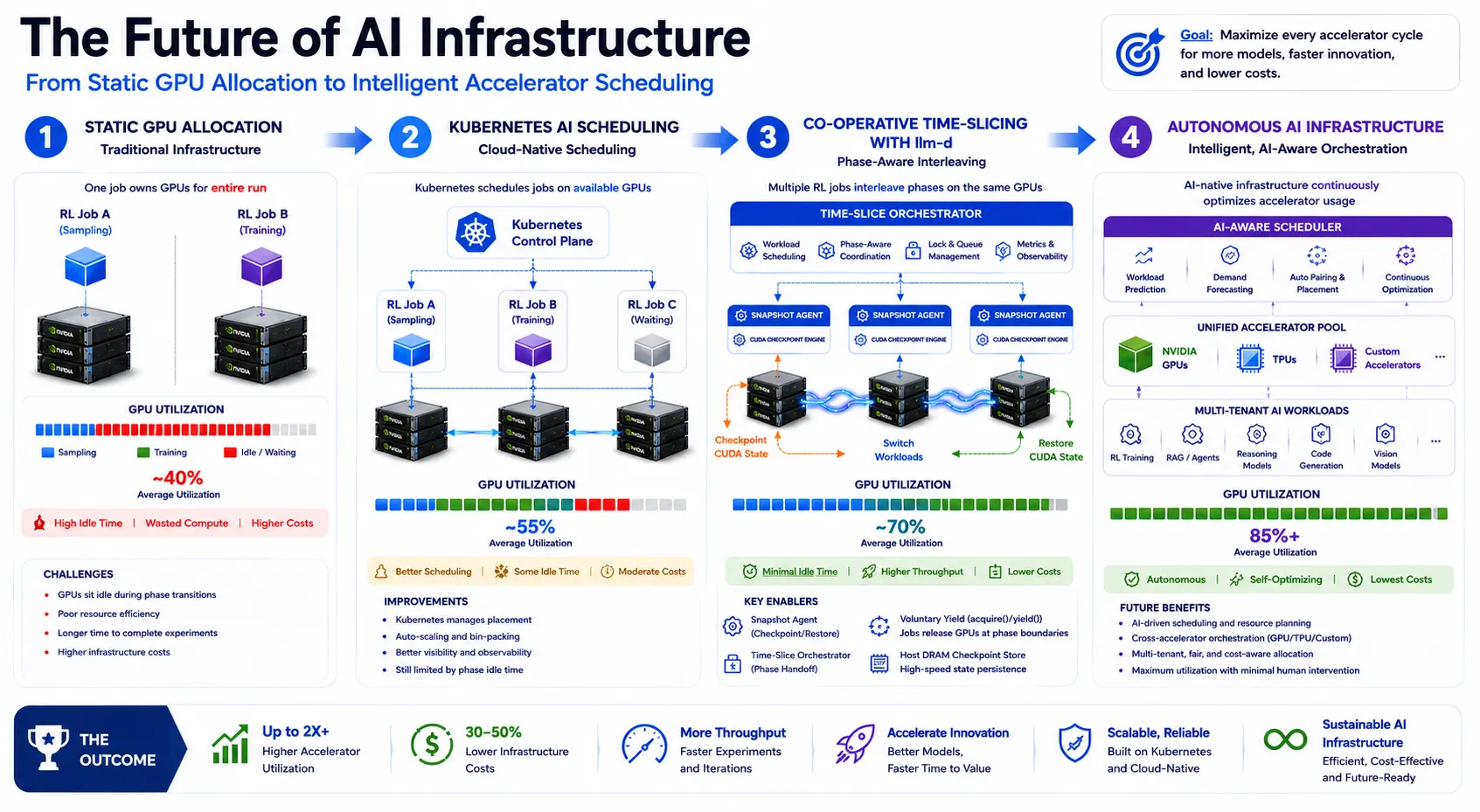
1. Context-Switch Overhead
Every workload transition requires GPU state to be transferred between accelerator memory and host DRAM.
Although Google minimizes disruption through optimized checkpoint and restore operations, frequent switching still introduces latency that must remain substantially lower than the idle periods it replaces.
Future roadmap items, including selective memory snapshotting and faster checkpoint backends, are intended to further reduce this overhead.
2. Intelligent Workload Pairing
Not every pair of RL jobs will benefit equally from time-slicing.
Ideally, workloads should exhibit complementary execution patterns so that one job becomes active precisely when another reaches an idle phase.
Google plans to automate this process through workload profiling and dynamic scheduling, reducing the need for manual configuration.
3. Hardware Diversity
Current implementations focus primarily on CUDA-based GPU environments.
As AI infrastructure becomes increasingly heterogeneous, extending support to TPUs and specialized accelerators will be essential for broader adoption.
Google has already identified cross-hardware compatibility as part of its development roadmap.
4. Operational Complexity
Introducing application-aware scheduling also adds operational complexity.
Infrastructure teams will need visibility into accelerator utilization, checkpoint performance, scheduling efficiency, and workload compatibility.
Comprehensive monitoring and observability will therefore become increasingly important components of production AI platforms.
Future Outlook
Co-operative time-slicing is unlikely to remain an isolated optimization.
Instead, it represents an early example of how AI infrastructure is becoming increasingly application-aware.
Future AI schedulers may incorporate:
Predictive workload modeling
AI-driven resource allocation
Automatic workload pairing
Dynamic accelerator partitioning
Multi-tenant reinforcement learning clusters
Cross-cloud AI scheduling
Native support for heterogeneous accelerators
Google's roadmap already points in this direction through automated scheduling, selective memory checkpointing, and expanded hardware compatibility.
As reinforcement learning becomes a standard component of enterprise AI development, infrastructure innovations such as llm-d's co-operative time-slicing could become as foundational to AI platforms as container orchestration itself.
For cloud providers, enterprises, and AI research organizations, the ability to maximize existing accelerator investments may ultimately prove just as valuable as deploying the next generation of hardware.
Conclusion
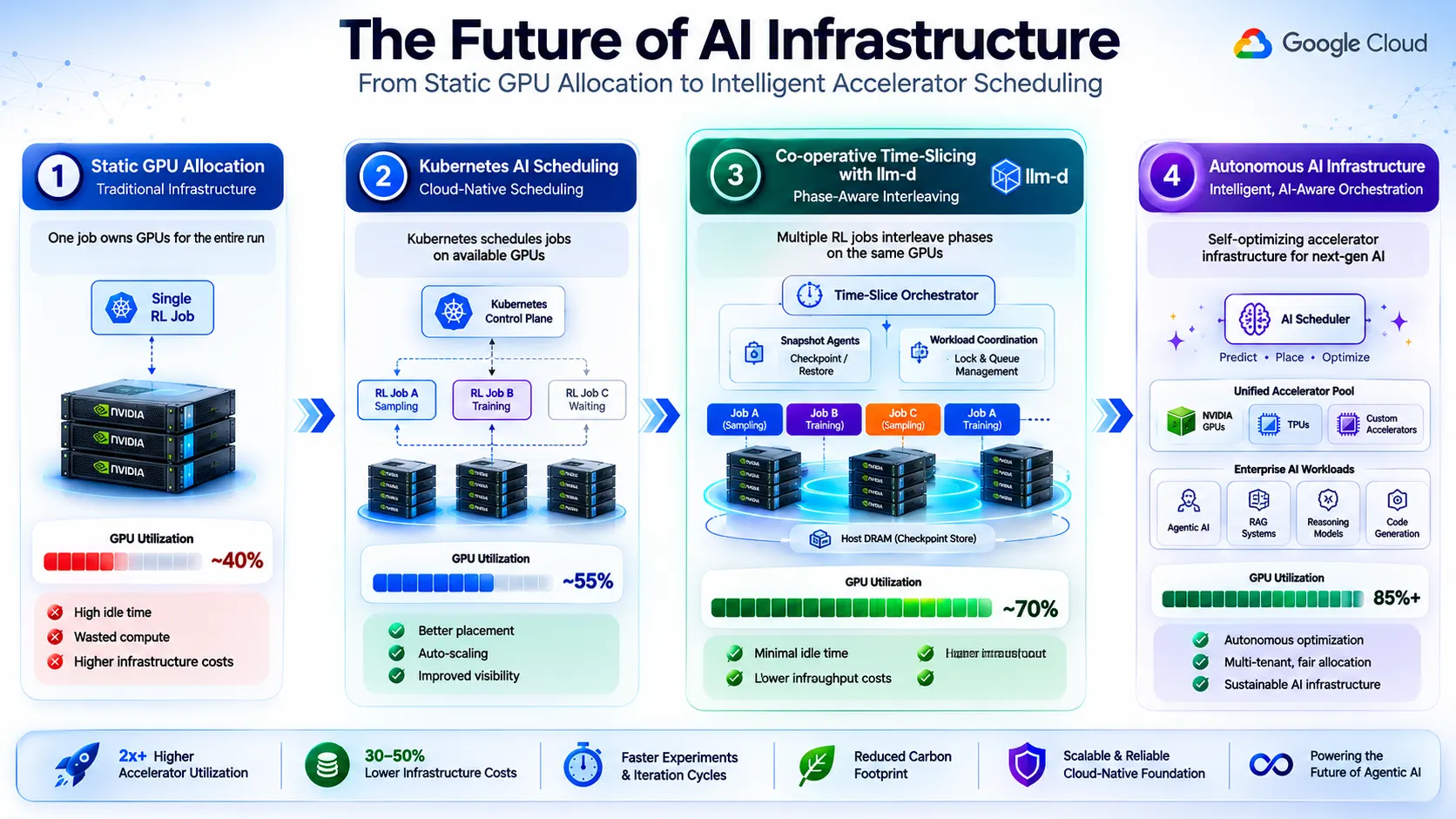
Google's introduction of co-operative time-slicing marks an important step in the evolution of AI infrastructure, shifting the industry's attention from simply acquiring more GPUs to making existing accelerator resources significantly more efficient.
Rather than treating reinforcement learning as just another distributed training workload, Google recognizes its unique execution patterns and redesigns infrastructure around them. By allowing independent RL jobs to share accelerator hardware through coordinated checkpoint and restore operations, the llm-d project addresses one of the most persistent inefficiencies in large-scale AI post-training: idle accelerators waiting for the next computational phase.
Initial benchmark results showing an increase in aggregate accelerator utilization from approximately 40% to 70% highlight the potential economic impact of intelligent scheduling. For organizations investing heavily in reinforcement learning, such improvements could translate into lower infrastructure costs, faster experimentation cycles, and better utilization of scarce accelerator resources without compromising model convergence or accuracy.
Equally significant is Google's decision to build this capability within the open-source llm-d ecosystem. By releasing the Snapshot Agent, Accelerator Orchestrator, and Python client libraries alongside a roadmap that includes automated scheduling, selective memory checkpointing, and broader hardware support, Google is encouraging the AI community to collaborate on solving infrastructure challenges that extend well beyond any single cloud platform.
As reinforcement learning continues to power more capable reasoning models, coding assistants, autonomous agents, and enterprise AI applications, infrastructure efficiency will become an increasingly important competitive differentiator. Future advances in AI may depend not only on larger models and more powerful accelerators but also on smarter orchestration systems capable of maximizing every available compute cycle.
In that context, co-operative time-slicing is more than an optimization feature. It represents an early glimpse into a new generation of AI-native infrastructure where scheduling decisions are informed by workload behavior, application semantics, and accelerator state rather than static resource allocation alone.
Source: Google Cloud Blog
About the Author