
Google Expands Gemini Enterprise Agent Platform with New Enterprise AI Capabilities
Google Cloud has announced major updates to Gemini Enterprise Agent Platform, making Agent Runtime, Agent Memory Bank, Agent Identity, Agent Gateway, and Agent Registry generally available to help organizations build, secure, and scale enterprise AI agents.
Xcademia Team
Xcademia Research Team
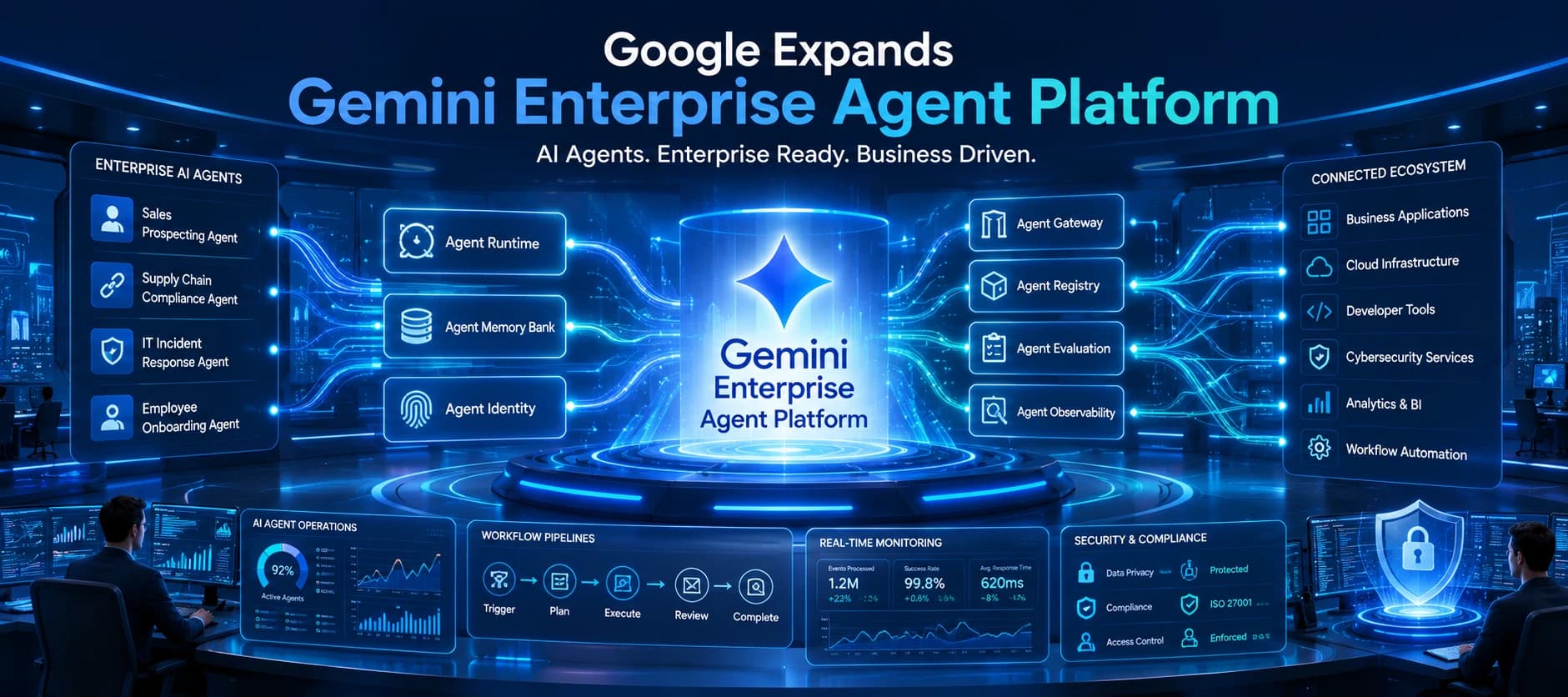
Google Expands Gemini Enterprise Agent Platform with New Enterprise AI Capabilities
A few months after introducing Gemini Enterprise Agent Platform, Google Cloud is expanding the platform with several of its most requested capabilities, making it easier for organizations to build, secure, govern, and manage enterprise AI agents at scale.
Since its launch, the platform has gained momentum among developers and enterprises building agentic AI applications. Google has supported this adoption by publishing 13 demonstrations showcasing the platform's capabilities and sharing guidance, including 20 questions organizations can use to establish a strong foundation for deploying AI agents responsibly.
Now, Google is making key capabilities such as Agent Runtime, Agent Memory Bank, Agent Identity, Agent Gateway, and Agent Registry generally available. The company also recently introduced CodeMender, a managed AI-powered code security agent designed to move beyond passive vulnerability scanning by helping automate code remediation and reduce zero-day risks.
Together, these enhancements reinforce Google Cloud's commitment to helping organizations simply and securely scale AI agents across enterprise environments.
Automating Long-Running AI Agents with Better Memory
While conversational AI has become increasingly capable, many enterprise workflows require AI agents to perform tasks that extend far beyond a single interaction.
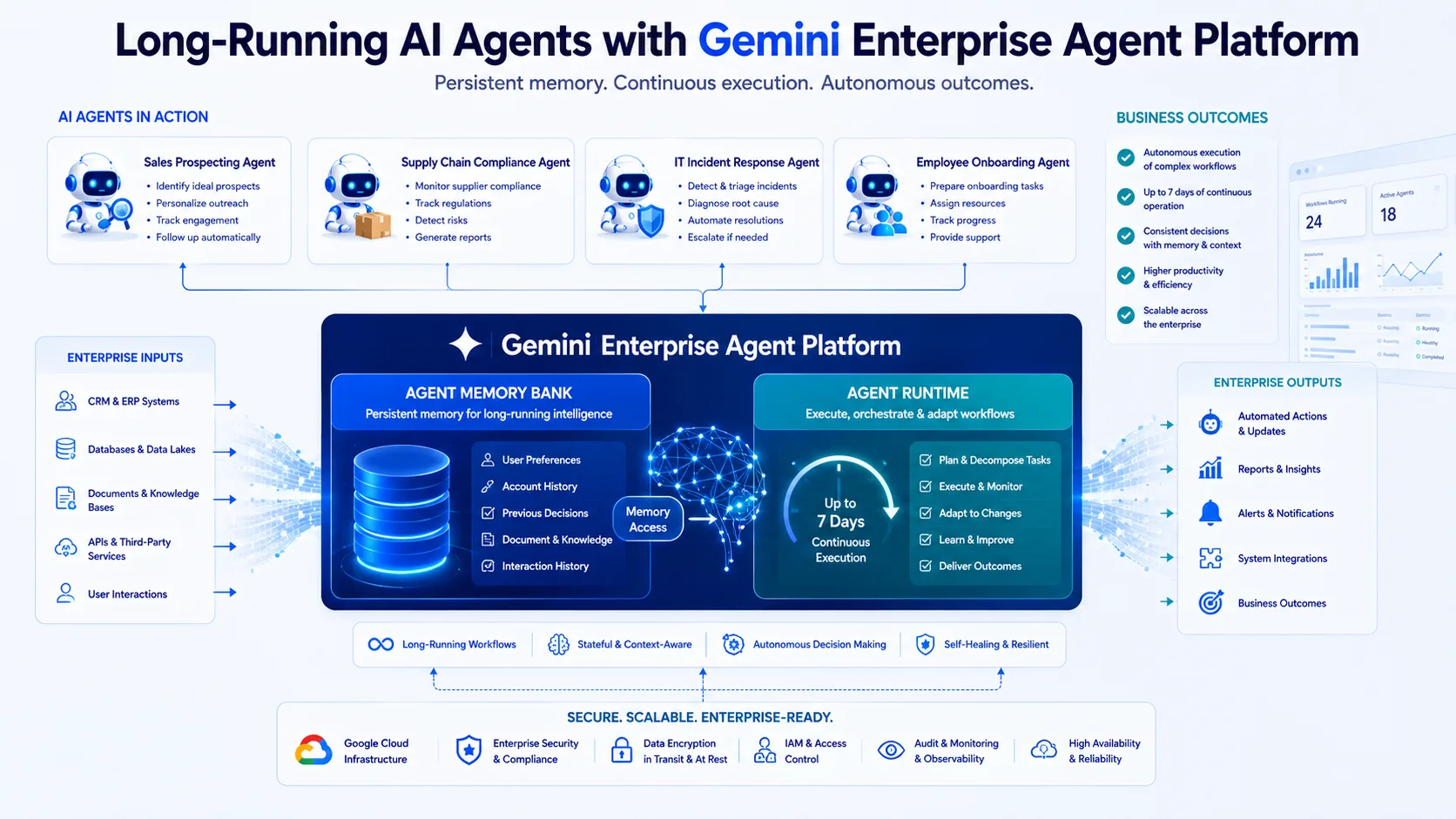
Organizations are beginning to use AI agents for processes such as managing sales prospecting campaigns, continuously monitoring supply chains for compliance risks, orchestrating IT incident response, and coordinating multi-stage employee onboarding. These long-running workflows require agents capable of executing multiple steps over extended periods while retaining the context needed to make informed decisions.
To support these enterprise scenarios, Google Cloud is making Agent Memory Bank and Agent Runtime generally available to all customers.
Agent Memory Bank Delivers Persistent Context
One of the biggest challenges for enterprise AI is maintaining context across long-running interactions.
Agent Memory Bank enables developers to define structured memory schemas that automatically extract and maintain important conversation context. Rather than treating every interaction as a completely new session, AI agents can retain key user preferences, previous decisions, and account history, allowing conversations and workflows to continue naturally even after long periods of inactivity.
Google says this low-latency memory architecture maximizes efficiency while delivering more personalized experiences without slowing response times.
For customer support, sales, and service teams, this means AI agents can resume conversations exactly where they left off instead of requiring users to repeat information.
Agent Runtime Supports Multi-Day Workflows
Google is also making Agent Runtime generally available, enabling AI agents to execute complex reasoning and automation tasks continuously for up to seven days.
Instead of requiring human intervention after every step, organizations can delegate extended asynchronous workflows to AI agents. Examples include executing week-long sales prospecting campaigns, coordinating multi-stage employee onboarding, monitoring vendor supply chains for compliance, or managing IT incident response and root-cause remediation across enterprise infrastructure.
By allowing agents to operate continuously while preserving context, Agent Runtime expands AI beyond chat experiences into autonomous business operations capable of supporting real-world enterprise processes.
A Stronger Foundation for Enterprise AI
Together, Agent Memory Bank and Agent Runtime provide the core capabilities needed for long-running enterprise AI workflows.
Persistent memory allows agents to remember previous interactions, while extended runtime enables them to complete complex tasks over several days without losing context. Combined, these capabilities help organizations automate sophisticated business processes while maintaining continuity, personalization, and operational efficiency.
As enterprises continue adopting agentic AI, these foundational services provide the scalability required to support increasingly autonomous business operations.
Building AI Agents with an End-to-End Enterprise Platform
Beyond introducing individual services, Google Cloud is positioning Gemini Enterprise Agent Platform as a complete environment for building, deploying, and operating enterprise AI agents throughout their entire lifecycle. Rather than requiring developers to assemble multiple disconnected tools, the platform brings together development frameworks, managed runtime services, governance capabilities, security controls, and operational monitoring into a unified experience.
Developers can build AI agents using the Agent Development Kit (ADK) and Agents CLI before deploying them to the fully managed Agent Runtime. Once running in production, agents can maintain persistent context through Agent Memory Bank while operating securely using Agent Identity. Agent Gateway, Agent Registry, Agent Evaluation, and Agent Observability then provide the governance, lifecycle management, quality monitoring, and operational visibility required for enterprise deployments.
This integrated approach reduces operational complexity while enabling development teams to move from experimentation to production more quickly. Instead of managing separate infrastructure for deployment, security, monitoring, and governance, organizations gain a consistent platform designed specifically for enterprise-scale agentic AI.
Securing, Auditing, and Governing Enterprise AI Agents
As AI agents become responsible for increasingly complex enterprise workflows, security and governance become just as important as intelligence and automation. Whether an agent is accessing sensitive business data, interacting with internal systems, or making decisions on behalf of users, organizations need strong controls to manage identities, permissions, compliance, and operational oversight.
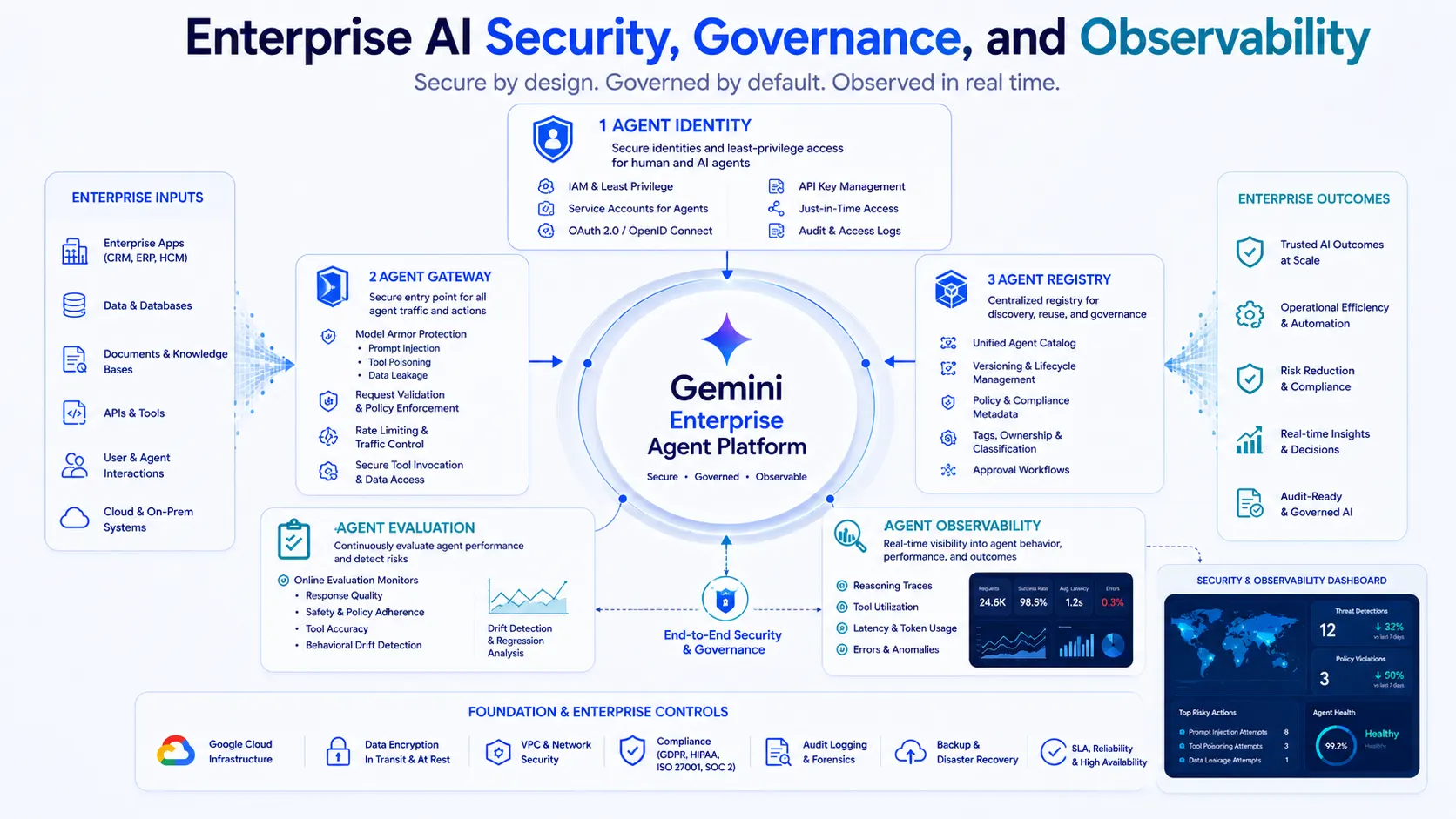
To help enterprises deploy AI agents securely at scale, Google Cloud is making Agent Identity, Agent Gateway, and Agent Registry generally available. These capabilities are designed to help organizations secure, audit, and centrally manage AI agents throughout their lifecycle while providing administrators with greater visibility and control.
Agent Identity Brings Enterprise-Grade Security to AI Agents
As organizations deploy growing numbers of autonomous AI agents, managing their identities becomes just as important as managing human users.
Google introduced Agent Identity as a new native Identity and Access Management (IAM) identity type built on open standards. The service applies a least-privilege approach to AI agent permissions, ensuring each agent receives access only to the resources required to perform its assigned tasks.
Unlike traditional service accounts, Agent Identity binds access directly to the running agent, helping mitigate token theft and unauthorized credential use. Every action performed by an AI agent is also fully auditable through non-repudiable auditing, giving organizations clear visibility into what actions were performed, which resources were accessed, and when those activities occurred.
Google also automates the entire identity lifecycle, eliminating dormant credentials that can create unnecessary security risks as enterprise AI deployments continue to grow.
Agent Gateway Centralizes Security and Governance
Managing security policies individually across dozens or hundreds of AI agents can quickly become difficult.
Agent Gateway provides a centralized control point where organizations can secure and govern interactions across their entire AI agent ecosystem. From a single management layer, administrators can enforce granular access controls using IAM conditions and natural language policy rules, helping ensure agents operate within approved organizational boundaries.
Integrated Model Armor protection adds another layer of security by defending AI agents against threats such as:
Prompt injection attacks
Tool poisoning
Sensitive data leakage
By embedding these protections directly into the platform, Agent Gateway helps organizations deploy AI agents with stronger security while simplifying enterprise governance and policy enforcement.
Google also highlighted that organizations including Broadcom, Palo Alto Networks, and Ping Identity are already using Agent Gateway to govern enterprise AI deployments securely at scale.
Agent Registry Provides a Centralized View of Enterprise AI
As AI adoption accelerates, organizations often develop specialized agents across multiple business units, making it increasingly difficult to understand what has already been deployed.
Google introduced Agent Registry to serve as a centralized library for AI agents, servers, and enterprise connections across an organization.
Rather than creating duplicate agents for similar tasks, development teams can discover, reuse, and extend existing agents through a centralized catalog. At the same time, administrators gain a single-pane view of the organization's AI ecosystem, making it easier to monitor agent sprawl, maintain governance policies, and manage the lifecycle of enterprise AI assets.
By centralizing agent discovery and management, Agent Registry supports both developer productivity and enterprise-wide governance while helping organizations scale AI in a more organized and efficient manner.
Supporting the Complete AI Agent Lifecycle
One of the central themes of Google's latest platform update is that enterprise AI requires much more than simply deploying a large language model. Organizations need tooling that supports every stage of an AI agent's lifecycle, from initial development to long-term optimization.
Gemini Enterprise Agent Platform is designed to provide those capabilities through a connected ecosystem of services. Developers can build and test agents using Google's development tools before deploying them to a managed runtime capable of executing long-running workflows. Persistent memory enables agents to retain context across sessions, while Agent Identity secures access to enterprise resources through least-privilege permissions. Governance capabilities such as Agent Gateway and Agent Registry help administrators manage growing fleets of AI agents, and Agent Evaluation together with Agent Observability ensures that deployed agents continue performing reliably over time.
By integrating these capabilities into a single platform, Google Cloud aims to simplify enterprise adoption while giving organizations greater confidence that AI agents remain secure, observable, and compliant throughout their operational lifecycle.
Improving Agent Performance with Evaluation and Observability
Building AI agents is only the beginning. Organizations also need continuous insight into how those agents perform after deployment and whether they continue making reliable decisions over time.
Google Cloud addresses this need by bringing Agent Evaluation and Agent Observability together within the Gemini Enterprise Agent Platform. By combining performance measurement with operational visibility, organizations can monitor, troubleshoot, and improve AI agents throughout their production lifecycle using a unified platform.
Agent Evaluation Continuously Measures AI Quality
Agent Evaluation enables organizations to continuously monitor AI agents running in production through online evaluation monitors that proactively detect performance degradation and behavioral drift before these issues begin affecting users.
Google provides multiple evaluation methods to support different enterprise requirements, including:
Pre-built evaluation metrics
Custom Python evaluation logic
LLM-as-a-Judge assessments
Adaptive rubrics co-developed with Google DeepMind
By supporting multiple evaluation strategies, organizations can measure AI quality using metrics that align with their specific business goals while continuously improving agent performance over time.
Agent Observability Provides End-to-End Visibility
While evaluation measures the quality of an AI agent's output, Agent Observability provides detailed insight into how those results were produced.
The service delivers comprehensive tracing across an agent's reasoning process, tool utilization, and execution performance through real-time observability dashboards.
This visibility allows developers and administrators to investigate execution paths, identify bottlenecks, troubleshoot failures, and optimize AI workflows with greater confidence.
Together, Agent Evaluation and Agent Observability ensure that the same metrics developers use while building AI agents continue measuring production performance after deployment, helping organizations maintain reliable, trustworthy, and continuously improving enterprise AI systems.
How Enterprises Are Adopting Gemini Enterprise Agent Platform
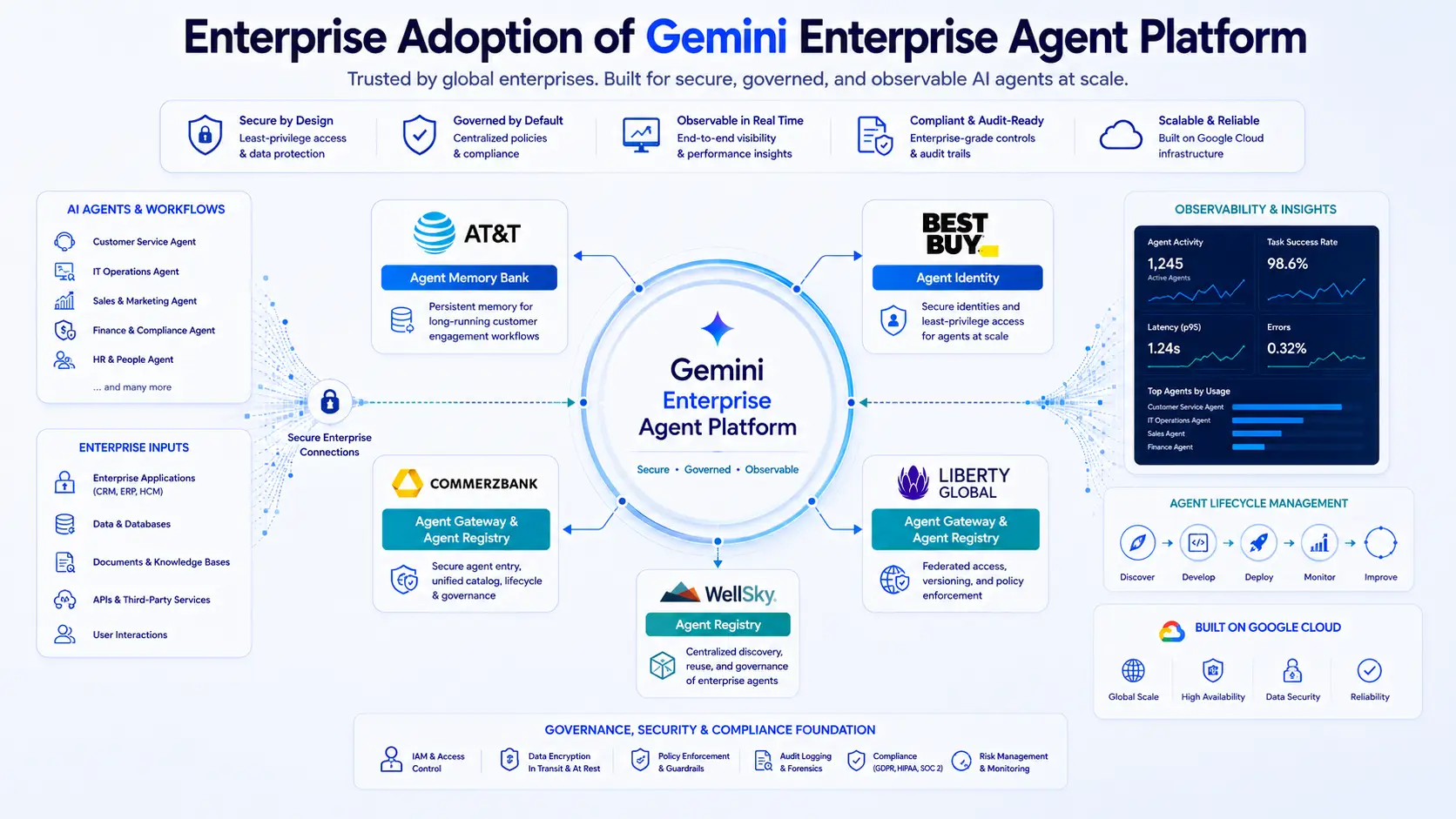
Alongside the new platform capabilities, Google Cloud shared how organizations across telecommunications, retail, financial services, media, and healthcare are already using Gemini Enterprise Agent Platform to strengthen AI governance, improve customer experiences, and accelerate enterprise AI adoption.
These customer examples demonstrate how long-running AI agents, centralized governance, and enterprise-grade security are enabling businesses to deploy agentic AI confidently at scale.
AT&T Uses Agent Memory Bank for Seamless Customer Conversations
AT&T is leveraging Agent Memory Bank to give its autonomous AI sales agents long-term conversational memory.
According to the company, AI agents in its app channel can now resume customer conversations by synthesizing key information from previous interactions, allowing them to move from simply responding to actively remembering customer history.
AT&T plans to extend this capability to its Interactive Voice Response (IVR) systems, enabling customers to continue conversations seamlessly across mobile apps, voice services, and web experiences without losing context or repeating information.
This demonstrates how persistent memory can create more natural and personalized customer experiences across multiple communication channels.
Best Buy Strengthens AI Governance with Agent Identity
Best Buy highlighted the growing importance of managing AI identities with the same level of control as human identities.
The retailer explained that traditional service accounts often resulted in orphaned credentials, unclear ownership, and permissions that expanded over time. By adopting Agent Identity, Best Buy can clearly define each AI agent's identity, control exactly what resources it can access, and establish accountability for every autonomous action.
Applying least-privilege permissions also helps reduce security risks while giving the company greater confidence to scale AI safely across its cloud platform.
Commerzbank Evaluates Governance for Responsible AI
Commerzbank AG is building a secure foundation for responsible agentic AI using Google Cloud.
As part of that strategy, the bank is evaluating Agent Registry and Agent Gateway to strengthen enterprise governance through improved agent discoverability, policy enforcement, and access management.
The company also views the platform's observability and auditing capabilities as essential for scaling AI while meeting the strict compliance and governance requirements expected within the financial services industry.
Liberty Global Focuses on Centralized AI Management
Liberty Global is using Gemini Enterprise Agent Platform to accelerate AI development while maintaining centralized governance across its multiple operating companies.
According to the company, Agent Gateway and Agent Registry provide the centralized oversight needed to enforce security policies, monitor AI deployments, and manage specialized agents across a diverse enterprise environment.
This governance model enables developers to build and deploy AI capabilities rapidly while ensuring AI systems remain secure and compliant across the organization.
WellSky Prioritizes Responsible AI in Healthcare
Healthcare technology provider WellSky is using Agent Registry as part of a proactive governance framework for its growing generative AI ecosystem.
The organization has established a centralized process to catalog, version, and manage the lifecycle of AI agents before they are deployed into production. By enforcing compliance policies and ensuring only approved agents reach production environments, WellSky is able to support AI innovation while maintaining the security and governance standards required by healthcare providers.
Moving Beyond AI Assistants to Autonomous Business Operations
The latest platform updates also reflect a broader shift in enterprise AI strategy. Early generative AI deployments primarily focused on conversational assistants that answered questions or summarized information. Enterprise organizations are now increasingly looking for AI systems capable of taking action, coordinating complex workflows, and collaborating with both people and software systems.
Google Cloud's new capabilities are designed to support that transition. Long-running execution through Agent Runtime, persistent context using Agent Memory Bank, enterprise-grade identity management, centralized governance, and continuous monitoring together enable organizations to build AI agents capable of operating independently while remaining secure and accountable.
Rather than replacing human decision-makers, these autonomous agents are intended to automate repetitive operational processes, accelerate business workflows, and assist employees with increasingly sophisticated tasks. As organizations expand their use of agentic AI, Google Cloud sees enterprise governance, observability, and lifecycle management becoming just as important as the intelligence of the underlying AI models themselves.
Getting Started with Gemini Enterprise Agent Platform
With these latest updates, Google Cloud is making many of Gemini Enterprise Agent Platform's most requested capabilities generally available, giving organizations a more complete foundation for building and operating enterprise AI agents.
Developers can now begin using features including Agent Runtime, Agent Memory Bank, Agent Identity, Agent Gateway, Agent Registry, Agent Evaluation, and Agent Observability to build agents capable of executing long-running workflows, maintaining persistent memory, and operating within enterprise governance and security controls.
Google Cloud also encourages developers to explore the platform's documentation, experiment with the Agent Development Kit and Agents CLI, and watch the latest livestream demonstrating the complete enterprise agent lifecycle. The session walks through building, deploying, governing, monitoring, and optimizing AI agents using the platform's managed services, helping organizations understand how these capabilities work together in real-world enterprise environments.
As adoption of agentic AI continues to accelerate, Google Cloud expects organizations to increasingly combine these services to create AI agents that can operate across multiple business systems while remaining secure, observable, and compliant with enterprise governance requirements.
Conclusion
Google Cloud's latest expansion of the Gemini Enterprise Agent Platform marks an important step in the evolution of enterprise AI. Rather than focusing solely on conversational assistants, the platform now delivers a comprehensive foundation for building, deploying, securing, governing, and optimizing autonomous AI agents capable of supporting complex business operations across industries.
The introduction of Agent Memory Bank and Agent Runtime enables organizations to develop AI agents that retain context across long-running interactions and execute workflows continuously for up to seven days. At the same time, Agent Identity, Agent Gateway, and Agent Registry provide the enterprise-grade identity management, centralized governance, and lifecycle controls needed to deploy AI agents securely at scale.
Google Cloud has also strengthened operational visibility by introducing Agent Evaluation and Agent Observability, allowing organizations to continuously measure agent quality, detect behavioral drift, trace reasoning paths, and optimize performance using real-time insights. Together, these capabilities create a unified platform that supports the complete AI agent lifecycle, from development and deployment to monitoring and continuous improvement.
Real-world implementations from organizations including AT&T, Best Buy, Commerzbank AG, Liberty Global, and WellSky demonstrate how enterprises across telecommunications, retail, financial services, media, and healthcare are already using these capabilities to improve customer experiences, strengthen governance, and scale AI responsibly.
Alongside the recent introduction of CodeMender, Google's managed AI-powered code security agent, these updates further reinforce Google Cloud's vision of helping enterprises move beyond isolated AI assistants toward secure, intelligent, and production-ready agentic AI systems.
As enterprise AI adoption accelerates, the Gemini Enterprise Agent Platform provides organizations with the tools needed to build intelligent agents that can automate complex workflows, operate securely, and deliver reliable outcomes while meeting the governance and compliance requirements of modern businesses.
Source: Google Cloud Blog
About the Author