
Google Cloud Targets Legacy Hive Bottlenecks With a Zero-Copy Lakehouse Catalog
Google Cloud says its serverless Lakehouse runtime catalog can help enterprises modernize Apache Hive Metastores without moving or rewriting existing data, while unifying metadata, governance and access across analytics engines.
Xcademia Team
Xcademia Research Team
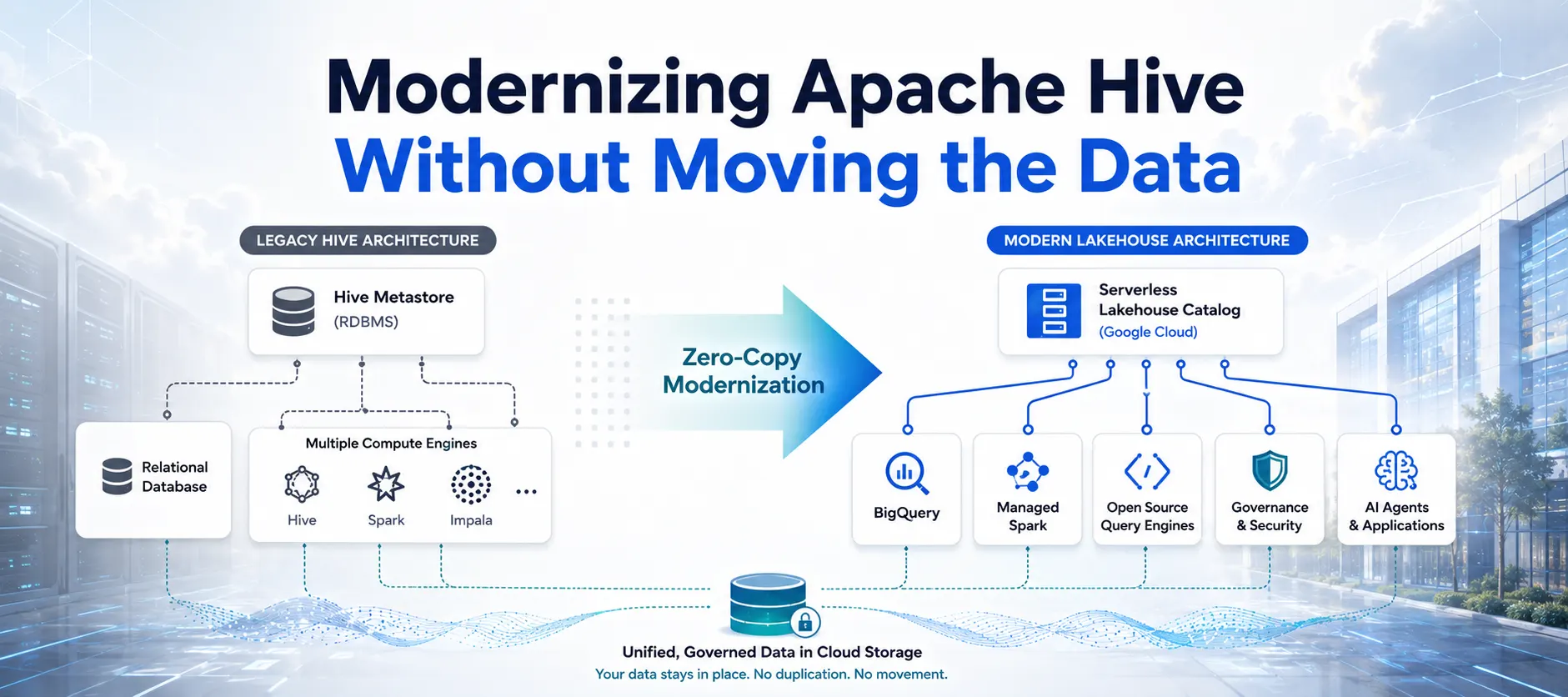
Google Cloud outlines a path away from legacy Apache Hive Metastores
Apache Hive Metastore (HMS) has been a central metadata layer for big data analytics for more than a decade. It has traditionally provided the schema and partition information needed by engines such as Apache Spark, Presto and Hive to work with data stored in formats including Parquet and ORC.
But modern enterprise data environments are becoming more distributed. Organizations may operate large data lakes while using multiple analytics engines, including managed Spark services, BigQuery and Trino.
Google Cloud says that at this scale, standalone Hive Metastores can become operational bottlenecks.
In an August 2026 Google Cloud Blog post, Vinod Ramachandran and Pratibha Suryadevara describe how the company's Lakehouse runtime catalog is designed to address these limitations. The catalog supports both Hive Catalog and Apache Iceberg REST Catalog and is positioned as a zero-data-copy migration solution for existing production Hive tables.
The key proposition is straightforward: modernize the metadata layer without requiring organizations to move or rewrite their existing data.
Why legacy Hive Metastores can become difficult to operate
Google Cloud identifies three major areas of concern with standalone Hive Metastore deployments.
1. Metadata scaling can become a bottleneck
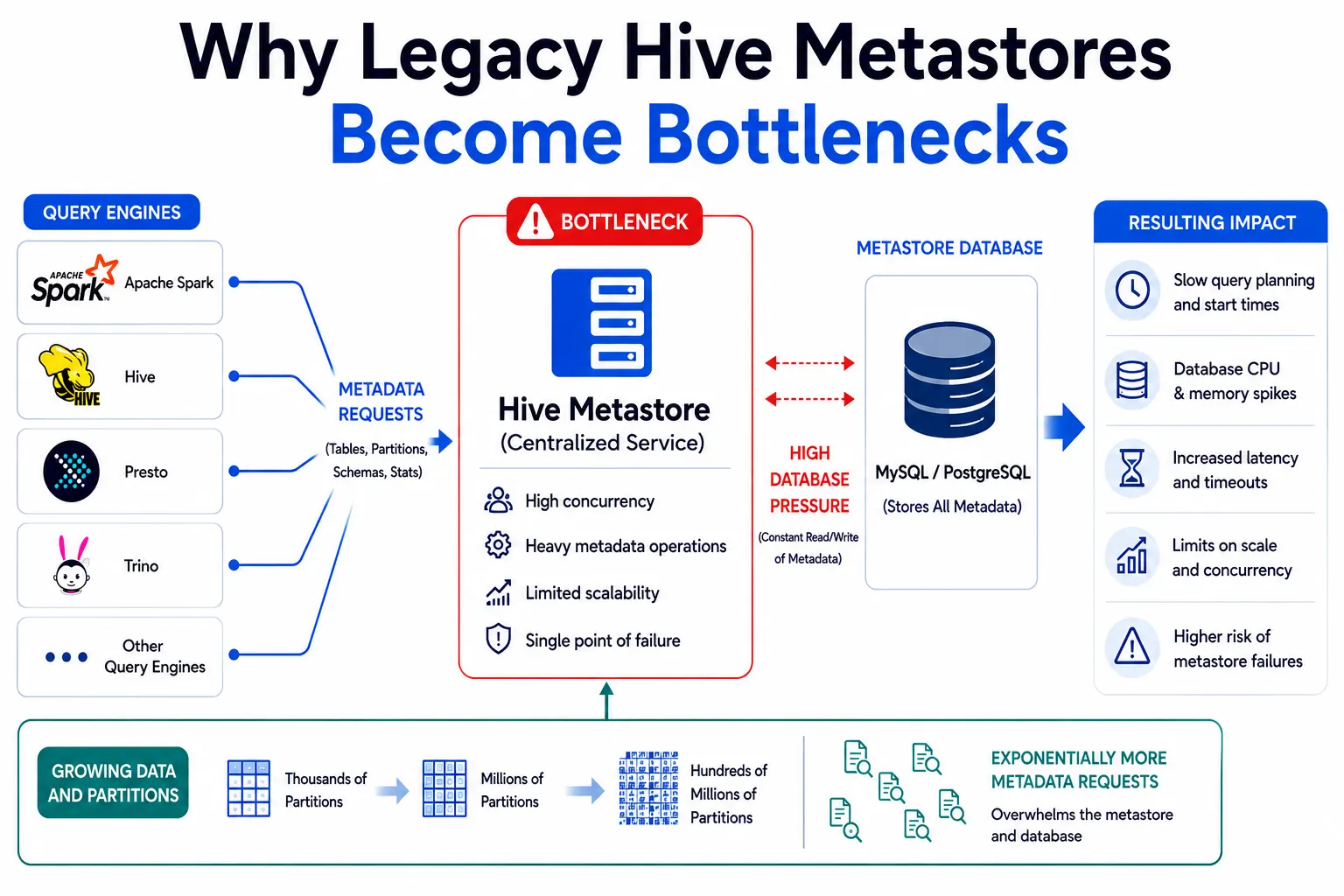
Traditional HMS deployments commonly rely on relational databases such as MySQL or PostgreSQL to store information about schemas, partitions and storage locations.
As data lakes expand and accumulate large numbers of partitioned tables, metadata-intensive operations can put substantial pressure on the relational database supporting the metastore.
Google Cloud gives the example of a complex Spark workload requesting partition metadata. According to the company, such activity can drive metastore CPU utilization to 100%, potentially contributing to query delays or out-of-memory failures.
2. Security and identity can become fragmented
Legacy Hive environments were largely designed around traditional Hadoop security models.
Modern cloud data platforms often require more granular controls, including table-level access policies. When multiple compute and query environments need to access the same datasets, organizations can end up maintaining security policies across separate control planes.
Google Cloud argues that this creates duplicated governance work when Spark workloads and enterprise SQL engines such as BigQuery need consistent access controls.
The issue is therefore not simply metadata management. It also involves how metadata, identity and data access policies work together across different analytics engines.
3. Infrastructure management adds operational overhead
A self-managed metastore also requires infrastructure and database administration.
Google Cloud points to tasks including maintaining highly available MySQL or PostgreSQL instances, patching Hive Metastore services and tuning JDBC connection pools. Instance-based deployments can also incur costs when infrastructure remains provisioned even when demand varies.
For data platform teams, this means engineering effort can be spent maintaining the metadata infrastructure rather than building and operating data products.
Google Cloud's Lakehouse runtime catalog approach
Google Cloud's proposed alternative is the Lakehouse runtime catalog, a serverless metadata registry designed to work with both legacy Hive/Parquet tables and modern open table formats such as Apache Iceberg.
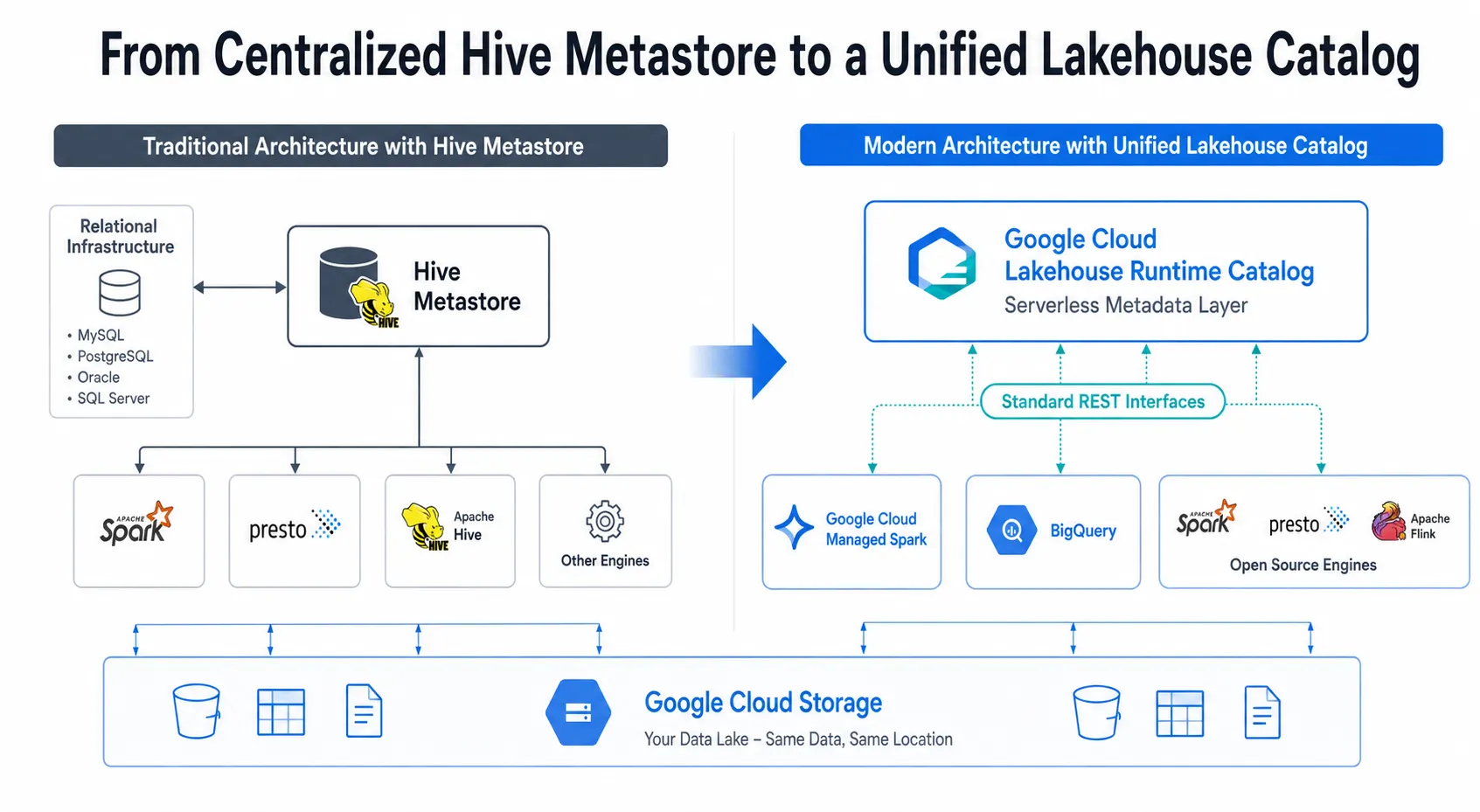
By implementing the Apache Iceberg REST Catalog specification, the Lakehouse runtime catalog decouples metadata discovery from compute engines.
This architectural separation is important because it allows compatible engines to work against a shared catalog rather than requiring separate metadata systems for every analytics environment.
The company says the approach supports access to the same underlying data without copying it between systems.
Zero-copy access is central to the migration strategy
One of the most significant aspects of Google's approach is that the migration does not require the underlying data to be moved.
The Lakehouse runtime catalog registers table definitions that point to existing data in Google Cloud Storage. According to Google Cloud, customers do not need to move, rewrite or duplicate the underlying storage payloads as part of this approach.
This distinction matters for large data environments. Moving large datasets can introduce additional migration complexity, storage requirements and operational dependencies.
With a zero-copy model, the modernization effort focuses primarily on the metadata and catalog layer rather than relocating the data itself.
Multi-engine interoperability
Google Cloud says registered tables can be discovered and queried across Google Cloud Managed Spark, BigQuery and open-source engines through standard REST interfaces.
The objective is to create a common metadata layer for environments where different teams may use different analytics technologies.
This also aligns with the broader direction of open table formats and interoperable data platforms. Rather than tying metadata access to one compute engine, the catalog exposes the information through standardized interfaces.
Open APIs
The Lakehouse runtime catalog supports both the Apache Iceberg REST Catalog and Hive Catalog.
This allows organizations to maintain compatibility with existing Hive-oriented workloads while also providing a path toward Iceberg-compatible architectures.
For enterprises with mixed environments, this can reduce the need to immediately replace every existing analytics component simply to modernize the metadata layer.
Governance and trusted context for AI workloads
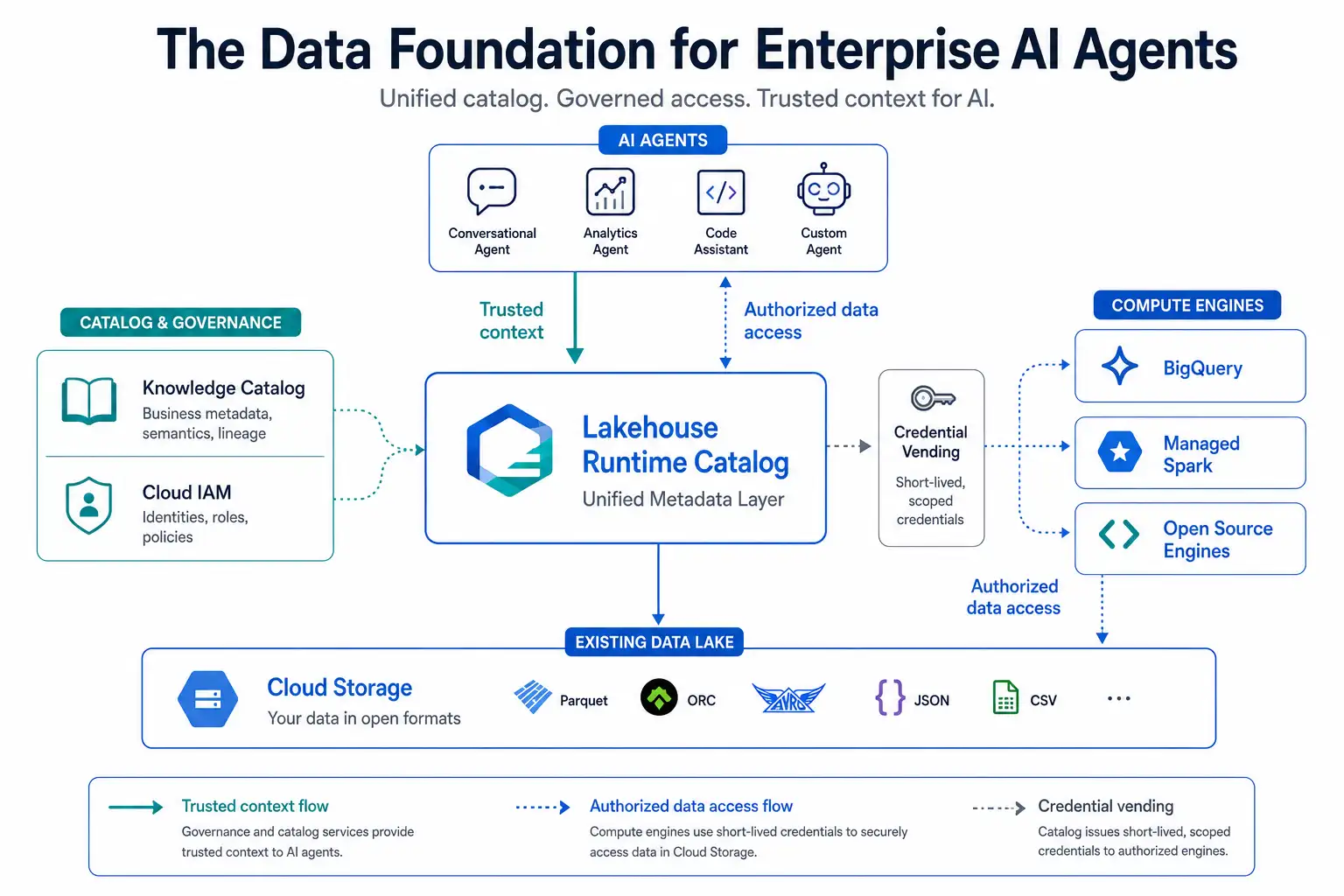
Google Cloud also positions the Lakehouse runtime catalog as part of the infrastructure needed for AI and agent-based workloads.
The service integrates with Knowledge Catalog and Cloud IAM. Google says this enables organizations to establish trusted context for agents and apply table-level security across compute engines.
The catalog also supports authorization mechanisms such as credential vending. Google describes this as allowing users to access tables without requiring direct access to the underlying Cloud Storage files.
This reflects a broader shift in enterprise data architecture.
As organizations introduce AI agents that can interact with enterprise data, metadata is increasingly more than a technical directory. It can also become part of the context and governance layer determining what data is discoverable and accessible.
Built for serverless metadata management
Google Cloud says the Lakehouse runtime catalog is backed by Spanner and Google infrastructure, with support for Cloud Storage dual-region and multi-region buckets for failover use cases.
The company also positions the service as serverless and no-ops, with the goal of reducing infrastructure management requirements and supporting metadata growth alongside data workloads.
The announcement does not provide specific comparative TCO figures or quantified infrastructure savings.
How the Hive Metastore migration works
Google Cloud also highlights a capability intended to simplify migration from a self-managed Hive Metastore.
The migration capability connects to the existing Hive Metastore, extracts external table definitions and partition maps, and registers them in the Lakehouse catalog. The resulting metadata can then be used with Google Managed Spark, BigQuery and Conversational Analytics agents with Gemini, according to Google Cloud.
The important point is that the migration focuses on the catalog and metadata definitions rather than copying the underlying datasets.
The company describes this as a way to move production Hive tables toward the Lakehouse environment while retaining the existing data in place.
What the change means for data teams
The announcement highlights a broader industry shift toward separating data storage, metadata management and compute.
Traditional data lake architectures often evolved around specific processing engines and infrastructure stacks. Modern cloud environments increasingly require multiple engines to work with common datasets while maintaining consistent governance.
Google Cloud's Lakehouse runtime catalog addresses this problem by putting a standardized catalog layer between data storage and compute.
For enterprises, this could mean that modernization does not necessarily require a wholesale replacement of existing data. Instead, organizations can focus on changing how data is registered, discovered, governed and accessed.
The approach may also be relevant for organizations preparing data platforms for AI agents. If agents are expected to interact with enterprise datasets, consistent metadata and access controls become important parts of the underlying architecture.
However, the announcement does not provide customer-specific migration results, independent performance benchmarks or quantified cost reductions.
The bigger picture
The modernization of Apache Hive Metastore is part of a larger evolution in enterprise data architecture.
Organizations are increasingly dealing with three overlapping requirements:
Multiple analytics engines need access to common datasets.
Governance policies need to remain consistent across those environments.
AI systems and agents need controlled access to trusted enterprise data.
Google Cloud's Lakehouse runtime catalog is designed around these requirements while maintaining compatibility with existing Hive environments.
Its zero-copy approach is particularly significant because it separates metadata modernization from physical data migration. Existing Hive/Parquet data can remain in Google Cloud Storage while its catalog representation is moved into the serverless Lakehouse environment.
For teams operating large Hive-based data platforms, that creates a potential path toward a more centralized and interoperable architecture without requiring an immediate rewrite of their underlying storage.
Additional details were not disclosed in the announcement about specific customer migration timelines, quantified performance improvements or comparative cost savings.
Conclusion
Google Cloud is positioning its Lakehouse runtime catalog as a bridge between legacy Apache Hive environments and modern multi-engine, AI-ready data architectures.
The service combines Hive Catalog and Apache Iceberg REST Catalog support with serverless metadata management, multi-engine interoperability, zero-copy access and integrated governance capabilities.
The central idea is relatively simple: organizations can modernize the metadata layer while keeping existing data in place.
As enterprise analytics environments become more distributed and AI agents increasingly interact with business data, the catalog layer is becoming an important architectural component. Google's latest announcement focuses on making that transition from legacy Hive Metastore infrastructure easier without requiring organizations to immediately move or rewrite their underlying data.
Source: Google Cloud Blog
About the Author