
Google Cloud KMS Introduces Quantum-Safe Digital Signatures to Protect Future Data Integrity
Google Cloud has introduced quantum-safe digital signatures and post-quantum cryptography support in Cloud KMS, helping organizations protect long-term data integrity, meet emerging security requirements, and prepare for future quantum computing threats.
Xcademia Team
Xcademia Research Team
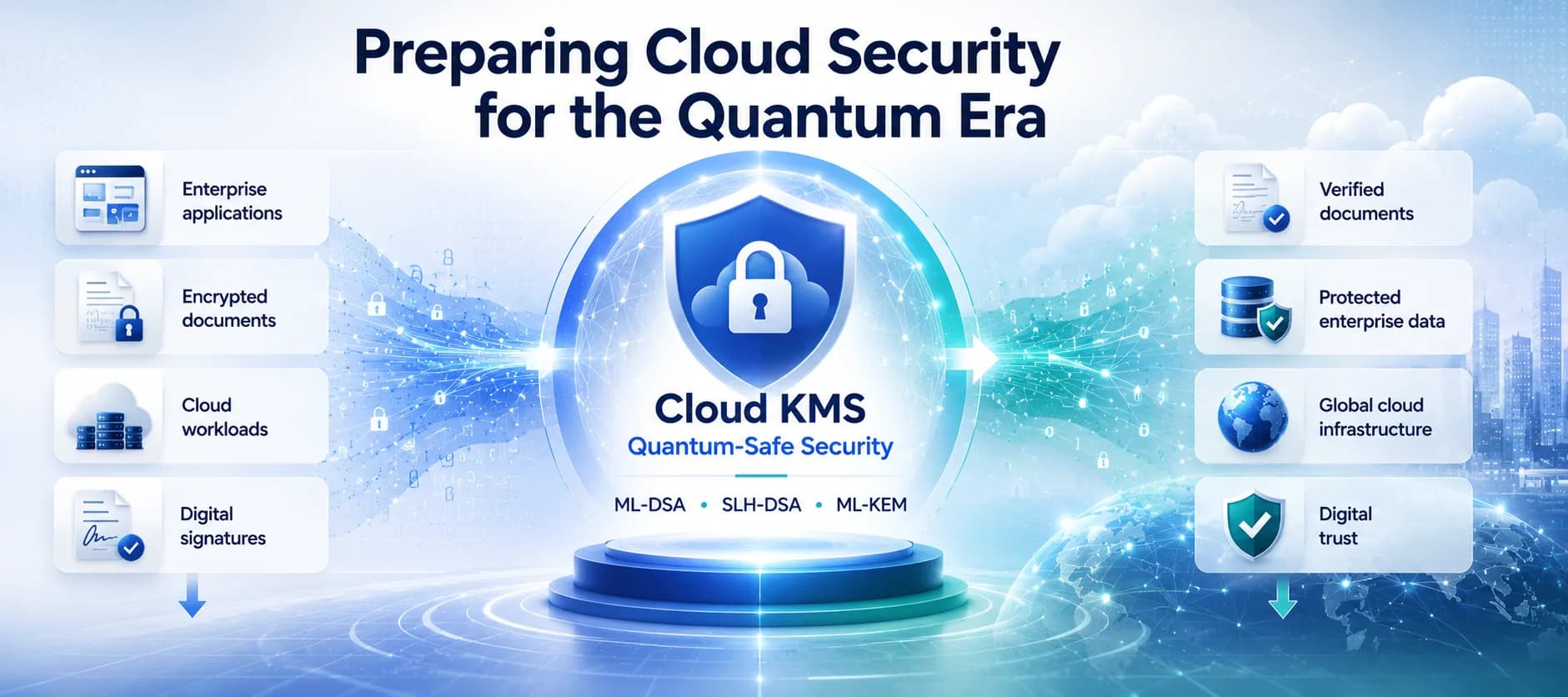
Preparing Enterprise Security for the Quantum Computing Era
As organisations prepare for the potential impact of quantum computing, protecting the long-term security of digital information has become a growing priority. Digital signatures play a critical role in verifying authenticity, maintaining trust, and ensuring that important data remains reliable over extended periods.
Cryptographically relevant quantum computers (CRQC) could eventually challenge some of today’s widely used cryptographic systems, creating new risks for data authenticity, digital signatures, and trusted communications. As a result, enterprises, governments, and security teams are beginning to plan their transition toward quantum-safe cryptography.
To help organizations prepare for this future, Google Cloud has announced the general availability of quantum-safe digital signatures and post-quantum key encapsulation capabilities in Google Cloud Key Management Service (Cloud KMS).
The new capabilities introduce support for advanced post-quantum cryptography (PQC) algorithms, including ML-DSA, SLH-DSA, and ML-KEM. These standards help organizations strengthen long-term data protection while preparing for evolving security requirements and regulatory expectations.
By integrating quantum-safe cryptographic capabilities into Cloud KMS, Google Cloud enables enterprises to begin adopting future-ready security approaches while continuing to use managed cloud key management workflows.
Why Quantum-Safe Cryptography Has Become a Security Priority
Quantum computing represents a major shift in the cybersecurity landscape.
Although large-scale cryptographically relevant quantum computers are not currently available, security organizations are already preparing because sensitive information protected today may need to remain secure for decades.
One concern driving this preparation is the possibility of attackers collecting encrypted information now and attempting to decrypt it in the future when quantum computing capabilities mature. This approach, commonly described as “harvest now, decrypt later,” highlights the importance of adopting cryptographic systems designed to withstand future threats.
Organizations managing sensitive workloads, including financial records, healthcare information, government data, intellectual property, and enterprise archives, need security strategies that protect information throughout its entire lifecycle.
Regulatory organizations are also accelerating this transition. Updated government timelines and emerging cybersecurity standards are encouraging enterprises to begin evaluating quantum-safe algorithms and migration strategies before quantum threats become an immediate operational challenge.
For businesses, preparing for post-quantum security is becoming part of broader cybersecurity planning, similar to previous transitions involving encryption standards and security infrastructure modernization.
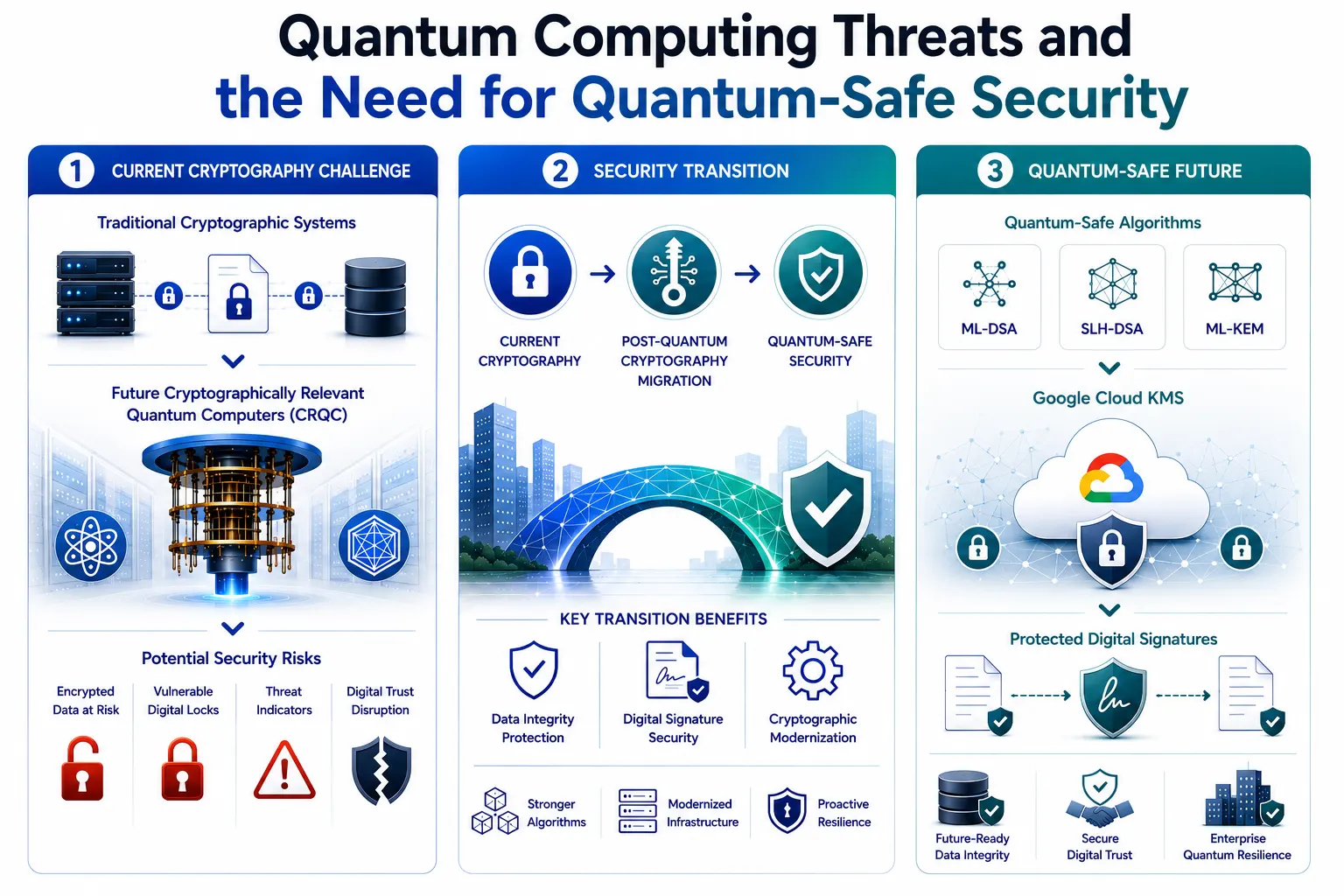
The Long-Term Data Integrity Challenge in a Quantum Future
As organizations prepare for the quantum computing era, the conversation is not limited to protecting encrypted information. A major concern is preserving digital trust over long periods.
Digital signatures are a fundamental part of modern technology ecosystems. They help verify that software updates come from trusted sources, financial documents have not been modified, and critical records remain authentic after years of storage.
Unlike short-term data protection requirements, many enterprise assets need to remain trustworthy for decades. Government archives, healthcare records, intellectual property, research data, and legally binding documents all depend on cryptographic systems that can continue proving authenticity far into the future.
The emergence of cryptographically relevant quantum computers introduces new considerations because some existing cryptographic methods may eventually become vulnerable to advanced quantum attacks. If digital signatures are compromised, attackers could potentially create fraudulent signatures or manipulate trusted digital assets.
This makes quantum-safe digital signatures an important part of future cybersecurity strategies. Organizations need cryptographic systems that not only protect confidentiality but also preserve authenticity and integrity throughout the entire lifecycle of their data.
By introducing post-quantum cryptography capabilities into Cloud KMS, Google Cloud is helping enterprises prepare for a future where maintaining digital trust requires stronger cryptographic foundations.
Cloud KMS Brings Quantum-Safe Digital Signature Support
Google Cloud Key Management Service now provides organizations with access to quantum-safe digital signature capabilities designed to protect data authenticity in future threat environments.
The new Cloud KMS capabilities include support for:
ML-DSA (FIPS 204): A lattice-based digital signature algorithm selected by NIST for post-quantum security.
SLH-DSA (FIPS 205): A stateless hash-based digital signature algorithm designed to provide defense-in-depth protection.
ML-KEM: A post-quantum key encapsulation mechanism designed to help secure encrypted communications.
By supporting these algorithms through Cloud KMS, organizations can create, manage, and use quantum-safe cryptographic keys through existing cloud security workflows.
This approach allows developers and security teams to explore post-quantum cryptography without creating separate key management infrastructure or changing their entire security architecture.
The availability of multiple algorithms and security levels also gives organizations flexibility when selecting cryptographic approaches based on application requirements, performance needs, and long-term protection goals.
Why Standardized Post-Quantum Algorithms Matter
The transition toward quantum-safe security requires organizations to adopt cryptographic standards that have been carefully evaluated for security, performance, and interoperability.
For years, researchers and security organizations have been developing approaches to replace cryptographic algorithms that could eventually be affected by quantum computing. The National Institute of Standards and Technology (NIST) has played a major role in evaluating and standardizing post-quantum cryptography algorithms.
Standardized algorithms provide enterprises with confidence that new security technologies can be adopted across different applications, platforms, and industries.
Google Cloud KMS now supports several NIST-standardized post-quantum algorithms, including:
ML-DSA (FIPS 204): A lattice-based digital signature algorithm designed for strong post-quantum security.
SLH-DSA (FIPS 205): A stateless hash-based digital signature algorithm providing an alternative security approach.
ML-KEM: A post-quantum key encapsulation mechanism designed to support secure communications.
Supporting multiple algorithms allows organizations to choose security approaches based on their specific requirements.
Some workloads may prioritize high-performance signing operations, while others may require the strongest available protection for long-term sensitive information. A flexible approach helps enterprises gradually introduce quantum-safe cryptography without disrupting existing systems.
Supporting Different Security Requirements with PQC Algorithms
Different applications require different balances between security strength, performance, and operational efficiency.
To support diverse enterprise requirements, Cloud KMS provides multiple quantum-safe digital signature algorithms and variants.
Algorithm | NIST Security Category | Variant Type | Purpose |
|---|---|---|---|
SLH-DSA-SHA2-128s | Level 1 | Pure, Pre-hash | Hash-based digital signatures for defense-in-depth protection |
ML-DSA-44 | Level 2 | Pure, External-µ | High-performance quantum-safe signing |
ML-DSA-65 | Level 3 | Pure, External-µ | Balanced security and performance |
ML-DSA-87 | Level 5 | Pure, External-µ | Highest security level for long-term data protection |
These options allow organizations to select cryptographic protection based on workload sensitivity and security objectives.
For example, applications requiring maximum long-term protection may prioritize higher security categories, while performance-sensitive workloads may select algorithms optimized for efficient signing operations.
Choosing the Right Quantum-Safe Algorithm for Enterprise Workloads
Different organizations have different security requirements. A global software provider signing applications, a government agency protecting long-term records, and a financial institution securing transaction data may require different levels of cryptographic protection.
Cloud KMS provides multiple post-quantum signature options to support these varying needs.
SLH-DSA-SHA2-128s provides a hash-based signature approach designed for defense-in-depth protection.
ML-DSA-44 offers Level 2 quantum security with a focus on efficient signing performance, making it suitable for workloads that require a balance between security and operational efficiency.
ML-DSA-65 provides Level 3 protection and represents a balanced option for organizations looking for stronger security while maintaining practical performance.
ML-DSA-87 delivers the highest security category supported by Cloud KMS, designed for applications requiring maximum long-term protection.
This flexibility allows enterprises to build cryptographic strategies based on workload importance, regulatory requirements, and expected data lifespan.
Instead of applying a single security model everywhere, organizations can select appropriate algorithms for different applications while moving toward a broader quantum-safe architecture.
The Challenge of Signing Large Data with Post-Quantum Cryptography
One of the major challenges in adopting post-quantum digital signatures is efficiently handling large data payloads.
Traditional digital signing workflows often rely on secure cryptographic boundaries, such as hardware security modules (HSMs) or managed key services, where private key operations are performed.
However, large files and massive enterprise data payloads create performance and bandwidth challenges because these secure environments are designed primarily to protect cryptographic keys rather than process unlimited amounts of data.
Sending complete files into a secure signing boundary can increase processing requirements and create unnecessary operational limitations.
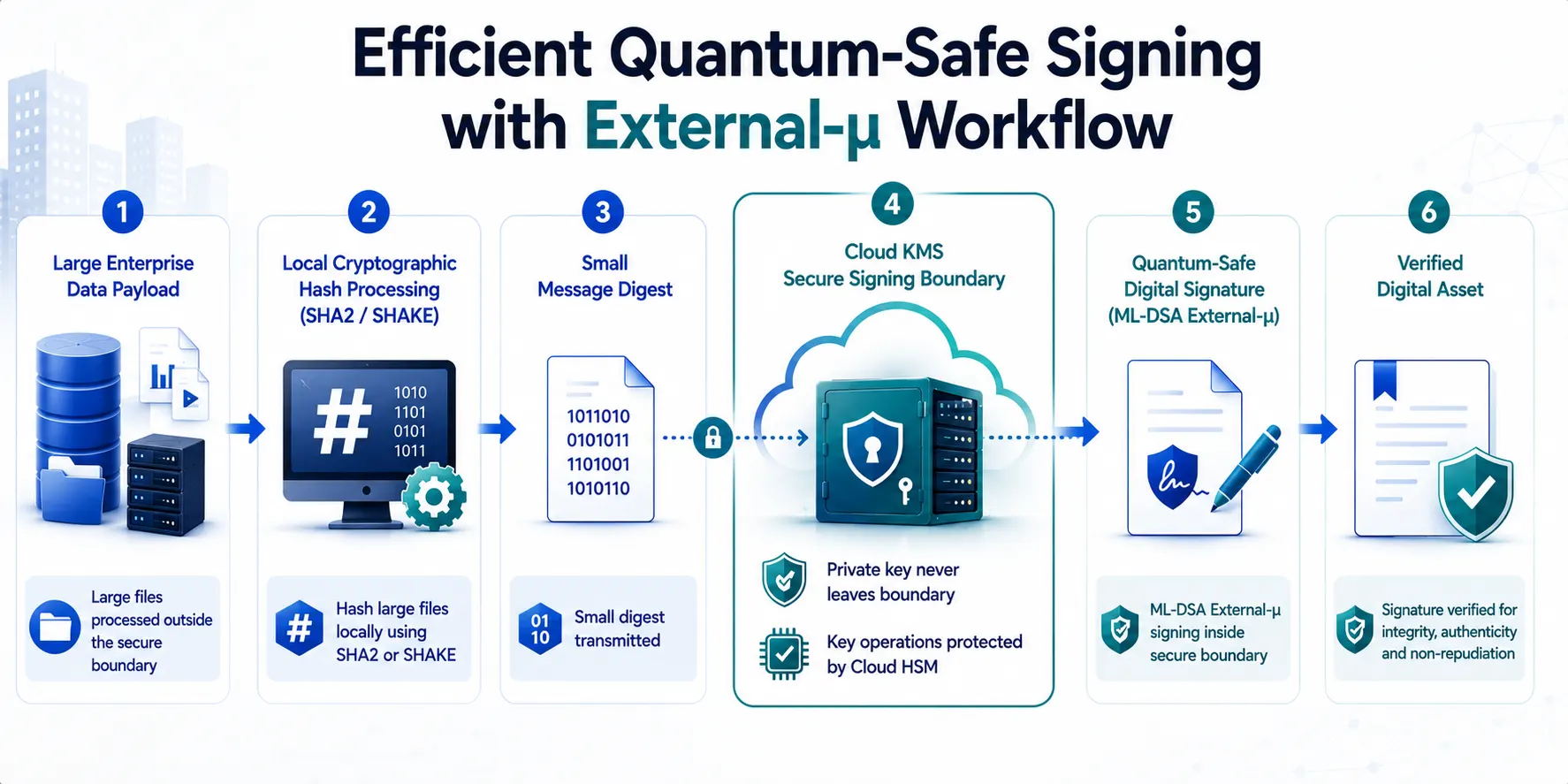
To address this challenge, modern cryptographic workflows separate data processing from the actual signing operation.
Instead of sending the entire message into the secure environment, applications first process the data locally using a cryptographic hash function such as SHA2 or SHAKE. This creates a small fixed-size digest representing the original content.
The secure key management system then signs this compact digest using the protected private key.
This approach improves efficiency while maintaining the security properties required for trusted digital signatures.
Why External-µ Variants Improve Quantum-Safe Signing Performance
A key challenge in post-quantum cryptography is balancing strong security protection with practical performance requirements.
Digital signatures typically involve two different types of data: the cryptographic elements used for signing, which have a predictable size, and the message being signed, which can range from a few bytes to extremely large files.
This difference creates operational challenges when organizations use secure signing environments such as hardware security modules (HSMs) or cloud-based key management services.
These systems are designed to protect sensitive private keys and perform secure cryptographic operations. However, they have limited bandwidth and processing capacity, making it inefficient to transfer and process very large messages directly inside the secure environment.
To overcome this limitation, applications can use a pre-hash workflow.
Instead of sending the complete data payload for signing, the application first processes the message locally using a cryptographic hash function such as SHA2 or SHAKE. The result is a small fixed-size digest that represents the original data.
The application then sends this compact digest to the secure signing system, where the protected private key performs the signature operation.
This approach reduces bandwidth requirements while maintaining strong cryptographic protection.
How External-µ Enhances ML-DSA Signing Workflows
Google Cloud KMS supports external-µ variants for ML-DSA, enabling organizations to efficiently handle large-scale signing operations while maintaining compatibility with pure ML-DSA verification.
The ML-DSA standard defined in FIPS 204 includes external-µ functionality for pre-hash workflows. This method allows an application to calculate the message representative externally before providing it to the ML-DSA signing process.
The approach combines two important advantages:
Efficient processing of large data through external hashing
Compatibility with standard ML-DSA verification processes
External-µ variants also provide an important security property called non-resignability.
This prevents attackers from modifying a message representative in a way that could be verified under another potentially attacker-controlled public key.
By mathematically binding the public key to the message representative, external-µ strengthens the integrity of the signing process.
With support for pre-hash and external-µ variants, Cloud KMS enables high-performance, low-latency quantum-safe signing workflows while maintaining secure key protection.
Getting Started with Quantum-Safe Signatures in Cloud KMS
Organizations can integrate quantum-safe signature capabilities through existing Cloud KMS APIs.
Developers can use familiar Cloud KMS workflows to create, manage, and use post-quantum cryptographic keys for signing operations.
This allows enterprises to begin experimenting with quantum-safe algorithms while maintaining centralized key management practices.
The integration approach helps security teams gradually introduce post-quantum cryptography into existing applications without requiring a complete redesign of their cloud security architecture.
Organizations can evaluate workloads, identify long-term data protection requirements, and introduce quantum-safe signatures where they provide the greatest security value.
As migration strategies evolve, managed cloud key services can help simplify the operational complexity associated with adopting new cryptographic standards.
Preparing for the Post-Quantum Security Transition
The move toward quantum-safe cryptography requires careful planning across security, application development, and infrastructure teams.
Organizations need visibility into where cryptographic technologies are currently used and which systems require long-term protection.
A successful transition begins with understanding existing cryptographic dependencies, including:
Applications that rely on digital signatures
Data requiring long-term authenticity protection
Existing cryptographic key storage systems
Regulatory and compliance requirements
Workloads suitable for quantum-safe migration
By assessing these areas early, organizations can prioritize critical systems and introduce quantum-resistant technologies gradually.
Waiting until quantum computing threats become immediate could create unnecessary migration pressure. A proactive approach allows enterprises to build flexible security architectures capable of adapting to future cryptographic changes.
Google Cloud’s Quantum-Safe Security Vision
The transition toward post-quantum cryptography requires collaboration between cloud providers, governments, security teams, and application developers.
As quantum computing research continues advancing, organizations need security architectures that can protect digital trust while maintaining the reliability of modern digital systems.
Google Cloud’s expansion of quantum-safe capabilities in Cloud KMS provides enterprises with a practical foundation for this transition.
By supporting standardized post-quantum algorithms, organizations can begin testing, planning, and deploying quantum-resistant security solutions while continuing to use managed cloud security infrastructure.
The availability of ML-DSA, SLH-DSA, and ML-KEM gives security teams flexibility when designing future-ready cryptographic strategies based on workload requirements, compliance needs, and data protection timelines.
Enterprise Benefits of Quantum-Ready Cryptography
Quantum-safe digital signatures are becoming increasingly important for organizations that need to maintain trust and authenticity over extended periods.
Many digital assets require validation long after their original creation, including government records, software packages, financial documents, healthcare data, research archives, and legal information.
For these use cases, cryptographic protection must remain reliable even as computing technology evolves.
By integrating quantum-safe algorithms into Cloud KMS, enterprises gain several advantages:
Future-ready protection against emerging quantum threats
Better alignment with evolving security requirements
Secure cloud-based cryptographic key management
More efficient signing workflows for enterprise workloads
Simplified migration toward post-quantum security
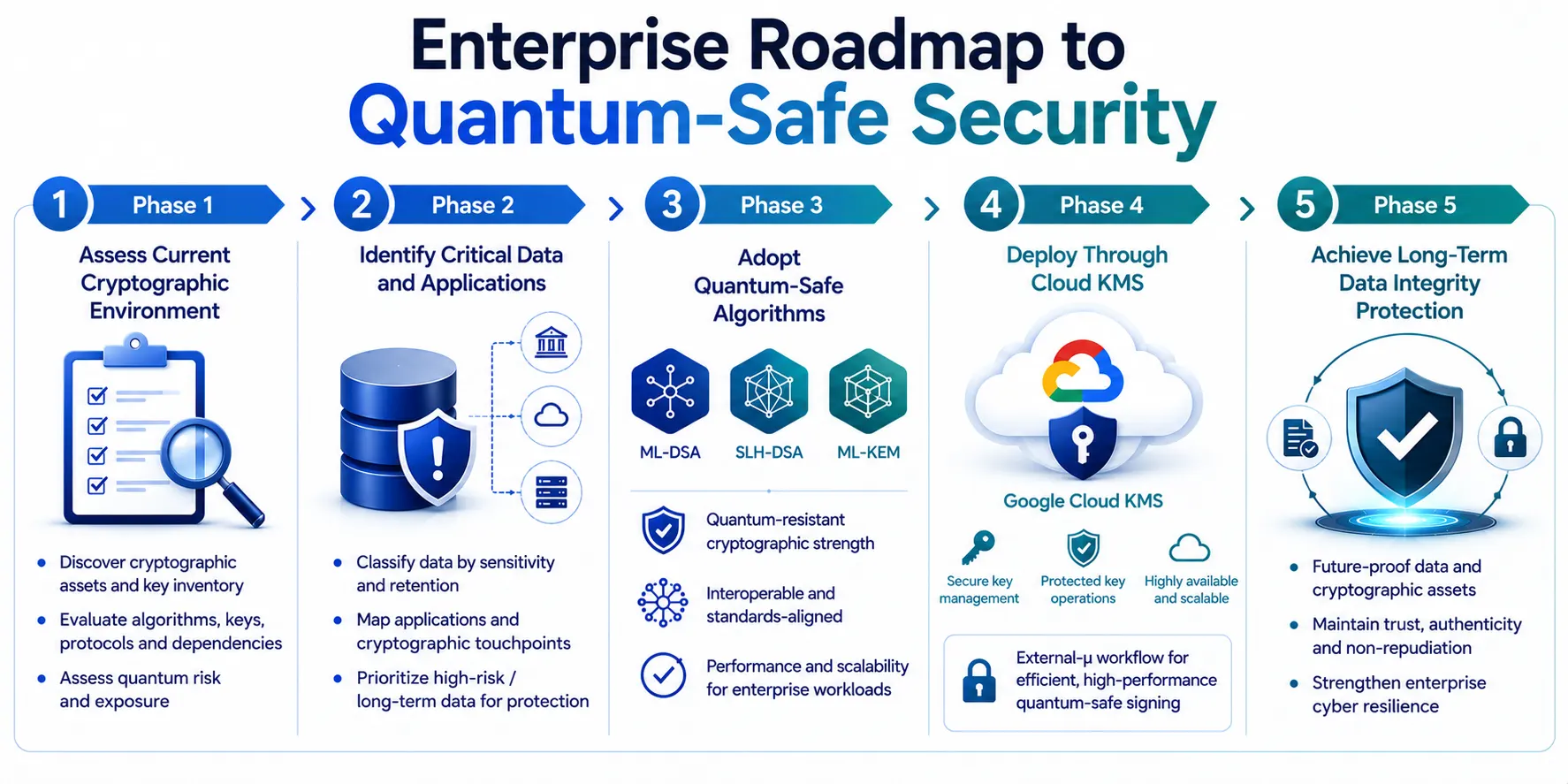
Building a Quantum-Safe Security Strategy
Organizations adopting quantum-safe cryptography need a structured migration approach rather than a single technology replacement. Security teams should begin by identifying where digital signatures, encryption systems, and cryptographic keys are used across applications and infrastructure.
The next step is prioritizing systems based on data sensitivity, regulatory requirements, and expected lifespan. Critical assets that require decades of authenticity protection should receive early attention.
By combining cryptographic inventory, algorithm evaluation, and gradual deployment, enterprises can transition toward quantum-resistant security without disrupting existing operations.
Conclusion
Google Cloud’s introduction of quantum-safe digital signatures in Cloud KMS represents an important step toward preparing enterprises for the future of cybersecurity.
As quantum computing continues to advance, organizations must rethink how they protect digital signatures, data authenticity, and long-term information integrity.
By adding support for ML-DSA, SLH-DSA, and ML-KEM, Cloud KMS provides enterprises with standardized post-quantum cryptography options designed for modern cloud environments.
Support for external-µ and pre-hash workflows also addresses one of the biggest operational challenges in post-quantum signing by enabling efficient protection of large data payloads without compromising secure key management.
For organizations managing critical applications and long-term digital assets, adopting quantum-safe cryptography early can reduce future migration risks and strengthen overall security strategies.
Quantum readiness is becoming an essential part of enterprise cybersecurity planning. By introducing standardized post-quantum cryptography capabilities into Cloud KMS, Google Cloud gives organizations a practical starting point to evaluate, test, and gradually adopt quantum-safe protections while continuing to use familiar managed key management workflows.
Source: Google Cloud Blog
About the Author