
Google Cloud Introduces Monthly AI Infrastructure Roundup for Enterprise AI
Google Cloud's first AI Infrastructure and Orchestration roundup highlights new storage, networking, Kubernetes, AI security, and accelerator updates designed to help enterprises scale production AI workloads.
Xcademia Team
Xcademia Research Team
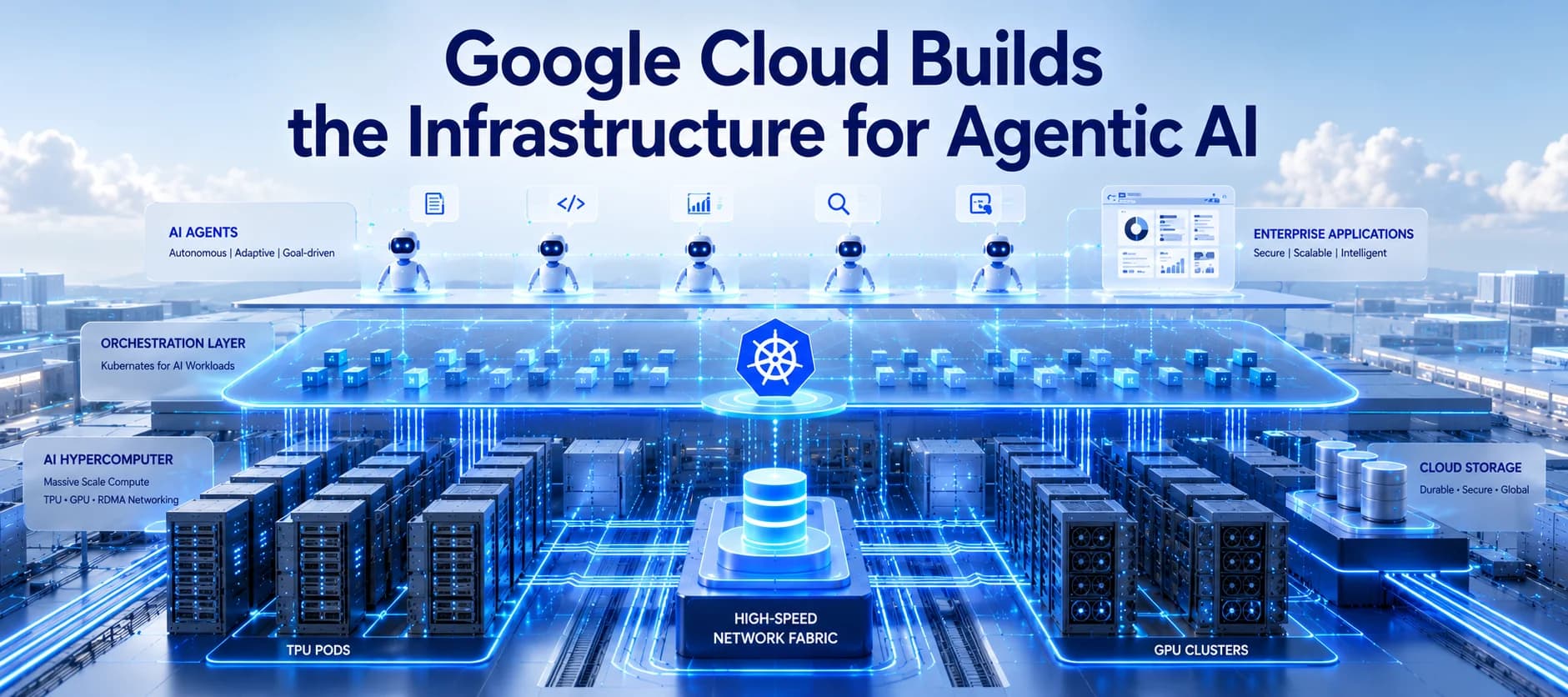
Google Cloud Introduces Monthly AI Infrastructure Roundup
Artificial intelligence is rapidly evolving from systems that answer questions into intelligent agents capable of reasoning, planning, and taking action. As enterprises move toward this next phase of AI, infrastructure has become a critical foundation for delivering reliable, scalable, and efficient AI experiences.
Building advanced AI applications requires more than powerful models. Organizations need optimized compute platforms, high-performance storage, fast networking, scalable orchestration, strong security controls, and tools that help developers move AI workloads from experimentation into production.
To support this growing demand, Google Cloud has introduced a new monthly AI Infrastructure and Orchestration roundup that brings together its latest infrastructure launches, technical guides, performance insights, research findings, and customer examples.
The roundup highlights Google's latest AI infrastructure developments across compute, storage, networking, orchestration, security, developer tools, and enterprise deployments.
The first edition highlights key innovations released during July 2026, along with selected updates from May and June that demonstrate Google's continued investment in building infrastructure for the agentic AI era.
How Google Cloud Is Building an End-to-End AI Infrastructure Platform
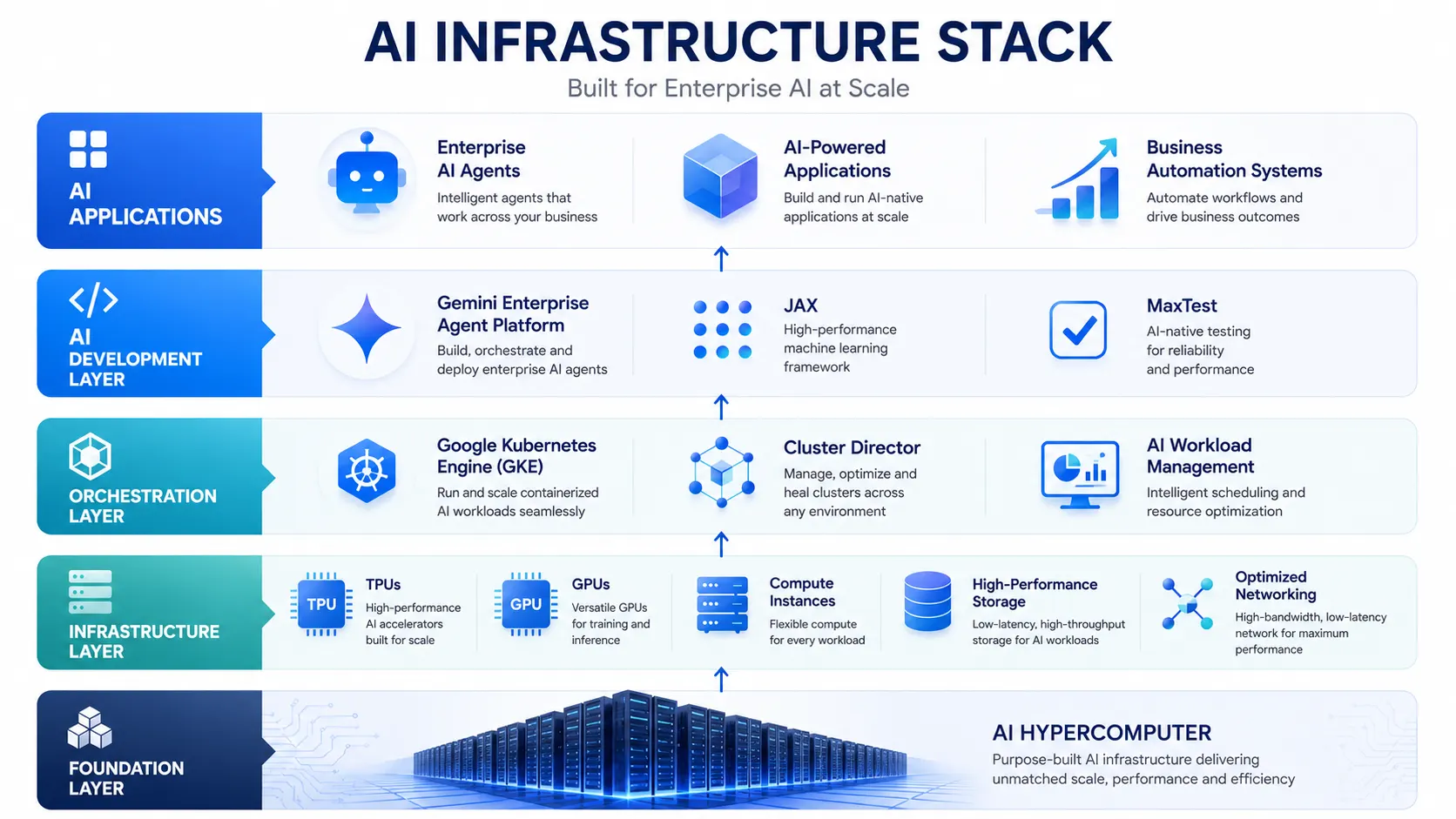
Google's AI approach extends across the entire technology stack, combining AI models, developer frameworks, cloud services, infrastructure, and orchestration into a unified ecosystem.
The company develops AI models such as Gemini and other generative AI systems, integrates AI capabilities into products including Gmail, BigQuery, AlloyDB, Google Cloud Code, and Google Cloud Assist, and provides frameworks that help developers build AI-powered applications.
Underneath these experiences is a large-scale infrastructure platform designed specifically for modern AI workloads.
Key components include:
AI Development Platforms
Gemini Enterprise Agent Platform
JAX
MaxTest
Model development and deployment tools
Compute and Accelerator Infrastructure
Google Cloud TPUs
NVIDIA GPU-powered systems
Standard compute infrastructure
AI Hypercomputer
Storage and Networking
High-performance storage systems
Optimized cloud networking
Infrastructure designed for large-scale AI training and inference
AI Orchestration
Google Kubernetes Engine (GKE)
Cluster Director
AI workload management tools
According to Google, this integrated approach helps organizations improve AI performance, optimize costs, increase operational efficiency, and support increasingly complex agentic AI applications.
As enterprises move beyond AI pilots and toward production deployments, infrastructure optimization becomes essential for delivering scalable and reliable AI systems.
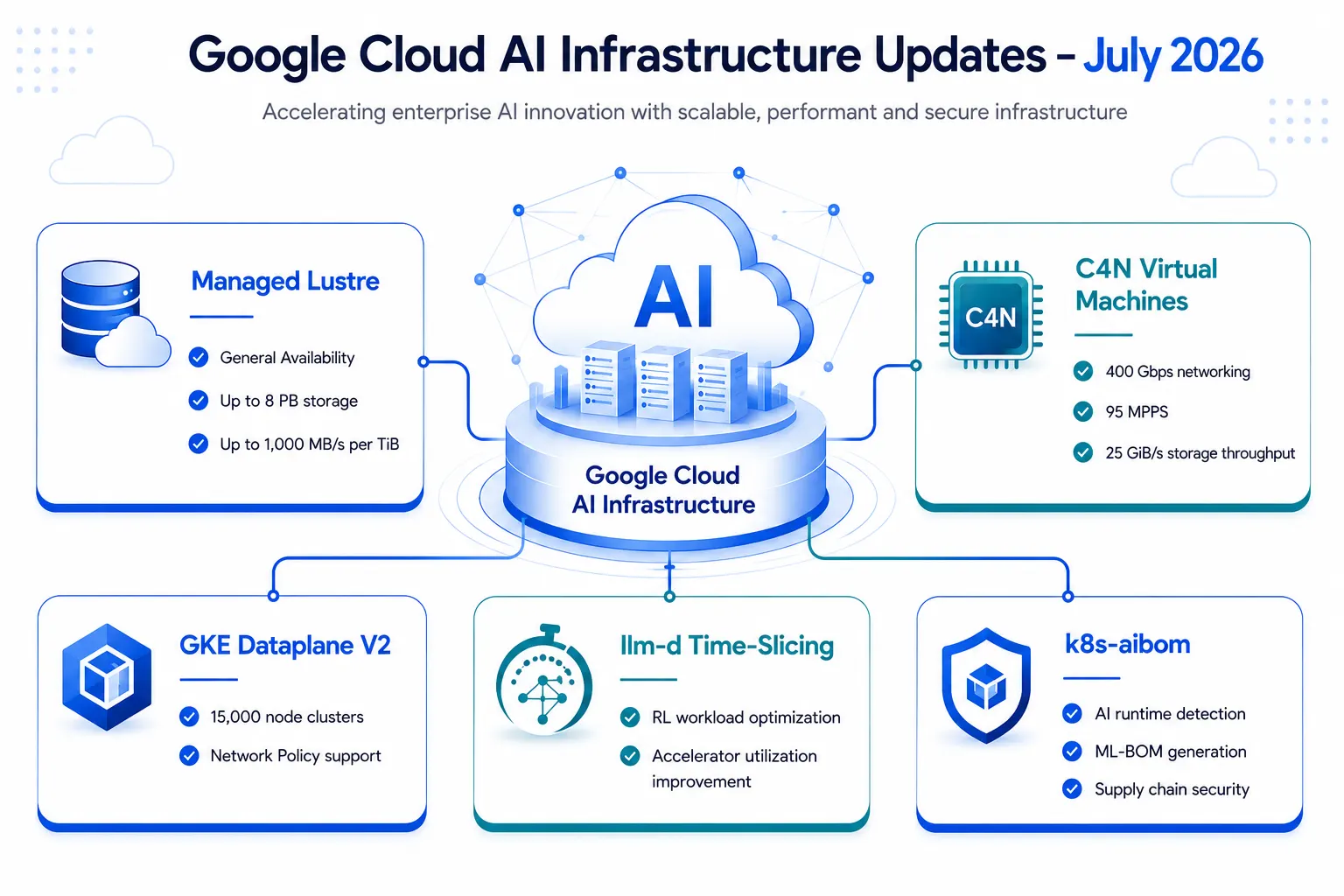
July 2026 AI Infrastructure Updates
The July 2026 updates focus on improving the performance, scalability, and security of AI workloads through advancements in storage, networking, Kubernetes, accelerator utilization, and AI supply chain protection.
Google Cloud Managed Lustre Reaches General Availability
Google Cloud announced the general availability of Google Cloud Managed Lustre, a fully managed high-performance file storage service designed for demanding AI, machine learning, and high-performance computing workloads.
The service is powered by DDN's EXAScaler, combining DDN's expertise in high-performance storage with Google Cloud's infrastructure capabilities.
Managed Lustre is available across four performance tiers:
Performance Tier | Throughput |
|---|---|
Tier Throughput5 MB/s per TiB | 125 MB/s per TiB |
Standard | 250 MB/s per TiB |
High Performance | 500 MB/s per TiB |
Ultra Performance | 1,000 MB/s per TiB |
Organizations can scale storage capacity up to 8 PB, enabling support for large AI datasets, model training pipelines, and data-intensive workloads.
The release helps enterprises simplify deployment and management of high-performance storage while maintaining the performance requirements of modern AI systems.
C4N Virtual Machines Improve Network and Storage Performance
Google Cloud also announced the general availability of C4N network and storage optimized virtual machines, designed to reduce data movement bottlenecks in demanding workloads.
C4N is Google's first VM series optimized specifically for network and block storage performance.
The instances are powered by:
5th Generation Intel Xeon Scalable processors
Google's Titanium offloading hardware
Key capabilities include:
Up to 400 Gbps network bandwidth
Up to 95 million packets per second (MPPS)
Up to 25 GiB/s block storage throughput with Hyperdisk Extreme
These improvements are designed for distributed AI training, large-scale analytics, databases, and workloads where fast communication between compute and storage resources is essential.
GKE Dataplane V2 Scales Kubernetes to 15,000 Nodes
Google expanded the scalability of Google Kubernetes Engine (GKE) with the general availability of GKE Dataplane V2 with Network Policies for clusters supporting up to 15,000 nodes.
The update allows large enterprise and AI/ML environments to maintain active network security policies while operating at significantly larger Kubernetes scales.
For organizations running thousands of containers across AI workloads, this provides:
Larger deployment capacity
Improved network visibility
Stronger security controls
Enterprise-scale Kubernetes management
The enhancement addresses the growing infrastructure requirements of organizations deploying complex AI applications in production.
Cooperative Time-Slicing Improves Accelerator Utilization
Google introduced cooperative time-slicing in llm-d to help organizations improve accelerator efficiency for reinforcement learning (RL) workloads.
The capability allows multiple independent RL jobs to share physical accelerator resources instead of dedicating hardware to a single workload.
According to Google, this approach can increase accelerator duty cycles from approximately 40% to 70% without affecting:
Model convergence
Training accuracy
Improved accelerator utilization enables organizations to run more AI workloads on existing infrastructure while improving cost efficiency.
k8s-aibom Strengthens AI Supply Chain Security
As AI deployments become more complex, organizations need better visibility into the software components powering their AI systems.
Google has open-sourced k8s-aibom, a lightweight Kubernetes controller designed to improve AI supply chain security.
The tool continuously monitors Kubernetes clusters to:
Detect running AI runtimes
Identify AI workloads automatically
Generate CycloneDX Machine Learning Bills of Materials (ML-BOMs)
It supports detection of AI runtimes including:
vLLM
Triton
By creating standardized ML-BOMs, organizations can improve AI governance, reduce shadow AI risks, and strengthen software supply chain visibility.
July 2026 Practitioner Guides and Technical Deep Dives
Beyond product announcements, Google Cloud published a series of technical guides and architectural deep dives aimed at helping developers and infrastructure teams optimize AI deployments.
These resources focus on practical implementation, performance tuning, and cost optimization for production-ready AI workloads.
Deploying Moonshot AI's Kimi K3 on Google Cloud
Google announced Day 0 support for Moonshot AI's Kimi K3, a 2.8-trillion-parameter open-weight model, on the same day its model weights were released.
To help organizations quickly evaluate the model, Google published a deployment guide covering multiple implementation approaches, including:
Deploying through Model Garden
Building custom AI orchestration workflows
Running the model on Google Kubernetes Engine (GKE) using llm-d recipes
The guide provides step-by-step instructions for evaluating and piloting Kimi K3 in Google Cloud environments.
This enables organizations to explore one of the industry's largest open-weight AI models while leveraging Google's AI infrastructure capabilities.
Running TPU and GPU Workloads with GKE Managed DRANET
Google expanded guidance around GKE managed DRANET, demonstrating how organizations can efficiently orchestrate both GPU and TPU workloads within Kubernetes environments.
Developers can choose between two deployment models:
→Standard GKE Clusters
Provides full configuration control for organizations that require customized infrastructure management.
→GKE Autopilot Clusters
Allows Google to manage much of the underlying infrastructure configuration, simplifying deployment and operations.
The accompanying hands-on lab demonstrates deploying Gemma 4 using TPUs within GKE Autopilot, helping developers take advantage of accelerator-optimized environments with reduced operational complexity.
Running Ray Workloads on TPUs
Ray has become a widely adopted distributed computing framework for AI and machine learning workloads.
To help developers use Google's custom AI hardware, Google published the first installment of a two-part guide explaining how to run Ray workloads on Cloud TPUs instead of traditional GPUs.
The guide explains how Ray treats TPU slices as another accelerator type, allowing distributed scheduling across TPU resources with minimal workflow changes.
It also introduces Ray's AI libraries and explores how developers can optimize distributed machine learning workloads for TPU-based environments.
Benchmarking TPU Performance More Accurately
Choosing the right accelerator requires more than comparing theoretical hardware specifications.
Google introduced a new TPU microbenchmark suite designed to help developers evaluate TPU performance using representative AI workloads.
The benchmarking tools help teams:
Measure real-world accelerator performance
Compare achieved throughput against theoretical limits
Identify architecture-specific bottlenecks
Detect performance issues before production deployment
These capabilities help organizations make better infrastructure decisions and maximize the value of accelerator investments.
Scaling AI Agents Without Increasing Infrastructure Costs
As organizations deploy larger numbers of AI agents, infrastructure efficiency becomes increasingly important.
Google published guidance explaining how Google Kubernetes Engine can help increase AI agent density while controlling operational costs.
The guide highlights two key technologies:
GKE Agent Sandbox
Provides secure isolation for AI agent workloads.
Pod Snapshots
Enable efficient workload management and faster recovery.
Together, these capabilities allow organizations to safely run more AI agents on existing compute infrastructure while maintaining reliability and operational control.
Google also provides recommendations for balancing:
Performance
Infrastructure utilization
Cost efficiency
Resource allocation
This guidance helps enterprises prepare for large-scale autonomous AI deployments.
Technical Blueprint: Optimizing Mistral 3 Large Inference on Ironwood
Google engineers published a technical blueprint describing how they optimized inference performance for the Mistral 3 Large Mixture-of-Experts (MoE) model on Ironwood (TPU v7x).
The engineering team implemented several low-level optimizations to improve inference performance while maintaining benchmark accuracy.
Key improvements included:
Hybrid sharding strategies
Replacing linear VPU summations with tree reductions
Optimizing General Matrix Multiplication (GMM) and Multi-Head Latent Attention (MLA) kernels
Introducing asynchronous scheduling techniques
These improvements delivered:
1.5× overall inference performance improvement
Up to 48% higher throughput
Maintained benchmark accuracy
The blueprint provides valuable insights for infrastructure engineers working to optimize large language model inference on TPU-based AI platforms.
Research Highlights Enterprise AI Infrastructure Challenges
Alongside product updates and technical guides, Google shared research examining the current state of enterprise AI infrastructure adoption.
The findings highlight the growing gap between AI ambitions and the infrastructure required to support production-scale deployments.
Google Named a Leader in AI Infrastructure
Google announced that it has been recognized as a Leader in the inaugural Gartner® Magic Quadrant™ for AI Infrastructure.
According to Google, Gartner positioned the company:
Highest for Ability to Execute
Furthest for Completeness of Vision
Google highlighted several infrastructure capabilities contributing to this recognition, including:
Proprietary scalable compute infrastructure
Integrated AI Hypercomputer architecture
Large-scale AI compute capacity
Hardware and software integration
The recognition reflects Google's continued focus on developing infrastructure designed specifically for enterprise AI workloads.
State of AI Infrastructure Report Reveals Growing Readiness Gap
Google also released findings from its State of AI Infrastructure report based on a survey of more than 1,400 senior IT leaders.
The report highlights a widening gap between enterprise AI goals and current infrastructure readiness.
One major finding:
83% of organizations require infrastructure upgrades to support production-grade agentic AI.
The research suggests that organizations moving toward autonomous AI applications need to prioritize investments in:
Compute capacity
High-performance networking
Storage infrastructure
AI orchestration
Operational efficiency
Google emphasizes that modern infrastructure will play a critical role in helping enterprises transition from AI experimentation to production-scale deployments.
June 2026 Updates: Strengthening Secure and Observable AI Infrastructure
While July focused on scaling AI infrastructure performance, Google's June 2026 updates centered on improving security, observability, and operational reliability for enterprise AI workloads.
As organizations move sensitive AI applications into production, protecting data during processing, monitoring accelerator performance, and maintaining infrastructure visibility have become essential requirements.
Confidential Computing Expands to G4 AI Infrastructure
Google expanded its Confidential Computing capabilities to the accelerator-optimized G4 machine series, powered by NVIDIA RTX PRO 6000 Blackwell Server Edition GPUs.
Confidential Computing helps protect sensitive data while it is actively processed by using hardware-based Trusted Execution Environments (TEEs) with verifiable data integrity.
For enterprise AI workloads, this provides stronger protection for:
Sensitive business data
Proprietary AI models
Regulated information
Confidential workloads
By extending Confidential Computing to GPU-powered AI infrastructure, Google enables organizations to strengthen AI security without requiring major changes to existing development workflows.
As enterprises increasingly use AI for critical business processes, secure computing environments are becoming a fundamental requirement for trustworthy AI adoption.
Customer Examples: AI Infrastructure in Production
Google highlighted several organizations using its AI infrastructure technologies in real-world environments, demonstrating how enterprises are combining AI models, cloud platforms, and optimized infrastructure to support production-scale applications.
Pager Health Builds AI-Powered Healthcare Experiences
Pager Health is using Google Cloud technologies including:
Google Kubernetes Engine (GKE)
BigQuery
Cloud SQL
Gemini Enterprise Agent Platform
to reduce operational complexity and deliver more personalized healthcare experiences.
The deployment demonstrates how enterprise AI infrastructure can support industry-specific applications where reliability, scalability, and efficient data processing are critical.
By combining AI capabilities with cloud infrastructure, organizations can create more responsive and personalized digital experiences while improving operational efficiency.
Trustpilot Builds High-Volume AI Streaming Pipeline
Trustpilot developed a high-volume streaming pipeline using:
Fine-tuned Gemma models
Dataflow
Gemini Enterprise Agent Platform
Cost-optimized A2 Virtual Machines
NVIDIA A100 GPUs
The architecture combines AI models, data processing capabilities, and optimized cloud infrastructure to support large-scale workloads.
This example highlights how enterprises can use AI infrastructure components together to build efficient production systems that handle demanding workloads.
Imgix Scales Visual Media Workloads with AI Hypercomputer
Visual media platform Imgix uses AI Hypercomputer infrastructure with G4 Virtual Machines powered by NVIDIA RTX PRO 6000 Blackwell GPUs.
The platform supports more than 8 billion images and videos, demonstrating how modern AI infrastructure can support large-scale media processing and AI-powered applications.
The example highlights the importance of specialized compute infrastructure for organizations managing massive amounts of visual data and AI-driven workloads.
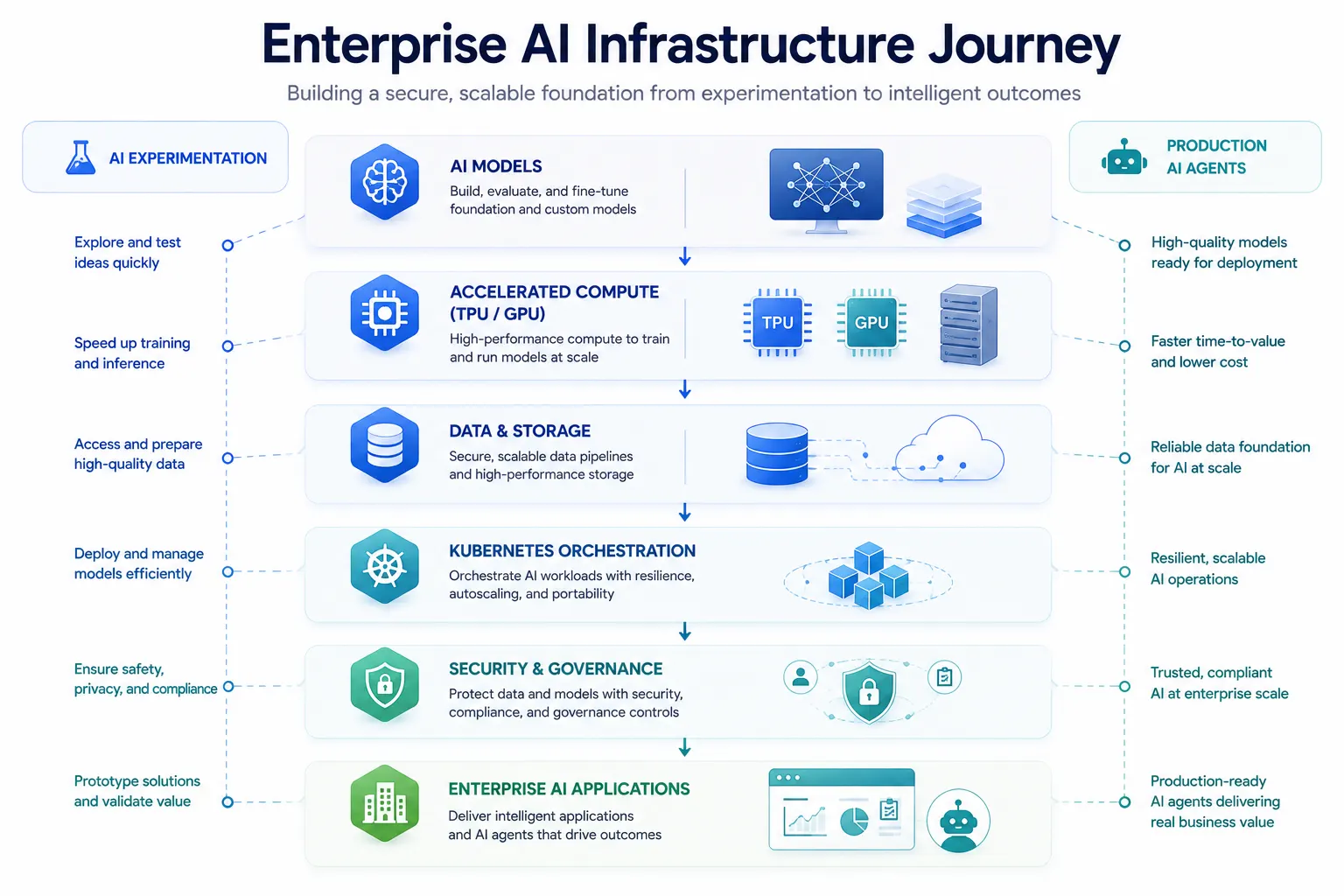
Conclusion: Building the Infrastructure for the Agentic AI Era
Google Cloud's first AI Infrastructure and Orchestration roundup brings together product launches, technical guidance, research, and customer success stories into a single monthly overview of its evolving AI platform.
Across the May, June, and July 2026 updates, the company focused on several key priorities:
High-performance compute, storage, and networking for AI workloads
Larger, more secure Kubernetes environments
Improved accelerator utilization and infrastructure efficiency
Stronger AI security, governance, and observability
Practical deployment guidance for production-ready AI systems
Together, these updates illustrate Google's broader strategy of combining AI models, developer platforms, cloud infrastructure, and orchestration technologies into an integrated ecosystem for enterprise AI.
As organizations continue moving from AI experimentation to production-scale agentic AI, scalable and secure infrastructure will remain a critical foundation for delivering reliable, efficient, and enterprise-ready AI applications.
Source: Google Cloud Blog
About the Author