
Google Cloud Introduces AI-Powered Mainframe Modernization Strategy for Safer Cloud Migration
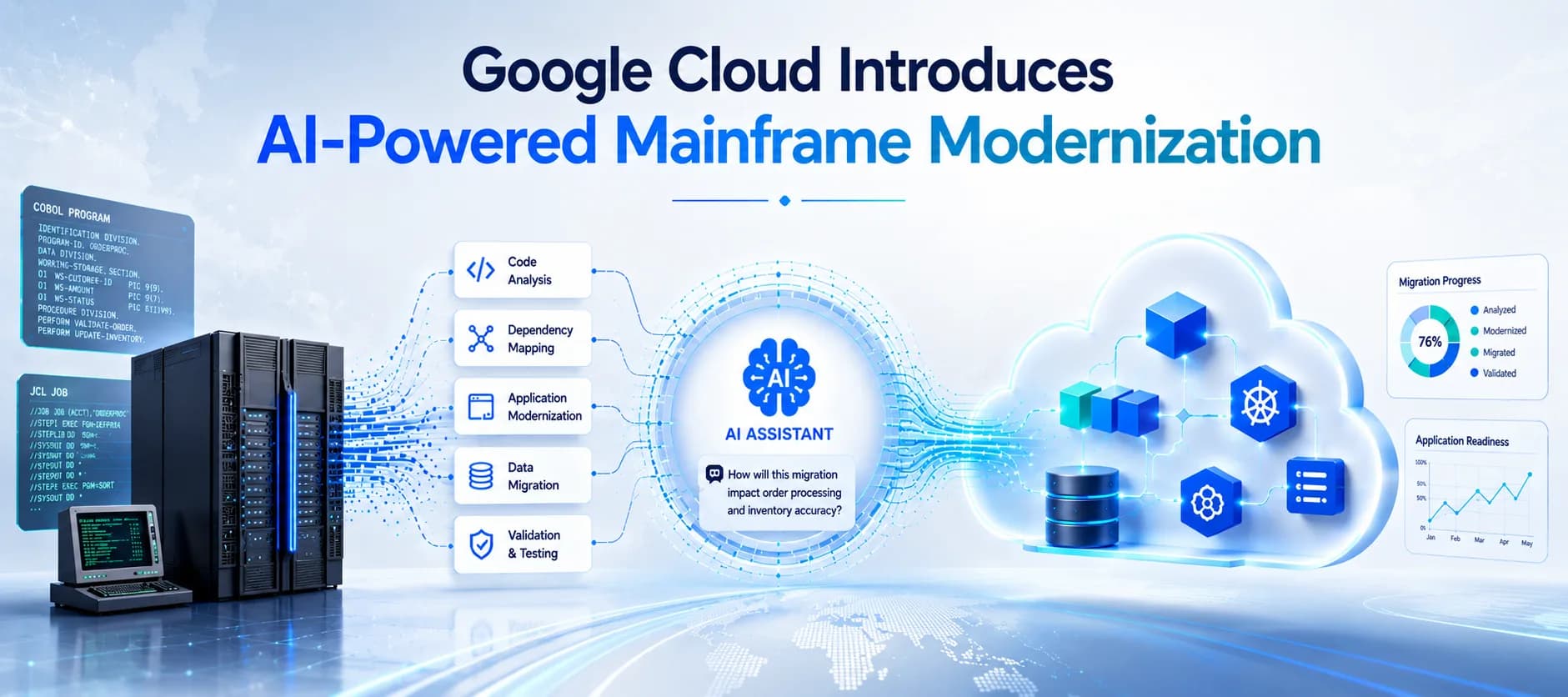
Google Cloud has unveiled an AI-powered mainframe modernization strategy that combines Gemini models with specialized tools to help enterprises assess, modernize, validate, and migrate legacy applications to the cloud through an incremental, lower-risk approach.
Xcademia Team
Xcademia Research Team
Why Enterprises Are Modernizing Mainframes
Mainframe systems continue to power many of the world's largest banks, insurance providers, manufacturers, retailers, and government organizations. While these platforms remain highly reliable, many enterprises face increasing pressure to modernize aging applications, reduce operational costs, and take advantage of cloud-native technologies.
Traditionally, organizations have faced two difficult choices: continue maintaining legacy mainframe environments or undertake a large-scale "big bang" migration that can introduce significant operational and business risks.
Google Cloud believes there is a better alternative.
In a new announcement, the company introduced an AI-powered mainframe modernization strategy that combines the reasoning capabilities of Gemini with specialized modernization tools designed to help enterprises modernize applications incrementally rather than through high-risk migrations.
According to Google Cloud, the approach focuses on understanding existing applications, modernizing code and data, validating production workloads before deployment, and migrating legacy data using a structured four-pillar framework.
The Mainframe Modernization Challenge
Although advances in artificial intelligence have made code conversion faster, Google Cloud argues that enterprise mainframe modernization extends far beyond translating one programming language into another.
Modern enterprise applications often contain decades of accumulated business logic, proprietary data structures, and tightly integrated workflows that cannot simply be rewritten without understanding how the entire environment operates.
According to Google Cloud, organizations frequently encounter challenges such as:
Applications tightly coupled with proprietary databases and record schemas
Legacy data formats including VSAM, flat files, and IMS hierarchical databases
Complex transaction processing through CICS and IMS Transaction Manager
Large sequential workflows with extensive conditional logic
Proprietary communication protocols including CTG, IMS Connect, MQ, and LU 6.2
Operational dependence on specialized mainframe utility suites
The company says these dependencies make modernization significantly more complex than converting COBOL code into Java or another modern programming language.
Instead, organizations must also modernize underlying data models, understand application dependencies, preserve business functionality, and validate new applications against production workloads before retiring legacy systems.
Google Cloud's AI-Powered Modernization Approach
Rather than encouraging organizations to replace entire mainframe environments in a single migration, Google Cloud recommends an iterative modernization strategy supported by AI and cloud technologies.
The company combines Gemini's code understanding capabilities with purpose-built modernization products that address the operational realities of enterprise mainframes.
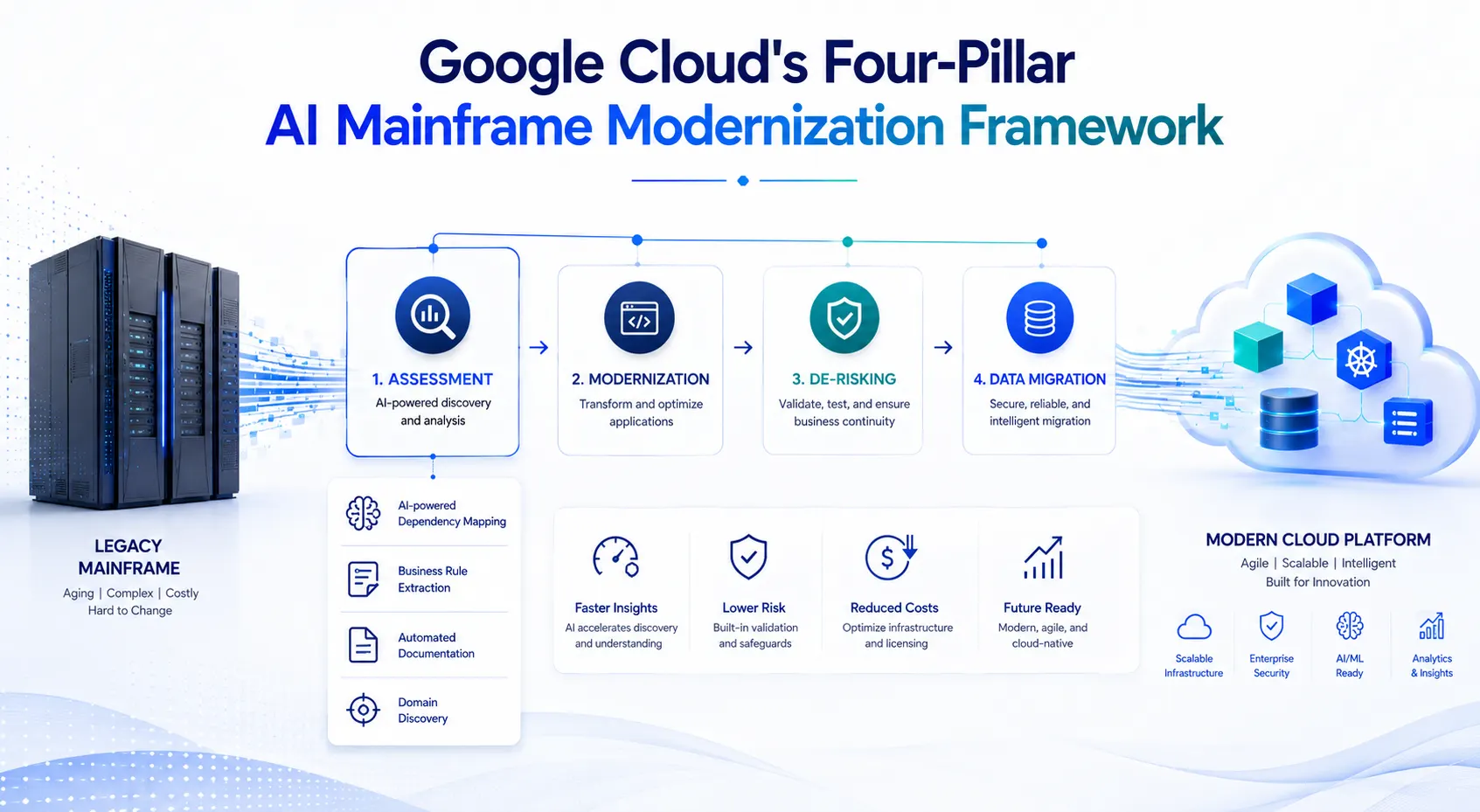
According to Google Cloud, the modernization framework is built around four core pillars:
Assessment
Application modernization
Production validation and risk reduction
Data modernization
Together, these components are designed to help organizations modernize gradually while maintaining application reliability and business continuity.
Google Cloud's Four-Pillar Modernization Framework
Google Cloud's approach is structured around four stages that guide organizations from understanding existing applications through production deployment in the cloud.
The framework includes:
Pillar | Purpose |
|---|---|
Assessment | Reverse-engineer legacy applications and document business logic |
Modernization | Transform applications using AI-assisted workflows |
De-risking | Validate cloud applications against live production workloads |
Data Migration | Move mainframe data into modern Google Cloud services |
Rather than treating modernization as a single migration event, Google Cloud positions these stages as an iterative workflow that reduces operational risk while improving long-term maintainability.
Assessment Begins with the Mainframe Assessment Tool
The first stage focuses on understanding legacy environments before any code transformation begins.
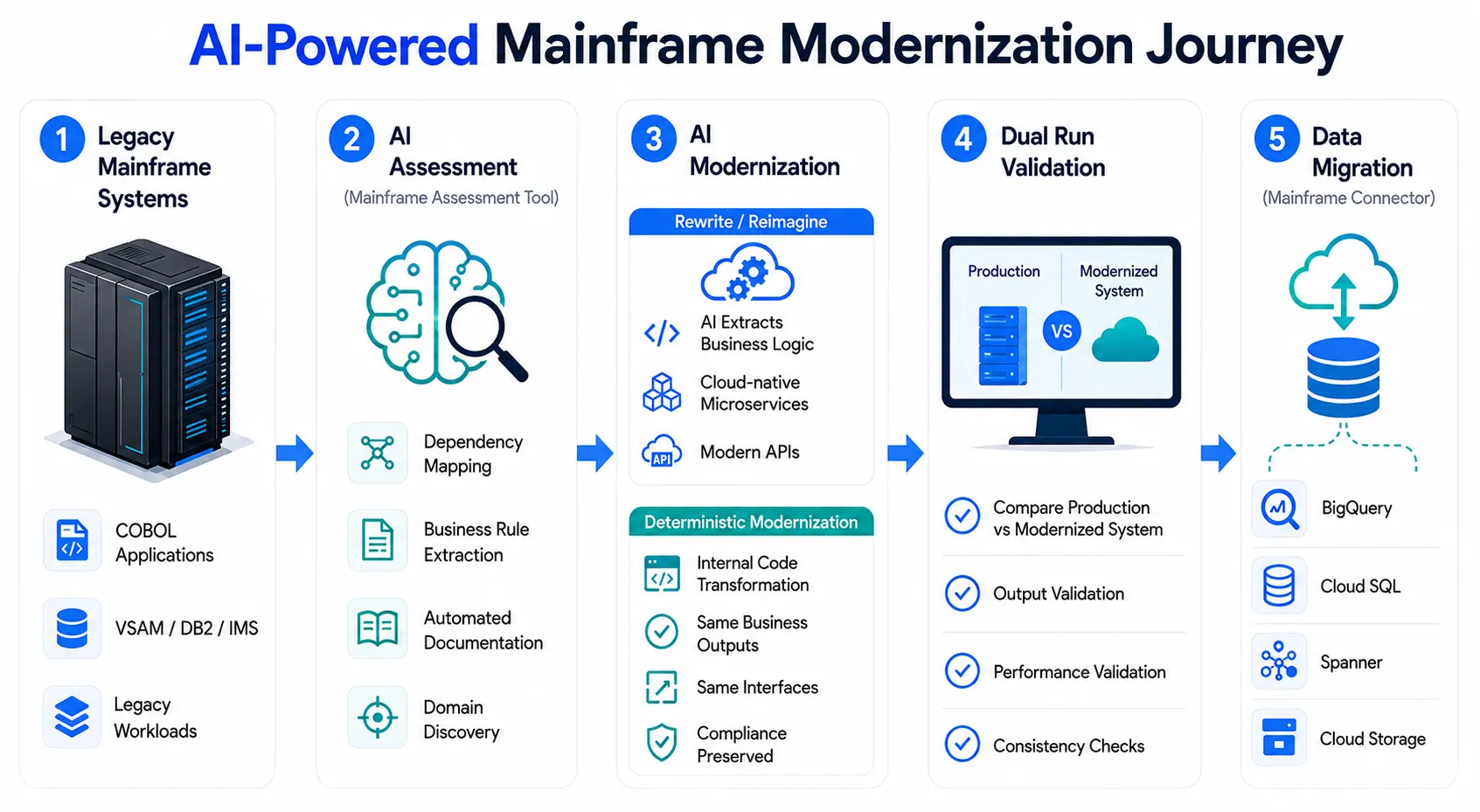
Google Cloud's Mainframe Assessment Tool (MAT) uses AI to reverse-engineer large enterprise codebases, helping organizations understand application behavior, business processes, and system dependencies.
According to Google Cloud, MAT provides four key capabilities.
1. Dependency Visualization
MAT maps relationships between applications, databases, and storage systems, helping engineering teams understand how legacy workloads interact across the enterprise.
This includes dependencies involving technologies such as:
DB2
VSAM
Application interfaces
Shared services
Understanding these relationships helps organizations identify modernization priorities while reducing the risk of breaking interconnected systems.
2. Business Rule Extraction
Legacy applications often contain decades of undocumented business logic embedded directly within source code.
Google Cloud says MAT automatically extracts these rules and converts them into:
Plain-language business requirements
Visual decision trees
Structured documentation
This makes complex applications easier for engineering teams and AI agents to understand before modernization begins.
3. Automated Documentation
Maintaining documentation for decades-old enterprise applications is often a significant challenge.
MAT generates technical documentation directly from production source code, providing organizations with up-to-date architectural information without requiring manual documentation efforts.
According to Google Cloud, this improves visibility into legacy systems while supporting future modernization planning.
4. Business Domain Discovery
MAT also identifies logical application boundaries and groups related workloads into broader business domains.
Google Cloud says the tool can automatically visualize:
Inputs
Outputs
Interfaces
Processing flows
Business domains
This gives organizations a clearer understanding of how applications support business operations and where modernization efforts should begin.
Preparing AI for Large-Scale Modernization
Google Cloud says the insights generated by MAT extend beyond documentation.
The extracted business rules, dependency maps, and application context can be integrated into agentic modernization workflows using the Model Context Protocol (MCP).
According to the company, providing AI agents with detailed, application-specific context enables more accurate code transformation while helping modernization efforts scale across large enterprise environments.
Instead of relying solely on generic code conversion, Google Cloud positions this assessment phase as the foundation for safe, explainable, and AI-assisted modernization of complex legacy systems.
Modernization: Transforming Legacy Applications with AI
Once organizations understand their legacy applications, the next stage focuses on modernizing them.
Google Cloud says there is no single modernization strategy that fits every workload. Different applications have different business requirements, regulatory obligations, and technical dependencies.
Instead of applying a one-size-fits-all approach, the company recommends selecting a modernization strategy based on the desired business outcome for each application.
To bridge the gap between AI capabilities and practical enterprise implementation, Google Cloud worked with its Mainframe Modernization Professional Services team to develop specialized AI agents that encode real-world modernization expertise into structured, repeatable workflows.
According to Google Cloud, these AI agents automate many modernization tasks while allowing organizations to retain human oversight throughout the process.
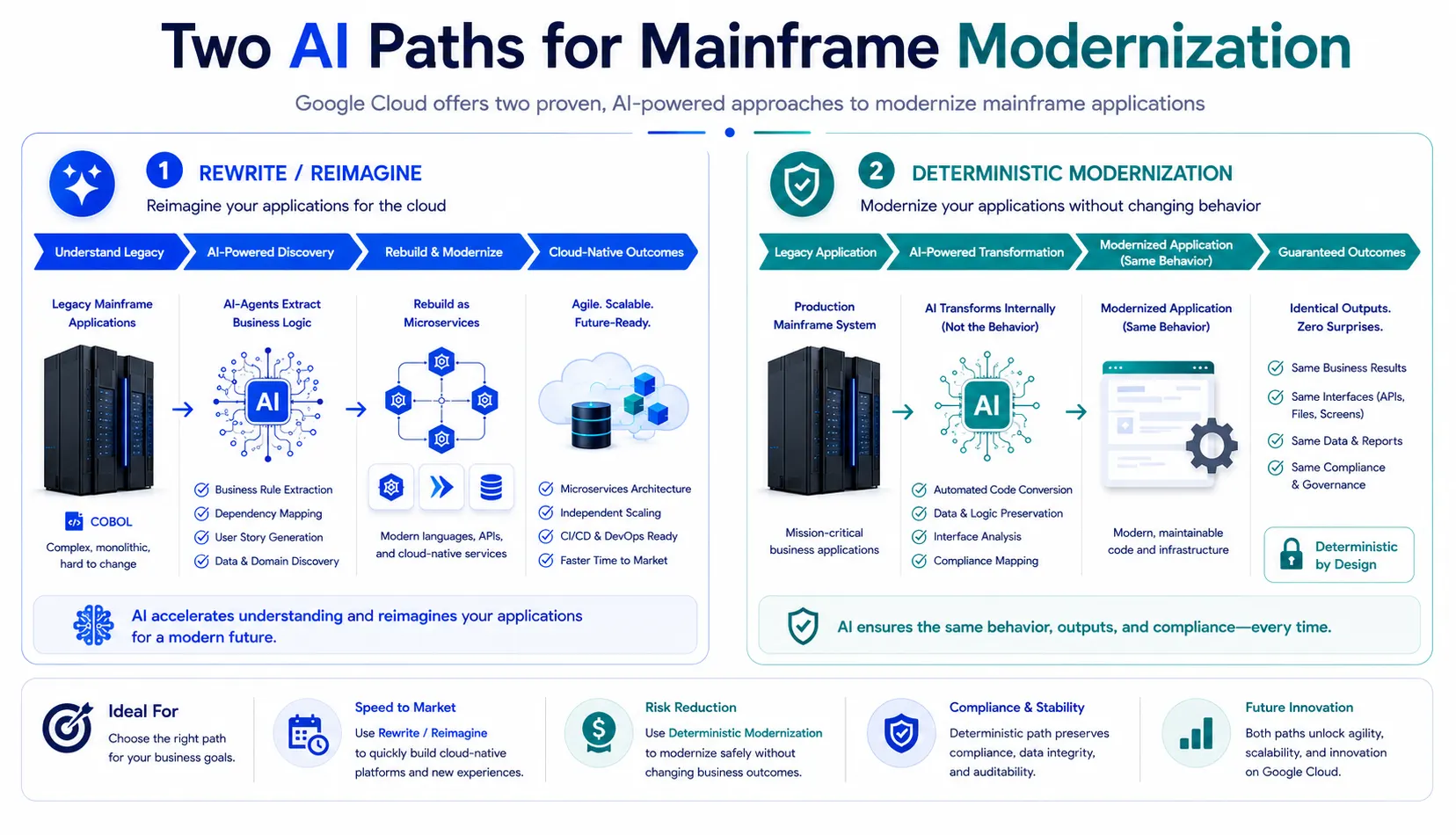
Two Modernization Paths
Google Cloud's modernization framework provides two primary approaches depending on application requirements.
1. Rewrite / Reimagine
This option is intended for applications where innovation and business transformation offer the greatest value.
Instead of simply translating code into another programming language, Google Cloud uses AI to extract business rules and rebuild applications as modern cloud-native systems.
The process begins with the Mainframe Assessment Tool (MAT), which analyzes legacy applications and converts complex business logic into structured business specifications.
Those specifications are then used by Google's Mainframe Modernization Agents to support forward engineering.
According to Google Cloud, the AI-assisted workflow includes:
Business rule extraction
Target application specification
Cloud architecture design
User story generation
Product backlog creation
Agentic coding implementation planning
Google Cloud says this workflow helps engineering teams separate business logic from legacy implementation details, making applications easier to maintain and evolve over time.
The company also integrates these workflows with Antigravity, an agentic orchestration framework that supports AI-assisted development while allowing optional human review and governance at every stage.
Rather than treating legacy applications as opaque systems, Google Cloud says this approach creates transparent, cloud-native applications designed for future innovation.
2. Deterministic (Like-for-Like) Modernization
Not every application requires complete redesign.
Many enterprise workloads depend on established business logic that organizations must preserve exactly because of regulatory, contractual, or operational requirements.
For these systems, Google Cloud offers a deterministic modernization approach.
Instead of changing application behavior, AI modernizes the internal implementation while maintaining identical outputs for every input.
According to Google Cloud, this enables organizations to reduce technical debt while preserving:
Existing interfaces
Business rules
Regulatory logic
External integrations
Operational behavior
The objective is structural modernization rather than business transformation, allowing organizations to migrate workloads with lower operational risk.
Matching the Right Strategy to Each Workload
Google Cloud emphasizes that most enterprises will use a combination of both modernization approaches across their application portfolio.
The company illustrates this with a financial services example.
For stable, high-volume batch processing applications such as nightly statement generation, organizations may choose deterministic modernization to reduce infrastructure costs while minimizing risk.
Core financial systems, including general ledger applications, can also follow a like-for-like modernization path while moving data to services such as Cloud SQL to improve reporting and analytics without changing regulatory logic.
Applications that provide competitive differentiation, however, may benefit from complete redesign.
For example, a customer-facing loan origination platform could be rebuilt using Gemini-powered workflows to support real-time approvals and deliver improved customer experiences.
According to Google Cloud, applying different modernization strategies to different workloads enables organizations to balance innovation with operational stability.
De-risking Modernization with Dual Run
Modernizing applications is only part of the challenge.
Organizations must also ensure that modernized applications behave exactly as expected before replacing production mainframe systems.
To address this, Google Cloud introduced Dual Run, a validation solution designed to reduce migration risk.
According to the company, Dual Run executes production workloads simultaneously across both the existing mainframe environment and the new Google Cloud deployment.
The system captures live production transactions and processes them through both environments before automatically comparing the results.
Google Cloud says the comparison includes:
Transaction protocols
Application messages
Data changes
Business outputs
This continuous validation continues until organizations achieve functional equivalence between legacy and modernized applications.
Rather than relying solely on testing in isolated environments, Dual Run enables enterprises to validate applications using real production traffic before completing migration.
Reducing Operational and Regulatory Risk
Google Cloud positions Dual Run as a production-grade safety mechanism for enterprise modernization projects.
According to the company, the approach helps organizations:
Reduce migration risk
Validate application behavior before deployment
Compare production outputs automatically
Minimize operational disruption
Support regulatory approval processes in highly regulated industries
Instead of requiring organizations to take a leap of faith during cutover, Dual Run provides continuous evidence that modernized applications produce the same business outcomes as their legacy counterparts.
For enterprises operating in sectors such as banking, insurance, healthcare, and government, this validation process can play an important role in maintaining operational continuity throughout modernization initiatives.
Modernizing Legacy Data with Mainframe Connector
Application modernization also requires access to the data that powers legacy systems.
Google Cloud says its Mainframe Connector enables organizations to move data from mainframe environments into Google Cloud services including BigQuery, Spanner, Cloud SQL, and Cloud Storage.
The connector handles mainframe data formats and integrates with existing ETL processes, allowing enterprises to migrate data incrementally while reducing mainframe processing requirements.
According to Google Cloud, this approach helps organizations unlock legacy data for analytics, cloud-native applications, and AI workloads while supporting gradual modernization.
Getting Started with AI-Powered Mainframe Modernization
Google Cloud encourages organizations to begin with a targeted pilot rather than a full-scale migration.
According to the company, customers can start by using the Mainframe Assessment Tool to analyze a selected application, identify hidden dependencies, and extract business rules. From there, organizations can work with Google Cloud experts and modernization partners to evaluate AI-assisted workflows and build a business case for broader modernization efforts.
Google Cloud also invites customers interested in its modernization approach to contact its mainframe modernization team to explore pilot engagements.
Conclusion
Google Cloud is positioning AI as a practical way to reduce the complexity and risk traditionally associated with mainframe modernization.
Rather than advocating a one-time migration, the company's strategy focuses on an iterative approach built around four core capabilities: AI-powered assessment, intelligent code modernization, production validation through Dual Run, and data migration using Mainframe Connector.
By combining Gemini models with specialized modernization tools and agentic workflows, Google Cloud aims to help enterprises understand decades of legacy code, modernize applications at scale, validate functional equivalence before deployment, and unlock valuable mainframe data for cloud-native services.
As organizations continue balancing innovation with operational stability, AI-assisted modernization could provide a more predictable path for moving critical workloads from legacy mainframes to the cloud while minimizing business disruption.
Source: Google Cloud Blog
About the Author