
Google AlloyDB Boosts pgvector With 4x Faster HNSW Vector Search for Enterprise AI
Google AlloyDB introduces columnar engine accelerated HNSW for pgvector, delivering up to 4x higher vector search performance than standard PostgreSQL HNSW. The update helps enterprises build faster and more accurate AI applications using PostgreSQL-compatible technology.
Xcademia Team
Xcademia Research Team

Google AlloyDB Boosts pgvector With 4x Faster HNSW Vector Search for Enterprise AI
Artificial intelligence is transforming how organizations store, process, and retrieve information. As enterprises move beyond AI experimentation and begin deploying production-scale AI systems, the performance of the underlying database infrastructure has become increasingly important.
Modern AI applications such as Retrieval Augmented Generation (RAG), enterprise search platforms, AI assistants, recommendation systems, and intelligent data discovery tools depend on one essential capability: quickly finding relevant information from large collections of data.
Large language models can generate advanced responses, but their effectiveness often depends on the quality of information retrieved before generation begins. In RAG architectures, databases provide the context that AI models use to answer questions, summarize documents, and complete business workflows.
This makes vector search a critical foundation for modern AI applications.
Unlike traditional database queries that rely on exact keyword matches, vector search uses machine learning-generated embeddings to understand relationships between concepts. These embeddings allow AI systems to identify similar information based on meaning rather than only matching specific words.
However, scaling vector search for enterprise workloads introduces a significant challenge. Organizations need databases capable of searching millions or billions of vectors while maintaining both high performance and accurate results.
Improving speed can sometimes reduce retrieval quality, while improving accuracy can increase computing requirements and latency.
Google Cloud is addressing this challenge with a new performance improvement for AlloyDB, its fully managed PostgreSQL-compatible database service.
The company has introduced columnar engine accelerated HNSW for pgvector, a capability currently available in preview that delivers up to 4x higher Queries Per Second (QPS) compared with standard PostgreSQL HNSW vector search.
The update helps enterprises improve AI retrieval performance, increase search accuracy, and scale production AI applications while continuing to use familiar PostgreSQL technologies.
Why Vector Search Has Become Essential for Enterprise AI
Traditional databases were originally designed to manage structured business information such as customer records, financial transactions, inventory systems, and operational data.
These systems remain essential for enterprise applications, but modern AI workloads increasingly depend on a different type of information.
AI applications work with large amounts of unstructured data, including business documents, customer conversations, images, product information, and internal knowledge resources.
To make this information understandable to AI models, machine learning systems convert data into numerical representations called embeddings.
Embeddings capture relationships between concepts, allowing AI systems to understand that different phrases or ideas may represent similar meanings.
For example, a user searching:
"How can I reduce cloud infrastructure expenses?"
may receive relevant results about:
"Optimizing cloud resource utilization"
because vector search understands the relationship between these concepts.
This capability supports many enterprise AI use cases, including:
AI-powered workplace assistants
Enterprise knowledge search
Customer support automation
Recommendation systems
Generative AI applications using RAG
As organizations expand these workloads, the database layer becomes increasingly important. AI systems need retrieval platforms that can deliver fast responses while maintaining high-quality results.
The Challenge: Balancing Vector Search Speed and Accuracy
Enterprise AI applications face a constant challenge between performance and retrieval quality.
When searching through millions or billions of vector embeddings, organizations must optimize two major factors:
(1) Query Performance
Queries Per Second (QPS) measures how many searches a database can process within a specific time period.
Higher QPS allows applications to:
Support more users simultaneously
Handle larger AI workloads
Scale without immediately increasing infrastructure
For enterprise AI systems, higher throughput directly improves application scalability.
(2) Search Accuracy
Vector search accuracy is commonly measured through recall.
Recall represents how effectively a system retrieves relevant results from a dataset.
Higher recall means AI applications receive better information before generating responses.
This is especially important for RAG systems, where retrieved documents and data provide the context used by AI models.
The challenge is that increasing search speed can sometimes reduce recall, while improving accuracy may require additional computing resources and increase latency.
Google Cloud designed AlloyDB’s new accelerated HNSW capability to address this speed and accuracy trade-off.
Understanding pgvector and HNSW Vector Search
For organizations already using PostgreSQL, the pgvector extension has become a popular method for adding vector search capabilities without introducing an entirely separate database system.
pgvector allows developers to store, index, and query vector embeddings directly inside PostgreSQL.
This enables organizations to combine traditional relational workloads with AI-powered search capabilities.
Developers can use pgvector to:
Store AI-generated embeddings
Create similarity search indexes
Query vector data using SQL
One of the most widely adopted indexing methods in pgvector is HNSW, which stands for Hierarchical Navigable Small World.
HNSW is a graph-based algorithm designed for Approximate Nearest Neighbor (ANN) search.
Traditional nearest neighbor search compares a query vector against every stored vector. While this approach can provide highly accurate results, it becomes expensive when datasets grow to millions or billions of records.
HNSW improves efficiency by creating a multi-layer graph structure that allows the search process to navigate relationships between vectors and quickly identify similar results.
Instead of examining every vector, the algorithm follows optimized paths through the graph to locate the closest matches.
This makes HNSW highly effective for large-scale AI workloads.
However, as enterprise AI applications continue growing, improving the search algorithm alone is not enough.
Database architecture, memory management, and index access patterns also play a major role in achieving production-scale performance.

AlloyDB Extends PostgreSQL for Advanced AI Workloads
AlloyDB combines PostgreSQL compatibility with Google’s database technologies to provide a platform designed for demanding enterprise workloads.
The database supports multiple capabilities within a single managed environment, including:
Relational database workloads
Vector search
Full-text search
Advanced analytics
This unified approach helps organizations avoid managing separate systems for different data workloads.
According to Google, AlloyDB’s columnar engine enables analytical queries to run up to 100 times faster than standard PostgreSQL.
With columnar engine accelerated HNSW, Google is extending these performance improvements to AI vector search workloads.
The new capability improves how HNSW indexes are stored and accessed, allowing applications to process more searches while maintaining strong retrieval quality.
For developers, the update provides a major advantage: existing PostgreSQL and pgvector workflows remain unchanged.
Organizations can continue using familiar SQL-based development practices while benefiting from improved AI search performance.
What Is the AlloyDB Columnar Engine?
AlloyDB’s columnar engine improves query performance by automatically organizing frequently accessed data into a column-oriented memory format designed for faster processing.
Traditional database architectures are primarily optimized for transactional workloads, where applications frequently read and update individual records.
Columnar storage uses a different data organization approach by grouping similar values together, making large-scale scans and analytical operations more efficient.
For vector search workloads, the AlloyDB columnar engine provides additional performance benefits by improving how data and indexes are accessed during AI retrieval operations.
The technology improves HNSW execution through three important capabilities.
(1) Optimized In-Memory Index Storage
The HNSW index can be stored directly inside the AlloyDB columnar engine memory environment.
This keeps frequently accessed vector search structures available for faster retrieval operations.
(2) Faster Graph Traversal
HNSW searches require navigating complex graph relationships between vectors.
The columnar engine uses a vectorized memory layout designed specifically for these pointer-heavy graph traversal operations.
This allows AlloyDB to move through vector relationships more efficiently.
(3) Reduced Database Processing Overhead
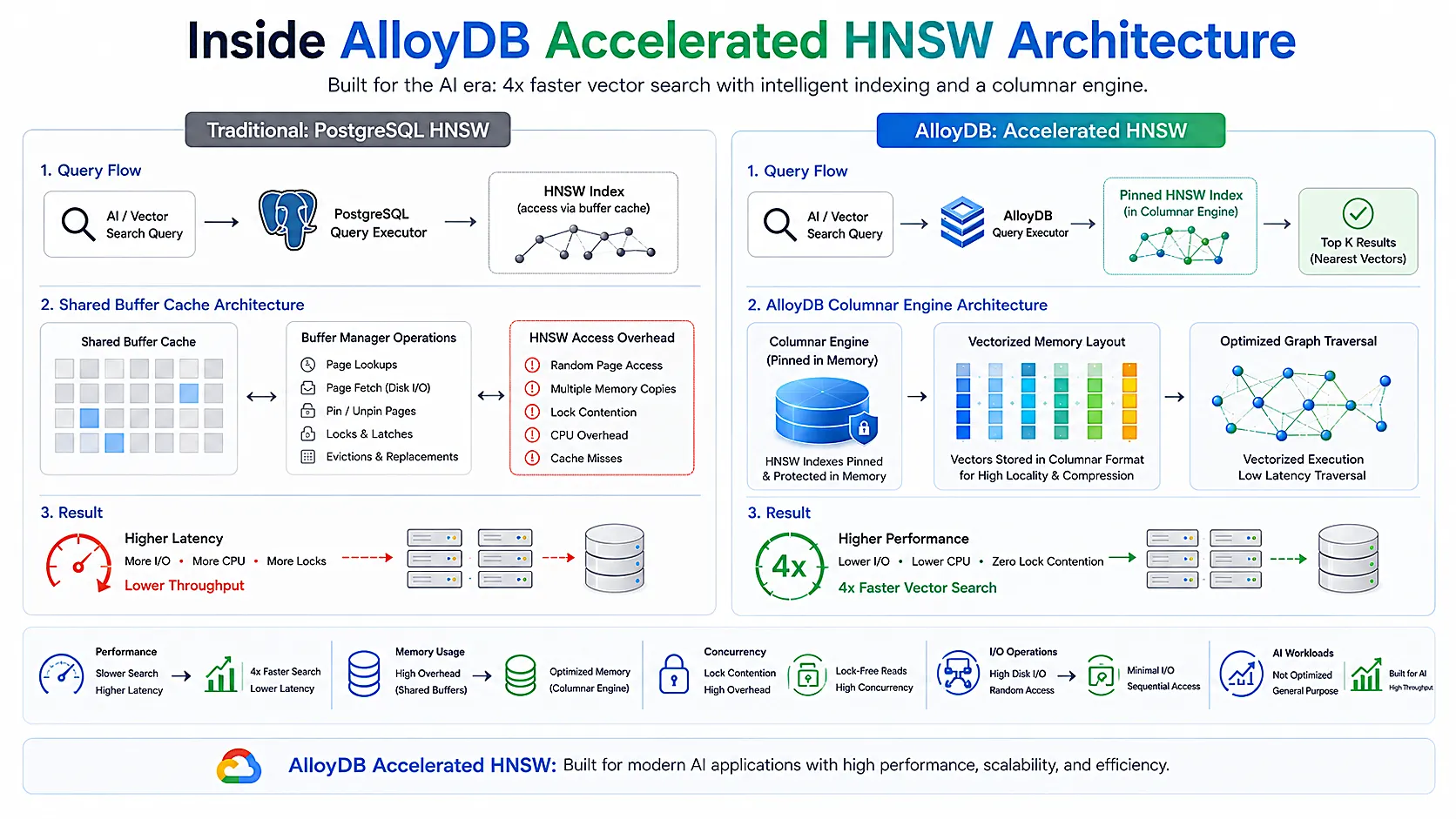
Standard PostgreSQL index operations rely on the shared buffer cache and require additional database management operations.
These operations include:
Buffer management
Page handling
Cache lookups
Lock management
The AlloyDB architecture reduces these overheads by allowing searches to run through a specialized memory environment.
Benchmark Results: AlloyDB Delivers Up to 4x Higher Vector Search Throughput
To measure the impact of columnar engine accelerated HNSW, Google evaluated the capability using the GloVe 100 Angular dataset.
The benchmark involved searching more than 1 million vector records with a search limit of 100 results.
The evaluation focused on the relationship between:
Queries Per Second (QPS)
Recall accuracy
The results showed two major improvements.
(1) Higher Search Throughput at Similar Recall Levels
Google found that columnar engine accelerated HNSW increased QPS by approximately 4.2x to 4.9x compared with standard PostgreSQL HNSW at similar recall levels.
This means enterprise applications can process significantly more vector searches using the same hardware resources.
For AI applications handling large volumes of retrieval requests, higher throughput improves scalability and reduces pressure on infrastructure.
(2) Improved Recall Without Additional Latency
The benchmark also showed improved retrieval accuracy at similar performance levels.
In Google’s example, running searches at approximately 350 QPS improved recall from around 0.78 to above 0.94 after enabling AlloyDB columnar engine acceleration.
This represents a significant improvement in retrieval quality without increasing latency.
For RAG applications, better recall means AI models receive more relevant context before generating responses.
Google also highlighted that these improvements were not simply the result of moving data from storage into memory.
The baseline comparison already used a PostgreSQL HNSW index that was fully cached in the PostgreSQL shared buffer cache.
The performance gains came from a more efficient memory architecture and optimized index access path.
The benchmark measurements were performed on an AlloyDB C4A 16 vCPU machine. Google noted that because HNSW graph construction includes inherent randomness, results may vary slightly between benchmark runs.
How Columnar Engine Accelerated HNSW Works Internally
The performance improvements in AlloyDB come from changing how HNSW indexes are stored, accessed, and processed during vector search operations.
In a standard PostgreSQL architecture, index operations rely on the shared buffer cache. This architecture is designed to support a wide range of database workloads, but high-volume AI vector search introduces unique performance requirements.
Even when data is already available in memory, PostgreSQL still performs additional operations such as:
Buffer table lookups
Page pinning and unpinning
Lock management
Least Recently Used (LRU) cache handling
These processes help maintain database reliability, but they introduce additional overhead during intensive vector searches involving millions of embeddings.
AlloyDB addresses these limitations by allowing HNSW indexes to operate through its specialized columnar engine architecture.
The improvement comes from three major architectural changes.
(1) Persistent HNSW Index Pinning
The first improvement is the ability to pin the pgvector HNSW index directly into the AlloyDB columnar engine memory.
Instead of repeatedly managing the index through traditional PostgreSQL memory operations, AlloyDB keeps the index available inside an optimized memory environment.
This reduces unnecessary processing steps and allows vector searches to begin more efficiently.
For high-concurrency AI applications, persistent index availability improves both consistency and throughput.
(2) Vectorized Memory Layout
The second improvement focuses on how HNSW graph data is accessed in memory.
HNSW searches require navigating complex relationships between vector embeddings. These operations involve many pointer-based graph traversals.
Traditional memory layouts are not specifically optimized for these search patterns.
AlloyDB uses a vectorized memory layout designed for high-concurrency HNSW traversal operations.
This allows the database to move through vector relationships more efficiently, improving search speed and resource utilization.
(3) Reduced Buffer Manager Overhead
The third improvement comes from reducing dependency on traditional PostgreSQL buffer management operations.
By navigating HNSW graphs inside a specialized memory environment, AlloyDB avoids many standard database processing steps.
This architectural shift enables higher search throughput while maintaining strong retrieval accuracy.
The result is not simply a faster index. It is a database architecture optimized specifically for modern AI retrieval workloads.
Why Faster Vector Search Matters for Enterprise AI
For organizations building production AI applications, faster vector search is not only about database performance.
It directly impacts infrastructure costs, AI response quality, and operational simplicity.
Reducing Infrastructure Costs
Higher search throughput allows organizations to process more AI requests using fewer computing resources.
Instead of continuously expanding infrastructure as AI usage grows, enterprises can improve efficiency by getting more performance from existing systems.
For organizations running large-scale AI applications, database optimization can translate into meaningful cost savings.
A system that handles more searches on the same hardware reduces the need for additional compute capacity.
Improving AI Response Quality
AI applications depend heavily on the quality of retrieved information.
In RAG systems, databases provide the context that large language models use to generate responses.
If retrieval systems fail to find the most relevant information, even advanced AI models may produce incomplete or less accurate answers.
Higher recall improves the quality of retrieved context by allowing AI systems to identify more relevant information before generation begins.
This can improve:
Answer accuracy
Enterprise knowledge retrieval
Search experiences
User confidence in AI applications
By improving recall without sacrificing performance, AlloyDB helps organizations create more reliable AI experiences.
No Application Changes Required
One of the key advantages of AlloyDB’s accelerated HNSW capability is that developers do not need to redesign existing applications.
The feature works with standard pgvector SQL syntax.
Organizations can continue using PostgreSQL workflows, existing database tools, and current application architectures while gaining improved vector search performance.
while gaining improved vector search performance.
This reduces migration complexity and allows development teams to adopt AI optimization without major application changes.
AlloyDB Provides a Unified AI Database Platform
Many enterprises currently manage separate systems for different workloads:
Transactional databases
Analytics platforms
Vector search systems
While this approach can work, it often introduces additional complexity.
Organizations may need to manage:
Data synchronization
Security controls
Multiple operational environments
Data movement between platforms
AlloyDB brings these workloads together in a PostgreSQL-compatible environment.
The platform allows organizations to manage relational data, analytics workloads, and AI-powered retrieval systems within one managed database service.
This unified approach can simplify architecture while supporting the needs of modern AI applications.
Choosing Between HNSW, ScaNN, and KNN in AlloyDB
Although the latest AlloyDB update focuses on accelerating HNSW performance, the platform supports multiple vector search approaches.
Different indexing methods provide different advantages depending on application requirements.
HNSW
HNSW is designed for fast approximate nearest neighbor search with strong accuracy.
It is suitable for applications such as:
AI assistants
Enterprise knowledge search
Semantic search
Recommendation systems
With columnar engine acceleration, HNSW becomes better suited for large-scale production AI workloads requiring high throughput.
ScaNN
AlloyDB also supports ScaNN, Google’s advanced vector indexing technology.
ScaNN is backed by more than 14 years of Google Research and is designed for high-performance vector search at large scale.
Organizations managing extremely large vector datasets can evaluate ScaNN when optimizing search performance.
KNN Search
For workloads requiring maximum precision, traditional k-nearest neighbor (KNN) search remains available.
KNN provides 100% recall, making it suitable for applications where exact results are more important than maximum speed.
The availability of multiple indexing options allows developers to choose the right balance between:
Performance
Accuracy
Dataset size
Infrastructure cost
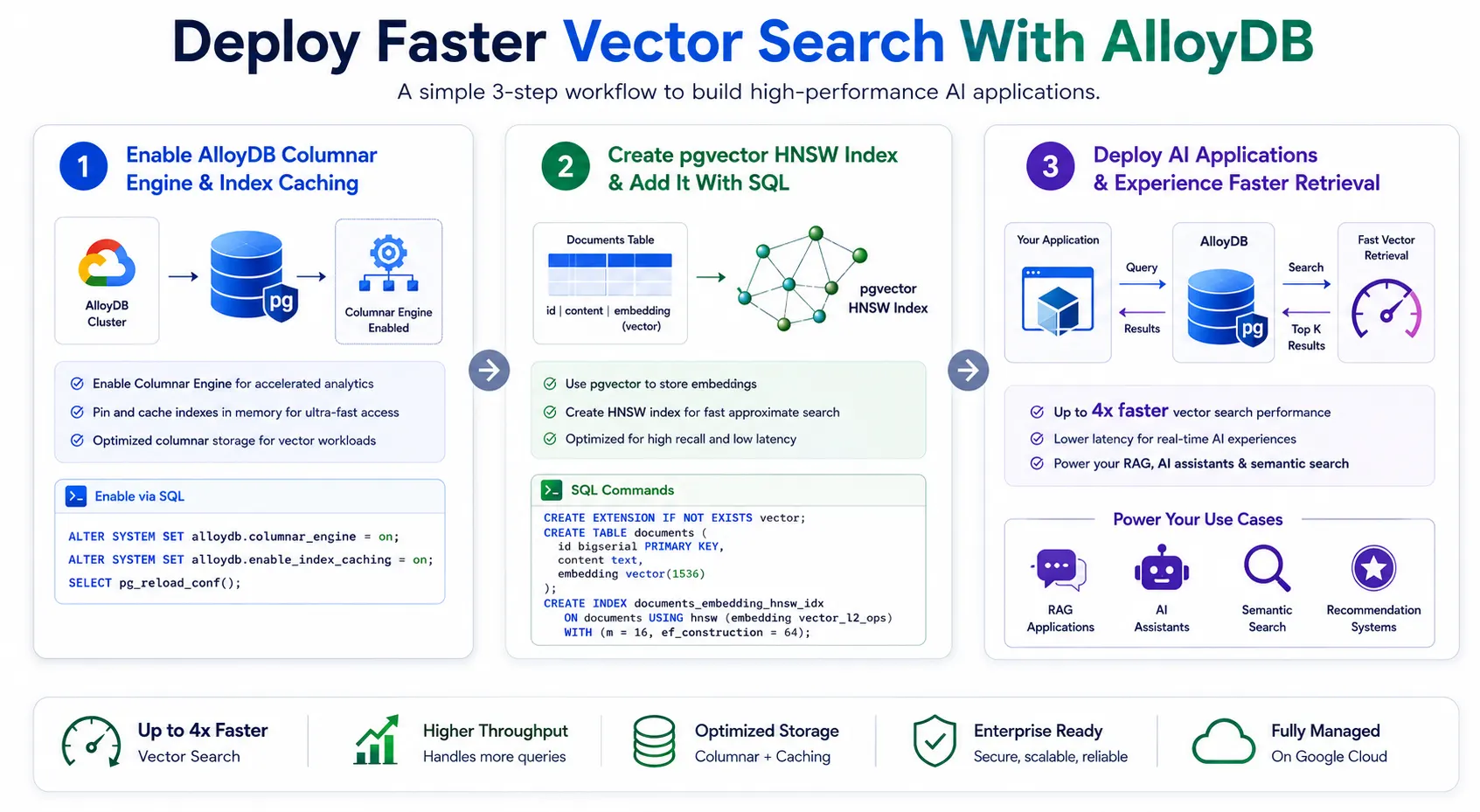
Getting Started With Columnar Engine Accelerated HNSW
Developers can try the new AlloyDB capability by enabling the columnar engine and index caching features.
The process requires three main steps.
Step 1: Enable Columnar Engine and Index Caching
Ensure the following AlloyDB settings are enabled:
google_columnar_engine.enabled = on

google_columnar_engine.enable_index_caching = on
These settings allow AlloyDB to use the columnar engine for accelerated index access.
⇩Step 2: Add the HNSW Index to the Columnar Engine
After creating an HNSW index using pgvector, developers can add the index to the columnar engine with:
SELECT google_columnar_engine_add_index('<hnsw_index_name>');Once added, AlloyDB can use the optimized memory architecture for vector searches.
⇩Step 3: Deploy AI Applications
After configuration, applications can continue using standard pgvector SQL queries while benefiting from improved search performance.
Google also provides a 30-day AlloyDB free trial instance, allowing developers to evaluate the performance improvements using their own workloads.
The Future of AI Databases
Artificial intelligence is changing the role of databases.
Future enterprise systems will not only store traditional business information. They will also manage embeddings, AI context, analytics workloads, and real-time retrieval pipelines.
As organizations move toward production-scale AI, database platforms need to provide more than storage and transactions.
Future enterprise database platforms must support intelligent search, high-performance retrieval, AI application integration, and enterprise-scale reliability.
With columnar engine accelerated HNSW, Google Cloud is strengthening AlloyDB as a PostgreSQL-compatible database platform built for modern AI workloads.
The update improves vector search performance, increases retrieval quality, and allows developers to continue using familiar PostgreSQL technologies.
For enterprises building RAG applications, AI assistants, and semantic search platforms, faster and more accurate vector retrieval can become a critical foundation for scaling AI successfully.
Source: Google Cloud Blog
About the Author