
GitHub Restructures Bug Bounty Program with VIP Researcher Tier, Higher Rewards, and New Signal Requirements
GitHub is overhauling its bug bounty program by launching a permanent VIP researcher tier, introducing fixed payouts, and adding signal requirements to reduce low-quality and AI-generated reports while rewarding high-impact security research.
Xcademia Team
Xcademia Research Team
Introduction
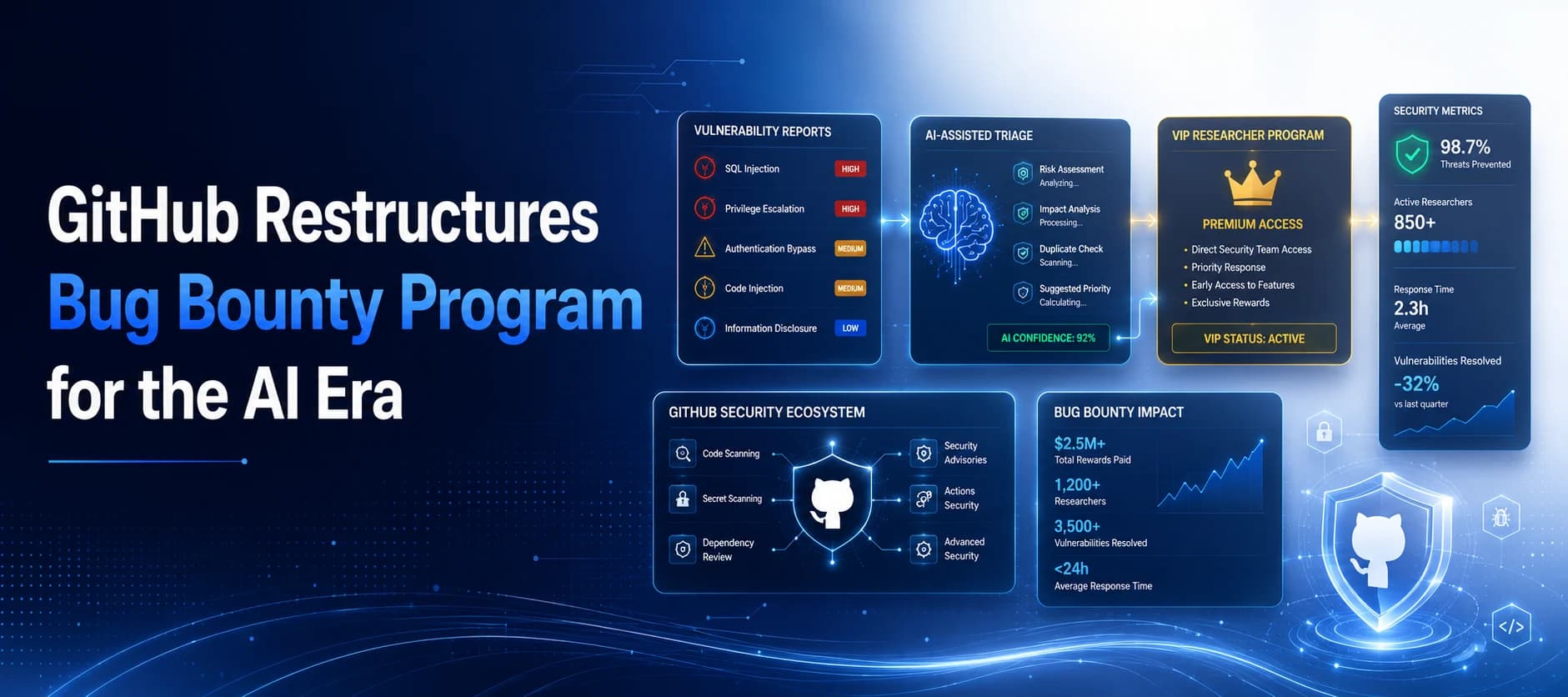
GitHub has announced a major restructuring of its bug bounty program, marking one of the most significant changes to its vulnerability disclosure and researcher engagement strategy in more than a decade.
The move reflects a growing challenge facing not only GitHub but the broader cybersecurity industry: managing a rapidly increasing volume of vulnerability reports while ensuring security teams can focus on high-quality findings that pose real risk to users and infrastructure.
The changes, scheduled to take effect on July 27, 2026, introduce three major shifts:
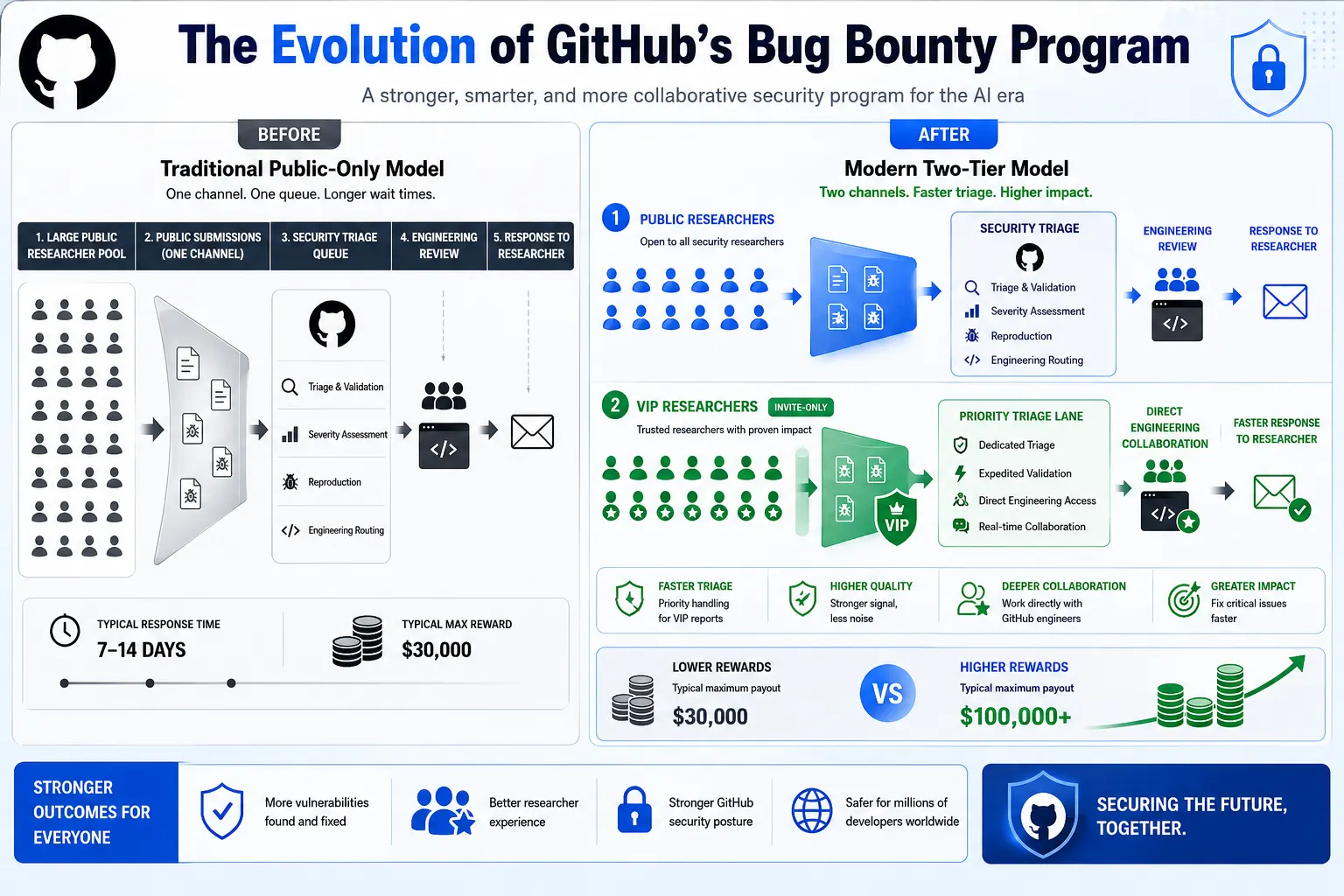
A permanent invite-only VIP bug bounty program
A simplified public bounty payout structure
New signal requirements designed to reduce low-quality and AI-generated submissions
The announcement signals a broader evolution in how large technology companies are approaching vulnerability research. As AI tools lower the barrier to entry for bug hunting and increase report volumes, organizations are increasingly looking for ways to reward depth, expertise, and meaningful collaboration over sheer submission counts.
For GitHub, whose platform sits at the center of global software development and open-source ecosystems, improving the effectiveness of security research partnerships has become a strategic priority.
Key Developments
GitHub's restructuring centers around creating a clearer distinction between general public participation and trusted security researchers who consistently deliver valuable findings.
1. Permanent VIP Program Launch
The most notable change is the introduction of a permanent private, invite-only VIP program.
Researchers who repeatedly demonstrate high-quality security work will gain access to:
Higher bounty payouts
Faster response times
Direct engagement with GitHub's security engineering teams
More collaborative vulnerability disclosure experiences
The program formalizes what many mature bug bounty initiatives have gradually adopted: deeper partnerships with trusted researchers who understand a company's architecture and security model.
VIP Bounty Rewards
Severity | VIP Payout |
|---|---|
Low | $1,000 |
Medium | $7,500 |
High | $20,000 |
Critical | $30,000+ |
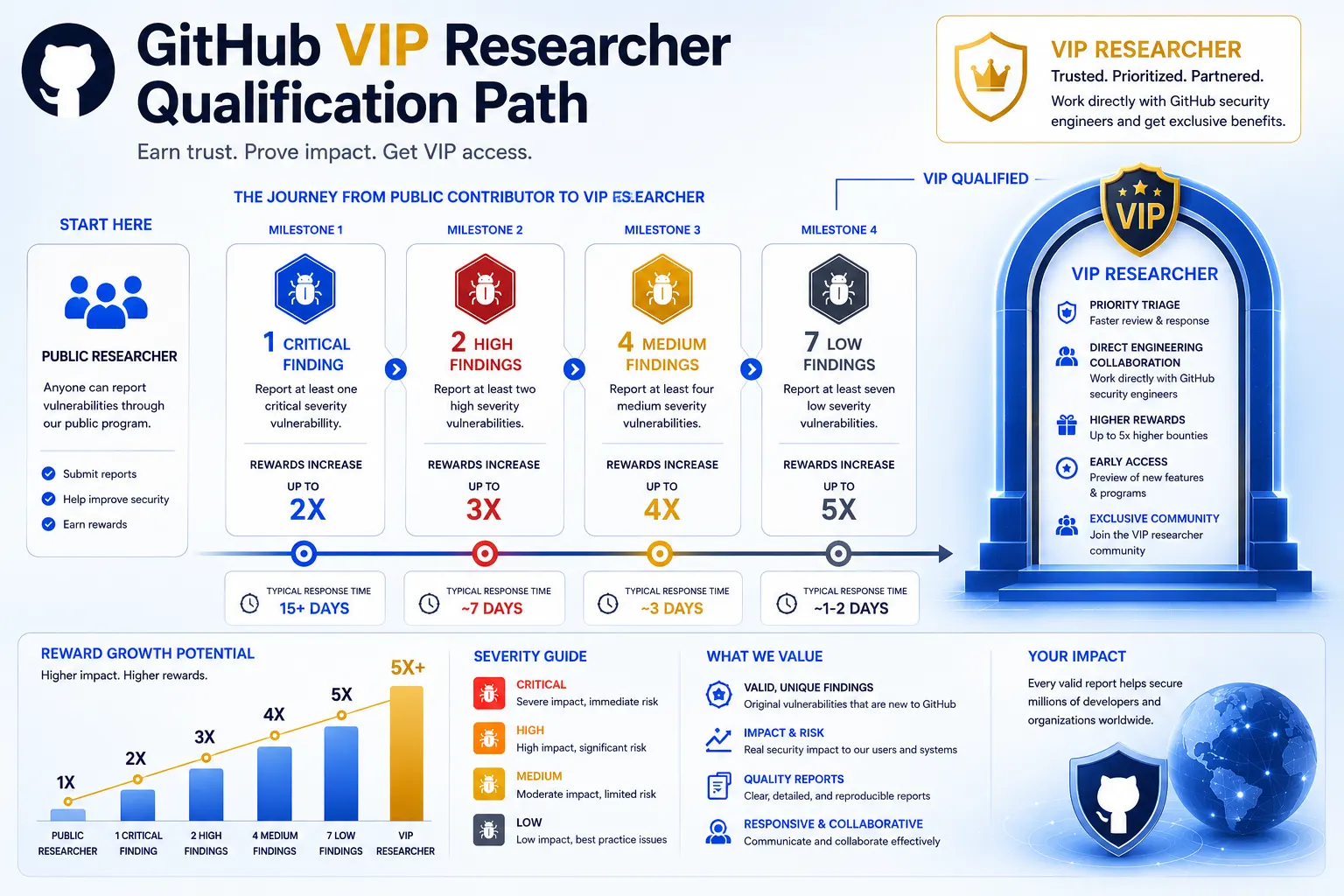
To qualify, researchers must achieve at least one of the following:
One critical finding
Two high-severity findings
Four medium-severity findings
Seven low-severity findings
According to GitHub, the objective is straightforward: reward quality rather than volume.
2. Public Program Simplification
GitHub is also replacing its previous payout ranges with fixed rewards.
New Public Bounty Structure
Severity | Public Payout |
|---|---|
Low | $250 |
Medium | $2,000 |
High | $5,000 |
Critical | $10,000 |
The company argues that fixed payouts create:
Better transparency
Reduced negotiation ambiguity
Faster bounty processing
More predictable researcher expectations
While public rewards are lower than VIP payouts, GitHub positions the public program as a pathway toward VIP status.
3. New Signal Requirements
GitHub is introducing HackerOne signal requirements to address growing report volume.
Researchers without established platform credibility will be limited in the number of reports they can submit initially.
New participants can still submit up to four reports while building their reputation.
The policy is specifically designed to reduce:
Low-effort submissions
Duplicate reports
Automated findings lacking validation
AI-generated vulnerability reports with insufficient evidence
This reflects a growing trend across the bug bounty ecosystem as organizations struggle to manage rising report volumes fueled by increasingly accessible AI-assisted security tools.
Technical Breakdown
Understanding GitHub's decision requires examining how modern bug bounty programs operate.
Bug bounty initiatives function as crowdsourced security testing environments where independent researchers identify vulnerabilities and report them responsibly in exchange for financial rewards.
Historically, the primary challenge was attracting enough researchers.
Today, the challenge is often the opposite.
The rise of:
AI-powered vulnerability discovery tools
Automated scanning platforms
Large language models assisting report generation
Growing numbers of first-time bug hunters
has dramatically increased submission volume.
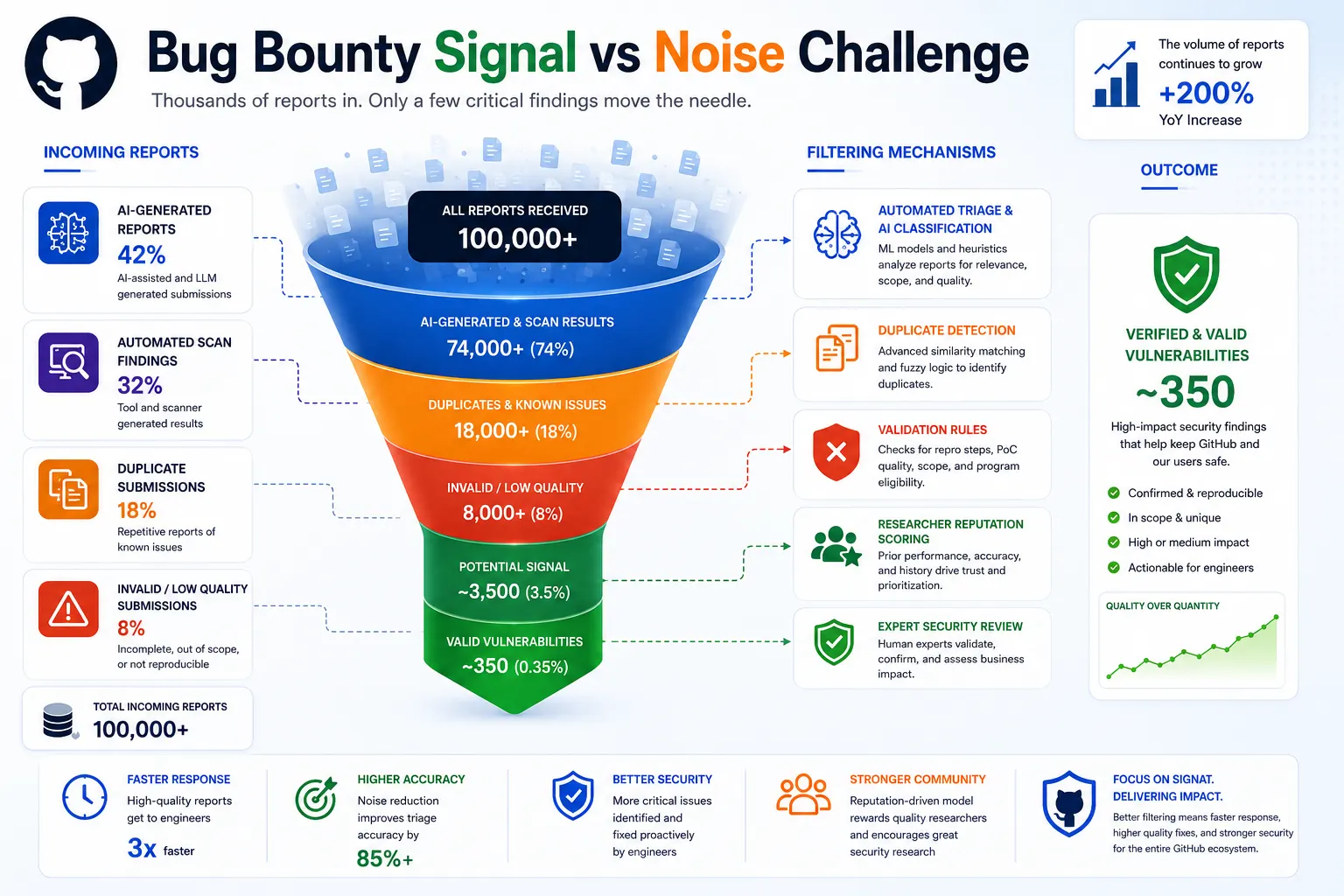
Many organizations now face a signal-to-noise problem.
Security teams spend significant time evaluating:
Duplicate findings
Invalid vulnerabilities
Misconfigured scanner outputs
Reports lacking proof of exploitability
As a result, mature programs increasingly prioritize researcher reputation and historical accuracy.
GitHub's VIP model effectively creates a trust-based security ecosystem.
Researchers who repeatedly demonstrate expertise gain privileged access and stronger collaboration channels, allowing security engineers to spend more time on meaningful vulnerability analysis and less time triaging noise.
Industry Impact
GitHub's announcement extends beyond its own security program.
It highlights broader shifts occurring across vulnerability disclosure programs worldwide.
1. For Security Researchers
Professional bug bounty hunters may welcome the changes.
The VIP model creates a clearer career progression path and rewards long-term expertise.
Researchers who invest substantial time learning GitHub's ecosystem can now access significantly higher payouts and stronger collaboration opportunities.
However, some members of the community may view reduced public payouts as a barrier to participation.
The success of the model will depend on how transparent and attainable VIP qualification remains.
2. For Enterprise Security Teams
Organizations operating bug bounty programs face similar challenges.
GitHub's approach may serve as a blueprint for:
Managing vulnerability triage workloads
Reducing false-positive submissions
Creating researcher reputation systems
Building long-term security partnerships
Many enterprise security leaders are likely watching closely to evaluate whether a tiered researcher ecosystem improves vulnerability quality.
3. For HackerOne and Bug Bounty Platforms
The introduction of signal requirements further reinforces the growing importance of platform reputation metrics.
Security marketplaces increasingly rely on trust scoring systems to identify researchers who consistently provide actionable findings.
GitHub's adoption of these mechanisms may encourage broader use across the industry.
Why This Matters
The announcement reflects a fundamental shift in cybersecurity economics.
For years, bug bounty programs primarily focused on attracting more researchers.
Today, the challenge has become optimizing researcher quality.
AI has dramatically changed vulnerability discovery workflows.
Researchers can now:
Generate attack hypotheses faster
Automate reconnaissance
Draft reports with language models
Scale testing activities
While these capabilities increase overall security coverage, they also increase operational burden for program administrators.
GitHub's restructuring recognizes a new reality:
The most valuable security research often comes from individuals who deeply understand a target's architecture rather than those submitting large volumes of generic findings.
The VIP model institutionalizes that philosophy.
Instead of rewarding quantity, GitHub is explicitly rewarding expertise, consistency, and impact.
Challenges and Considerations
Although the restructuring offers clear operational advantages, it also raises several important considerations.
Accessibility for New Researchers
One concern is whether signal requirements could discourage newcomers.
Bug bounty programs have historically provided an entry point for aspiring security professionals.
Maintaining accessibility while controlling spam will require careful balancing.
GitHub's allowance of four initial submissions attempts to address this issue, but the long-term impact remains to be seen.
Risk of Researcher Concentration
VIP programs naturally concentrate rewards among experienced researchers.
While this improves efficiency, it may reduce diversity of perspectives.
Many impactful vulnerabilities have historically been discovered by first-time researchers approaching systems with fresh viewpoints.
Maintaining healthy public participation will remain critical.
AI's Expanding Role
GitHub specifically referenced low-effort and AI-generated reports.
This highlights a growing industry debate.
AI itself is not inherently problematic.
Many highly skilled researchers already use AI responsibly to accelerate testing and documentation.
The challenge lies in distinguishing valuable AI-assisted research from automated report spam.
Future bug bounty programs will likely continue refining policies around AI usage.
Future Outlook
GitHub's changes are likely part of a broader transformation occurring across vulnerability disclosure programs.
Several trends are likely to emerge over the next few years:
Expansion of Trusted Researcher Programs
More organizations may create invite-only tiers that prioritize long-term researcher relationships over open participation alone.
Reputation-Based Security Ecosystems
Researcher credibility metrics will likely become increasingly important for prioritization and rewards.
AI-Aware Triage Systems
Security teams may deploy AI-powered validation tools to help distinguish high-quality vulnerability reports from automated noise.
Stronger Researcher Collaboration
Organizations will continue shifting from transactional bounty relationships toward strategic partnerships with trusted security researchers.
These developments suggest bug bounty programs are maturing from crowdsourced testing platforms into sophisticated researcher ecosystems.
Conclusion
GitHub's restructuring of its bug bounty program reflects a broader cybersecurity industry transition toward quality-focused vulnerability research.
By launching a permanent VIP program, simplifying public payouts, and introducing signal requirements, GitHub aims to improve researcher experience while reducing operational overhead caused by increasing report volumes.
The strategy recognizes a growing challenge facing modern bug bounty programs: balancing accessibility with efficiency in an era of AI-assisted security research.
Whether the model becomes a new industry standard will depend on its ability to maintain openness for emerging researchers while rewarding the deep expertise that uncovers the most impactful vulnerabilities.
For security professionals, researchers, and enterprises alike, GitHub's changes offer an early glimpse into what the next generation of bug bounty programs may look like.
Source: GitHub Blog
About the Author