
Critical Ruby on Rails Flaw Could Lead to Remote Code Execution Through Active Storage Image Processing
A newly disclosed critical Ruby on Rails vulnerability could allow attackers to read sensitive server files and potentially achieve remote code execution through Active Storage image variants. Developers are urged to update immediately to patched Rails releases.
Xcademia Team
Xcademia Research Team
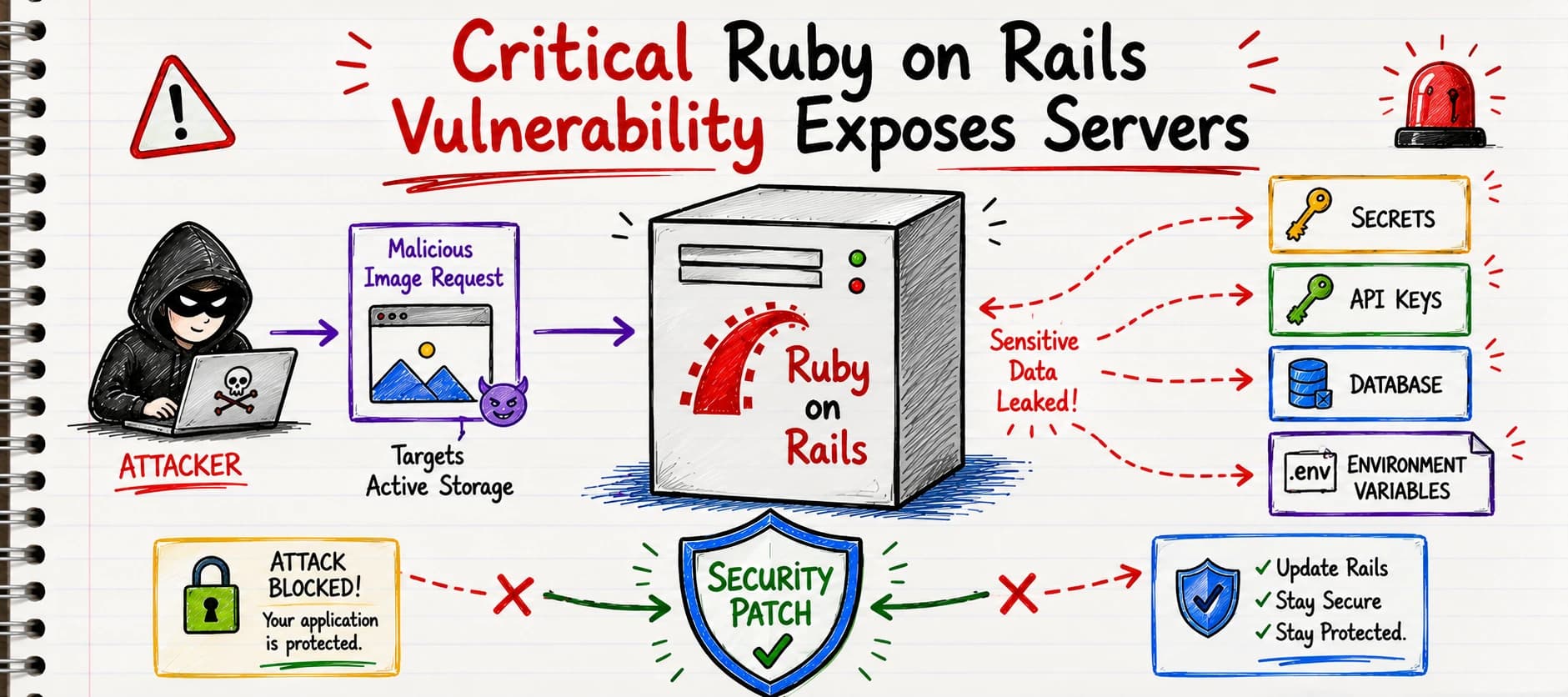
Critical Ruby on Rails Flaw Could Lead to Remote Code Execution Through Active Storage
Ruby on Rails developers are being urged to patch their applications immediately after the Rails security team disclosed a critical security vulnerability that could allow attackers to read arbitrary files from vulnerable servers and potentially escalate the attack into remote code execution (RCE).
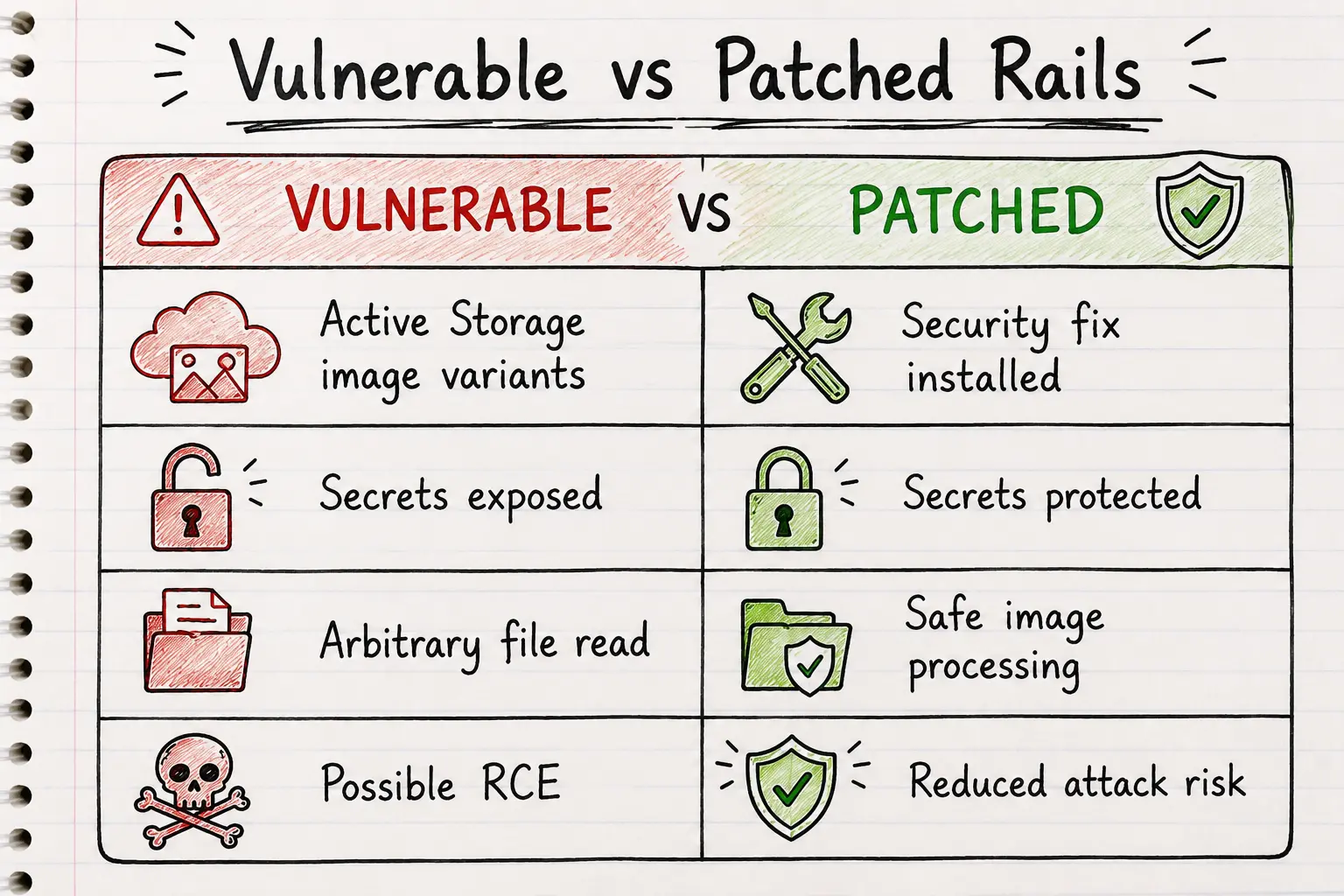
The vulnerability, tracked under GHSA-xr9x-r78c-5hrm, affects applications using Active Storage image variants, a feature commonly used for resizing and processing uploaded images.
According to the official Rails security advisory, an unauthenticated attacker may be able to retrieve sensitive files from the server, including environment variables containing secrets such as secret_key_base. If these secrets are exposed, attackers may gain the ability to execute arbitrary code or move laterally into connected systems.
Why This Vulnerability Matters
Ruby on Rails powers thousands of web applications worldwide, from startups to enterprise SaaS platforms.
Many applications enable Active Storage by default for handling user-uploaded files such as:
Profile pictures
Product images
Documents
Media uploads
Because image processing is such a common feature, the vulnerability has a potentially broad impact across production environments.
Unlike many vulnerabilities that require authentication, this issue can be exploited by an unauthenticated attacker, significantly increasing the risk.
What Happens During the Attack?
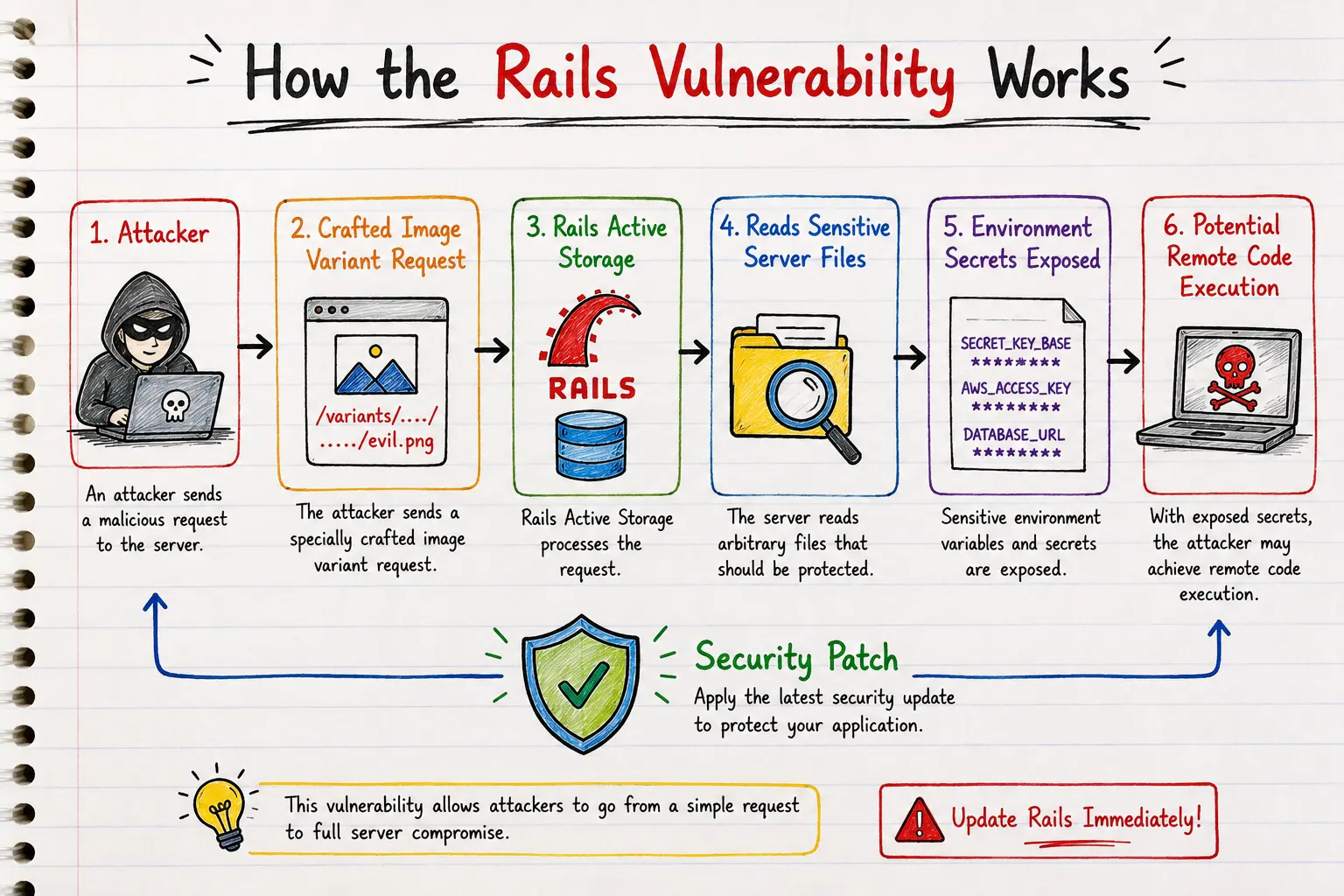
The Rails advisory explains that specially crafted requests targeting image variants can expose arbitrary files stored on the application server.
Those files may include:
Environment configuration
API keys
Cloud credentials
Database passwords
secret_key_baseOther application secrets
Once attackers obtain these credentials, they may use them to compromise the application further, potentially achieving remote code execution or accessing external infrastructure connected to the application.
Technical Overview
The vulnerability affects Active Storage image variants, which generate transformed versions of uploaded images such as resized thumbnails.
Normally the feature processes images safely.
However, the newly disclosed flaw allows attackers to manipulate image variant requests in a way that exposes arbitrary server files.
The official advisory warns that once sensitive environment variables become accessible, they can expose credentials used by the application to communicate with databases, cloud providers, third-party APIs, and internal services.
Potential Business Impact
A successful attack could have serious consequences for organisations running affected Rails applications.
Possible impacts include:
Exposure of confidential customer data
Leakage of cloud credentials
Database compromise
Remote code execution
Lateral movement across infrastructure
Full application takeover
For organisations using Rails in production, this represents a high-priority security update.
Who Is Affected?
Applications are at risk if they:
Use Ruby on Rails
Enable Active Storage
Generate image variants
Have not installed the latest security updates
Applications that never process image variants are generally not affected by this specific issue, according to the Rails advisory.
Patched Versions
The Rails team has released security updates addressing the vulnerability.
Developers should upgrade to the latest patched versions supported by the Rails project as soon as possible.
If immediate upgrades are not possible, organisations should carefully review temporary mitigations suggested in the official advisory while planning emergency maintenance windows.
Immediate Recommendations for Developers
Security experts recommend the following actions:
1. Update Rails Immediately
Install the latest patched Rails release recommended by the Rails security team.
2. Rotate Exposed Secrets
If compromise is suspected, rotate:
secret_key_base
Database passwords
Cloud API keys
OAuth secrets
Access tokens
3. Review Logs
Look for unusual requests involving:
Active Storage
Image variants
Unexpected file access
Suspicious HTTP requests
4. Audit Infrastructure
Check whether attackers accessed:
Cloud services
Databases
Internal APIs
Object storage
5. Monitor for Indicators of Compromise
Watch for:
Unexpected administrator sessions
Credential misuse
New API tokens
Unknown deployments
Why Secret Leakage Is Dangerous
Many Rails applications store sensitive configuration inside environment variables.
Examples include:
AWS credentials
Azure credentials
Google Cloud credentials
Stripe API keys
GitHub tokens
Database connection strings
If attackers obtain these secrets, they may no longer need to exploit another vulnerability.
Instead, they can simply authenticate using the stolen credentials, making detection much more difficult.
Industry Response
Security researchers quickly highlighted the severity of the disclosure because it combines two dangerous stages:
Arbitrary file disclosure
Potential remote code execution
Security researchers noted that Active Storage is widely deployed across Rails applications, increasing the urgency for organisations to assess their exposure.
Indicators That Your Application May Be at Risk
Administrators should investigate their Rails environments if they notice unusual behaviour related to image processing or unexpected access to sensitive files.
Potential warning signs include:
Unexpected requests to Active Storage endpoints
Image processing failures with unusual parameters
Access to files outside expected directories
Suspicious downloads of configuration files
Unusual outbound connections after image uploads
Unexpected authentication token usage
While these indicators do not necessarily confirm compromise, they should prompt a thorough security review.
Best Practices to Prevent Similar Attacks
Although applying the official security update is the highest priority, organisations can strengthen their overall security posture by following secure development practices.
Recommended best practices include:
Keep Ruby on Rails and all dependencies up to date.
Enable automated dependency vulnerability scanning.
Apply the principle of least privilege to application accounts.
Store secrets in dedicated secret management services instead of environment files where possible.
Monitor application logs for unusual file access attempts.
Regularly rotate API keys and access credentials.
Perform routine security assessments and penetration testing.
These measures help reduce the impact of future framework vulnerabilities.
What Security Teams Should Do Next
Security teams should treat this advisory as a high-priority remediation task.
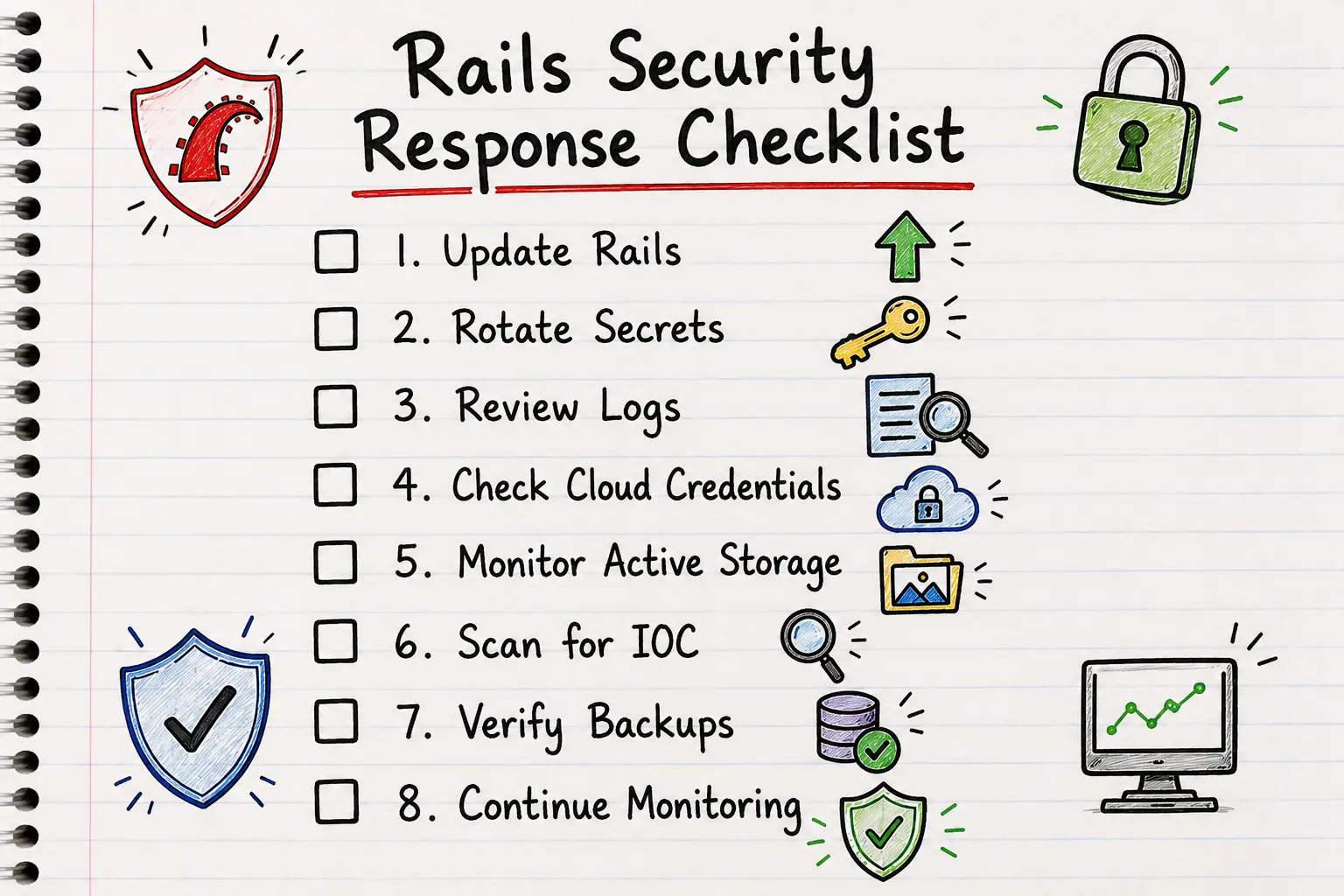
A recommended response plan includes:
Identify all Rails applications within the organisation.
Verify whether Active Storage image variants are enabled.
Upgrade to the latest patched Rails release.
Rotate sensitive credentials if exposure is suspected.
Review logs for signs of exploitation.
Validate application backups before making production changes.
Continue monitoring for newly released indicators of compromise or additional guidance.
Taking these steps promptly can significantly reduce the likelihood of a successful attack.
Conclusion
The disclosure of this critical Ruby on Rails vulnerability highlights how a single weakness in a widely used framework feature can create significant security risks for organisations. By targeting Active Storage image variants, attackers may be able to access sensitive server files, exposing secrets that could lead to a much broader compromise if left unpatched.
The good news is that a security update is already available. Developers and security teams should act quickly by upgrading to the latest patched Rails version, reviewing their applications for signs of suspicious activity, and rotating any credentials that may have been exposed. Proactive patch management, continuous monitoring, and secure credential handling remain essential for protecting modern web applications against emerging threats.
As cyber threats continue to evolve, staying informed about security advisories and applying critical updates without delay is one of the most effective ways to maintain a resilient and secure application environment.
Source: Ruby on Rails Security Advisory
About the Author