
Can ASML Become Europe's First $1 Trillion Company? AI Chip Boom Fuels Historic Growth
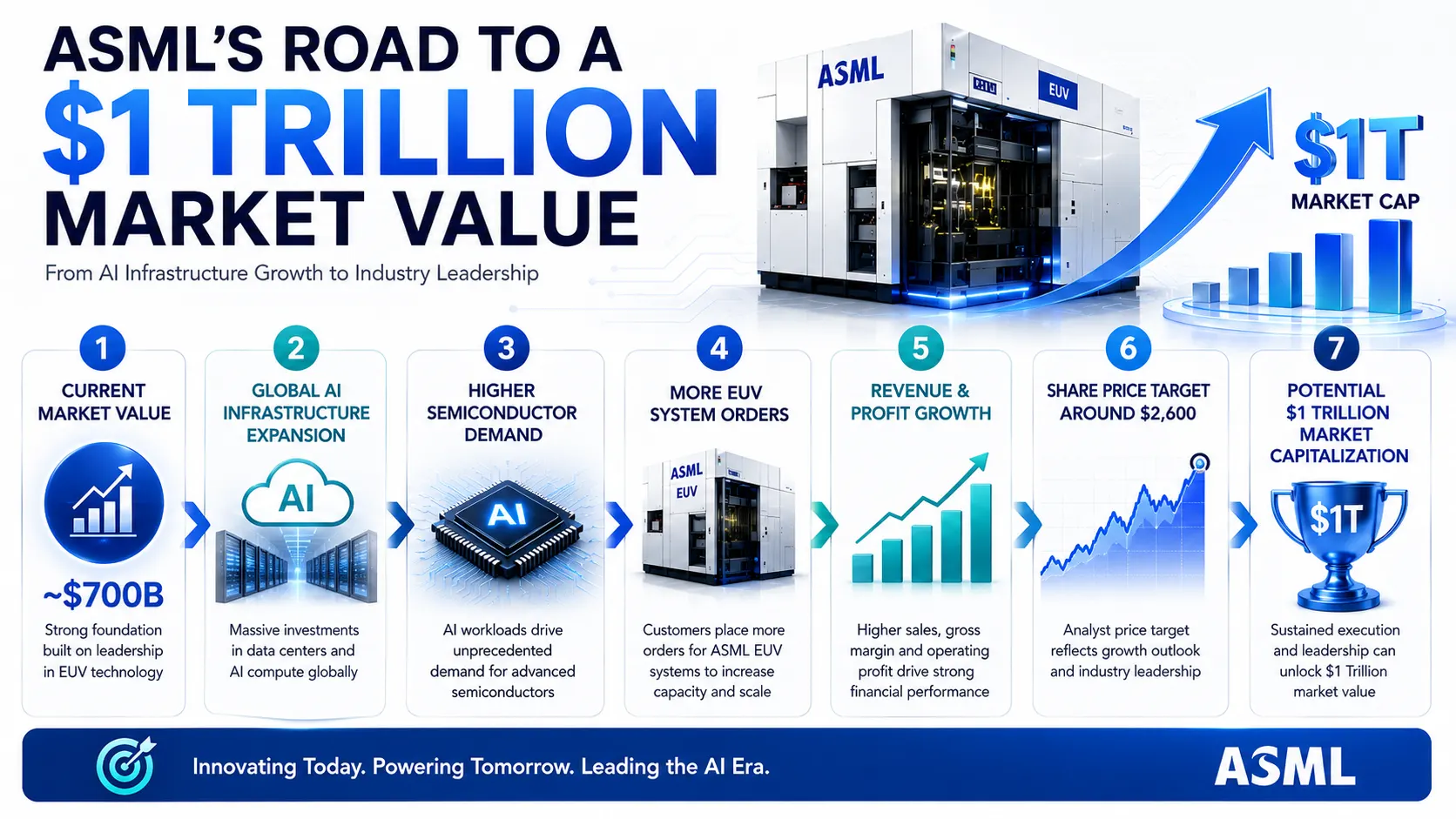
ASML's dominance in EUV lithography and booming AI chip demand have pushed its valuation close to $700 billion. Analysts now believe the Dutch semiconductor equipment leader could become Europe's first company to reach a $1 trillion market capitalization.
Xcademia Team
Xcademia Research Team
The artificial intelligence revolution has transformed the global technology landscape, creating new winners across nearly every segment of the semiconductor industry. While companies such as Nvidia, AMD, and Broadcom often dominate headlines for designing the processors powering modern AI systems, another company has quietly become one of the most valuable players in the entire ecosystem.
That company is ASML.
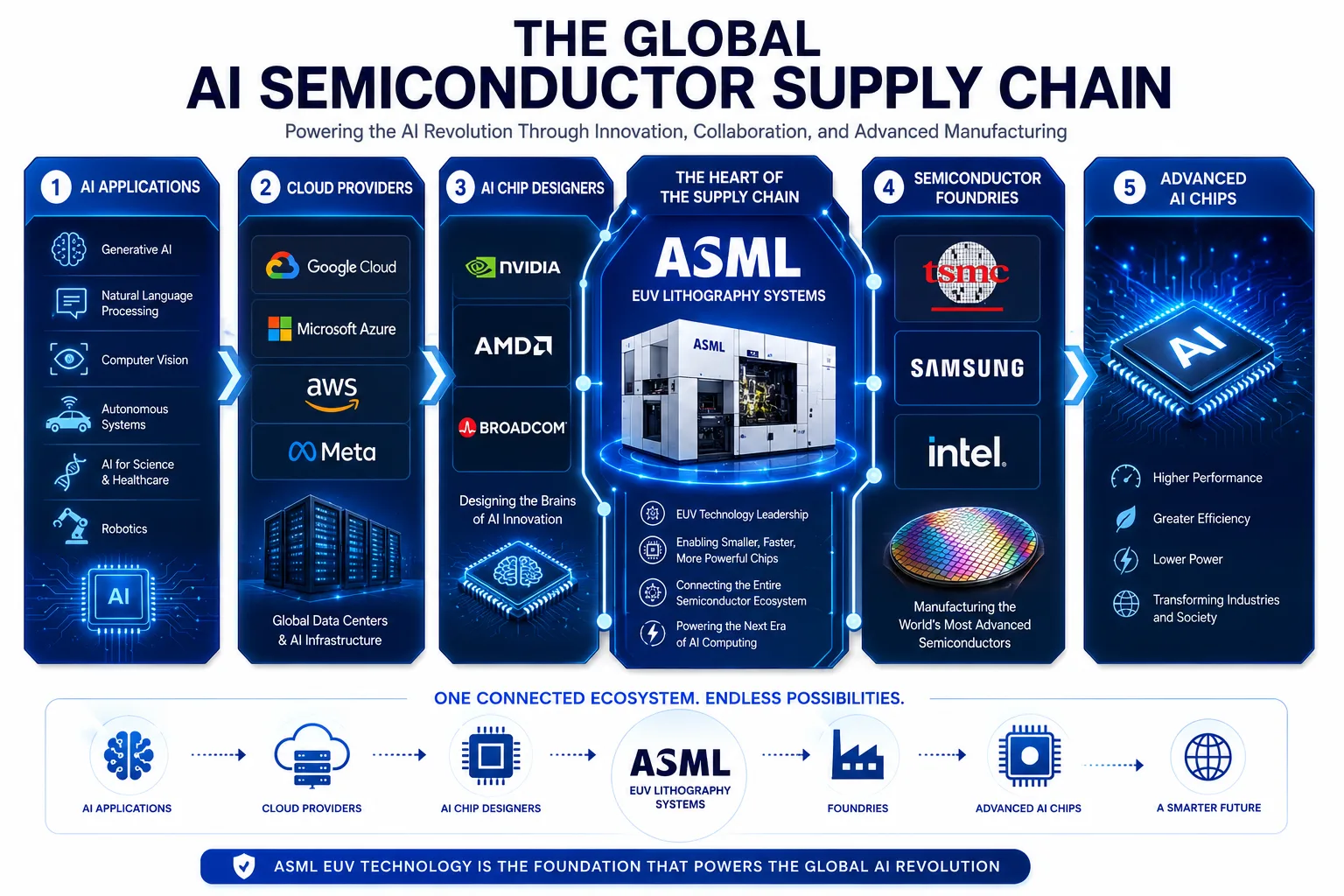
Based in the Netherlands, ASML manufactures the highly sophisticated lithography machines required to produce the world's most advanced semiconductors. Every cutting-edge AI processor designed by companies such as Nvidia or manufactured by foundries like TSMC and Samsung ultimately depends on ASML's technology.
This unique position has placed the company at the heart of the global AI infrastructure boom. Strong demand for AI chips, record orders for advanced manufacturing equipment, and growing investments in semiconductor fabrication have helped propel ASML's stock to new highs in 2026. Following an impressive second-quarter earnings report, investors are now asking a question that once seemed almost impossible:
Could ASML become Europe's first trillion-dollar company?
With its market value approaching $700 billion after a remarkable share price rally, many analysts believe the answer is no longer a matter of "if," but rather "when," provided the AI investment cycle continues over the coming years.
Although several challenges remain, ASML's unparalleled technological leadership and growing importance in semiconductor manufacturing have positioned the company among the strongest long-term beneficiaries of the AI revolution.
The Company Powering the World's Most Advanced Chips
Unlike companies that design or manufacture semiconductors, ASML supplies the equipment that makes modern chip production possible.
Its flagship products are Extreme Ultraviolet (EUV) lithography systems, machines capable of printing microscopic circuit patterns onto silicon wafers with extraordinary precision. These systems are essential for producing chips built on the world's most advanced manufacturing processes.
Without EUV technology, manufacturing today's most sophisticated AI accelerators would simply not be possible.
These chips power an enormous range of technologies, including:
Large language models and generative AI
Cloud computing infrastructure
AI data centers
Autonomous driving systems
Advanced smartphones
High-performance computing
AI memory processors
Because no commercial alternative currently exists, ASML occupies one of the strongest competitive positions in the global technology industry.
Many investors compare the company's business model to selling "picks and shovels during a gold rush." Instead of competing directly in artificial intelligence software, ASML supplies the indispensable tools required by every major semiconductor manufacturer building AI hardware.
That strategic advantage has become increasingly valuable as AI adoption accelerates worldwide.
Why ASML Has No Real Competitor
One of the primary reasons investors remain optimistic about ASML is the company's virtually unmatched technological leadership.
Developing EUV lithography technology required decades of scientific research, billions of dollars in investment, and collaboration across hundreds of highly specialized suppliers. The engineering challenges involved are so complex that replicating ASML's capabilities would take competitors many years, even with unlimited financial resources.
Each EUV machine represents one of the most advanced manufacturing systems ever created.
A single system contains well over 100,000 individual components sourced from suppliers around the world. Precision mirrors, high-powered lasers, sophisticated optics, vacuum chambers, and advanced robotics all work together to produce incredibly small semiconductor features measured in just a few nanometers.
Building one machine takes months of manufacturing and testing before it can be delivered to customers. Transporting the equipment is equally challenging, often requiring dozens of shipping containers and specialized logistics operations.
The result is an extraordinary competitive moat.
Unlike many technology companies that constantly battle new entrants, ASML effectively operates as the sole supplier of commercial EUV lithography systems, giving customers few alternatives when expanding advanced semiconductor production.
This exclusivity allows the company to command premium prices while maintaining exceptionally strong demand.
AI Is Reshaping the Semiconductor Industry
Artificial intelligence has fundamentally changed the economics of semiconductor manufacturing.
Previous technology cycles were largely driven by consumer electronics such as smartphones, laptops, and gaming devices. Today's investment boom, however, is fueled by something much larger: enterprise AI infrastructure.
Every major cloud provider is investing aggressively in next-generation data centers capable of training and running increasingly sophisticated AI models. These facilities require enormous numbers of advanced graphics processors, AI accelerators, networking chips, and high-bandwidth memory modules.
The demand for these components has created an unprecedented expansion across the semiconductor supply chain.
Manufacturers must now produce more advanced chips than ever before while simultaneously improving performance and reducing power consumption. Achieving these goals requires increasingly sophisticated manufacturing technologies, making ASML's EUV systems more valuable with every new generation of processors.
Industry analysts believe this trend extends well beyond today's excitement surrounding generative AI.
Machine learning is rapidly becoming integrated into healthcare, financial services, manufacturing, automotive technology, cybersecurity, robotics, and scientific research. As AI adoption spreads across industries, demand for advanced semiconductors is expected to remain strong for years rather than months.
This structural transformation is one of the key reasons investors continue assigning premium valuations to companies positioned at the center of AI infrastructure.
AI Infrastructure Spending Is Fueling Record Demand
Technology giants including Google, Amazon, Microsoft, Meta, and other hyperscale cloud providers have collectively committed hundreds of billions of dollars toward expanding AI infrastructure.
New data centers require increasingly powerful processors capable of handling massive AI workloads, while next-generation networking equipment and AI memory chips further increase semiconductor demand.
For ASML, this investment wave translates directly into orders for advanced lithography systems.
The company is already reported to be nearly sold out of its flagship EUV machines through 2027, demonstrating the extraordinary level of customer demand.
Unlike consumer electronics markets that can fluctuate significantly from year to year, AI infrastructure investments tend to involve long planning cycles and multi-year capital expenditure commitments.
Semiconductor manufacturers therefore continue investing aggressively in new fabrication facilities to ensure sufficient production capacity for future AI hardware.
This sustained investment has strengthened confidence that ASML's growth could continue even if short-term economic conditions become more uncertain.
Industry forecasts suggest global AI infrastructure spending will remain elevated throughout the decade as governments, enterprises, and cloud providers compete to build increasingly capable computing platforms.
The race to develop larger AI models, faster inference systems, and more efficient processors continues to create opportunities across the semiconductor ecosystem, with ASML standing among its biggest beneficiaries.
Could ASML Really Reach a $1 Trillion Valuation?
Just a few years ago, the idea of ASML becoming Europe's first trillion-dollar company would have sounded unrealistic.
Today, the conversation has changed dramatically.
After climbing approximately 60 percent during 2026, ASML's market capitalization has approached the $700 billion mark, making it one of Europe's most valuable publicly traded companies.
Following the company's strong second-quarter earnings, several investment banks significantly increased their price targets.
Analysts at Barclays, Bernstein, and Susquehanna now project share prices exceeding $2,600, a level that would roughly correspond to a $1 trillion market capitalization.
For many institutional investors, the possibility is no longer theoretical.
They view ASML as one of the few companies with both durable competitive advantages and long-term structural growth supported by global AI investment.
Its valuation reflects more than current earnings. Investors are pricing in years of future demand driven by semiconductor manufacturing expansion, AI infrastructure deployment, and continued technological leadership.
Even at approximately 38 times projected 2027 earnings, many analysts argue that ASML deserves a premium compared with traditional semiconductor companies because of its unique market position.
For long-term shareholders, the company's combination of limited competition, strong pricing power, and growing order backlog continues to justify optimism despite its already substantial valuation.
Why Institutional Investors Remain Bullish
Large investment firms continue increasing their exposure to ASML because they view the company as a foundational component of the global semiconductor industry.
Unlike businesses whose fortunes depend on the success of a single AI model or hardware product, ASML benefits from growth across the entire semiconductor ecosystem.
Whether Nvidia, AMD, Intel, Samsung, TSMC, or future AI chip designers succeed, they all require increasingly advanced manufacturing equipment.
This diversified exposure significantly reduces dependence on any single customer or technology trend.
Several factors continue supporting investor confidence:
Exclusive leadership in commercial EUV lithography technology
Long-term AI infrastructure investment across global markets
Strong order backlog extending into 2027
High barriers preventing meaningful competition
Increasing demand for advanced semiconductor manufacturing
For many portfolio managers, ASML represents one of the highest-quality technology businesses in the world because its products remain essential regardless of which AI companies ultimately dominate the market.
Why TSMC, Samsung, and Intel Depend on ASML
The world's largest semiconductor manufacturers all share one critical dependency: ASML's lithography technology.
Taiwan Semiconductor Manufacturing Company (TSMC), the world's largest contract chip manufacturer, relies extensively on ASML's EUV systems to produce processors for companies including Nvidia, Apple, AMD, Qualcomm, and numerous AI startups. Every new generation of AI accelerator, smartphone processor, and high-performance computing chip requires increasingly advanced manufacturing techniques, making ASML's equipment indispensable.
Samsung also depends heavily on EUV technology for both logic chips and advanced memory products. As demand grows for High Bandwidth Memory (HBM), a key component used alongside AI GPUs, Samsung continues expanding its investment in advanced semiconductor manufacturing.
Intel, meanwhile, is investing billions of dollars to regain leadership in chip manufacturing. The company is building new fabrication facilities across the United States and Europe while adopting increasingly advanced process technologies that require ASML's latest equipment.
This widespread dependence creates a unique business advantage. Regardless of which chipmaker wins market share in the future, ASML remains positioned to benefit because nearly every leading manufacturer requires its machines.
The EUV Upgrade Cycle Could Drive Another Wave of Growth
Even if AI infrastructure spending eventually moderates, ASML may have another significant source of long-term revenue.
Memory manufacturers are increasingly transitioning from older Deep Ultraviolet (DUV) manufacturing processes to newer EUV-based production technologies.
Companies such as SK Hynix, Samsung, and Micron are investing heavily in advanced memory chips to support the exploding demand for AI applications. High-performance AI systems require enormous amounts of fast memory, creating sustained demand for newer manufacturing processes.
This migration represents more than routine equipment replacement.
EUV systems are significantly more sophisticated and more expensive than previous generations of lithography equipment. As customers modernize their production lines, ASML benefits from higher-value equipment sales, long-term service contracts, and ongoing maintenance revenue.
Many analysts describe this transition as a multi-year "upgrade cycle" that could support growth independently of AI infrastructure spending.
Rather than relying on a single market trend, ASML may benefit from two parallel growth drivers: expanding AI demand and modernization of semiconductor manufacturing.
Risks That Could Slow ASML's Growth
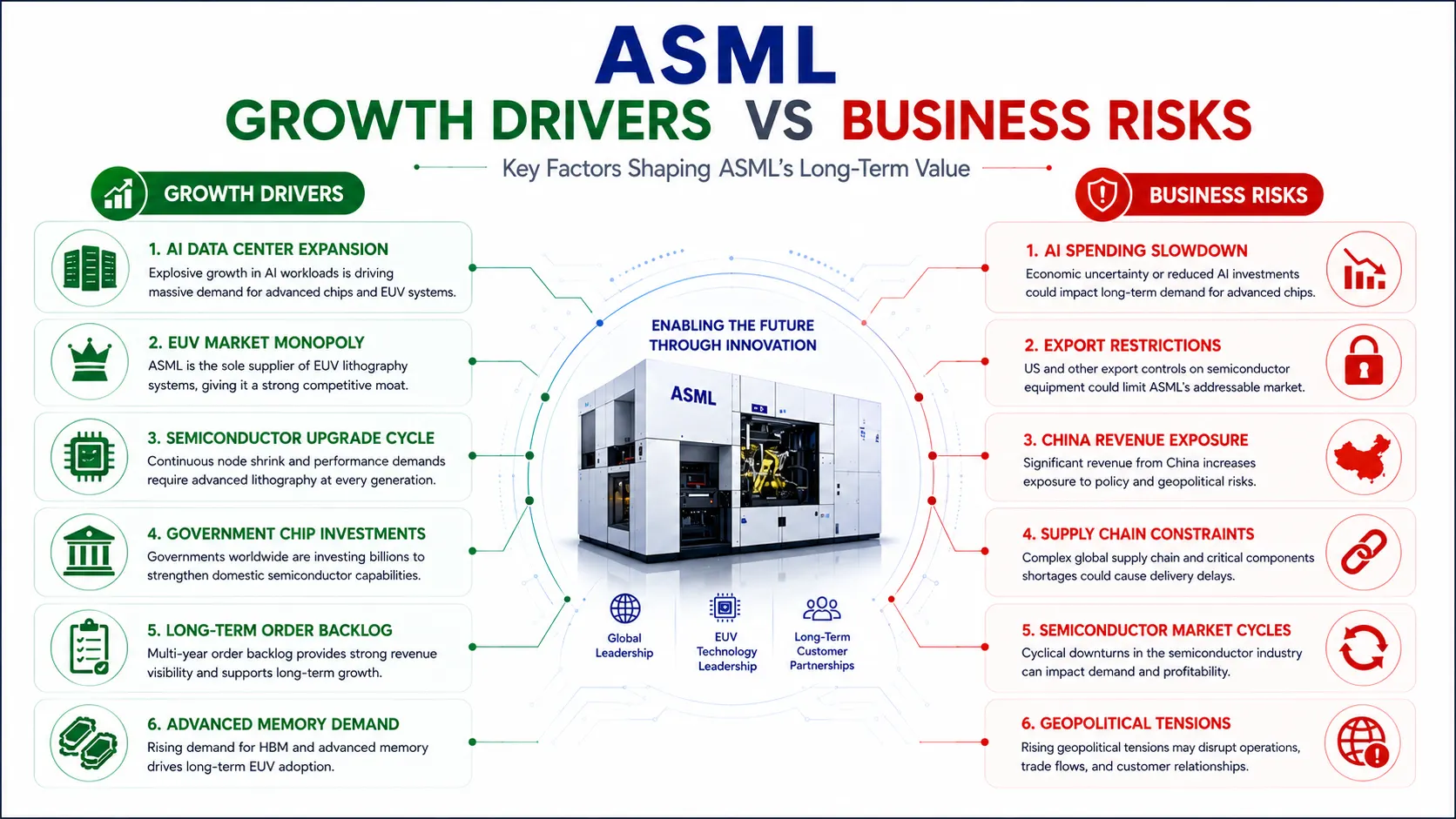
Despite the optimistic outlook, analysts emphasize that reaching a trillion-dollar valuation is far from guaranteed.
One of the biggest questions concerns the sustainability of AI infrastructure investment.
Technology companies are currently spending at unprecedented levels to build AI data centers. However, if demand for generative AI services grows more slowly than expected or cloud providers begin reducing capital expenditures, the effects would ripple throughout the semiconductor industry.
Because ASML sits near the beginning of the semiconductor supply chain, any slowdown in new fabrication investments could eventually reduce equipment orders.
Supply chain execution also remains a challenge.
ASML's EUV systems contain thousands of precision-engineered components sourced from specialized suppliers around the world. Manufacturing delays, logistics disruptions, or shortages of critical parts could affect production schedules and delivery timelines.
Another important consideration is the cyclical nature of the semiconductor industry.
Historically, periods of rapid investment have occasionally been followed by slower capital spending as supply catches up with demand. While many analysts believe artificial intelligence represents a structural technology shift rather than a temporary trend, investors continue monitoring whether today's extraordinary spending levels can be sustained over the long term.
Geopolitical Challenges Remain a Major Concern
Beyond market demand, geopolitical tensions represent another source of uncertainty.
Governments increasingly view semiconductor manufacturing as a matter of national security, leading to tighter export controls and greater oversight of advanced technologies.
The United States has already imposed restrictions on certain semiconductor technologies destined for China, and lawmakers continue discussing additional measures that could affect equipment suppliers.
One proposal, known as the MATCH Act, could further limit ASML's ability to sell or service advanced semiconductor manufacturing equipment in China.
This is particularly significant because China remains an important market for the company. ASML expects approximately 20 percent of its revenue during 2026 to come from Chinese customers.
Any additional restrictions could influence future revenue growth, although analysts note that strong demand from other global semiconductor manufacturers may offset some of these effects.
Balancing international trade policies while maintaining relationships with customers across multiple regions will remain an important challenge for the company.
New Semiconductor Fabs Could Create Fresh Opportunities
While much of today's excitement centers on AI data centers, semiconductor manufacturing capacity is also expanding rapidly.
Governments worldwide are investing heavily in domestic chip production through initiatives designed to strengthen supply chain resilience and reduce dependence on overseas manufacturing.
The United States, Europe, Japan, South Korea, and India have all announced major semiconductor investment programs that include incentives for new fabrication facilities.
Each new fab represents potential demand for ASML's advanced lithography systems.
Private-sector investments are also contributing to this expansion.
Large chipmakers continue constructing new production facilities to meet growing demand for processors used in artificial intelligence, autonomous vehicles, industrial automation, and advanced communications.
Another potential long-term opportunity is Elon Musk's proposed Terafab facility in Texas. If developed as planned, it could create additional demand for advanced lithography equipment, although its long-term impact remains uncertain. As semiconductor manufacturing becomes increasingly strategic for national economies, ASML's technology is likely to remain central to future industry expansion.
Why Investors Continue Paying a Premium
ASML currently trades at a higher valuation multiple than many companies within the semiconductor industry.
At first glance, this premium may appear expensive.
However, investors argue that comparing ASML with traditional chip manufacturers overlooks the company's unique position within the value chain.
Unlike semiconductor producers that compete directly on pricing, manufacturing capacity, or product performance, ASML operates in a market with exceptionally high barriers to entry.
Its decades of technological expertise, extensive patent portfolio, and highly specialized supplier ecosystem create advantages that are difficult to replicate.
This combination of pricing power, recurring service revenue, strong customer relationships, and limited competition helps justify the company's premium valuation.
For long-term investors, ASML represents more than a semiconductor equipment manufacturer.
It has become critical infrastructure for the global digital economy.
What Could Push ASML Beyond $1 Trillion?
Several long-term trends could support continued growth over the next decade.
The first is the continued expansion of generative AI across enterprise software, healthcare, financial services, education, manufacturing, and scientific research.
The second is the increasing adoption of AI hardware in consumer devices, autonomous vehicles, industrial robotics, and edge computing.
Third, governments around the world continue prioritizing semiconductor independence through domestic manufacturing initiatives, creating additional demand for advanced fabrication equipment.
Finally, ongoing improvements in semiconductor technology will require even more sophisticated lithography systems as manufacturers continue shrinking transistor sizes and increasing chip performance.
If these trends continue simultaneously, ASML could experience sustained growth well beyond the current AI investment cycle.
Outlook
ASML has evolved from a specialized semiconductor equipment manufacturer into one of the world's most strategically important technology companies.
The explosive growth of artificial intelligence has elevated the company's role within the global semiconductor ecosystem, making its lithography systems essential for producing the processors that power modern AI applications.
Although risks remain, including geopolitical uncertainty, supply chain challenges, and the possibility of slower AI infrastructure spending, the company's competitive advantages remain exceptionally strong.
Its near-monopoly in EUV lithography, expanding customer base, long order backlog, and central role in semiconductor innovation position ASML to benefit from multiple long-term technology trends rather than a single market cycle.
For investors, the question is no longer whether ASML is one of Europe's most valuable technology companies. Instead, the focus has shifted to whether its leadership in semiconductor manufacturing equipment can propel it past the historic $1 trillion valuation milestone.
Achieving that goal will require continued execution, sustained customer investment, and favorable market conditions. Yet as artificial intelligence reshapes industries around the world and semiconductor demand continues to rise, the possibility appears more realistic today than ever before.
Whether ASML ultimately becomes Europe's first trillion-dollar company or reaches that milestone later than expected, its importance to the future of artificial intelligence and advanced computing is unlikely to diminish. As long as the world continues building faster, more efficient, and more powerful chips, ASML will remain one of the foundational companies enabling the next generation of technological innovation.
Source: Reuters
About the Author