
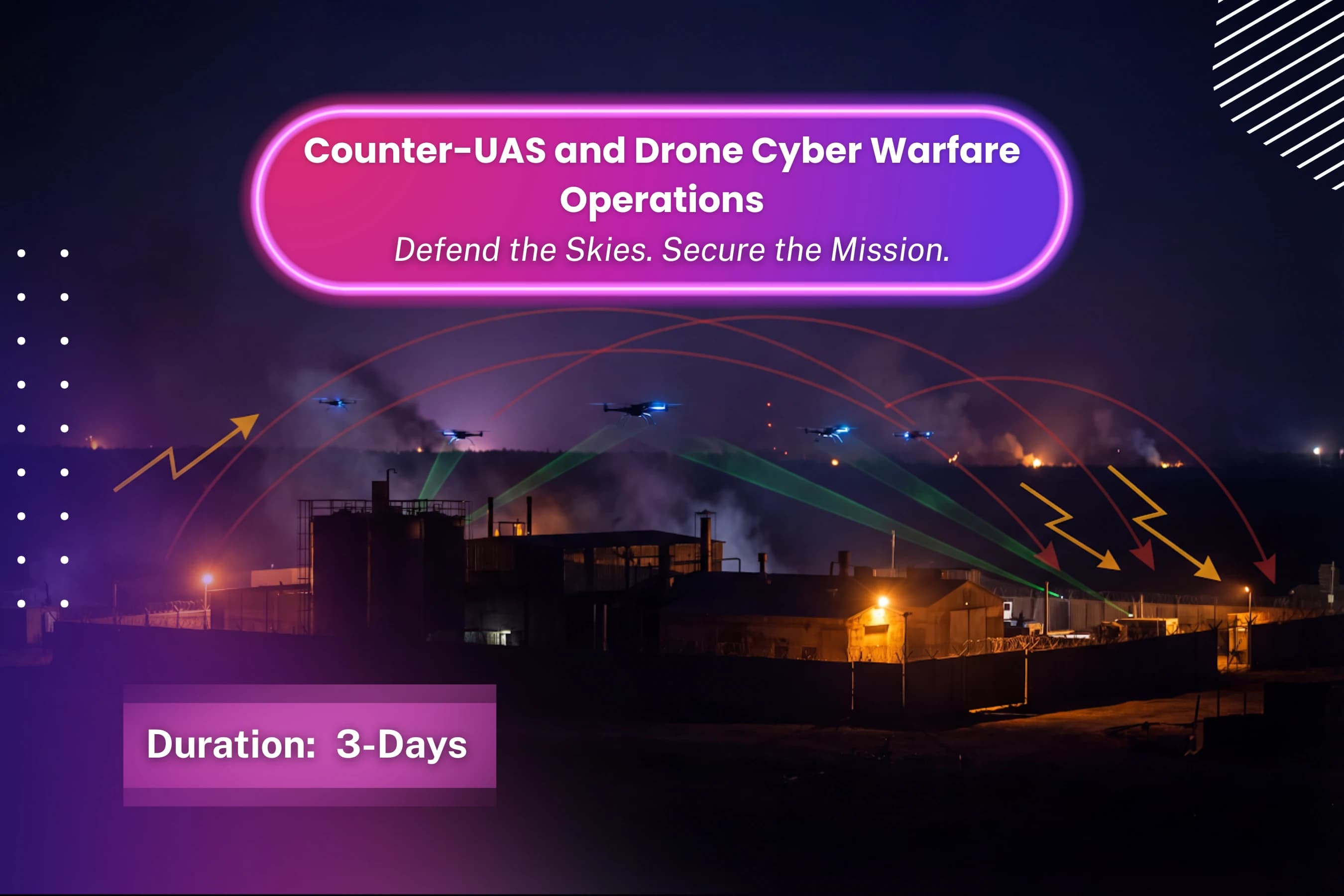
Course Overview
Unmanned aerial systems have transformed modern conflict and are now a credible threat to corporate facilities, critical national infrastructure, government buildings, airports, and events. From Houthi drone swarms targeting oil infrastructure to commercial drones modified for surveillance and payload delivery, the threat has migrated from the battlefield to the civilian domain at speed.
This three-day programme gives security professionals the knowledge to understand drone threat typologies, the cyber and electronic attack methods used against and by UAS, and the layered counter-UAS defence architectures being deployed by governments and operators globally. It is designed for physical security leads, critical infrastructure operators, government security advisers, and corporate security managers who need to move beyond general awareness to operational competence.
Hands-On Learning
Counter-UAS architecture design: specify a layered detection and response system for a defined facility type and threat profile
Mentor-Led Sessions
Structured feedback on counter-UAS architecture designs: what is missing, over-specified, or legally non-compliant
Career-Ready Skills
UAS threat classification, counter-UAS architecture design, UK legal authority application, drone incident response coordination, and site-specific drone security policy design.
Learning Outcomes
Classify drone threats by capability, intent, and attack vector.
Explain how GPS spoofing, command-link exploitation, and swarm coordination vulnerabilities are exploited against and by UAS.
Design a layered counter-UAS detection and response architecture for a facility or site.
Apply the UK regulatory framework governing counter-UAS measures to operational planning.
Lead incident response for a drone security event, coordinating with law enforcement and government agencies.
Conduct a UAS risk assessment and write a counter-UAS policy for an organisation.
Prerequisites
Professional experience in physical security, critical infrastructure protection, government advisory, or aviation security.
No technical or engineering background required.
Detailed Syllabus
Step-by-step learning journey from basics to professional practice
Topics Covered
- Pre-reading: UK CAA drone regulatory framework and NCSC UAS threat guidance
- Accessing course materials, threat taxonomy reference, and case study packs
- Course objectives, participant role mapping, and learning agreement
- Introduction to the UAS threat classification model used throughout the programme
Skills You'll Gain
Master these in-demand skills through hands-on practice
Career Progression
A clear view of the roles this programme supports, what typically comes next, and where learners progress over time
Ways to Learn
Choose the learning format that works best for you and your team
Live Online
Instructor-Led Training
Join live instructor-led sessions from anywhere. Interactive, engaging, and flexible.
- Live instructor interaction (real-time)
- Trainer-led walkthroughs and real examples
- Guided resources and session notes provided
- Structured Q&A and practical discussion
Price per person
Group enrolments and early planning options available.
All prices are exclusive of VAT where applicable. Group enrolments and custom packages available on request.
Prefer a Faster, Personalised Route into IT?
Not everyone learns best in a group. If you want focused guidance, faster clarity, and confidence you can use on the job, our 1-to-1 Fast-Track Training gives you private, mentor-led support tailored to your experience and goals.
"Many learners choose 1-to-1 when they want understanding, not memorisation."
Exam & Certification Information
Everything you need to know about the certification exams
Important Information
You will receive an Xcademia certificate of completion based on participation and successful completion of labs and scenario simulations.
Credential
Certificate of Completion
On successful completion of Counter-UAS and Drone Cyber Warfare Operations, learners receive an Xcademia Certificate of Completion. This standalone certificate is issued directly by Xcademia and is aligned with globally recognised frameworks and best practices.
Frequently Asked Questions
Everything you need to know about this course
Primarily operational. The course focuses on threat assessment, detection architecture, legal frameworks, and incident response. Technical concepts related to RF and GPS are introduced at awareness level, not engineering depth.
Ready to Start Your Learning Journey?
Take the next step in your professional development